

Decoding the 1990s Shift: Urban Solitude, Ironic Wit, and Postmodern Korean Fiction
Phase 1: Empathy & Immersion
안녕하세요! 매일한글 에디터입니다. (Annyeonghaseyo! It’s your Daily Hangul editor.)
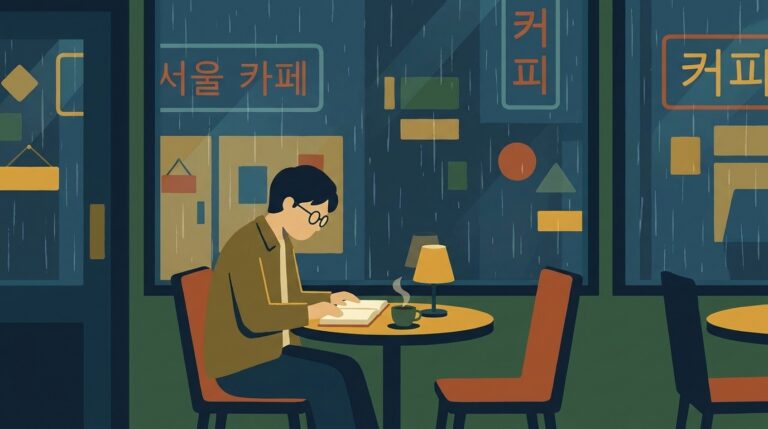
Picture this: You are sitting in a dimly lit, minimalist independent bookstore in Yeonnam-dong, holding an original 1990s edition of Kim Young-ha’s I Have the Right to Destroy Myself (나는 나를 파괴할 권리가 있다) or Shin Kyung-sook’s evocative prose. You came into Korean literature expecting historical epics—stories soaked in the collective trauma of national division (bundan) or the sweat-stained fury of 1980s student protests. Yet, as you turn the pages, there are no grand speeches, no heroic factory workers, and no flag-waving martyrs. Instead, you encounter a protagonist staring blankly into an espresso cup in a neon-lit Apgujeong café, ruminating on an unnamable alienation, listening to Western pop, and laughing cynically at romance.
You hit an unexpected linguistic and cultural roadblock. The standard vocabulary you learned for discussing history and society feels clumsy here. How do you articulate this subtle, razor-sharp existential ennui? How do native Korean critics effortlessly dissect that transition from collective ideology to microscopic, fragmented interiority without sounding overly textbookish?
If you have ever felt tongue-tied trying to debate modern Korean fiction at a C2 level, you are not alone. Many of our advanced learners confess that moving past socio-political vocabulary into the realm of modern psychological nuance feels like learning an entirely new dialect. This guide was born directly out of literary seminars conducted with our highest-level scholars. Today, we will master the intellectual lexicon, cultural subtext, and critical perspectives that defined South Korea’s pivotal 1990s literary renaissance.
Phase 2: Core Expressions Deep Dive
Let us analyze three indispensable expressions that unlock the postmodern Korean psyche.
1. 내면의 균열을 들여다보다 (Naemyeon-ui gyunyeor-eul deuryeodaboda)
- Pronunciation: [Nae-myeon-eui gyun-yeol-eul deu-ryeo-da-bo-da] (Sounds like “Nay-myun-ui gyoon-yul-eul doo-ryeo-da-bo-da”)
- Meaning: Literally “to peer into the crack of one’s interiority”; figuratively, to closely examine the deep psychological wounds, vulnerabilities, and fractures hidden beneath one’s everyday persona.
- K-Culture Moment: Think of an introspective scene from Lee Chang-dong’s film Burning or Shin Kyung-sook’s early novellas where characters retreat from the noisy city to silently confront their unhealed emotional voids.
- Editor’s Insight: Use this when a narrative strips away societal expectations to reveal an individual’s existential fragility. It implies courage mixed with melancholia.
- Situation Spectrum: Casual 🚫 | Semi-formal ⚠️ | Formal/Literary ✅
- 🤔 Think About It: Does your native tongue distinguish between examining external flaws versus gazing into a “structural fracture” within the soul?
2. 거대 담론의 종언 (Geodae damnon-ui jong-eon)
- Pronunciation: [Geo-dae dam-non-ui jong-eon] (Sounds like “Guh-day dam-non-ui jong-un”)
- Meaning: Literally “the demise of grand discourse”; referring to the Post-Cold War shift away from collective meta-narratives (nation, class revolution, democratization) toward individualized, private realities.
- K-Culture Moment: Frequently heard in modern intellectual debates or YouTube video essays analyzing why 1990s youths abandoned ideological banners for personal aesthetics and indie rock.
- Editor’s Insight: This phrase marks the intellectual dividing line between 1980s dissident literature and 1990s postmodernism. It embodies the disillusionment that followed the achievement of formal democracy in 1987.
- Situation Spectrum: Casual 🚫 | Semi-formal ⚠️ | Formal/Literary ✅
- 🤔 Think About It: How did your culture’s literature change when major 20th-century geopolitical conflicts subsided?
3. 일상에 스며든 냉소 (Ilsang-e seomyeodeun naengso)
- Pronunciation: [Il-sang-e seu-myeo-deun naeng-so] (Sounds like “Il-sahng-eh soo-myuh-doon nang-so”)
- Meaning: Literally “cynicism steeped into everyday life”; describes an ironic, emotionally detached defense mechanism used by modern urbanites.
- K-Culture Moment: The signature tone of Eun Hee-kyung’s masterpiece A Gift from a Bird (새의 선물), where a young protagonist observes the adult world with unsparing, mature sarcasm rather than dramatic tears.
- Editor’s Insight: Unlike destructive anger, this “냉소” (naengso) is quiet, analytical, and protective. It is the literary equivalent of a wry smirk at life’s absurdity.
- Situation Spectrum: Casual ⚠️ | Semi-formal ✅ | Formal/Literary ✅
- 🤔 Think About It: Is cynicism in your culture viewed as a sign of intellectual maturity or simple pessimism?
Phase 3: Textbook Korean vs. Real Korean
Elevate your discourse from clunky academic textbook Korean to the sharp, natural cadence of an authentic literary critic.
Situation 1: Describing the stylistic shift of 1990s authors
- 📖 교과서 한국어 (Textbook Korean):
1990년대 소설가들은 사회적 문제보다 개인의 심리적인 상태를 더 많이 묘사하기 시작했습니다.
(1990s novelists began to describe individuals’ psychological states more than social issues.) - 🗣️ 진짜 한국어 (Real Modern Critical Discourse):
90년대 작가진은 집단적 당위에서 벗어나 파편화된 개인의 내면과 도시적 고독을 세련된 감각으로 포착해 냈죠.
(The 90s authors broke away from collective imperatives, capturing fragmented personal interiority and urban solitude with sleek sensibilities.) - 💡 왜 다를까? (Why the Difference?): Textbook phrasing relies on basic comparison markers (
~보다 더), while native critics deploy conceptual nouns like “집단적 당위” (collective imperative) and “도시적 고독” (urban solitude) to capture ideological nuance.
Situation 2: Expressing existential detachment or irony
- 📖 교과서 한국어 (Textbook Korean):
그 인물은 세상에 대해 별로 관심이 없고 매우 차가운 태도를 가지고 있습니다.
(That character does not care much about the world and has a very cold attitude.) - 🗣️ 진짜 한국어 (Real Modern Critical Discourse):
그 인물 특유의 시니컬한 시선과 거리두기는 부조리한 현실을 견뎌내기 위한 일종의 방어기제 같아요.
(That character’s signature cynical gaze and emotional distancing feel like a defense mechanism for enduring an absurd reality.) - 💡 왜 다를까? (Why the Difference?): Moving beyond simplistic emotional adjectives like “차갑다” (cold) to loanwords like “시니컬한” (cynical) combined with psychoanalytic terms like “거리두기” (distancing) and “방어기제” (defense mechanism) signals true C2 fluency.
Phase 4: K-Culture Deep Dive & Non-Verbal Manners
4-1. Nunchi & Literary Demeanor
When discussing literary trauma, post-modern irony, or deep societal fatigue with Koreans in an academic salon or book club, avoid overly boisterous debate tactics. Postmodern discussions demand gwanjo (관조 – contemplative detachment):
* The Wry Pause: When articulating the term “냉소” (cynicism) or “상실감” (sense of loss), native speakers rarely make intense eye contact. Instead, they cast their gaze slightly downward at their notebook or coffee cup, pausing for a split second to simulate emotional gravity.
* Subtle Head Tilts: A slight tilt of the head accompanied by a quiet sigh (하긴..., “Indeed…”) conveys deep empathy with the author’s existential despair without needing dramatic exclamations.
4-2. Cultural Code Analysis: The 1990s Consumer Explosion & Hongdae Indie Scene
The 1990s in South Korea was the era of the “Shinsedae” (New Generation). Following decades of rapid industrialization and military dictatorship, Koreans suddenly found themselves with disposable income, democratic freedoms, pagers, and early internet chat rooms (PC Tongsin). However, this consumer euphoria was short-lived: the catastrophic 1997 Asian Financial Crisis (IMF Crisis) shattered faith in lifetime employment and societal stability. Authors like Kim Young-ha and Eun Hee-kyung chronicled this exact psychological trajectory—from consumerist coolness to sudden existential precarity. Understanding this historical arc is essential for deciphering why Korean indie cinema, K-indie music, and modern novels share a lingering, bittersweet urban melancholy.
Phase 5: Real-Life Roleplay Scenario
Setting: A book talk at an independent literature café near Mangwon Station. You are discussing Eun Hee-kyung’s prose with Min-seo, a veteran literary editor.
Min-seo: 이번 은희경 작가 북토크 어떠셨어요? 80년대 소설들과는 결이 확실히 다르죠? (Ibeon Eun Hee-kyung jakga buktokeu eotteosyeosseoyo? Palsipdae soseoldeulgwaneun gyeori hwaksilhi dareujyo?)
🎭 leaning back with a gentle, curious smile
You: 네, 정말 인상 깊었어요. 이전 시대 문학이 역사의 무게에 짓눌려 있었다면, 이번 작품은 개인의 미시적인 상처에 현미경을 들이댄 느낌이에요. (Ne, jeongmal insang gipeosseoyo. Ijeon sidae munhagi yeoksa-ui muge-e jinnullyeo isseotdamyeon, ibeon jakpumeun gaein-ui misijeogin sangcheo-e hyeonmigyeongeul deuridaen neukkimi-eyo.)
🎭 adjusting glasses and nodding thoughtfully
Min-seo: 맞아요. 바로 그 지점이죠! 거대 담론이 퇴색한 자리에 일상의 냉소와 자조가 자리 잡았다고 할까요? (Maj-ayo. Baro geu jijeom-ijyo! Geodae damnon-i toesaekhan jari-e ilsang-ui naengso-wa jajo-ga jari jab-atdago halkkayo?)
🎭 tapping the table lightly with a fountain pen
You: 동감합니다. 특히 화자가 타인과의 관계에서 끊임없이 거리를 두려는 태도가 돋보였어요. (Donggamhamnida. Teukhi hwajaga tain-gwa-ui gwan-gye-eseo kkeunhimeopsi georireul duryeoneun taedoga dodboyeosseoyo.)
🎭 speaking in a calm, analytical tone
Min-seo: 그런 냉소적인 태도가 어쩌면 현대 도시인들이 상처받지 않으려는 방어막이었겠죠. (Geureon naengsojeogin taedoga eojjeomyeon hyeondae dosiin-deuri sangcheobatji aneuryeoneun bangeomak-ieotgetjyo.)
🎭 sighing softly with a knowing look
You: 네, 내면의 균열을 애써 감추기보다는 차라리 차갑게 응시하는 방식을 택한 것 같아요. (Ne, naemyeon-ui gyunyeoreul aesseo gamchugibodaneun charari chagapge eungshihaneun bangsigeul taekhan geot gat-ayo.)
🎭 holding eye contact with quiet confidence
Min-seo: 김영하 작가의 초기작들도 그런 허무주의와 맞닿아 있는데, 다음 주에 같이 발제해 보실래요? (Kim Young-ha jakga-ui chogijakdeuldo geureon heomujuui-wa matda-a inneunde, da-eum jue gachi baljehae bosillaeyo?)
🎭 tilting head, eyes gleaming with excitement
You: 영광이죠! 포스트모던 서사가 한국적 맥락에서 어떻게 변주되었는지 깊이 있게 다뤄보겠습니다. (Yeonggwang-ijyo! Poseuteumodeon seosaga hangukjeok maengnage-seo eotteoke byeonjudwoe-eotneunji gipi itge darwo bogesseumnida.)
🎭 bowing slightly with a bright, engaged smile
🔀 Branching Choices: How do you respond to Min-seo’s invitation?
- Option A: “아뇨, 저는 90년대 문학보다는 80년대 노동문학이 훨씬 역사적 가치가 높다고 봐서 관심 없습니다.” (No, I think 80s labor literature is far more historically valuable, so I am not interested.)
- Feedback (Risk): Far too blunt and ideologically dismissive. In a Korean literary gathering, dismissing another’s aesthetic focus creates instant social friction.
- Option B: “네, 그냥 읽고 좋았는지 나빴는지만 간단하게 이야기해 봐요!” (Sure, let’s just talk simply about whether we liked it or not!)
- Feedback (Bad): While friendly, it abandons the analytical sophistication expected at a C2 level book talk.
- Option C: “좋습니다! 90년대 문학 특유의 유희적 문체와 도시적 환멸을 비교하며 텍스트를 분석해 오겠습니다.” (Sounds wonderful! I will analyze the text by comparing the 90s fiction’s playful style with its urban disillusionment.)
- Feedback (Best): Superb! Balances enthusiasm with scholarly precision and demonstrates a mastery of thematic nuance.
Phase 6: 10-Second Emotion Shadowing Drill
Read these sentences aloud. Observe the / pauses and match the emotional milestones.
[🧐 차분하고 비판적인 어조 / Calm & analytical]
거대 담론의 / 종언 이후, / 한국 문학은 비로소 / 개인의 내밀한 상처를 / 응시하기 시작했습니다.
(Geodae damnon-ui / jong-eon ihu, / Hanguk munhageun biroso / gaein-ui naemilhan sangcheoreul / eungsihagi sijakhaesseumnida.)-
[☕ 나른하고 씁쓸한 어조 / Melancholic & world-weary]
화려한 네온사인 뒤편의 / 도시적 고독과 / 냉소는, / 그 시대 청춘들의 / 피할 수 없는 초상이었죠.
(Hwaryeohan ne-onsain dwipyeon-ui / dosijeok godok-gwa / naengsoneun, / geu sidae cheongchun-deur-ui / pihal su eomneun chosang-ieotjyo.) -
[💡 깨달음을 얻은 명쾌한 어조 / Insightful & decisive]
사적 서사로의 전환은 / 현실 도피가 아니라, / 내면의 균열을 직시하려는 / 새로운 서사 전략이었습니다.
(Sajeok seosaro-ui jeonhwaneun / hyeonsil dopiga anira, / naemyeon-ui gyunyeoreul jiksiharyeoneun / saeroun seosa jeollyagieosseumnida.)
Phase 7: K-Culture Mini Dictionary
-
각자도생 (Gak-ja-do-saeng)
Literal translation: Each person seeks their own survival.
Context: Ubiquitous post-1997 phrase describing the hyper-individualistic race in contemporary South Korea where the collective welfare umbrella has dissolved. -
후일담 문학 (Hu-il-dam mun-hak)
Literal translation: Post-story literature / Epilogue literature.
Context: Novels written in the late 80s and 90s reflecting on the aftermath, guilt, emotional hangover, and disillusionment of people who participated in fierce political protest movements. -
파편화된 자아 (Pa-pyeon-hwa-doen ja-a)
Literal translation: Fragmented self / ego.
Context: Postmodern critical term denoting an identity that has lost its unified narrative center, wandering through consumer choices and psychological fissures. -
키치 (Ki-chi / Kitsch)
Literal translation: Kitsch / Artificial or campy aesthetic.
Context: Extensively used in 1990s Korean literary reviews to describe ironic, intentionally shallow, or subversive consumer aesthetics embraced to mock high-brow moral seriousness.
Phase 8: Literary Explorer’s Survival Kit
Essential Survival Expressions
- 텍스트의 행간을 읽다 (Tekseuteu-ui haenggan-eul ikda)
- Pronunciation: [Tek-seu-teu-ui haeng-gan-eul ik-da]
- Meaning: To read between the lines of the text.
- Pro Tip: Use when an author leaves their true intentions unspoken through elliptical endings.
- 탈이념적 서사 (Tal-i-nyeom-jeok seosa)
- Pronunciation: [Tal-i-nyeom-jeok seo-sa]
- Meaning: Post-ideological narrative.
- Pro Tip: Perfect shorthand for works that deliberately refuse to take clear political sides.
- 자기 반영적 문체 (Ja-gi ban-yeong-jeok mun-che)
- Pronunciation: [Ja-gi ban-yeong-jeok mun-che]
- Meaning: Meta-fictional / Self-reflexive style.
- Pro Tip: Use when describing authors like Kim Young-ha who playfully reference the act of storytelling within the story itself.
Editor’s Travel Note for Literary Wanderers
If you want to experience the moody, contemplative atmosphere of Seoul’s literary world, plan a pilgrimage to independent bookshops in Mangwon, Seochon, and Yeonnam-dong. Download the Naver Map app for navigating Seoul independent bookshops to find tucked-away reading salons that algorithms miss. When visiting, do not expect loud café chatter; these are sanctuaries where visitors read in hushed reverence over pour-over coffee. Always purchase at least one book or essay collection before sitting down, and carry a transit card like Climate Card for effortless subway hopping between literary hubs.
Phase 9: A Step Deeper (한 발 더 깊이)
The shift from collectivism to extreme interiority in 1990s Korean fiction was not merely an aesthetic whim; it was a profound ontological coping mechanism. In Korean society, the collective Uri (우리 – We/Us) has long superseded the isolated Na (나 – I/Me). When the historical missions of democratization were nominally achieved and the unfettered market of neoliberal consumerism arrived, the societal glue suddenly liquefied. The individual found themselves unmoored—liberated from authoritarian surveillance, yet deeply terrified by the isolation of urban independence. Reading 90s fiction allows us to witness the exact historical moment when the modern Korean “individual” was born: bruised, self-conscious, and armed with defensive irony.
💬 Your Turn: Does literature in your native country lean more toward collective social missions or microscopic individual psychology today? How does your language articulate the loneliness of city life? Share your thoughts in the comments below!
Phase 10: FAQ & Avoiding Misunderstandings
Q: 1990년대 한국 문학은 정치적 의식이 완전히 사라진 문학인가요?
A: 절대 그렇지 않습니다. 표면적으로는 사적이고 일상적인 소재를 다루지만, 거대 이데올로기가 해체된 이후 자본주의의 소외와 개인주의의 한계를 비판적으로 드러냄으로써 ‘미시정치(Micropolitics)’의 역할을 충실히 수행했습니다.
Q: ‘냉소(Cynicism)’와 ‘비관(Pessimism)’은 문학적으로 어떻게 구별하나요?
A: ‘비관’은 상황이 나아질 수 없다는 절망적 감정에 침몰하는 상태인 반면, ‘냉소’는 부조리한 대상과 의도적으로 감정적 거리를 둠으로써 자신을 보호하고 날카롭게 풍자하는 비판적 지적 태도에 가깝습니다.
Q: 한국 문학을 논할 때 ‘탈근대’와 ‘포스트모더니즘’은 완전히 같은 말인가요?
A: 학술적으로 긴밀히 연결되어 통용되지만, ‘탈근대’는 서구적 근대성(이성 중심주의, 발전주의)을 극복하려는 역사철학적 패러다임을 강조하고, ‘포스트모더니즘’은 파편화, 패러디, 장르 해체 등 구체적인 예술·문학적 양식을 지칭할 때 주로 사용됩니다.
🚨 Common Mistakes Warning Board
- Mistake: Labeling any story about sadness as “한” (Han – deep ancestral grief).
- Correct Action: Reserve Han for historical, collective tragedy. For 90s urban alienation, use “도시적 고독” (urban solitude) or “상실감” (sense of loss).
- Mistake: Using “이기주의” (selfishness) to describe literary individualism.
- Correct Action: Selfishness carries a moral condemnation. Use “개인주의” (individualism) or “주체적 개인” (autonomous individual).
- Mistake: Pronouncing ‘냉소’ as [Naeng-sho].
- Correct Action: Keep the ‘ㅅ’ clean and unpalatalized before ‘ㅗ’: [Naeng-so].
Phase 11: Action Missions
- 🥉 Bronze Mission (Solo Practice):
Write down 3 sentences in your study journal describing your favorite book or film using the terms내면의 균열,냉소, and거리두기. - 🥈 Silver Mission (Social Media Share):
Post an aesthetic photo of an independent bookstore or your current Korean read on Instagram or X. Caption it using:거대 담론을 벗어나 일상의 결을 들여다보는 시간 ☕📖. - 🥇 Gold Mission (Real-World Execution):
Join a Korean book club or visit an independent bookstore in Korea. Ask the staff: “1990년대 특유의 도시적 감성과 냉소적인 내면 묘사가 잘 드러난 소설 한 권 추천해 주실 수 있나요?”
🎮 K-Culture Mission: Watch Bong Joon-ho’s early film Barking Dogs Never Bite (플란다스의 개) or read the prologue of Kim Young-ha’s I Have the Right to Destroy Myself. Identify three moments where characters exhibit ironic detachment rather than dramatic emotion!
Phase 12: Interactive Quiz Challenge
Question 1: Situational Judgment
In a literary discussion, your peer remarks: “90년대 소설은 민족이나 계급 같은 중요한 문제를 외면하고 너무 개인의 사소한 연애나 잡생각에만 매몰된 것 같아요.” How do you respond critically at a C2 level?
* A) 맞아요, 역사적 책임감이 전혀 없는 한심한 소설들이죠.
* B) 오히려 거대 담론의 폭력성을 해체하고, 미시적인 일상을 통해 자본주의적 소외를 드러낸 전략적 전환으로 볼 수 있지 않을까요?
* C) 글쎄요, 저는 그냥 재미있으면 다 좋은 문학이라고 생각해요.
Question 2: Fill-in-the-Blank
“80년대의 집단적 열정이 식은 자리에는 일상에 깊숙이 스며든 (____)와 고독이 자리 잡았다.”
* A) 냉소 (Naengso)
* B) 애국심 (Aeguksim)
* C) 단결 (Dangyeol)
Question 3: True or False
The term “후일담 문학” refers to futuristic sci-fi literature set in outer space. (True / False)
👉 Click to Reveal Answers & In-depth Explanations
- Q1 Answer: B
Explanation: Option B demonstrates mastery of critical counter-arguments. It frames the shift not as escapism, but as a subversion of ideological dogma (거대 담론의 폭력성 해체) that critiques modern capitalist alienation through microscopic details. - Q2 Answer: A (냉소 – Cynicism/Irony)
Explanation: The core emotional pivot of 1990s South Korean literature was the emergence of everyday cynicism (일상에 스며든 냉소) in contrast to the fervent collective unity (단결) or patriotism (애국심) of previous eras. - Q3 Answer: False
Explanation: “후일담 문학” (hu-il-dam mun-hak) refers to retrospective fiction written after social movements (specifically the 1980s democratization era), dealing with the emotional aftermath, moral guilt, and psychological burnout of former activists.
🎬 Watch Our Daily Videos! (Daily Hangul Official Instagram)
Review the expressions you learned in this article with our fun daily short videos! Check out native pronunciation and real-life nuances in action.
- Instagram @dailyhangul_en






