

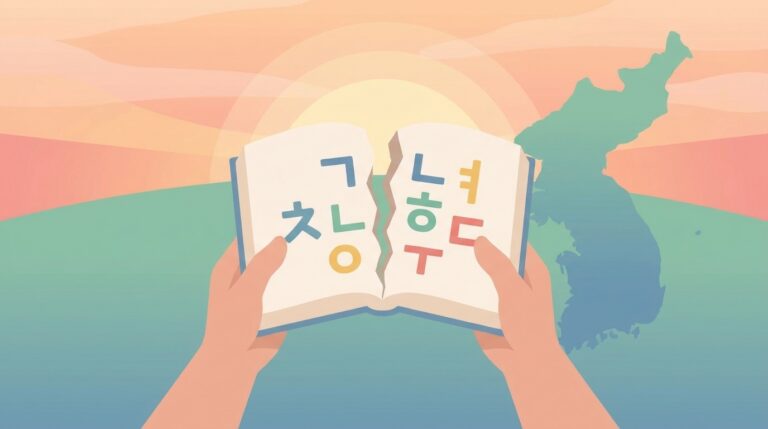
Beyond the 38th Parallel: Healing Linguistic Scars in Divided Korea
Phase 1: Empathy & Immersion (Opening Narrative)
안녕하세요! 매일한글 에디터입니다. (Hello! I’m your Daily Hangul editor.)
Picture this: You are watching an emotionally charged scene in a Korean drama where a family separated across the Demilitarized Zone meets for the first time in seven decades. As they grasp trembling hands, an unsettling silence falls. It is not because love is missing, but because their words clash. The southern granddaughter talks about “스트레스” (seuteureseu, stress) and “스마트폰” (seumateupon, smartphone), while the northern grandfather speaks of “일없소” (ireopso, “it doesn’t matter” or “you’re welcome”) and “고난의 행군” (gonan-ui haenggun, the arduous march). In that heartbreaking hesitation, we witness something profound: over 75 years of geopolitical division have etched themselves deep into the very phonemes, syntax, and vocabulary of the Korean language.
For C2 advanced learners, mastering South-North Korean linguistic divergence (남북한 언어 이질화) is often the final frontier of sociolinguistic proficiency. You already know the subjunctive mood, honorific chains, and idiomatic proverbs. But when confronted with Munhwa’ŏ (문화어, North Korea’s Cultured Language) alongside Pyojun-eo (표준어, South Korea’s Standard Language), many scholars feel paralyzed by ideological anxiety or clinical terminology.
True linguistic reunification cannot be achieved by merely replacing Northern loan-translations with Southern Anglo-borrowings or enforcing administrative standardization from a desk in Seoul. As our veteran linguists often remind students, the first true step begins when we listen closely enough to embrace the lived human texture (삶의 결, salm-ui gyeol) woven into every regional accent. This guide is built upon years of fieldwork, defector interviews, and cross-border lexicographical research to give you the highest register of analytical empathy in modern Korean.
Phase 2: Core Expressions for Sociolinguistic Empathy
1. 삶의 결을 보듬다 (Salm-ui gyeol-eul bodeumda)
- Pronunciation: [Sal-meui gyeol-eul bo-deum-da] (Imagine the quiet rustle of fine raw silk for “salm”, followed by “gyeol” vibrating like the smooth, natural grain of aged cedar wood.)
- Meaning: Literally, “to embrace the grain of life.” In practice, it signifies delicately acknowledging, honoring, and embracing the intricate emotional layers, hardships, and historical trauma embedded in another person’s lived identity.
- K-Culture Moment: Used frequently in contemplative investigative documentaries and award-winning literary cinema (such as reflections on the Gyeoremal-keunsajeon joint dictionary project) when scholars discuss healing historical trauma across generations.
- Editor’s Insight: The word “결” (gyeol) refers to the innate texture or grain found in wood, fabric, or water. When you “보듬다” (bodeumda—wrap your arms protectively around) someone’s “결”, you are saying you will not force them to sand down their differences to fit your mold.
- Situation Spectrum: Casual: 🚫 | Semi-formal: ⚠️ | Formal: ✅
- 🤔 Think About It: Does your native tongue have a word that compares a person’s life experiences to the organic grain of natural timber? What does this metaphor reveal about the traditional Korean view of suffering and endurance?
2. 말씨의 이질감을 털어내다 (Malssi-ui ijilgam-eul teoreonaeda)
- Pronunciation: [Mal-ssi-ui i-jil-ga-meul teo-reo-nae-da] (Picture gently brushing off powdery winter snow from your wool coat with decisive, caring strokes.)
- Meaning: Literally, “to shake off the sense of foreignness or alienation from one’s tone of speech.” Pragmatically, it describes transcending dialectal or ideological discomfort to establish genuine interpersonal intimacy.
- K-Culture Moment: Depicted in variety shows featuring North Korean defectors, such as Now On My Way to Meet You (이제 만나러 갑니다), when guests describe the pivotal moment South Korean neighbors stopped judging their Hamgyong or Pyongan intonations.
- Editor’s Insight: “이질감” (ijilgam) is the chilling sensation that someone belongs to an entirely different species or system. Pairing it with the physical verb “털어내다” (to shake off / brush off) demonstrates agency: alienation is not a permanent barrier, but mere dust that can be brushed away through mindful dialogue.
- Situation Spectrum: Casual: ⚠️ | Semi-formal: ✅ | Formal: ✅
- 🤔 Think About It: When you encounter an unfamiliar accent in your native language, is your initial instinct to correct it, exoticize it, or listen to the emotional message underneath?
3. 통일어의 접점을 모색하다 (Tong-ir-eo-ui jeopjeom-eul moseokhada)
- Pronunciation: [Tong-i-reo-ui jeop-jjeo-meul mo-seok-ha-da] (“Jeop” snaps sharply like two strong magnets clicking together, followed by the measured, academic cadence of “moseokhada”.)
- Meaning: Literally, “to search out points of contact for a unified language.” Connotatively, it refers to negotiating mutual linguistic compromises where neither Seoul nor Pyongyang hegemony erases the cultural heritage of the other.
- K-Culture Moment: Quoted in academic forums, peace symposia, and inter-Korean policy briefings discussing the harmonization of terminology in international sporting events (e.g., the unified Olympic hockey team).
- Editor’s Insight: Notice the noun “접점” (tangent point / intersection). It rejects unilateral assimilation (흡수통일) in favor of mutual geometric touchpoints, reflecting modern South Korean sociolinguistics at its most enlightened level.
- Situation Spectrum: Casual: 🚫 | Semi-formal: ⚠️ | Formal: ✅
- 🤔 Think About It: If linguistic unification requires compromises, should a unified lexicon favor indigenous Korean coinages (favored by the North) or globally adapted international loanwords (favored by the South)?
Phase 3: Textbook Korean vs. Real Korean
Situation 1: Discussing North-South Vocabulary Differences
- 📖 교과서 한국어 (Textbook):
남북한의 언어 이질화 현상을 극복하기 위해 문화어 단어를 체계적으로 암기해야 합니다.
(Nambukhanoe eoneo ijilhwa hyeonsangeul geukbokhagi wihae munhwaeo daneoreul chegyejeogeuro amgihaeya hamnida.)
“To overcome the linguistic divergence between South and North Korea, one must systematically memorize Cultured Language vocabulary.” - 🗣️ 진짜 한국어 (Real-world C2 Discourse):
서로 쓰는 어휘가 낯설더라도, 그 표현에 서린 굴곡진 역사를 먼저 헤아려보는 배려가 필요해요.
(Seoro sseuneun eohwiga natseoldeorado, geu pyohyeone seorin gulgokjin yeoksareul meonje hearyeoboneun baeryeoga piryohaeyo.)
“Even if our vocabularies sound unfamiliar, we need the grace to first contemplate the winding history infused within those expressions.” - 💡 왜 다를까? (Why the divergence?):
Bureaucratic textbooks frame vocabulary divergence as an engineering problem solved by rote memorization. Sophisticated native speakers treat it as an act of historical empathy (배려, baeryeo), recognizing that linguistic differences are scars of survival, not lexical errors.
Situation 2: Reacting to Unfamiliar Northern Phrases
- 📖 교과서 한국어 (Textbook):
방금 하신 말씀은 표준어 규정에 어긋나므로 뜻을 이해하기 어렵습니다.
(Banggeum hasin malsseumeun pyojuneo gyujeonge eogeunnameuro tteuseul ihaehagi eoryeopseumnida.)
“What you just said violates Standard Korean rules, making it difficult to understand.” - 🗣️ 진짜 한국어 (Real-world C2 Discourse):
“입맛을 돋우는 정겨운 우리 토박이말이네요! 남쪽의 ‘도넛’보다 훨씬 감각적인걸요?”
(“Immaseul doduneun jeonggyeoun uri tobagimal-ineyo! Namjjogui ‘doneot’-boda hwolssin gamgakjeogingeolyo?”)
“What a heartwarming indigenous expression that stirs the appetite! It feels far more visceral and sensory than our Southern loanword ‘donut’!” - 💡 왜 다를까? (Why the divergence?):
Clinical prescriptivism alienates speakers. Culturally mature communicators use praise and cultural validation (e.g., celebrating North Korea’s preservation of pure Korean roots like 가락지빵 [garakjibbang] for donut) to build rapport without condescension.
Phase 4: K-Culture Deep Dive & Non-Verbal Manners
4-1. 눈치 (Nunchi) & Non-Verbal Etiquette
When interacting with North Korean diaspora members, defectors, or discussing inter-Korean linguistics in high-level intellectual spaces, bodily language communicates far more than vocabulary:
* The Non-Corrective Gaze (비시선 교정): When hearing distinct Northern phonological traits—such as preserving the initial “ㄹ” and “ㄴ” sounds without applying the Southern initial consonant law (두음법칙, Dueumbeopchik, e.g., pronouncing “리성적” instead of “이성적”), never raise your eyebrows or mirror back the “corrected” Southern form. Keep your gaze warm, grounded, and attentive.
* De-exoticizing Nods (덤덤한 끄덕임): Avoid theatrical gasps of surprise like “신기해요!” (That’s so exotic/novel!). In Korean sociolinguistic hierarchy, treating someone’s mother tongue as a spectacle (신기함의 대상) reduces them to an outsider. Instead, offer measured, respectful nodding (차분한 고개 끄덕임).
4-2. Cultural Code Analysis: The Lexicon of Longing
In South Korean pop culture touchstones like Crash Landing on You (사랑의 불시착) or humanitarian projects like the Gyeoremal-keunsajeon (Unified Korean National Dictionary), language is not portrayed merely as syntax, but as an archive of memory. South Korea’s rapid post-war industrialization welcomed intense American English lexical borrowing (외래어 범람), while North Korea’s state-driven “Language Purification Campaign” (말다듬기 운동) favored ideologically curated native compounds.
Yet, underneath the political varnish, regional dialects like Hamgyong and Pyongan retain archaic Middle Korean vowel lengths, musical pitch accents, and deep emotional sincerity. To understand their speech is to listen to the unfiltered voices of our shared ancestors before the armistice line hardened in 1953.
Phase 5: Real-Life Roleplay Scenario
Setting: A quiet lounge at the Seoul Press Center following an international symposium on comparative Korean lexicography.
Characters:
* Dr. Min-woo (민우): Senior Sociolinguist from Seoul National University.
* Dr. Eun-hye (은혜): Lexicographer born in Hamhung, now a chief researcher for the Inter-Korean Joint Dictionary Committee.
[Turn 1]
* Dr. Min-woo: 🎭 조심스럽게 따뜻한 차를 건네며
박사님, 오늘 발표하신 북측의 전문용어 전산화 과정 발제는 참으로 고무적이었습니다.
(Baksanim, oneul balpyohasin bukcheugui jeonmun-yong-eo jeonsanhwa gwajeong baljeneun cham-euro gomujeogieotseumnida.)
“Doctor, your paper on North Korea’s computerization of specialized terminology was deeply inspiring.”
[Turn 2]
* Dr. Eun-hye: 🎭 찻잔을 두 손으로 감싸 쥐며 옅은 미소를 띤다
남측 학자분들께서 색안경을 벗고 순수 언어학적 가치로 귀 기울여주시니 참 고마운 일입네다.
(Namcheuk hakjabundeulkkeseo saegangyeongeul beotgo sunsu eoneohakjeok gachiro gwi giuryeojusini cham gomaun irimneda.)
“I am truly grateful that Southern scholars took off their biased lenses and listened with pure linguistic appreciation.”
[Turn 3]
* Dr. Min-woo: 🎭 깊이 공감하듯 천천히 고개를 끄덕이며
오히려 저희가 반성해야지요. 반세기가 넘는 세월 동안 표준어 중심주의에 갇혀 북녘 겨레의 말속에 담긴 삶의 결을 간과해 온 게 사실이니까요.
(Ohiryeo jeohuiga banseonghaeyajiyo. Bansegiga neomneun sewol dongan pyojuneo jungsimjuuie gachyeo bungnyeok gyeore-ui malsoge damgin salmui gyeoreul ganggwahae on ge sasirinikkayo.)
“Rather, we are the ones who should reflect. For over half a century, trapped in standard-language chauvinism, we overlooked the lived texture of life embedded in the speech of our Northern kin.”
[Turn 4]
* Dr. Eun-hye: 🎭 목소리를 낮추며 차분하지만 단호하게
말이란 게 행정구역에 따라 하루아침에 갈라놓을 수 있는 물건이 아니지 않습네까. 평양말이든 서울말이든 결국 백성들의 피땀이 배어 있는 삶의 거울이지요.
(Mariran ge haengjeongguyeoge ttara haruachime gallanohul su inneun mulgeoni aniji anseumnikka. Pyeong-yangmarideun seoulmarideun gyeolguk baekseongdeurui pittami baeeo inneun salmui geourijiyo.)
“Language is not an object that can be severed overnight along administrative lines. Whether Pyongyang or Seoul speech, it is ultimately a mirror of life soaked in the sweat and blood of our people.”
[Turn 5]
* Dr. Min-woo: 🎭 진지한 눈빛으로 시선을 맞추며
맞습니다. 언어 통합의 출발점은 억지스러운 획일화가 아니라, 서로의 다름을 온전히 보듬어 안는 태도에 달려 있습니다.
(Masseumnida. Eoneo tonghabui chulbaljeomeun eokjiseureoun hoegilhwaga anira, seoroui dareumeul onjeonhi bodeumeo anneun taedoe dallyeo itseumnida.)
“Indeed. The starting point of linguistic reunification does not lie in forced homogenization, but in the attitude of wholeheartedly embracing one another’s differences.”
[Turn 6]
* Dr. Eun-hye: 🎭 안도 섞인 한숨을 내쉬며 찻잔을 내려놓는다
남측으로 건너와 처음엔 억양 하나 때문에 사람 취급을 못 받을까 봐 날마다 가슴을 졸였댔지요.
(Namcheugeuro geonneowa cheoeumen eogyang hana ttaemune saram chwigeubeul mot badeulkka bwa nalmada gaseumeul joryeotdaetjiyo.)
“When I first crossed to the South, my heart was in my throat every single day, terrified I wouldn’t be treated as a human being simply because of my accent.”
[Turn 7]
* Dr. Min-woo: 🎭 가슴 아픈 표정으로 손을 모으며
우리 사회가 그동안 말씨의 이질감을 털어내지 못해 많은 분께 상처를 드렸습니다. 이제는 통합 사전 작업을 넘어 정서적 연대로 나아가야 합니다.
(Uri sahoega geudongan malssi-ui ijilgameul teoreonaeji motae maneun bunkke sangcheoreul deuryeotseumnida. Ijeneun tonghap sajeon jageobeul neomeo jeongseojeok yeondaero naagaya hamnida.)
“Our society has caused so much pain because we failed to shake off the sense of alienation toward your speech. We must now move beyond compiling joint dictionaries toward true emotional solidarity.”
[Turn 8]
* Dr. Eun-hye: 🎭 환하게 웃으며 손을 내민다
그렇게 말씀해주시니 굳었던 마음이 봄눈 녹듯 풀립네다. 우리 함께 통일어의 아름다운 접점을 찾아갑시다.
(Geureoke malsseumhaejusini gudeotdeon maeumi bomnun nokdeut pullimneda. Uri hamkke tong-iroeui areumdaun jeopjeomeul chajagapsida.)
“Hearing you say that melts my hardened heart like spring snow. Let us search out those beautiful touchpoints of a unified language together.”
🔀 Interactive Choice Point
At this moment, Dr. Eun-hye asks you, an international linguistics scholar observing their dialogue:
“외국인 학자분께선 남북한 언어 중에서 어느 쪽 표현이 더 직관적이라고 생각하십네까?”
(As a foreign scholar, which variety’s expressions do you find more intuitive?)
- Option A: “북한의 ‘얼음보숭이’ 같은 순화어는 유치해서 현대 국제사회에서는 남한의 영어 외래어가 훨씬 더 우월합니다.”
(North Korea’s purified coinages like ‘ice treat’ are childish; South Korea’s English loanwords are far superior in modern global society.)- Feedback: [BAD] Unilateral linguistic imperialism. Demittles decades of indigenous Korean morphology and instantly destroys rapport with North Korean speakers.
- Option B: “남과 북의 언어는 우열의 문제가 아니라, 각자의 생존 환경과 역사적 궤적이 빚어낸 고유한 문화유산이라고 봅니다.”
(The languages of South and North are not matters of superiority; they are unique cultural heritages sculpted by distinct historical trajectories and survival environments.)- Feedback: [BEST] Sublime C2 sociolinguistic diplomacy. It frames divergence through historical relativism and mutual dignity without falling into political traps.
- Option C: “저는 외국인이라 정치적인 문제는 잘 모르겠고, 그냥 표준어만 배우는 게 취업에 훨씬 유리한 것 같아요.”
(I’m a foreigner so I don’t know politics; I just think learning Standard Seoul Korean is far better for my job prospects.)- Feedback: [RISK] Narrow and transactional. While practical, it signals an intellectual disconnect from the deep cultural responsibility expected of a C2 speaker.
Phase 6: 10-Second Emotion Shadowing Drill
Practice these lines with deliberate emotional gravity. Use / as your breathing and rhythmic inflection pauses.
- Sentence 1:
[🕊️ 깊은 연민과 포용을 담아 - Deep compassion and gentle embrace]
“서로의 말속에 담긴 / 굴곡진 삶의 결을 보듬는 것이야말로 / 진정한 언어 통일의 첫걸음입니다.”
(Seoroui malsoge damgin / gulgokjin salmui gyeoreul bodeumneun geosiyamallo / jinjeonghan eoneo tong-irui cheotgeoreumimnida.)
Embracing the rugged grain of life / embedded in one another’s words / is indeed the very first step toward true linguistic unity. -
Sentence 2:
[🤝 차분하면서도 결연하게 - Calm, dignified, and resolute]
“우리가 말씨의 이질감을 / 온전히 털어낼 때 / 비로소 분단의 장벽도 / 허물어지기 시작할 것입니다.”
(Uriga malssi-ui ijilgameul / onjeonhi teoreonael ttae / biroso bundanoe jangbyeokdo / heomureojigi sijakhal geosimnida.)
Only when we completely shake off / the alienation born of our accents / will the barricades of national division / truly begin to crumble.
Phase 7: K-Culture Mini Dictionary
-
말다듬기 운동 (Maldadeumgi undong)
- Translation: Language Purification Campaign.
- Contextual Nuance: North Korea’s systematic postwar policy replacing Sino-Korean characters and Western loanwords with native Korean roots (e.g., using 모임칸 for a train compartment or 손기척 for knocking). While sometimes politically co-opted, it holds immense value for indigenous Korean lexicography.
- 두음법칙 (Dueumbeopchik)
- Translation: Initial Consonant Phonological Rule.
- Contextual Nuance: The linguistic law applied strictly in South Korea where initial “ㄹ” and “ㄴ” morph into “ㅇ” or “ㄴ” (e.g., 로동 becomes 노동; 녀자 becomes 여자). North Korea rejected this rule, preserving the historical northern phonology.
- 겨레말 (Gyeoremal)
- Translation: The Tongue of the Shared Kin / Ethnic Nation.
- Contextual Nuance: A non-partisan, neutral linguistic designation chosen over 한국어 (South) or 조선말 (North) to describe the collective mother tongue of all Korean people across the globe.
- 동질성 회복 (Dongjilseong hoebok)
- Translation: Restoration of Linguistic & Cultural Homogeneity.
- Contextual Nuance: Often invoked in cultural treaties, referring not to state coercion, but to rekindling underlying historical affinities between separated populations.
Phase 8: Field Researcher’s Survival Kit
Survival Expressions TOP 3
- “단어는 다르지만 본뜻은 통하네요.”
(Daneoneun dareujiman bontteuseun tonghaneyo.)- Pro Tip: Use this immediately whenever a Northern defector uses an unfamiliar expression. It bridges understanding without making them feel self-conscious.
- “북녘의 토박이말 표현이 참 신선하고 감각적입니다.”
(Bungnyeogui tobagimal pyohyeoni cham sinseonhago gamgakjeogimnida.)- Pro Tip: Ideal for academic discussions to praise indigenous coinages without sounding patronizing.
- “억양의 차이에서 정겨운 정취가 느껴집니다.”
(Eogyang-ui chai-eseo jeonggyeoun jeongchwiga neukkyeojimnida.)- Pro Tip: Neutralizes accent anxiety by reframing difference as emotional warmth (정취, poetic charm).
Editor’s Travel & Fieldwork Note
If you are conducting field interviews or visiting border heritage sites:
* When planning field research near the DMZ, install the KakaoMap Public Transport & Border Route Guide for precise updates on civil access areas.
* For authoritative linguistic comparisons before your interviews, consult the official National Institute of Korean Language Online Lexicon Search Portal to verify standard etymologies versus cultural loan-coinages.
* Remember: Debit/credit cards function everywhere in South Korea, but when visiting defector-run restaurants near Incheon or Suwon, bringing a humble cash payment often prompts warm conversations with elder proprietors who lived through the border crossing.
Phase 9: “한 발 더 깊이” (Philosophical Contemplation)
Language is not merely a transparent vehicle for logic; it is a repository of shared survival. For seven decades, Koreans in the North and South fought cold wars within their own vocal tracts—one side filtering reality through revolutionary collectivism and indigenous neologisms, the other embracing hyper-capitalist globalization and rampant English borrowings. Yet when an elderly grandmother from Hamgyong and a grandson from Busan weep together, the syntax of their tears requires no translation. True linguistic reunification does not begin with an administrative proclamation from a government ministry; it begins in the quiet humility of listening until the foreignness of an accent melts into the shared song of a divided family.
💬 Your Turn: In your home country, how do regional accents reflect historical divisions or socio-economic scars? Have you ever had to “보듬다” (tenderly embrace) someone’s way of speaking? Share your reflections in the comments below!
Phase 10: FAQ & Common Pitfalls
Q: Is North Korean (문화어) considered a completely distinct language from South Korean (표준어)?
A: Scientifically, no. They are mutual varieties of the Koreanic language family with high mutual intelligibility (roughly 70–80% for daily discourse). The divergences exist primarily in modern administrative vocabulary, technical jargon, foreign loanwords, and intonation contours, rather than underlying syntax.
Q: Will North Korean defectors be offended if I ask them about their accent in Seoul?
A: Yes, if asked carelessly. Many defectors experience intense linguistic discrimination in housing and employment due to South Korean bias against Northern accents. Never frame it as “신기하다” (weird/exotic). Instead, show respect for their bilingual adaptability and regional heritage.
Q: What is the single biggest grammatical difference between North and South Korean writing?
A: The treatment of the initial sound rule (두음법칙) and word spacing (띄어쓰기). North Korean orthography retains initial ㄹ/ㄴ (로동, 녀자) and generally uses tighter spacing with fewer word breaks compared to South Korea’s meticulous spacing rules.
🚨 Common Mistakes Board (외국인 학습자의 흔한 실수 TOP 3)
- Mistake: Imitating North Korean military cadence (e.g., “~했습네다!”) as a comedic joke.
- Correct Action: Never mock dialectal cadence. North Koreans in daily life use gentle, melodic sentence endings such as “~했시오” or “~했습네”. Treat it with dignified respect.
- Mistake: Assuming all North Korean words are pure Korean.
- Correct Action: North Korean vocabulary contains hundreds of Russian loanwords (e.g., 뜨락또르 for tractor, 깜빠니아 for campaign). Do not romanticize it as purely indigenous.
- Mistake: Labeling South Korean forms as “Correct” and Northern forms as “Wrong”.
- Correct Action: Use descriptive linguistic framing: “남측 표준어 규정” (Southern standard rule) versus “북측 문화어 규정” (Northern cultured rule).
Phase 11: Action Missions
- 🥉 Bronze Mission (Solo Practice): Read the Phase 6 shadowing sentences aloud 5 times, paying close attention to softening your breath on “삶의 결” (salm-ui gyeol).
- 🥈 Silver Mission (SNS & Peer Share): Write a 3-sentence commentary on social media analyzing why the Gyeoremal-keunsajeon project is vital for global linguistic preservation, tagging
#DailyHangul #Sociolinguistics. - 🥇 Gold Mission (Real-world Application): In your next advanced Korean conversation exchange or symposium, use the phrase “말씨의 이질감을 털어내다” when discussing cross-cultural communication.
- 🎮 K-Culture Mission: Watch an episode of a documentary detailing separated families (이산가족 상봉) or scenes from Crash Landing on You, and write down three specific moments where body language replaced missing vocabulary.
Phase 12: Interactive Quiz Challenge
Question 1: Situational Judgment
When participating in a round-table forum with researchers from both Koreas, Dr. Kang uses the unfamiliar word “동무” (dongmu). How should a C2 communicator interpret and respond?
* A) Laugh and report it as prohibited socialist propaganda.
* B) Recognize that while politically charged in the North, it historically means “treasured friend” in classical Korean; maintain composure and assess contextual intent.
* C) Demand that Dr. Kang restate the sentence using standard Seoul dialect.
👉 Click to reveal Answer & Explanation
Correct Answer: B
Explanation: At the C2 level, you must understand lexical history. “동무” was the universal Korean word for childhood friend (as in the classic children’s song “동무들아 모여라”) before political polarization split its usage. Mature linguists respect historical depth without knee-jerk panic.
Question 2: Fill-in-the-Blank
분단 반세기를 넘어 남북이 서로의 상처를 치유하기 위해서는 단순한 어휘 통일을 넘어 서로의 언어 속에 깃든 ( )을/를 다정하게 보듬어 안아야 한다.
(To heal scars beyond half a century of division, we must look beyond lexical unification and tenderly embrace the [ ] woven into each other’s language.)
👉 Click to reveal Answer & Explanation
Correct Answer: 삶의 결 (salm-ui gyeol)
Explanation: “삶의 결” captures the intricate, organic grain of lived experience and cultural identity.
Question 3: True / False Cultural Check
Statement: The linguistic differences between North and South Korea are now so extreme that ordinary speakers require a certified court interpreter for any basic commercial exchange.
👉 Click to reveal Answer & Explanation
Correct Answer: FALSE
Explanation: Despite significant divergence in technical, sociopolitical, and loanword vocabularies, core Korean grammar, high-frequency verbs, and everyday human conversation remain mutually intelligible with minimal patience and goodwill.
🎬 Watch Our Daily Videos! (Daily Hangul Official Instagram)
Review the expressions you learned in this article with our fun daily short videos! Check out native pronunciation and real-life nuances in action.
- Instagram @dailyhangul_en







