

Phase 1: 공감 (Immersive Opening)
안녕하세요! 매일한글 에디터입니다.
Have you ever spent hours hovering your cursor over a single Korean sentence, agonizing over how to translate a word into English without stripping away its soul? Picture this: You are watching the acclaimed Korean cinematic masterpiece Decision to Leave (헤어질 결심), or reading Han Kang’s contemplative prose. A character lets out a heavy, fluttering sigh and whispers, “마음이 헛헛하다” (Maeumi heotheothada). The English subtitle reads: “I feel empty.” You wince. While empty conveys a lack of substance, it completely misses the distinct, chilly wind whistling through a hollowed-out chest that 헛헛하다 evokes.
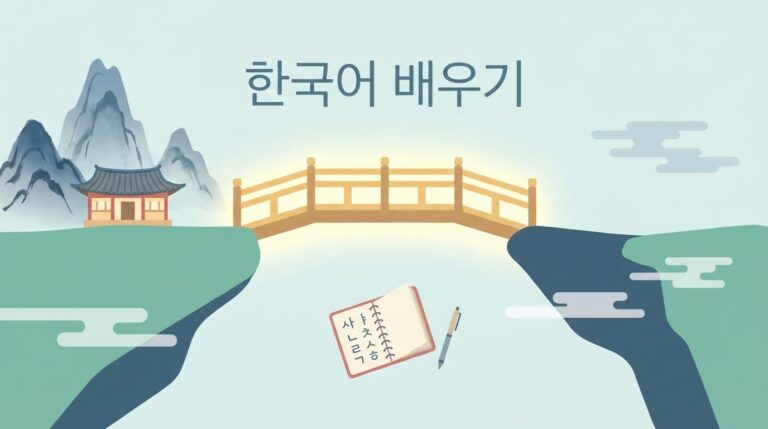
As advanced C2 scholars of Korean, you have already mastered syntactic structures and honorific registers. Your real pain point now is far more existential: encountering the boundary of untranslatability (번역 불가능성). In translation theory, Italian thinkers often cite “Traduttore, traditore” (Translator, traitor). Yet, translation is never merely a sterile mathematical equivalence; it is a courageous, creative act of betrayal that builds a luminous bridge across the vast abyss separating two distinct worldviews.
This guide draws directly upon the field notes of veteran Korean literary translators, localization directors, and bilingual essayists. By uncovering the subterranean currents beneath Korea’s most culturally distinct vocabulary, you will transcend basic functional comprehension. You will learn to navigate the delicate art of dynamic equivalence—deciding when to annotate, when to re-create, and when to let an emotion breathe across linguistic borders.
Phase 2: 핵심 표현 3선 심층 분석 (Key Expressions In-Depth)
Here are three masterclass Korean concepts that perpetually defy effortless Western translation, demanding dynamic re-creation.
1. 서운하다 (Seounhada)
- Pronunciation: [Seo-un-ha-da] (Imagine sighing “suh-oon-ha-dah” like letting warm air gently escape into frost)
- Meaning: Literal: “To feel sad/regretful” | Nuanced: A quiet, tender ache caused by an unspoken emotional expectation falling short between people who share an affectionate bond (Jeong).
- K-Culture Moment: In K-drama melodramas, when a lifelong partner or sibling forgets an intimate milestone, the protagonist does not rage; they lower their eyes and whisper, “그냥 좀 서운해서 그래” (Geunyang jom seounhaeseo geurae – “It’s just that I felt a bit hurt/let down”).
- Editor’s Insight: You cannot feel 서운하다 toward a total stranger. It presupposes an emotional investment. Calling it “angry” or “sad” flattens the deep intimacy and vulnerability inherent in the word.
- Situation Spectrum: Casual (✅) | Semi-formal (✅) | Formal (⚠️)
- 🤔 Think About It: Does your native tongue distinguish between anger at an injustice versus the gentle, fragile sorrow of having expected more warmth from a loved one?
2. 시원섭섭하다 (Siwonseopseophada)
- Pronunciation: [Si-won-seop-seop-ha-da] (Pronounce each syllable with steady, rhythmic weight: “shee-won-suhp-suhp-ha-dah”)
- Meaning: Literal: “Cool and sad” | Nuanced: A profound emotional state of bittersweet catharsis, where relief over completing an ordeal merges seamlessly with melancholy over its ending.
- K-Culture Moment: At drama wrap-up interviews (종방연), veteran actors are invariably asked how they feel. They universally respond: “오랜 대장정을 끝내니 참 시원섭섭하네요” (Oraen daejangjeongeul kkeunnaeni cham siwonseopseophaneyo – “Having finished this long odyssey, I feel truly bittersweet and relieved”).
- Editor’s Insight: Western psychology often categorizes emotions as polar opposites (relief vs. sadness). The Korean linguistic landscape treats ambivalence not as cognitive dissonance, but as an authentic single experiential state.
- Situation Spectrum: Casual (✅) | Semi-formal (✅) | Formal (✅)
- 🤔 Think About It: Why does modern English require hyphenated compounds (e.g., bittersweet, bittersweet-relief) to describe a paradox that Korean synthesizes into a single root adjective?
3. 눈치를 보다 / 살피다 (Nunchireul boda / salpida)
- Pronunciation: [Nun-chi-reul bo-da / sal-pi-da] (A crisp, focused inflection: “noon-chee-reul bo-dah”)
- Meaning: Literal: “To look at eye-measures” | Nuanced: Navigating interpersonal dynamics by intuitively reading situational undercurrents, micro-expressions, and unspoken social atmospheres.
- K-Culture Moment: In high-stakes Korean corporate thrillers, a junior associate freezes at a dinner meeting, silently decoding the chairman’s subtle brow twitch before reaching for the soju bottle.
- Editor’s Insight: While Western localization often flippantly renders nunchi as “tact” or “reading the room,” 눈치를 살피다 is a somatic, embodied vigilance born from high-context collective survival.
- Situation Spectrum: Casual (✅) | Semi-formal (✅) | Formal (✅)
- 🤔 Think About It: How does living in a low-context culture change our understanding of communication when silence carries heavier communicative weight than speech?
Phase 3: 교과서 한국어 vs 진짜 한국어 (Textbook vs. Real Native C2 Korean)
At the C2 tier, sounding native means discarding sterile dictionary definitions in favor of evocative sensory and spatial metaphors.
Situation 1: Expressing visceral internal emptiness or loneliness
- 📖 교과서 한국어: “프로젝트가 끝나고 나니 매우 공허하고 외롭습니다.”
(Peurojekteuga kkeunnago nani maeu gongheohago oeropseumnida. – Now that the project is over, I feel very empty and lonely.) - 🗣️ 진짜 한국어: “모든 게 일단락되고 나니 왠지 모르게 마음 한구석이 헛헛하네요.”
(Modeun ge ildallakdoego nani waenji moreuge maeum hanguseogi heotheothaneyo. – Now that things have reached a milestone, an inexplicable hollow ache lingers in the corner of my heart.) - 💡 왜 다를까? 공허하다 (gongheohada) sounds detached, clinical, or overly academic. In contrast, native speakers describe emotion spatially and physically—헛헛하다 captures a physical, chilly draft inside the soul.
Situation 2: Graciously declining an offer due to internal hesitation
- 📖 교과서 한국어: “그 제안을 수락하기 어렵습니다. 거절합니다.”
(Geu jeeaneul surakhagi eoryeopseumnida. Geojeolhamnida. – It is difficult to accept that proposal. I reject it.) - 🗣️ 진짜 한국어: “말씀은 정말 감사하지만, 어쩐지 발걸음이 선뜻 떨어지지가 않네요.”
(Malsseumeun jeongmal gamsahajiman, eojjeonji balgeoreumi seontteut tteoeojijiga anneyo. – I am profoundly grateful for your kind words, but somehow my feet cannot quite bring themselves to move forward.) - 💡 왜 다를까? Direct refusals fracture relational harmony (체면 and 화합). Expressing bodily hesitation (발걸음이 떨어지지 않다) dynamically conveys profound reluctance without assigning blame.
Phase 4: K-Culture 딥다이브 & 비언어적 매너 (Deep Dive & Non-Verbal Nuance)
4-1. 눈치 (Nunchi), Gazes, and the Eloquence of Hesitation
When discussing complex, untranslatable emotional states in Korean, physical presence matters as much as vocabulary. Notice how native speakers handle their gaze (시선 처리): when expressing a deeply vulnerable nuance like 서운함 (seounham) or 미안함 (mianham), look downward at a 45-degree angle for two seconds, exhale softly, and then re-engage eye contact. Maintaining aggressive, direct eye contact while explaining an emotional wound reads as confrontational rather than poignant.
4-2. Cultural Code: The Art of Subtitle Localization
Consider director Bong Joon-ho’s collaboration with his longtime English subtitle translator, Darcy Paquet, on Parasite (기생충). When translating 짜파구리 (Jjapaguri), translating it literally as “a mix of Chapagetti and Neoguri instant noodles” would have halted cinematic immersion. Instead, Paquet invented “Ram-don” (Ramen + Udon). While it is a factual distortion, it was a brilliant stroke of dynamic equivalence: it instantly delivered the socio-economic signifier of cheap junk food juxtaposed with expensive Hanwoo beef steak. Dynamic translation requires the humility to acknowledge that total fidelity is an illusion, liberating the translator to recreate resonance.
Phase 5: 실전 롤플레이 시나리오 (Real-Life Roleplay)
Setting: A quiet, wooden-beamed literary salon in Bukchon Hanok Village, Seoul. Rain gently taps against the traditional clay tiles (기와). You are consulting with Jiyoung, a renowned Korean literary critic and translator, about localizing a contemporary Korean essay collection.
- 지영 (Jiyoung): “작가님 원고에서 ‘애틋하다’라는 표현을 마주쳤을 때, 영역본에서 어떻게 풀어내실지 정말 고민스러웠어요.”
(Jakganim wongoeseo ‘aeteuthada’raneun pyohyeoneul majuchyeosseul ttae, yeong-yeokboneseo eotteoke pureonaesilji jeongmal gominseureowosseoyo. – When I encountered the word ‘aeteuthada’ in the author’s manuscript, I was deeply anxious about how you would unravel it in English.)
🎭 (찻잔을 천천히 돌려 잡으며 진지한 눈빛으로 바라본다) - 나 (You): “네, 단순한 ‘affection’이나 ‘heartbreaking love’로는 그 미세한 결이 도저히 살아나지 않더라고요.”
(Ne, dansunhan ‘affection’ina ‘heartbreaking love’roneun geu misehan gyeori dojeohi saranaji anteoragoyo. – Yes, mere terms like ‘affection’ or ‘heartbreaking love’ utterly failed to animate that fine-grained texture.)
🎭 (노트를 펼치며 깊은 고뇌의 흔적을 내비친다) - 지영 (Jiyoung): “맞아요. 사랑하면서도 가슴 한구석이 저릿하고, 상대가 안쓰러워서 눈물겨운 감정이 바로 ‘애틋함’이니까요.”
(Majayo. Saranghamyeonseodo gaseum hanguseogi jeorithago, sangdaega ansseureowoseo nunmulgyeoun gamjeongi baro ‘aeteutham’inikkayo. – Exactly. ‘Aeteutham’ is that precise feeling where love carries a stinging ache in the chest, accompanied by a tearful pity for the other person.)
🎭 (나지막한 탄식과 함께 고개를 끄덕인다) - 나 (You): “결국 단어 하나로 번역하기보다, 문맥 속에서 두 인물의 시선과 호흡으로 정서를 재창조해야 했습니다.”
(Gyeolguk daneo hanaro beon-yeokhagiboda, munmaek sogeseo du inmurui siseongwa hoheubeuro jeongseoreul jaechangjohaeya haessseumnida. – Ultimately, rather than translating it with a single word, I had to recreate the sentiment through the characters’ gazes and breathing within the context.)
🎭 (확신에 찬 어조로 잔을 매만진다) - 지영 (Jiyoung): “바로 그거예요. 언어의 심연을 직시하는 번역가만이 그런 다리를 놓을 수 있죠.”
(Baro geugeoyeyo. Eoneoui sim-yeoneul jiksihaneun beon-yeokgamani geureon darireul noeul su itjyo. – That is precisely it. Only a translator who stares directly into the linguistic abyss can erect such a bridge.)
🎭 (따뜻한 미소를 지으며 잔을 들어 가볍게 목을 축인다) - 나 (You): “완벽한 일치란 불가능하다는 겸허함에서 오히려 새로운 문학적 창조가 시작되는 것 같아요.”
(Wanbyeokhan ilchiran bulganeunghadaneun gyeomheohameseo ohiryeo saeroun munhakjeok changjoga sijakdoeneun geot gatayo. – It seems that true literary recreation paradoxically begins with the humility of knowing perfect parity is impossible.)
🎭 (창밖의 빗소리를 잠시 응시하며 여운을 남긴다) - 지영 (Jiyoung): “훌륭해요. 이번 번역본은 단순한 언어 변환이 아니라 진정한 문화적 대화가 되겠네요.”
(Hullyunghaeyo. Ibeon beon-yeokboneun dansunhan eoneo byeonhwan-i anira jinjeonghan munhwajeok daehwaga doegenneyo. – Wonderful. This translated edition will not be a sterile conversion of code, but an authentic cultural dialogue.)
🎭 (흡족한 표정으로 원고에 펜으로 별표를 남긴다)
🔀 인터랙티브 분기점 (Interactive Fork)
How do you conclude your translation proposal to Jiyoung?
- Option A: “사전적 정의에 충실하게 직역한 뒤, 각주를 꼼꼼히 달아 독자를 가르치겠습니다.” (I will translate literally according to dictionary definitions and add exhaustive footnotes to educate the reader.)
- Option B: “한국어 원어 그대로 알파벳으로 음차 표기하고, 영어 문맥 속에 자연스럽게 스며들도록 질감을 직조해 보겠습니다.” (I will transliterate the Korean word phonetically and weave its tactile texture organically into the surrounding English syntax.)
- Option C: “서양 독자가 직관적으로 이해할 수 있는 가장 흔하고 쉬운 대중적 영단어로 치환하겠습니다.” (I will replace it with the most common, effortless Western pop-culture term for intuitive ease.)
Feedback:
* Option A [Bad]: Heavy reliance on footnotes disrupts literary immersion, turning prose into a pedagogical textbook.
* Option B [Best]: Elegant! Transliteration combined with contextual sensory weaving respects cultural distinctiveness while providing dynamic readability.
* Option C [Risk]: Over-domestication erases cultural nuance entirely, turning Korean philosophy into a generic Western trope.
Phase 6: 10초 감정 섀도잉 드릴 (10-Second Emotional Shadowing Drill)
Practice these lines out loud. Respect the pause marks (/) and embody the designated emotional tone.
[🧐 고뇌에 찬 철학적 어조로 - Anguished, philosophical introspection]
“번역이란 / 두 언어 사이의 메울 수 없는 심연을 / 겸허히 마주하는 일입니다.”
(Beon-yeogiran / du eoneo saiui meul su eomneun sim-yeoneul / gyeomheohi majuhaneun irimnida.)
(“Translation is / humbly confronting / the unbridgeable abyss between two tongues.”)-
[🌿 담담하지만 깊은 여운으로 - Calm, serene, yet deeply resonant]
“직역이라는 배반 대신, / 울림을 전하는 / 창조적 재탄생을 택했습니다.”
(Jig-yeogiraneun baeban daesin, / ullimeul jeonhaneun / changjojeok jaetan-saeng-eul taekhaesseumnida.)
(“In lieu of the betrayal of literalism, / I chose a creative rebirth / that delivers authentic resonance.”) -
[🥺 가슴 저린 애틋함을 담아 - With tender, heart-aching yearning]
“그 단어에 담긴 서글픈 결을 / 결코 지우고 싶지 않았어요.”
(Geu dan-eoe damgin seogeulpeun gyeoreul / gyeolko jiugo sipji anasseoyo.)
(“I desperately did not want to erase / the sorrowful grain / etched within that word.”)
Phase 7: K-Culture 미니 사전 (Untranslatable Gems)
-
한 (恨, Han)
Translation: Collective sorrow, unresolved grief, and transcendent resilience.
Usage: Far deeper than mere sadness or grudge. It represents historical and existential anguish that has crystallized into artistic beauty and spiritual endurance over generations. -
정 (情, Jeong)
Translation: Ineffable relational adhesive; invisible communal warmth.
Usage: More than “love” or “affection.” It builds quietly through shared time, routine familiarity, and even mutual irritation (cf. 미운 정 – affection born through shared grievance). -
답답하다 (Dapdaphada)
Translation: Suffocating psychological or situational congestion.
Usage: Used when someone is slow on the uptake, when atmospheric air is thick, or when institutional bureaucracy prevents any sense of forward momentum. -
살갑다 (Salgapda)
Translation: Endearingly tender, affectionate, and smoothly amicable.
Usage: Refers to someone whose manner is remarkably warm, considerate, and naturally intimate without any performative falseness.
Phase 8: 여행자를 위한 생존 키트 (Sophisticated Cultural Toolkit)
When navigating the intellectual and cultural corridors of Korea (art biennials, book markets, tea houses), keep these high-level linguistic assets handy:
- “단어의 결이 참 섬세하네요.” (Daneo-ui gyeori cham seomsehadaeyo.)
Translation: “The grain and texture of that word are truly exquisite.”
Pro Tip: Use this when speaking to indie bookstore owners in Seochon or curatorial docents. It marks you instantly as a connoisseur of language. -
“행간에 숨은 의미가 마음에 와닿습니다.” (Haeng-gan-e sum-eun uimiga maeum-e wadatseumnida.)
Translation: “The meaning lingering between the lines deeply touches my heart.”
Pro Tip: Perfect for literary discussions or writing a guestbook entry at a historic hanok gallery. -
“직역하기엔 너무 아까운 깊이가 있어요.” (Jig-yeokhagien neomu akkaun gipiga isseoyo.)
Translation: “It holds a depth far too precious to be reduced to a literal translation.”
Pro Tip: An elegant conversation starter when discussing K-dramas with Korean colleagues over tea.
Editor’s Travel Note
When wandering Seoul’s cultural enclaves like Paju Book City or the alleys of Insa-dong, never rely on auto-translators. Instead, consult high-precision tools such as the Naver Korean Dictionary for etymological roots and hanja origins. For traversing Seoul’s intricate historical labyrinths without losing cell reception, save your favorite cultural cafes on the Naver Map Application.
Phase 9: “한 발 더 깊이” (Cultural Essay)
French philosopher Paul Ricœur spoke of “linguistic hospitality”—the noble ethical endeavor to host foreign words within one’s mother tongue without violently assimilating them. Korean is an inherently osmotic language, shaped by high-context relational dynamics, communal solidarity, and centuries of historical perseverance. When a Korean native says “마음이 쓰인다” (Maeumi sseuinda), translating it as “I care” or “I am worried” discards the tactile metaphor of one’s own heart being physically spent and threadbare on another’s behalf. Embracing untranslatability is not a failure of language; it is the ultimate affirmation of our shared human diversity.
💬 Your Turn: What is an untranslatable Korean word that feels completely foreign yet somehow completely true to your own emotional life? Share your thoughts below!
Phase 10: FAQ & 흔한 실수 (FAQ Schema & Pitfalls)
Q: Why can’t we simply translate ‘효도’ (Hyodo) as ‘filial piety’?
A: While filial piety carries the historical Confucian denotation, in modern English it sounds archaic, religious, and rigid. Modern Korean 효도 encompasses lively emotional expressions: sending parents on luxury vacations, cooking abalone porridge when they fall ill, and staying attentive. A dynamic equivalence often frames it as “devoted filial love” or portrays it through direct narrative action rather than classical Latinate jargon.
Q: How do professional translators decide between transliteration and replacement?
A: If a concept is crucial to the ideological backbone of a work (like Han in Korean literature or Hybris in Greek tragedy), it is better to transliterate, establish its contextual ecosystem, and allow it to take root in the reader’s vocabulary. If it is merely decorative local color, dynamic substitution prevents cognitive fatigue.
Q: Is dynamic equivalence an excuse for inaccurate translation?
A: Absolutely not. Dynamic equivalence requires an even deeper, obsessive understanding of the source text than literalism. As Eugene Nida emphasized, it seeks equivalence of response rather than identity of form. The goal is for the target reader to feel the same emotional vibration that the source text sparked in its original audience.
🚨 흔한 실수 (Common Mistakes TOP 3)
- Translating ‘섭섭하다’ as ‘Angry’ or ‘Enraged’:
Correct Action: Recognize that 섭섭하다 contains sadness and lingering affection, never wrath. Render it as “disappointed,” “heart-sore,” or “wistfully hurt.” - Reducing ‘눈치’ to ‘Tact’ in formal literature:
Correct Action: In literary translation, replace it with sensory descriptions: “reading the atmospheric shift” or “attuning to the unsaid.” - Overusing literal idioms (e.g., ‘간이 콩알만 해지다’ as ‘liver shrank to a pea’):
Correct Action: Unless the metaphor’s anatomical oddity is intentional, render the physiological impact dynamically: “my heart leaped into my throat” or “paralyzed with sudden terror.”
Phase 11: 액션 미션 & 참여 유도 (Action Missions)
- 🥉 Bronze Mission (Solo Mastery): Choose three untranslatable Korean words (정, 한, 섭섭하다). Write a two-paragraph English micro-story where the English prose illustrates the core emotion without ever using the Korean word itself.
- 🥈 Silver Mission (Social Bridge): Post your favorite untranslatable Korean word on your study Instagram or X (Twitter). Explain its nuanced difference from Western emotional vocabulary and tag #DailyHangulC2 #TranslationNotes.
- 🥇 Gold Mission (Real Application): While watching your next K-drama with English subtitles, spot a line where the English translation fails to capture the Korean subtext. Draft your own alternative dynamic subtitle and submit it to the Daily Hangul community forum!
🎮 K-Culture Mission: Read an English translation of a poem by Kim So-wol or a passage from a Han Kang novel alongside the Korean original. Highlight the moments where the translator made a “creative betrayal” to maintain poetic resonance.
Phase 12: 인터랙티브 퀴즈 챌린지 (Quiz Challenge)
1. 상황 판단 (Situational Judgment)
A lifelong colleague has resigned to pursue their dream abroad. You feel immense happiness for their new journey, but simultaneously feel a deep, lonely ache knowing their desk will sit empty tomorrow. Which phrase best articulates this exact synthesis?
* (A) 홀가분하고 후련하다 (Holgabunhago huryonhada)
* (B) 시원섭섭하다 (Siwonseopseophada)
* (C) 어처구니가 없다 (Eocheoguniga eopda)
2. 빈칸 채우기 (Fill-in-the-Blank)
상대방의 침묵과 표정을 통해 사태의 심각성을 순간적으로 알아차리는 능력을 일컬어 “_______(이)가 빠르다”라고 표현합니다.
(The innate capability to intuitively decode the gravity of a situation through silence and micro-expressions is expressed as “_______-i ppareuda”.)
3. True / False 문화 퀴즈
True or False: Dynamic Equivalence in translation means altering the story completely whenever a cultural term is too difficult to explain, prioritizing speed over emotional fidelity.
👉 Click to Reveal Answers & Analysis
- Answer: (B) 시원섭섭하다 (Siwonseopseophada)
Analysis: (A) indicates total unburdened relief; (C) indicates utter dumbfounded disbelief. Only (B) captures the harmonious co-existence of relief and sorrow. -
Answer: 눈치 (Nunchi)
Analysis: “눈치가 빠르다” (Nunchiga ppareuda) means being remarkably swift at reading social atmospheres and unspoken cues. -
Answer: False
Analysis: Dynamic equivalence does not mean abandoning the text; it is the disciplined pursuit of evoking the exact same emotional and cognitive impact in the target language through culturally creative means.
🎬 Watch Our Daily Videos! (Daily Hangul Official Instagram)
Review the expressions you learned in this article with our fun daily short videos! Check out native pronunciation and real-life nuances in action.
- Instagram @dailyhangul_en







