

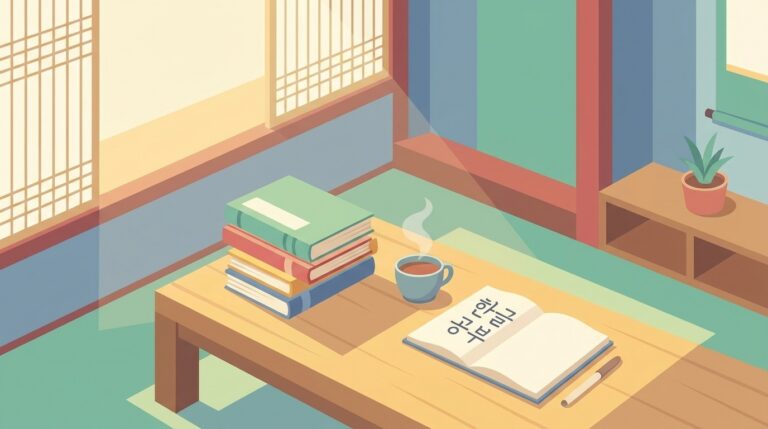
Phase 1: 공감 (A Cozy Seoul Afternoon with Books)
안녕하세요! 매일한글 에디터입니다.
Imagine spending a quiet Saturday afternoon in a sunlit hanok cafe in Seochon or a hidden independent bookstore near Mangwon-dong. Rain gently taps against the glass window, you have a warm mug of omija tea beside you, and your fingers rest on the textured cover of a Korean essay you just finished reading. You glance up at your bookshelf at home in your mind, or at the quaint wooden shelves around you, feeling that deep, serene satisfaction. You want to tell your Korean friend: “Just looking at the books I’ve read stacking up one by one on the bookshelf enriches my heart.”
However, when intermediate Korean learners attempt to express this sentiment, they often stumble. Many reach for stiff translations like “책을 많이 봐서 행복합니다 (I am happy because I read many books)” or awkward literal renderings of “enrich my heart” that sound straight out of a 19th-century poem. How do modern Koreans actually articulate that unique sensory nostalgia for paper books over e-readers? In this lesson, developed directly from recurring questions in our intermediate conversation salons, we will unpack how to naturally express sensory depth, aesthetic pride, and the timeless paper-versus-screen debate at a natural B1 level.
Phase 2: 핵심 표현 3선 심층 분석
Here are the three foundational expressions that will transform your book conversations from basic to richly nuanced.
1. 책꽂이에 한 권씩 쌓여 가다 (Chaek-kkoji-e han gwon-ssik ssa-yeo ga-da)
- Pronunciation: [Chae-kko-ji-e han gwon-ssik ssa-yeo ga-da] (Think: check-co-jee-eh han gwon-seek sah-yeo gah-dah)
- Meaning: “To stack up one by one on the bookshelf”
- K-Culture Moment: Often heard in lifestyle vlogs (Vlog) or cozy healing K-dramas (like When the Weather Is Fine), when the protagonist reflects on their reading journey.
- Editor’s Insight: The grammar combination
-어 가다implies a continuous progression over time. It doesn’t just mean a messy pile of books; it emphasizes the gradual, dedicated accumulation of your personal growth and memories.- Situation Spectrum: Casual: ✅ | Semi-formal: ✅ | Formal: ✅
- 🤔 Think About It: In English, we often say “my reading list is growing.” Why do you think Korean emphasizes the physical visual of books stacking vertically (
쌓여 가다)?
2. 마음이 풍요로워지다 (Maeum-i pung-yo-ro-wo-ji-da)
- Pronunciation: [Mae-eu-mi pung-yo-ro-wo-ji-da] (Sounds like: mah-eum-ee poong-yo-ro-wo-jee-dah)
- Meaning: Direct: “One’s heart/mind becomes fertile/abundant” | Natural: “To feel emotionally enriched and fulfilled”
- K-Culture Moment: Commonly used by interviewees on Korean book podcasts or literary variety shows when describing art, music, or literature that fills an emotional void.
- Editor’s Insight:
풍요롭다traditionally describes a bountiful harvest. Combining it with마음(mind/heart) expresses a deep, mature satisfaction far richer than just기분이 좋다(feeling good) or행복하다(being happy).- Situation Spectrum: Casual: ⚠️ (sounds a bit poetic/philosophical) | Semi-formal: ✅ | Formal: ✅
- 🤔 Think About It: In your native language, is emotional fulfillment likened to agriculture or material abundance?
3. 손맛 / 종이 넘기는 맛 (Son-mat / Jong-i neom-gi-neun mat)
- Pronunciation: [Son-mat / Jong-i neom-gi-neun mat]
- Meaning: Direct: “Hand taste / The taste of turning pages” | Natural: “Tactile pleasure / The unique satisfaction of turning physical pages”
- K-Culture Moment: Two friends debating whether to buy an e-reader (like a Crema or Kindle) versus sticking to paper books in a Kyobo Bookstore aisle.
- Editor’s Insight: In Korean,
맛(taste) is frequently used metaphorically to describe a satisfying sensory experience or unique thrill (e.g.,손맛in fishing, gaming, or turning book pages).- Situation Spectrum: Casual: ✅ | Semi-formal: ✅ | Formal: ⚠️
- 🤔 Think About It: Why do Koreans use the word for “taste” to describe physical textures and tactile hobbies?
Phase 3: 교과서 한국어 vs 진짜 한국어
Let’s compare stiff, classroom Korean with the vibrant, natural expressions native speakers use daily.
Situation 1: Explaining why you still prefer physical paper books over digital screens
- 📖 교과서 한국어: 저는 전자책보다 종이책을 더 선호합니다. (Jeoneun jeonjachaekboda jong-ichaeg-eul deo seonhohamnida. / “I prefer paper books more than electronic books.”)
- 🗣️ 진짜 한국어: 그래도 책은 한 장씩 넘겨 가며 읽는 손맛이 최고죠! (Geuraedo chaegeun han jangssik neomgyeogamyeo ingneun sonmasi choegojo! / “Still, nothing beats the tactile joy of flipping through pages one by one!”)
- 💡 왜 다를까?: While
선호하다(to prefer) is grammatically flawless, native speakers express attachment through sensory phrases like넘겨 가며 읽는 손맛(the tactile joy of turning pages) to convey warmth and passion.
Situation 2: Looking at your personal book collection at home
- 📖 교과서 한국어: 많은 책을 읽어서 기분이 아주 좋습니다. (Maneun chaegeul ilgeoseo gibuni aju jotseumnida. / “Because I read many books, my feeling is very good.”)
- 🗣️ 진짜 한국어: 다 읽은 책들이 책장에 꽂혀 있는 것만 봐도 든든하고 뿌듯해요. (Da ilgeun chaekdeuri chaekjange kkotyeo inneun geonman bwado deundeunhago ppudeutaeyo. / “Just seeing the books I finished sitting on the shelf makes me feel so proud and content.”)
- 💡 왜 다를까?: Native speakers use double emotional adjectives like
든든하다(reassuring/substantial) and뿌듯하다(proud/heartwarmed) to express inner accomplishment rather than a generic기분이 좋다.
Phase 4: K-Culture 딥다이브 & 비언어적 매너
4-1. 눈치 (Nunchi) & Bookstore Manners
When browsing indie bookstores (독립서점) in trendy Seoul spots like Yeonhui-dong or Ikseon-dong, body language is everything. Independent bookstores in Korea are often curated silent sanctuaries.
* The Two-Handed Spine Check: Never pull a paper book by the top edge of its spine with one finger; gently cup the book with both hands. It shows reverence for the author’s work.
* Sample Book Courtesy: Look for the label 견본 (Sample) or 샘플. Unwrapped books without sample stickers should be handled delicately without breaking the spine flat. If you plan to read for a long time, buy a beverage or purchase a small bookmark to support the shop owner.
4-2. Cultural Codes: The #북스타그램 (#Bookstagram) & “북캉스” (Book-cance)
In South Korea, reading has transformed from a solitary chore into an aesthetic, mindful lifestyle.
* 북캉스 (Book-cance): A blend of Book and Vacance (vacation). Young Koreans routinely check into boutique hotels or hanok stays solely to disconnect from smartphones and read paper books.
* 소장욕구 (Desire to Collect): While subscription apps like Millie’s Library (밀리의 서재) dominate commuting hours on subways, Korean readers still buy physical copies of books they loved on their e-readers simply to place them on their shelves. Displaying books is viewed as curating one’s personal identity.
Phase 5: 실전 롤플레이 시나리오
Setting: A cozy book cafe in Seochon, Seoul. Warm jazz plays softly. Wooden shelves line the brick walls.
Characters:
* 민지 (Minji): A Korean friend who recently bought an e-reader (이북 리더기).
* You: A passionate reader who still loves paper books.
- 민지: 민우 씨, 요즘도 가방에 두꺼운 종이책 들고 다녀요? 안 무거워요? 🎭 (웃으며 자신의 얇은 전자책 리더기를 들어 보인다)
(Min-u ssi, yojeumdo gabang-e dukkeoun jong-ichaek deulgo danyeoyo? An mugeowoyo?)
“Minwoo, are you still carrying thick paper books in your bag these days? Isn’t it heavy?” -
You: 조금 무겁긴 한데, 전 역시 종이 넘기는 손맛을 포기 못 하겠어요. 🎭 (가방에서 종이책을 조심스럽게 꺼내며 미소 짓는다)
(Jogeum mugeopgin hande, jeon yeoksi jong-i neomgineun sonmaseul pogi mot hagesseoyo.)
“It is a bit heavy, but I just can’t give up the tactile joy of flipping real pages.” -
민지: 하긴, 그 사각거리는 종이 냄새랑 소리가 진짜 매력적이긴 하죠. 🎭 (책의 질감을 만져보며 고개를 끄덕인다)
(Hagin, geu sagakgeorineun jong-i naemsaerang soriga jinjja maeryeokjeog-igin hajyo.)
“True, that crisp paper smell and sound really are so charming.” -
You: 맞아요. 그리고 책꽂이에 내가 읽은 책들이 한 권씩 쌓여 가는 모습을 바라보는 것만으로도 마음이 풍요로워져요. 🎭 (창가 선반의 책들을 따뜻한 눈빛으로 바라보며)
(Majayo. Geurigo chaek-kkoji-e naega ilgeun chaekdeuri han gwon-ssik ssa-yeo ganeun moseubeul baraboneun geonman-eurodo maeum-i pung-yo-ro-wo-jyeoyo.)
“Exactly. And just looking at the books I’ve read stacking up one by one on the bookshelf enriches my heart.” -
민지: 와, 그 말 들으니까 되게 시적이다! 저도 집 책장 보면 뿌듯할 때가 많아요. 🎭 (감탄하며 차를 한 모금 마신다)
(Wa, geu mal deureunikka doege sijeog-ida! Jeodo jip chaekjang bomyeon ppudeutal ttaega manayo.)
“Wow, hearing you say that sounds so poetic! Seeing my home bookshelf makes me feel proud too.” -
You: 전자책은 편리해서 좋고, 종이책은 마음에 남는 깊이가 달라서 둘 다 매력 있어요. 🎭 (민지의 이북 리더기를 관심 있게 살펴보며)
(Jeonjachaeg-eun pyeonrihaeseo jotgo, jong-ichaeg-eun maeum-e namneun gip-iga dallaseo dul da maeryeok isseoyo.)
“E-books are great for convenience, while paper books leave a different kind of depth in your heart, so both have their charm.” -
민지: 맞아요! 그래서 저도 전자책으로 먼저 읽고 정말 좋은 책은 종이책으로 또 사요. 🎭 (공감하며 손뼉을 살짝 친다)
(Majayo! Geuraeseo jeodo jeonjachaeg-euro meonjeo ilgo jeongmal joeun chaegeun jong-ichaeg-euro tto sayo.)
“Exactly! That’s why I read on my e-reader first and buy physical copies of the ones I truly love.” -
You: 오, 완벽한 독서 루틴이네요! 오늘 여기서 같이 한 챕터 읽고 갈까요? 🎭 (책을 펼치며 편안한 자세를 잡는다)
(O, wanbyeokhan dokseo rutinineyo! Oneul yeogiseo gachi han chaepteo ilgo galkkayo?)
“Oh, that’s the perfect reading routine! Shall we read a chapter here together today?”
🔀 인터랙티브 분기점 (Interactive Choice)
Now Minji asks you: “전자책 사면 종이책 읽는 시간 줄어들까요? (If I buy an e-reader, will my paper book reading time decrease?)” How do you respond?
- Option A: “오히려 장소 가리지 않고 더 자주 읽게 돼서, 결국 종이책도 더 사랑하게 될 거예요!” (On the contrary, you read anywhere more often, so you end up loving paper books even more!)
- Feedback (Best): Extremely empathetic, encouraging, and uses natural B1 connector
오히려(on the contrary).
- Feedback (Best): Extremely empathetic, encouraging, and uses natural B1 connector
- Option B: “종이책은 무거우니까 무조건 전자책만 쓰세요.” (Paper books are heavy, so unconditionally use only e-books.)
- Feedback (Bad): Too blunt and dogmatic. It negates the emotional depth of the prior conversation.
- Option C: “제 마음이 풍요로우니까 괜찮습니다.” (Because my heart is enriched, it is okay.)
- Feedback (Risk): Grammatically awkward context!
풍요롭다cannot be used as an answer to a practical scheduling question.
- Feedback (Risk): Grammatically awkward context!
Phase 6: 10초 감정 섀도잉 드릴 (Shadowing Drills)
Practice reading these out loud, pausing at the / marks to capture native rhythm and emotional cadence!
[😌 차분하고 감성적인 목소리로]
책꽂이에 / 내가 읽은 책들이 / 한 권씩 쌓여 가는 모습을 바라보는 것만으로도 / 마음이 풍요로워져요.
(Chaek-kkoji-e / naega ilgeun chaekdeuri / han gwon-ssik ssa-yeo ganeun moseubeul baraboneun geonman-eurodo / maeum-i pung-yo-ro-wo-jyeoyo.)-
[✨ 생동감 넘치고 확신에 찬 어조로]
아무리 전자책이 편해도 / 종이 넘기는 손맛은 / 절대 못 따라오죠!
(Amuri jeonjachaegi pyeonhaedo / jong-i neomgineun sonmaseun / jeoldae mot ttara-ojyo!) -
[🥰 뿌듯하고 애정 어린 톤으로]
다 읽은 책을 꽂아둘 때 / 느껴지는 그 묵직함이 / 정말 좋아요.
(Da ilgeun chaegeul kkojadul ttae / neukkyeojineun geu mukjikhami / jeongmal joayo.)
Phase 7: K-Culture 미니 사전
-
벽돌책 (Byeokdol-chaek)
- Meaning: “Brick book”
- Usage: Refers to an intimidatingly thick, heavy book (usually 600+ pages). Finishing a 벽돌책 is celebrated with commemorative photos on Korean social media.
- 활자중독 (Hwalja-jungdok)
- Meaning: “Addiction to printed letters”
- Usage: Playfully used to describe someone who cannot stop reading anything in sight—from classic novels to shampoo ingredient labels.
- 소장각 (Sojang-gak)
- Meaning: “Worth owning / Must-keep item”
- Usage: Slang combining 소장 (possession) and 각 (angle/vibe). Used when a book has such beautiful cover art or life-changing content that you must buy the physical copy.
- 사각사각 (Sagak-sagak)
- Meaning: Onomatopoeia for crisp, scraping sounds.
- Usage: Expresses the tactile sound of a pencil gliding on textured paper or turning dry paper pages in a quiet room.
Phase 8: 여행자를 위한 생존 키트 (Traveler’s Survival Kit)
TOP 3 Bookworm Survival Expressions
- “혹시 이 책 샘플 볼 수 있나요?” (Hoksi i chaek saemple bol su innayo?)
- Pro Tip: Use this when a book in an indie bookstore is sealed in protective plastic wrap.
- “이 책 선물용인데 포장해 주실 수 있나요?” (I chaek seonmuryong-inde pojanghae jusil su innayo?)
- Pro Tip: Korean bookstores offer tasteful gift-wrapping, often with minimalist Korean paper.
- “요즘 가장 잘나가는 베스트셀러가 뭐예요?” (Yojeum gajang jallaganeun beseuteuselleoga mwoyeyo?)
- Pro Tip: Great conversation starter with staff at local neighborhood bookshops.
Editor’s Travel Note: Book-Lovers in Seoul
If you want to experience the grandeur of Korean reading culture, head to the flagship 교보문고 광화문점 네이버 지도 안내. Their famous stone plaque reads: “사람은 책을 만들고 책은 사람을 만든다” (Humans make books, and books make humans). For independent aesthetics, explore the charming alleys of Seochon or Yeonnam-dong using the 네이버 지도 앱 다운로드 to search for “독립서점” (Independent Bookstore). Most book cafes do not require reservations, but ordering one drink per person is strict etiquette.
Phase 9: “한 발 더 깊이” (Cultural Essay)
In modern Korean society, life moves at a relentless, fast-paced speed (빨리빨리 culture). We work with dual monitors, order groceries that arrive at dawn, and consume 30-second short-form reels on crowded subway lines. In this hyper-digital landscape, pausing to turn physical paper pages is an act of quiet rebellion. When a Korean says that their heart feels 풍요롭다 (enriched) looking at their bookshelf, they are not bragging about intellect; they are acknowledging that amidst the digital rush, they carved out intentional time to be fully human.
💬 Your Turn: What does your bookshelf look like right now? Do you lean toward digital convenience or the tactile “손맛” of physical books? Leave a comment below in Korean using today’s grammar point -는 것만으로도!
Phase 10: FAQ & 오해 방지 (FAQ Schema)
Q: Can I use “마음이 풍요로워져요” when talking about eating good food or buying clothes?
A: While technically understandable, it sounds slightly unnatural. 풍요롭다 is best reserved for cultural, emotional, intellectual, or spiritual enrichment—such as reading books, watching inspiring cinema, taking a walk in nature, or spending deep time with family. For good food or shopping, use 마음이 든든해요 (I feel warm and satisfied) or 기분 전환이 됐어요 (It refreshed my mood).
Q: What is the exact difference between “책꽂이” (Chaek-kkoji) and “책장” (Chaek-jang)?
A: 책장 refers to a larger bookcase or multi-tiered bookshelf furniture unit. 책꽂이 can refer to the same, but it often specifically denotes smaller desk-top book racks or the slots where books are inserted.
Q: Does “손맛” only apply to paper books?
A: No! 손맛 is a versatile cultural word. It describes the tactile feedback in fishing when a fish bites the line, the satisfaction of kneading dough in cooking, playing a musical instrument, or typing on a clicky mechanical keyboard.
🚨 Common Mistakes Checklist
- ❌ Mistake 1: Translating “My reading is increasing” as 내 독서가 증가해요 (Stiff and awkward).
- ✅ Correct Action: Say 요즘 책을 더 자주 읽고 있어요 or 읽은 책들이 차곡차곡 쌓여 가고 있어요.
- ❌ Mistake 2: Saying 전자책은 맛이 없어요 to mean “E-books lack that special feel.”
- ✅ Correct Action: Say 전자책은 종이책 특유의 손맛이 안 나요 (E-books don’t provide that distinct tactile feeling of paper).
- ❌ Mistake 3: Omitting the progressive marker: 책이 책꽂이에 쌓여요.
- ✅ Correct Action: Add
-어 가다(책이 쌓여 가요) to capture the meaningful journey of books accumulating over time.
- ✅ Correct Action: Add
Phase 11: 액션 미션 & 참여 유도
- 🥉 Bronze Mission (Solo Practice): Stand in front of your personal bookshelf (or your bedside table). Say aloud: “책꽂이에 책들이 쌓여 가는 것만 봐도 뿌듯해!” three times with feeling.
- 🥈 Silver Mission (Social Share): Snap a photo of your current Korean study book or favorite novel. Post it on Instagram or your study journal with the caption: “오늘의 한 줄: 책 넘기는 손맛이 최고예요 📖 #DailyHangul #책스타그램”.
- 🥇 Gold Mission (Real Life): Visit a local bookstore or talk to a Korean speaker online. Ask them: “종이책이랑 전자책 중에 어떤 걸 더 좋아하세요?” and follow up with your perspective using
손맛or풍요로워지다.
🎮 K-Culture Bonus Mission: In the next K-drama you watch, notice whenever characters are in their bedrooms or study rooms. Look at their bookshelves—is there a stack of 벽돌책 sitting beside their bed? Share your spotting in our community forum!
Phase 12: 인터랙티브 퀴즈 챌린지
Test your understanding of today’s expressions and cultural nuances!
1. Situational Judgment:
Your Korean friend shows you their brand-new, ultra-thin e-reader. You want to acknowledge its utility while politely sharing why you still cherish physical books. Which sentence is most natural?
* (A) 전자책은 맛이 없어서 절대 싫어요.
* (B) 편리하긴 한데, 전 종이 넘기는 손맛이랑 책이 쌓여 가는 느낌이 더 좋더라고요.
* (C) 저는 책꽂이가 없어서 전자책만 좋아합니다.
2. Fill in the Blank:
좋은 책을 한 권 다 읽고 나면 텅 비었던 마음이 따뜻하고 ________ 느낌이 들어요.
(Hint: B1 keyword for “emotionally enriched/abundant”)
3. True or False:
In Korean culture, 손맛 (son-mat) can only be used when tasting food prepared with bare hands. (True / False)
👉 Click to reveal answers & detailed explanations!
- Answer: (B)
- Explanation: Option (B) gracefully validates the e-reader’s convenience (
편리하긴 한데) while expressing affection for physical books using genuine idiomatic phrasing (손맛,쌓여 가는 느낌). Option (A) is rude and misuse of맛이 없다.
- Explanation: Option (B) gracefully validates the e-reader’s convenience (
- Answer: 풍요로워지는 (or 풍요로운)
- Explanation:
마음이 풍요로워지다is the exact emotional pairing for feeling inner abundance after a deep cultural experience.
- Explanation:
- Answer: False
- Explanation: While it originates in cooking,
손맛is widely used for reading paper books, fishing, sports, and mechanical hobbies to denote tactile feedback.
- Explanation: While it originates in cooking,
🎬 Watch Our Daily Videos! (Daily Hangul Official Instagram)
Review the expressions you learned in this article with our fun daily short videos! Check out native pronunciation and real-life nuances in action.
- Instagram @dailyhangul_en







