

Phase 1: 공감 (Story-driven Opening)
안녕하세요! 매일한글 에디터입니다.
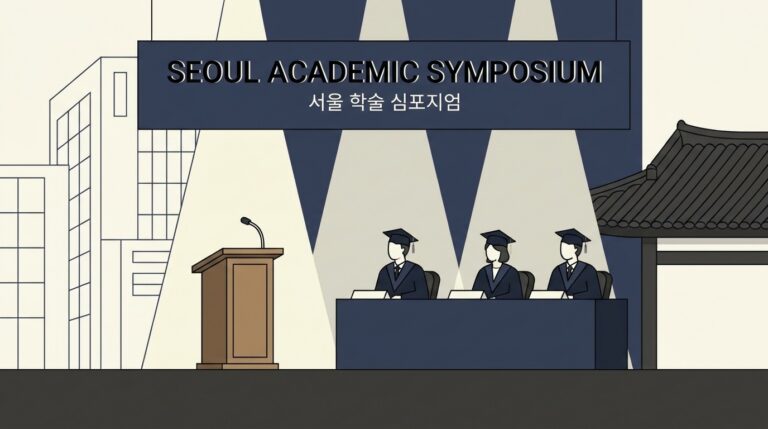
Picture this: You are sitting at the head of a prestigious conference stage at COEX in Gangnam, Seoul. The session topic is cutting-edge AI ethics, the audience includes esteemed professors and industry executives, and the digital clock on the podium is blinking an unforgiving red: 00:03:15. Three minutes left. You turn to your three distinguished panelists—senior scholars who could easily talk for another hour each. How do you gracefully guide them to a close without sounding abrupt, while leaving the entire auditorium with chills of intellectual inspiration?
If you have ever watched the final moments of a high-stakes K-drama like Queenmaker or a televised presidential forum on JTBC, you know that the true star is often the moderator (좌장, jwajang). A master moderator does not simply say, “Time is up, bye.” Instead, they ask for a singular, punchy takeaway that crystallizes the debate into an indelible memory. Drawing from real feedback from our advanced C1 fellows who lead international symposia in Korea, this guide equips you with the exact linguistic finesse and non-verbal charisma required to wrap up high-level discussions like an elite Korean academic.
Phase 2: Core Expressions Deep Dive (핵심 표현 3선)
1. 각 패널분들께 마지막으로 핵심 제언을 한 문장씩 부탁드립니다.
- Pronunciation: Gak paeneolbundeul-kke majimak-euro haeksim jeeon-eul han munjang-ssik butakdeurimnida. (Sounds like: Gahk peh-nawl-boon-deul-gkeh mah-jee-mahk-oo-roh hehk-sheem jeh-eon-ool hahn moon-jahng-ssheek boo-tahk-deu-reem-nee-dah)
- Meaning: “I would like to ask each panelist for their core recommendation in a single sentence as we conclude.”
- K-Culture Moment: Seen in prestigious public affairs broadcasts like KBS Sunday Diagnostics when the anchor prompts senior politicians to deliver their bottom-line resolution before the credits roll.
- Editor’s Insight: The noun 제언 (jeeon) elevates your language far above the casual “생각 (thought)” or “의견 (opinion).” It refers to a formal, structured proposition or advisory remark suited for policy, science, and academic discourse.
- Situation Spectrum: Casual 🚫 | Semi-formal ⚠️ | Formal ✅
- 🤔 Think About It: In English, you might say “Give me your final one-liner.” Why does Korean require specifying the honorific counter -분들께 (-bundeul-kke) alongside the humble request ending -부탁드립니다 (-butakdeurimnida) even when you hold total stage authority as the chairperson?
2. 긴 여운을 남길 수 있는 한 줄 메시지로 토론을 매듭지어 주시겠습니까?
- Pronunciation: Gin yeo-un-eul namgil su inneun han jul mesiji-ro toron-eul maedeupjieo jusigess-seumnikka? (Sounds like: Geen yaw-oon-ool nahm-geel soo een-neun hahn jool meh-shee-jee-roh toh-rohn-ool meh-deup-jee-aw joo-shee-geht-seum-nee-kkah?)
- Meaning: Literal: “Could you tie up the debate with a one-line message that leaves a lasting resonance?” / Real Nuance: “Could each of you offer an inspiring closing thought to wrap up our panel?”
- K-Culture Moment: Evokes the philosophical closing remarks heard in high-brow cultural podcasts or keynote sessions at the Jeju Forum, where speakers tie complex sociological data back to humanistic values.
- Editor’s Insight: 여운 (yeo-un) is a poetic concept describing the lingering resonance of a bell long after it has been struck. By asking for yeo-un, you explicitly invite panelists to share an evocative, memorable aphorism rather than dry statistics.
- Situation Spectrum: Casual 🚫 | Semi-formal ⚠️ | Formal ✅
- 🤔 Think About It: How does invoking aesthetic imagery like “여운 (lingering resonance)” transform an administrative time-check into an engaging intellectual finale?
3. 시간 관계상, 앞으로의 비전을 담은 압축적인 한 말씀을 청해 듣고자 합니다.
- Pronunciation: Sigan gwangyesang, ap-euro-ui bijeon-eul dameun apchukjeok-in han malsseum-eul cheonghae deutgoja hamnida. (Sounds like: Shee-gahn gwahn-gyeh-sahng, ah-poo-roh-ooy bee-jawn-ool dah-meun ahp-chook-jawk-een hahn mahl-sseum-ool chawng-heh deut-goh-jah hahm-nee-dah)
- Meaning: Literal: “Due to time constraints, I wish to invite condensed remarks encapsulating future vision.” / Real Nuance: “Since we are tight on time, please give us your most concise final forecast.”
- K-Culture Moment: The signature move of veteran tech conference moderators at events like the World Knowledge Forum when cutting off circular debates to pivot toward forward-looking action items.
- Editor’s Insight: 시간 관계상 (sigan gwangyesang) is the ultimate polite disclaimer in Korean professional life. Pairing it with 청해 듣고자 합니다 (cheonghae deutgoja hamnida)—an ultra-honorific idiom meaning “I eagerly seek to hear your esteemed words”—softens the strict time boundary with immense deference.
- Situation Spectrum: Casual 🚫 | Semi-formal ⚠️ | Formal ✅
- 🤔 Think About It: Notice the passive-honorific phrasing. How does framing time as the villain (“due to time constraints”) preserve everyone’s public face (체면, chaemyeon)?
Phase 3: Textbook Korean vs. Real Korean
Situation 1: Asking Panelists to Keep it Short
- 📖 교과서 한국어 (Textbook Korean): 시간이 없으니 짧게 말씀해 주세요. (Sigan-i eopseuni jjalge malsseumhae juseyo. / “We don’t have time, so please speak briefly.”)
- 🗣️ 진짜 한국어 (Real C1 Korean): 한정된 시간 내에 명쾌한 화두를 던져 주시면 감사하겠습니다. (Hanjeongdoen sigan nae-e myeongkwaehan hwadureul deonjyeo jusimyeon gamsahagessseumnida. / “I would appreciate it if you could leave us with a crystal-clear talking point within our remaining time.”)
- 💡 왜 다를까? (Cultural Insight): Telling distinguished keynote speakers “시간이 없다” (we lack time) sounds dismissive. Framing their brevity as “화두를 던지다” (tossing a provocative focal issue) flatters their intellectual contribution while enforcing your timer.
Situation 2: Transitioning from Discussion to Wrap-up
- 📖 교과서 한국어 (Textbook Korean): 이제 토론을 끝내겠습니다. (Ije toron-eul kkeunnaegessseumnida. / “Now I will end the discussion.”)
- 🗣️ 진짜 한국어 (Real C1 Korean): 오늘 나눠주신 치열한 통찰을 갈무리할 시점입니다. (Oneul nanoeojusin chiyeolhan tongchal-eul galmurihal sijeom-imnida. / “It is now time to harvest and synthesize the rigorous insights shared today.”)
- 💡 왜 다를까? (Cultural Insight): “끝내다” sounds like punching out on a timecard. High-level Korean uses the native agrarian verb 갈무리하다 (galmurihada), meaning to meticulously bundle and store harvested crops, honoring the intellectual labor of the participants.
Phase 4: K-Culture Deep Dive & Non-Verbal Manners
4-1. 눈치 (Nunchi) & Gestures on the Stage
As a panel moderator (좌장), your hands and eyes do half the talking:
* The Open-Palm Invitation: Never point with an index finger at a panelist. Extend your right hand with fingers together, palm tilted slightly upward at a 45-degree angle. This signals profound respect while smoothly passing the floor.
* The Nunchi Head Tilt & Eye Arc: Before delivering the wrap-up prompt, glance unobtrusively at the floor manager holding the “1 min” cue card. Then, make a deliberate, sweeping arc of eye contact across all panelists, ending with the speaker seated farthest from you. This signals to everyone: Prepare your final sentence; your turn is imminent.
* The Vocal Downward Arc: When delivering the prompt, keep your pitch firm and resonant during the setup (“치열한 논의를 바탕으로…”), then soften into a calm, decisive drop at the finish (“…부탁드립니다”). This auditory boundary cues the audio tech to adjust the microphones for rapid-fire final lines.
4-2. Cultural Code Analysis: The Art of Chaemyeon (체면) in Public Academia
In Western debate, a moderator might bluntly interrupt: “Dr. Smith, wrap it up in ten seconds.” In Korea, doing so damages the scholar’s 체면 (chaemyeon – social face/prestige), especially in front of junior colleagues (후배, hubae). Advanced Korean moderators master “flattering containment”—you praise their depth of insight before asking them to compress it. By emphasizing that their one sentence will leave a 여운 (lasting resonance), you elevate the task from a rushed concession into an oratorical spotlight.
Phase 5: Real-World Roleplay Scenario
Setting: Grand Ballroom, Grand InterContinental Seoul Parnas. The Global Bio-Ethics Summit has reached its final 3 minutes.
Characters:
* Moderator (You): The charismatic session chair balancing scholarly precision with broadcast-level polish.
* Dr. Min (민 박사): Senior researcher, renowned for brilliant papers but notorious for lengthy tangents.
* Dr. Chloe Kang (강 박사): Dynamic Silicon Valley biotech founder who speaks in rapid bullet points.
- Turn 1 (Moderator):
자, 어느덧 약속된 시간이 다가왔습니다. 오늘 세 분의 발표를 통해 생명윤리의 새로운 지평을 확인할 수 있었는데요.
(Ja, eoneudeot yaksokdoen sigan-i dagawasseumnida. Oneul se bun-ui balpyo-reul tonghae saengmyeong-yunri-ui saeroun jipyeong-eul hwag-inhal su iseonneundeyo.)
“Well, our allotted time is drawing near. Through our three speakers’ presentations, we have witnessed a compelling new horizon in bioethics.”
🎭 Maintains broad stage posture, nodding toward the audience before turning smoothly toward the panel. -
Turn 2 (Dr. Min):
사실 이 주제는 규제 기관과의 합의 모델까지 더 짚어봐야 온전한 논의가 완성되는데, 시간이 참 야속하군요.
(Sasil i juje-neun gyuje gigwan-gwa-ui hab-ui model-kkaji deo jipeobwaya onjeonhan non-ui-ga wanseongdoeneunde, sigan-i cham yasokhagunyo.)
“Frankly, this topic requires examining regulatory consensus models to be complete; time is truly unforgiving.”
🎭 Chuckles dryly, tapping his 50-page presentation slide remote reluctantly. -
Turn 3 (Moderator):
민 박사님의 깊이 있는 혜안 덕분에 객석의 고민도 한층 깊어졌으리라 봅니다.
(Min baksa-nim-ui gip-i inneun hye-an deokbune gaekseok-ui gomin-do hancheung gipeojyeosseurira bomnida.)
“Thanks to Dr. Min’s profound acumen, I am certain the audience’s reflections have deepened significantly.”
🎭 Smiles warmly with a micro-bow, validating Dr. Min before pivoting the floor. -
Turn 4 (Moderator):
그래서 오늘의 뜻깊은 논의를 매듭짓기 위해, 각 패널분들께 청중의 가슴에 남길 핵심 제언을 한 문장씩 부탁드리고자 합니다.
(Geuraeseo oneul-ui tteutgipeun non-uireul maedeupjitgi wihae, gak paeneolbundeul-kke cheongjung-ui gaseum-e namgil haeksim jeeon-eul han munjang-ssik butakdeurigoja hamnida.)
“Therefore, to tie up today’s meaningful discourse, I would like to ask each panelist for a one-sentence takeaway to imprint on our audience’s hearts.”
🎭 Gently gestures with both hands open toward the panel, raising the emotional stake. -
Turn 5 (Dr. Chloe Kang):
기술의 진보보다 중요한 것은 그 기술이 지향하는 인간 존엄성의 회복이라는 점을 기억해 주십시오.
(Gisul-ui jinboboda jung-yohan geos-eun geu gisul-i jihyanghaneun ingan jon-eomseong-ui hoebok-iraneun jeom-eul gieokhae jusipsio.)
“Please remember that more critical than technological progress is restoring the human dignity toward which that technology strives.”
🎭 Speaks with crisp precision, looking straight into the camera. -
Turn 6 (Moderator):
인간 존엄성의 회복, 가슴을 울리는 명료한 화두입니다. 민 박사님께도 같은 부탁을 드려도 될까요?
(Ingan jon-eomseong-ui hoebok, gaseum-eul ullineun myeongkwaehan hwadu-imnida. Min baksa-nim-kkedo gateun butak-eul deuryeodo doelkkayo?)
“Restoring human dignity—a poignant and crystal-clear talking point. May I ask the same of Dr. Min?”
🎭 Catches Dr. Chloe Kang's exact phrase, repeating it concisely before inviting Dr. Min with an expectant smile. -
Turn 7 (Dr. Min):
혁신은 두려움을 넘어서되, 윤리는 그 혁신의 속도를 조율하는 현명한 브레이크가 되어야 합니다.
(Hyeoksin-eun duryeoum-eul neomeoseodoe, yunri-neun geu hyeoksin-ui sokdoreul joyulhaneun hyeonmyeonghan beureikeu-ga doe-eoya hamnida.)
“Innovation must surpass fear, yet ethics must serve as the wise brake that modulates the speed of that innovation.”
🎭 Straightens up, delivering a tightly honed metaphor to enthusiastic applause. -
Turn 8 (Moderator):
현명한 브레이크라는 통찰로 오늘 패널 세션을 완벽하게 갈무리해 주셨습니다. 경청해 주신 청중 여러분께 감사드립니다!
(Hyeonmyeonghan beureikeu-raneun tongchal-ro oneul paeneol sesyeon-eul wanbyeokhage galmurihae jusyeosseumnida. Gyeongcheonghae jusin cheongjung yeoreobun-kke gamsadeurimnida!)
“With that brilliant insight of a ‘wise brake,’ our panel session is brought to a flawless wrap-up. Thank you to our audience for your attentive listening!”
🎭 Delivers a crisp standing bow as applause rises, gesturing gracefully to both scholars.
🔀 Interactive Decision Point
Suppose Dr. Min ignores your one-sentence prompt and begins reading a fresh five-minute slide deck. How do you interject?
- Option A: “민 박사님, 시간이 초과되었으니 그만 말씀하시고 마이크 내려놓으세요.”
(Dr. Min, time is up so stop talking and put down your mic.) - Option B: “박사님의 방대한 제언은 차기 포럼의 핵심 의제로 삼기로 하고, 오늘 청중을 위한 단 하나의 키워드로 압축해 주시겠습니까?”
(Dr. Min, let us adopt your expansive proposals as the core agenda for our next forum; could you condense your message into a single keyword for today’s audience?) - Option C: (Remain silent, look nervously at the floor director, and wait until Dr. Min naturally finishes.)
— Analysis:
* Option A (Bad): Catastrophic breach of academic etiquette. You humiliate an esteemed scholar on stage, killing the professional atmosphere.
* Option B (Best!): Masterful C1 moderating! You honor his ideas by framing them as worthy of an entire future conference (“차기 포럼의 핵심 의제”), while decisively narrowing his output to a single keyword (“단 하나의 키워드”).
* Option C (Risk): Fails stage governance. The next session will be delayed, the technical crew will be furious, and you lose authority as an international moderator.
Phase 6: 10-Second Emotion Shadowing Drill
Repeat these lines out loud, honoring the / pauses and matching the exact tonal markers:
- Drill 1:
[🧐 진중하면서도 정중하게 - Serious yet utmost courtesy]
시간 관계상, / 앞으로의 비전을 담은 / 압축적인 한 말씀을 / 청해 듣고자 합니다.
(Sigan gwangyesang, / ap-euro-ui bijeon-eul dameun / apchukjeok-in han malsseum-eul / cheonghae deutgoja hamnida.) -
Drill 2:
[✨ 여운을 남기며 차분하게 - Resonant, inspiring, and composed]
긴 여운을 남길 수 있는 / 한 줄 메시지로 / 오늘의 뜨거운 토론을 / 매듭지어 주시겠습니까?
(Gin yeo-un-eul namgil su inneun / han jul mesiji-ro / oneul-ui tteugeoun toron-eul / maedeupjieo jusigess-seumnikka?) -
Drill 3:
[😊 당당하고 명료하게 - Confident, crisp, and authoritative]
오늘 나눠주신 치열한 통찰을 / 바탕으로, / 각 패널분들의 핵심 제언을 / 한 문장씩 부탁드립니다.
(Oneul nanoeojusin chiyeolhan tongchal-eul / batangk-euro, / gak paeneolbundeul-ui haeksim jeeon-eul / han munjang-ssik butakdeurimnida.)
Phase 7: K-Culture Mini Dictionary
-
좌장 (Jwajang) [Chairperson / Panel Moderator]
Literal translation: Seat Head.
Contextual usage: Used exclusively in academic conferences, parliamentary hearings, and formal symposia to denote the moderator holding scholarly governance over a session. -
갈무리 (Galmuri) [Synthesizing Wrap-up / Consolidating Conclusion]
Literal translation: Careful storing of finished harvests.
Contextual usage: The gold standard verb at C1/C2 level when summing up a multifaceted intellectual discussion rather than simply “ending” (끝내기) it. -
화두 (Hwadu) [Provocative Central Theme / Talking Point]
Literal translation: Zen Buddhist meditation head-phrase.
Contextual usage: Refers to a profound question or perspective thrown into public discourse that stimulates lingering reflection (화두를 던지다 – to pose a central discourse point). -
제언 (Jeeon) [Policy Recommendation / Scholarly Proposal]
Literal translation: Presenting words.
Contextual usage: The formal counterpart to 제안 (suggestion). Used when scholars advise governments, institutions, or industry leaders.
Phase 8: Survival Kit for Travelers & Attendees
Top 3 Academic Conference Survival Phrases
- 1. 오늘 좌장님의 명쾌한 진행 덕분에 토론의 결이 한층 풍성했습니다.
(Oneul jwajang-nim-ui myeongkwaehan jinhaeng deokbune toron-ui gyeor-i hancheung pungseonghaesseumnida.)
Pro Tip: Use this when greeting the moderator during the coffee break. “토론의 결 (texture of the debate)” will make you sound like a native literary critic. - 2. 발표 자료집과 녹화본은 학회 홈페이지에 등재됩니까?
(Balpyo jaryojip-gwa nokhwabon-eun hakhoe hompeiji-e deungjaedoemnikka?)
Pro Tip: Flawless question for the registration desk when collecting proceedings. - 3. 명함 한 장 교환하며 차후 공동 연구의 기회를 논의하고 싶습니다.
(Myeongham han jang gyohwanhamyeo chahu gongdong yeongu-ui gihoe-reul non-uihago sipsumnida.)
Pro Tip: Hand over your business card with both hands held chest-high.
Editor’s Travel Note: Conquering Seoul’s Mega-Convention Centers
Seoul’s premier venues like COEX in Samseong-dong, SETEC, and Songdo Convensia are colossal labyrinthine complexes. Before you arrive, complete your download Naver Map app for smooth navigation search setup, as international mapping apps frequently lose pedestrian routing inside underground Korean concourses. Academic dress codes in Seoul lean conservative: tailored navy or charcoal blazers are standard. Carry at least 30 paper business cards (명함, myeongham); digital contacts are gaining ground, but physical card exchange before panel discussions remains a sacred networking ritual in Korea.
Phase 9: “한 발 더 깊이” (One Step Deeper)
In Western debate traditions rooted in the Greco-Roman dialectic, the goal of an intellectual exchange is often thesis versus antithesis, producing truth through sharp conflict. In Korean academic forums, however, the presiding virtue is 화쟁 (Wonhyo’s Hwajeong – Harmonization of Disputes). The role of the 좌장 is not merely that of a referee blowing a whistle, but that of an alchemist who harmonizes contrasting perspectives into collective wisdom for society. When you ask each panelist for a one-sentence takeaway, you are not cutting them off; you are inviting them to weave their thread into a single, cohesive tapestry of shared enlightenment.
💬 Your Turn: Have you ever moderated or spoken on a panel where a speaker rambled on? How would asking for a “one-sentence resonance” change the dynamic in your native language? Share your thoughts below in English or Korean!
Phase 10: FAQ & Avoiding Misunderstandings
Q: Can I use “요약해 주세요 (Please summarize)” when asking for the wrap-up?
A: While grammatically correct, “요약해 주세요” sounds pedagogical, like a schoolteacher quizzing a student. In an academic forum with senior experts, use “핵심 제언을 한 문장으로 갈무리해 주시겠습니까?” (Could you wrap up your core recommendation in a single sentence?) to respect their peer status.
Q: What if a panelist speaks for two minutes instead of one sentence?
A: Gently nod your head twice, smile, and make brief eye contact while repeating their first key noun back to them: “네, 말씀해 주신 [핵심 키워드]에 대한 경각심, 깊이 새기겠습니다. 다음 패널분께 넘어가겠습니다.” This uses verbal mirroring to put a decisive period on their sentence without confrontation.
Q: How do I refer to myself as the moderator?
A: Never say “저는 리더입니다 (I am the leader).” Refer to yourself modestly as “오늘 좌장을 맡은 [이름/소속]입니다” (I am [Name/Affiliation], serving as today’s session chair).
🚨 Common Mistakes Top 3
- Mistake: Saying “빨리 끝내주세요 (Please finish quickly)” to an academic speaker.
- Correct Action: Use “시간 관계상 간결한 한 말씀 부탁드립니다 (Due to time constraints, I invite a concise word).”
- Mistake: Pointing your index finger to select which panelist speaks next.
- Correct Action: Extend your open hand with palm facing upward toward the speaker.
- Mistake: Cutting off a speaker without acknowledging their point.
- Correct Action: Use the “Praise & Pivot” technique—summarize their last phrase in two words, then hand the floor to the next panelist.
Phase 11: Action Missions
- 🥉 Bronze Mission (Solo Practice): Stand in front of your mirror or phone camera. Set a 15-second timer. Deliver Drill 1 from Phase 6 smoothly without stumbling over “시간 관계상…”.
- 🥈 Silver Mission (Community Challenge): Post an audio snippet of your best C1 moderator closing line in the Daily Hangul study group or on Instagram/X with the hashtag
#DailyHangulC1. - 🥇 Gold Mission (Real-life Execution): In your next meeting, webinar, or mock class, transition to the end using: “오늘 회의를 마무리하며 각자 한 줄 메시지 부탁드립니다.”
- 🎮 K-Culture Mission: Search YouTube for the closing segment of the Jeju Forum (제주포럼) or a SBS D Forum (SDF) panel. Identify how the Korean moderator signals the final 3 minutes!
Phase 12: Interactive Quiz Challenge
Quiz 1: Situational Judgment
You have 90 seconds left in an international AI ethics symposium. Two panelists have spoken, and one panelist remains. How should you invite their final thought?
* A) “시간 다 됐으니까 빨리 마지막 말 하세요.”
* B) “마지막으로 여운을 남길 수 있는 한 줄 제언을 청해 듣겠습니다.”
* C) “이제 발표 끝났으니 청중 질의응답으로 바로 넘어가겠습니다.”
Quiz 2: Fill-in-the-Blank
Fill in the missing C1 academic term:
오늘 나눠주신 치열한 통찰을 잘 ( )하여 다음 연구의 디딤돌로 삼겠습니다.
(We will meticulously synthesize/bundle today’s rigorous insights to serve as a stepping stone for our next research.)
Quiz 3: True / False Cultural Manners
In high-level Korean panel moderation, it is polite to interrupt senior scholars by clapping your hands loudly and shouting “타임오버! (Time over!)” because efficiency is the #1 value in Korea.
* True / False
Click to view answers and explanations
- Quiz 1 Answer: B
Explanation: Option B combines the aesthetic concept of 여운 with the respectful request form 청해 듣겠습니다. Option A is impolite, and Option C completely snubs the final panelist. - Quiz 2 Answer: 갈무리 (or 갈무리하다)
Explanation: 갈무리하다 is the refined academic term for gathering, synthesizing, and preserving valuable insights. - Quiz 3 Answer: False
Explanation: Clapping and shouting “타임오버!” destroys social face (체면). A master moderator uses subtle body language, non-verbal timing cues, and honorific phrasing like 시간 관계상 to conclude harmoniously.
🎬 Watch Our Daily Videos! (Daily Hangul Official Instagram)
Review the expressions you learned in this article with our fun daily short videos! Check out native pronunciation and real-life nuances in action.
- Instagram @dailyhangul_en







