

Phase 1: Empathy (Story Opening)
안녕하세요! 매일한글 에디터입니다.
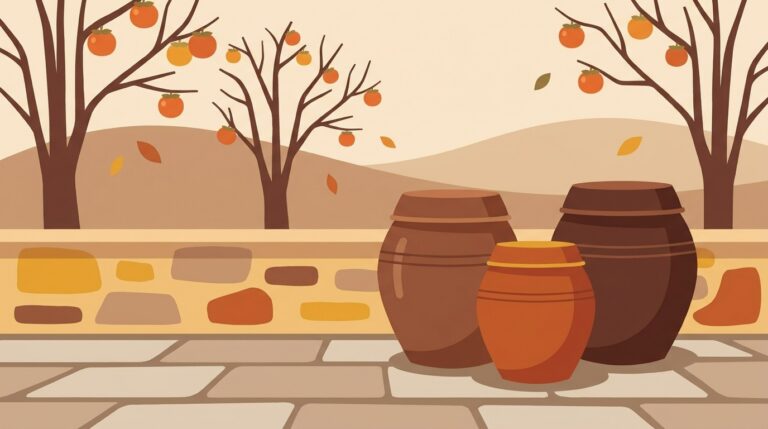
Imagine walking into a peaceful hanok courtyard in late autumn. Bathed in amber sunlight, an array of deep-brown, rounded earthenware vessels stands gracefully on a raised stone terrace called a jangdokdae (장독대). You peek closer, catching the rich, savory scent of ripening soybean paste (된장, doenjang) and the fizzy, appetizing tang of winter kimchi. Many travelers and intermediate Korean learners wonder: in this age of high-tech appliances and sleek airtight plastic containers, why do Koreans still cherish these heavy, rustic clay pots known as 옹기 (Onggi)?
One of our intermediate learners recently shared a funny yet disastrous story: “I bought homemade kimchi in Seoul and sealed it tightly in an airtight glass mason jar in my Airbnb fridge. Two days later—BOOM! The pressure built up and fermented juice exploded everywhere!” That incident perfectly illustrates the genius of Onggi. Unlike modern airtight containers, Onggi is affectionately called “breathing pottery” (숨 쉬는 도자기). It features millions of microscopic pores that allow fresh air to circulate while keeping rainwater and contaminants out, creating the perfect oxygen-rich sanctuary for beneficial lactic acid bacteria to thrive.
Mastering how Koreans speak about Onggi and fermentation will immediately elevate your Korean from textbook-stiff to culturally profound (CEFR B2). Today’s guide is crafted directly from our cultural immersion workshops and consultations with master brewers in Korea. Let’s unlock the living language behind Korea’s fermentation science!
Phase 2: 3 Key Expressions Deep-Dive
1. 숨을 쉬다 (Sumeul swida)
- Pronunciation: [Su-meul swi-da] (Soo-meul shwee-dah, like saying “sweet” without the ‘t’)
- Meaning: Literal: To breathe / Real Nuance: To be porous, dynamically aerated, and alive with airflow.
- K-Culture Moment: In food documentaries and historical dramas like Jewel in the Palace (대장금), the head court lady touches a clay jar and reminds her pupils: “옹기는 살아 숨을 쉽니다” (The earthenware vessel is alive and breathes).
- Editor’s Insight: Koreans rarely say an earthenware pot has “permeability” (통기성). Instead, giving life to clay with the verb “숨을 쉬다” reflects the worldview that fermentation is an active partnership between nature, the pot, and the maker.
- Situation Spectrum: Casual: ✅ | Semi-formal: ✅ | Formal: ✅
- 🤔 Think About It: Does your native language personify cooking tools as “breathing” or “living,” or do you rely on scientific terms?
2. 제맛이 나다 (Jemas-i nada)
- Pronunciation: [Je-ma-si na-da] (Je-mah-shi nah-dah)
- Meaning: Literal: “Its own taste emerges” / Real Nuance: To reach peak, authentic flavor through patient ripening.
- K-Culture Moment: In the healing movie Little Forest, Kim Tae-ri scoops a spoonful of winter stew and smiles softly: “옹기에서 숙성돼야 제맛이 나요” (It only brings out its true, authentic flavor when aged in an Onggi jar).
- Editor’s Insight: “제맛” refers to the inherent, unadulterated essence of an ingredient. It suggests that good flavor cannot be rushed or faked with artificial additives; it must be patiently coaxed out over time.
- Situation Spectrum: Casual: ✅ | Semi-formal: ✅ | Formal: ✅
- 🤔 Think About It: English speaks of food being “ripe” or “well-aged,” but Korean frames it as the food achieving its “true self.” What does that say about the virtue of patience?
3. 익어가다 (Ikeogada)
- Pronunciation: [I-geo-ga-da] (Ee-gaw-gah-dah)
- Meaning: Literal: To cook or ripen progressively / Real Nuance: To mature gracefully into deeper flavor and character.
- K-Culture Moment: Beyond cuisine, this phrase is immortalized in popular ballad lyrics: “우리는 늙어가는 것이 아니라 조금씩 익어가는 겁니다” (We are not simply growing old; we are ripening gracefully little by little).
- Editor’s Insight: Unlike simply rotting (상하다) or getting old (늙다), “익어가다” frames aging as a beneficial, enriching journey. In Korean culinary talk, well-ripened kimchi is always described with “익다”.
- Situation Spectrum: Casual: ✅ | Semi-formal: ✅ | Formal: ✅
- 🤔 Think About It: How does changing your vocabulary from “getting old” to “ripening” alter how you view time and wisdom?
Phase 3: Textbook Korean vs. Real Korean
Situation 1: Explaining how Onggi circulates air
📖 교과서 한국어: “옹기에는 미세한 구멍이 있어서 통기성이 우수합니다.” (Onggi has microscopic holes, so its ventilation is superior.)🗣️ 진짜 한국어: “옹기가 숨을 쉬니까 발효가 훨씬 깊고 시원하게 돼요.” (Because the Onggi breathes, the fermentation turns out much deeper and crisper.)💡 왜 다를까?: Native speakers rarely use technical jargon like “통기성” (permeability) when praising food. Instead, they evoke vivid sensations using “숨을 쉬다” (to breathe) paired with taste descriptors like “깊다” (deep) and “시원하다” (refreshingly crisp).
Situation 2: Praising well-fermented artisanal Kimchi or sauce
📖 교과서 한국어: “김치가 적절하게 발효되어 맛이 아주 좋습니다.” (The kimchi is moderately fermented and tastes very good.)🗣️ 진짜 한국어: “와, 김치가 제대로 익어서 톡 쏘는 맛이 완전 예술이에요!” (Wow, the kimchi has ripened properly—that effervescent tang is pure art!)💡 왜 다를까?: When evaluating fermented dishes, natural Korean speakers emphasize the sensory sensation of naturally produced sparkling carbonic acid (“톡 쏘는 맛”) and colloquially exalt perfection with “예술이다” (it’s a work of art).
Phase 4: K-Culture Deep Dive & Non-Verbal Manners
4-1. Nunchi (눈치) & Jangdokdae Manners
When visiting a traditional Korean temple, an artisanal brewery (양조장), or a rural hanok, you will likely encounter a jangdokdae (the stone terrace where earthenware pots reside). Here are essential cultural etiquette rules:
* Never touch jar lids barehanded without an invitation: Traditional Onggi naturally absorbs oils, sweat, and salts from human skin. Artisans consider the jar an active ecosystem housing generational yeast and microbial cultures.
* Mind your posture: When standing near a master’s Onggi platform, keep your hands respectfully gathered in front of your stomach in the gongsu (공수) position. If invited to peek inside, grasp the lid with two hands, tucking your fingers inward to avoid touching the inner rim.
4-2. Cultural Code: The Philosophy of Living Harmony
In Korean heritage, Onggi represents Sangsaeng (상생)—mutual symbiosis with the natural environment. While Western canning and modern packaging prioritize hermetic sealing and sterilization to freeze time, Korean fermentation embraces time. The natural ash glaze (jaetmul, 잿물) applied to Onggi leaves microscopic air passages that allow the sauce or liquor to experience seasonal temperature shifts without rotting. It is living gastronomy designed to collaborate with nature rather than isolate from it.
Phase 5: Real Roleplay Scenario
Setting: You are touring an artisanal traditional makgeolli and soy sauce brewery in Andong with Master Brewer Park (박 명인).
- Turn 1 (Master Park): 어서 와요! 여기가 우리 양조장의 심장인 장독대예요. (Eoseo wayo! Yeogiga uri yangjojang-ui simjang-in jangdokdaeyo. – Welcome! This jangdokdae is the very heart of our brewery.)
🎭 인자하게 웃으며 햇볕이 내리쬐는 장독대를 가리킨다. - Turn 2 (Learner): 우와, 항아리들이 반짝반짝하네요! 플라스틱 통 대신 왜 옹기만 고집하세요? (Uwa, hang-ariduri banjjak-banjjakhaneyo! Peullaseutik tong daesin wae onggiman gojiphaseyo? – Wow, the jars are gleaming! Why do you insist on Onggi instead of plastic containers?)
🎭 감탄하며 가지런히 놓인 옹기들을 둘러본다. - Turn 3 (Master Park): 옹기는 ‘숨 쉬는 그릇’이거든. 눈에 안 보이는 미세한 숨구멍이 살아 있어요. (Onggineun ‘sum swineun geureut’igeodeun. Nune an boineun misehan sumgumeongi sara isseoyo. – Onggi is a ‘breathing vessel.’ It has microscopic breathing pores that are alive.)
🎭 옹기 표면을 조심스럽게 어루만지며 설명한다. - Turn 4 (Learner): 숨구멍이요? 그러면 비가 오면 빗물이 스며들지 않나요? (Sumgumeong-iyo? Geureomyeon biga omyeon binmuri seomyeodeulji annayo? – Breathing pores? Then when it rains, doesn’t rainwater seep in?)
🎭 호기심 어린 눈빛으로 옹기 뚜껑 쪽을 살핀다. - Turn 5 (Master Park): 허허, 그게 바로 우리 조상들의 지혜지! 공기는 드나들지만 물방울은 절대 못 들어와요. (Heoheo, geuge baro uri josangdeurui jihyeji! Gonggineun deunadeuljiman mulbang-ureun jeoldae mot deureowayo. – Haha, that is the very wisdom of our ancestors! Air can pass through, but water droplets never enter.)
🎭 껄껄 웃으며 옹기의 흙 배합 원리를 손짓으로 보여준다. - Turn 6 (Learner): 공기는 통하고 물은 막는다니, 유산균에게 최고의 집이네요! (Gonggineun tonghago mureun mangneundani, yusangyun-ege choego-ui jib-ineyo! – Passing air while blocking water… that is the ultimate home for lactic acid bacteria!)
🎭 깊이 감탄하며 고개를 끄덕인다. - Turn 7 (Master Park): 바로 맞혔어요! 덕분에 술과 장이 잡내 없이 깊고 그윽하게 익어가지요. (Baro machyeosseoyo! Deokbune sulgwa jang-i jamnae eopsi gipgo geueukhage ikeogajiyo. – Spot on! Thanks to that, our brew and pastes ripen deeply and mellowly without off-flavors.)
🎭 흡족한 표정으로 엄지손가락을 세워 보인다. - Turn 8 (Learner): 자연과 도자기의 합작품이네요. 오늘 전통주의 깊은 맛이 정말 기대돼요! (Jayeongwa dojagi-ui hapjakpum-ineyo. Oneul jeontongju-ui gipeun masi jeongmal gidaedwaeyo! – It’s a collaboration between nature and pottery. I’m really looking forward to tasting this deep artisanal brew today!)
🎭 두 손을 모으고 기대감에 찬 미소를 짓는다.
🔀 Interactive Decision Point
Master Park gently unfastens the cloth tied around a massive, 15-year-old soy sauce jar and pauses. What do you do?
* Option A: “우와, 대박! 제가 뚜껑 얼른 열어봐도 될까요?” (Wow, awesome! Can I quickly open the lid myself?)
* Feedback [Risk]: Too hasty! Touching a master’s ancestral jar without direct invitation risks contaminating centuries-old strains and disregards apprentice etiquette.
* Option B: “명인님, 뚜껑을 여실 때 옆에서 살짝 향을 맡아봐도 괜찮을까요?” (Master, when you open the lid, would it be alright if I gently smell the aroma beside you?)
* Feedback [Best]: Exemplary nunchi! It demonstrates profound respect for craftsmanship while showing polite curiosity.
* Option C: “전통 장은 냄새가 너무 셀 것 같은데 그냥 닫아두셔도 돼요.” (Traditional fermented paste might smell too strong, so you don’t have to open it.)
* Feedback [Bad]: Refusing an artisan’s rare hospitality by presuming their prized brew smells unpleasant is a major social misstep.
Phase 6: 10-Second Emotion Shadowing Drill
- Sentence 1:
[😲 Wonder & Awe]옹기는 / 눈에 안 보이는 미세한 숨구멍으로 / 숨을 쉬어요. (Onggineun / nune an boineun misehan sumgumeong-euro / sumeul swieoyo. – Onggi / breathes through microscopic pores / invisible to the naked eye.) - Sentence 2:
[😌 Confident & Calm]비는 막아주고 / 공기는 통하니까 / 유산균이 제일 맛있게 익어가죠. (Bineun mag-ajugo / gonggineun tonghanikka / yusangyuni jeil mas-itge ikeogajyo. – It blocks rain / while letting air pass through, / allowing lactic acid bacteria to ripen at their best.) - Sentence 3:
[😋 Relishing & Expressive]제대로 된 옹기에서 발효돼야 / 감칠맛과 톡 쏘는 탄산감이 / 예술이 돼요! (Jedaero doen onggieseo balhyodwaeya / gamchilmatgwa tok ssoneun tansangami / yesuri dwaeyo! – Only when fermented in a genuine Onggi / do the savory umami and sparkling fizz / turn into pure art!)
Phase 7: K-Culture Mini Dictionary
- 장독대 (Jangdokdae): An elevated outdoor stone terrace in traditional Korean houses designed for sunlight, breeze, and jar storage.
- 숨구멍 (Sumgumeong): Breathing pore. Scientifically used for micropores in clay, and colloquially used to describe a vital “breathing space” or emotional relief in a stressful schedule.
- 감칠맛 (Gamchilmat): Rich, savory umami flavor generated naturally as proteins break down into amino acids during extended fermentation.
- 발효 (Balhyo): Fermentation. Contrasted sharply with bupae (부패, rotting/decay); it signifies intentional, life-giving microbial transformation.
Phase 8: Traveler Survival Kit
Survival Expressions TOP 3
- “이거 옹기에서 직접 숙성하신 건가요?” (Igeo onggieseo jikjeop sukseonghasin geon-gayo? – Did you age this directly in an Onggi jar?)
- Pro Tip: Use this at artisanal makgeolli taverns (jujeom) or heritage restaurants to signal you appreciate traditional craft.
- “인공 감미료 없는 전통주 추천해 주세요.” (Ingong gammiryo eomneun jeontongju chucheonhae juseyo. – Please recommend an artisanal liquor without artificial sweeteners like aspartame.)
- “항아리 뚜껑은 손대면 안 되죠?” (Hang-ari ttukkeong-eun sondaemyeon an doejo? – I shouldn’t touch the jar lids, right?)
- Pro Tip: Asking this proactively before leaning over a jar shows top-tier cultural sensitivity.
Editor’s Travel Note
Planning to explore Korea’s famous pottery centers like the Oegosan Onggi Village in Ulsan? Make sure to use the Naver Map app navigation guide instead of Google Maps, which often lacks updated rural bus transfer schedules. Remember that small regional workshops require advance reservation for kiln tours, and public transit terminals rarely take foreign cards at physical ticket windows—always carry a backup Korean T-money transportation card.
Phase 9: “Digging Deeper” (생각 질문)
Western gastronomy often pursues absolute preservation—chilling, vacuum sealing, and pasteurizing to freeze a product at a static moment of perfection. In contrast, Korea’s Onggi foodways celebrate dynamic impermanence. An Onggi pot allows nature’s ambient weather, wild yeasts, and changing seasons to actively transform the sauce over decades.
💬 Your Turn: In your home country, do you have traditional foods stored in materials that “breathe” with nature (such as oak wine barrels or terracotta amphorae), or does your culture prioritize airtight modern containers? Share your thoughts in the comments below!
Phase 10: FAQ & Common Mistakes
Q: Can any glazed ceramic pot be used as an Onggi for kimchi?
A: Absolutely not! Modern glossy decorative ceramics use chemical enamels that melt into glass, completely sealing all pores. Genuine Onggi uses a natural ash glaze (jaetmul) made from plant ash and iron-rich red clay slip, leaving the breathing micro-channels open.
Q: Why do traditional Onggi jars develop white residue on the outside?
A: Do not panic—that is not mold! That white powder consists of mineral salts expelled through the microscopic pores as moisture evaporates. In Korea, this is lovingly called “salt bloom” (kkot-sogeum) and proves that the pot is breathing actively.
Q: How do modern Kimchi refrigerators compare to authentic Onggi?
A: Modern Kimchi refrigerators are marvels of food science designed to emulate the stable, low-temperature microclimate of an Onggi jar buried underground during a Korean winter. However, connoisseurs still insist that earthenware aged above ground develops deeper microbial complexity due to continuous aeration.
🚨 Common Mistakes Warning Board
- Mistake 1: Washing an Onggi jar with synthetic dish soap. Earthenware pores absorb chemicals, which seep back into your food later! Correct Action: Clean Onggi using only lukewarm water, coarse sea salt, or diluted baking soda.
- Mistake 2: Saying “김치가 썩었어요” (The kimchi is rotten) when it has simply become sour. Correct Action: Say “김치가 푹 익었어요” (The kimchi is deeply ripened) or “신김치” (sour kimchi).
- Mistake 3: Covering an Onggi pot’s mouth with non-porous plastic wrap before putting the lid on. Correct Action: Use traditional breathable cotton gauze or Korean mulberry paper (hanji) to block insects while preserving airflow.
Phase 11: Action Mission & Participation
- 🥉 Bronze Mission (Solo): Stand in front of your mirror and practice shadow sentence #2 with steady confidence three times: “비는 막아주고 공기는 통하니까 유산균이 제일 맛있게 익어가죠.”
- 🥈 Silver Mission (Social): Next time you eat fermented Korean food, snap a photo and post it on your social channels with the Korean phrase: “옹기에서 제대로 익은 맛!” (True ripened taste from Onggi!).
- 🥇 Gold Mission (Real-life): Visit a traditional Korean eatery or makgeolli bar and ask the proprietor: “이 막걸리는 옹기에서 발효한 건가요?” (Was this makgeolli fermented in an Onggi jar?).
- 🎮 K-Culture Media Mission: Watch an episode of a Korean food series (such as Netflix’s A Nation of Kimchi) and spot at least two different sizes of Onggi jars on a rooftop or terrace!
Phase 12: Interactive Quiz Challenge
1. Situational Judgment: You are touring a traditional sauce brewery and want to complement the artisan on their 5-year-old aged kimchi. Which expression is the most natural for a B2 speaker?
* A) 김치가 적당히 썩어서 참 좋아요.
* B) 옹기에서 제대로 익어서 깊은 맛이 예술이에요!
* C) 통기성이 우수해서 가스 배출이 잘 되었네요.
2. Fill-in-the-blank: Complete the core phrase describing Onggi’s natural ventilation:
* “옹기는 미세한 구멍으로 ____을/를 쉬는 그릇이에요.”
3. True or False: True or False? You should scrub a traditional Onggi vessel with fragrant synthetic dishwashing liquid to keep it sanitized.
👉 Click here to reveal the answers and explanations!
- Answer: B. “옹기에서 제대로 익어서 깊은 맛이 예술이에요!” (It ripened properly in the Onggi, so the deep flavor is pure art!) Option A uses ‘썩다’ (to rot), which is insulting. Option C sounds like an engineering manual rather than a conversational compliment.
- Answer: 숨 (Sum). Full sentence: “옹기는 미세한 구멍으로 숨을 쉬는 그릇이에요.” (Onggi is a vessel that breathes through microscopic pores.)
- Answer: False! Onggi’s porous surface will absorb synthetic dish detergents, contaminating your next batch of food. Use warm water and coarse salt instead.
🎬 Watch Our Daily Videos! (Daily Hangul Official Instagram)
Review the expressions you learned in this article with our fun daily short videos! Check out native pronunciation and real-life nuances in action.
- Instagram @dailyhangul_en







