

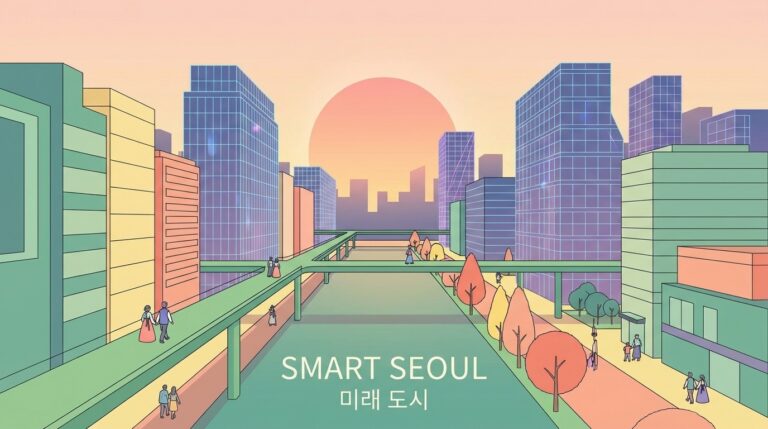
The Soul of Smart Cities: Balancing Digital Twin Algorithms with Human-Scale Warmth
Phase 1: 공감 (Story-Immersive Opening)
안녕하세요! 매일한글 에디터입니다.
Imagine stepping out of an autonomous shuttle into the hyper-futuristic core of Songdo or Pangyo Techno Valley. Drones slice through the smog-free air, sensors regulate the ambient street temperature, and massive digital twin simulations orchestrate traffic flows down to the microsecond. On paper, it is a masterclass in algorithmic urban optimization. Yet, as you walk down an eight-lane boulevard flanked by towering glass monoliths, an uncanny chill settles in: Where are the street vendors roasting walnuts? Where is the lively banter between neighbors at the corner fruit stand? Where is that quintessential Korean saram naemsae (사람 냄새—human warmth)?
Many advanced Korean learners working in architecture, tech policy, and sustainable governance hit an unexpected linguistic wall when discussing these developments. You might know high-register technical terms like dijiteol teuwin (디지털 트윈) or apchuk dosi (압축도시), but when joining a high-level municipal brainstorming session or an urban design forum in Seoul, purely technical jargon sounds sterile. To truly resonate with Korean urban planners, cultural critics, and civil leaders, you need to articulate the delicate tension between high-density technological efficiency and pedestrian-scale vitality (bohaengja-ui nunnopi). This guide is built directly on executive coaching insights and municipal think-tank discussions to help you master C2-level discourse that bridges digital precision with humanistic sensibility.
Phase 2: 핵심 표현 3선 심층 분석 (Core Expressions)
1. 기술의 편리함 이면에 보행자의 눈높이를 놓쳐서는 안 됩니다
- Pronunciation: Gisul-ui pyeon-riham imyeon-e bohaengja-ui nun-nopi-reul nochyeoseoneun an doemnida (Sound analogy: Think of nunnopi as ‘noon-no-pee’, matching the rhythm of an earnest, measured advisory tone).
- Meaning: Literal: “Behind the convenience of technology, we must not miss the pedestrian’s eye level.” / Nuance: “Algorithmic efficiency must never eclipse the lived, sensory scale of everyday walkers.”
- K-Culture Moment: Evocative of a tense policy debate in an urban-planning drama like My Mister or a civil engineering committee in Designated Survivor: 60 Days, where progressive architects push back against profit-driven megaprojects.
- Editor’s Insight: Nunnopi (눈높이) is a deeply resonant Korean concept. While it literally translates to eye-level, culturally it means empathy, cognitive grounding, and meeting ordinary people on their own experiential plane rather than imposing top-down technocratic solutions.
- Situation Spectrum: Casual 🚫 | Semi-formal ⚠️ | Formal ✅
- 🤔 Think About It: In English, urbanism often separates ‘walkability’ as an engineering metric from ‘empathy’ as a psychological one. Why does Korean combine both inside the sensory metaphor of nunnopi?
2. 압축도시의 핵심은 입체적 공간 복합화와 공동체의 온기가 공존하는 데 있습니다
- Pronunciation: Apchukdosi-ui haeksim-eun ipchejeok gonggan bokhaphwa-wa gongdongche-ui ongiga gongjonhaneun de itseumnida (Sound analogy: Glide through ip-che-jeok like an authoritative keynote cadence).
- Meaning: Literal: “The core of a compact city lies in the coexistence of three-dimensional spatial integration and community warmth.” / Nuance: “High-density vertical urbanism only succeeds if structural zoning actively fosters social cohesion.”
- K-Culture Moment: A hallmark statement during Seoul City Hall public hearings when defending historic neighborhood preservation against blanket demolition in areas like Euljiro or Seongsu-dong.
- Editor’s Insight: Notice the deliberate pairing of cold, structural planning terms (ipchejeok gonggan bokhaphwa) with the sensory, tactile word ongi (온기 – subtle, radiant warmth). In advanced Korean rhetoric, balancing rigid Sino-Korean vocabulary with soft, native emotional descriptors creates an irresistible intellectual gravity.
- Situation Spectrum: Casual 🚫 | Semi-formal ⚠️ | Formal ✅
- 🤔 Think About It: Does your home culture measure the success of high-density zoning strictly by commercial output, or does it also value ambient community warmth (ongi)?
3. 디지털 트윈 시뮬레이션이 결코 사람 냄새 나는 정주 여건을 온전히 대체할 순 없죠
- Pronunciation: Dijiteol teuwin simyulleisyeon-i gyeolko saram naemsae naneun jeongju yeogeon-eul onjeonhi daechehal sun eopjyo (Sound analogy: Deliver saram naemsae smoothly, pausing slightly before jeongju yeogeon for rhetorical contrast).
- Meaning: Literal: “Digital twin simulations can by no means completely replace a living environment that smells of humans.” / Nuance: “Data models cannot replicate the organic, messy, vibrant soul of authentic neighborhood life.”
- K-Culture Moment: A seasoned neighborhood community activist or an experienced civil architect speaking candidly on an SBS documentary addressing smart city alienation.
- Editor’s Insight: The phrase saram naemsae (사람 냄새—the smell/essence of human living) is the supreme cultural barometer in modern Korean society. Even the most ambitious hyper-connected multi-billion-dollar development will be branded a clinical failure if public opinion decides it lacks saram naemsae.
- Situation Spectrum: Casual ⚠️ | Semi-formal ✅ | Formal ✅
- 🤔 Think About It: Why does Korean culture elevate olfactory metaphors (saram naemsae) to represent authentic communal connection rather than purely visual or spatial metaphors?
Phase 3: 교과서 한국어 vs 진짜 한국어 (Textbook vs. Real Native Korean)
Situation 1: Critiquing hyper-dense commercial towers without public walkability
- 📖 교과서 한국어 (Textbook Korean): 도시 개발 계획 시 고밀도 개발과 보행자 통행로를 함께 고려해야 합니다. (Dosi gaebal gyehoek si gomildo gaebal-gwa bohaengja tonghaengro-reul hamkke goryeohaeya hamnida. – When planning urban development, high-density development and pedestrian walkways must be considered together.)
- 🗣️ 진짜 한국어 (Real Native Korean): 빽빽하게 건물만 올릴 게 아니라, 주민들이 슬리퍼 끌고 편하게 걸어 다닐 맛 나는 동네를 만들어야죠. (Ppaekppaekhage geonmulman ollil ge anira, jumindeul-i seullipeo kkeulgo pyeonhage georeo danil mat naneun dongnereul mandeureoyajyo. – Rather than just throwing up concrete boxes packed wall-to-wall, we need to create a neighborhood where residents feel the genuine joy of strolling out casually in their house slippers.)
- 💡 왜 다를까? (Why the difference?): The textbook phrase reads like a stale public policy manual. Real industry thought leaders capture the public’s imagination by evoking relatable lifestyle metaphors like seullipeo kkeulgo (슬리퍼 끌고—slipping out effortlessly in flip-flops, an iconic Korean marker of a safe, compact, liveable neighborhood).
Situation 2: Evaluating a showcase smart city district reliant solely on IoT dashboards
- 📖 교과서 한국어 (Textbook Korean): IoT 센서와 빅데이터 기반의 교통 통제 시스템이 우수하게 작동하고 있습니다. (IoT senseo-wa bikdeiteo giban-ui gyotong tongje siseutem-i usuhage jakdonghago itseumnida. – The traffic control system based on IoT sensors and big data is operating excellently.)
- 🗣️ 진짜 한국어 (Real Native Korean): 데이터 대시보드만 번지르르하지, 정작 뙤약볕 피할 그늘막 하나, 어르신들 엉덩이 붙일 벤치 하나 없는 게 현실이에요. (Deiteo daesibodeuman beonjireureuhaji, jeongjak ttoeyakbyeot pihal geuneulmak hana, eoreusindeul eongdeongi buchil benchi hana eomneun ge hyeonsil-ieyo. – The data dashboards look sleek on the surface, but the grim reality is there isn’t a single sunshade canopy to escape the scorching heat, nor a bench where senior citizens can take a breather.)
- 💡 왜 다를까? (Why the difference?): High-level Korean thinkers expose technocratic superficiality (beonjireureuhada) by contrasting abstract metrics with hyper-concrete, everyday human discomforts (eongdeongi buchil benchi).
Phase 4: K-Culture 딥다이브 & 비언어적 매너 (Deep Dive & Non-Verbal Manners)
4-1. 눈치 (Nunchi) & Gestures in Urban Governance and Architectural Review
When presenting critiques or alternative designs during Korean spatial planning symposiums or municipal hearings, delivering blunt contradictions will instantly alienate senior committee chairs. Practice the “3-Second Cushion Technique”:
* The Empathetic Head Tilt: Nod slowly twice while looking at the digital projection model, keeping both palms flat on the table or lightly cupped in front of your chest.
* The Cushion Transition: Open with an appreciative validation of technical ambition (“물론 최첨단 트윈 모델링의 정밀함은 가히 압도적입니다만…” – Of course, the sheer precision of the cutting-edge digital twin modeling is formidable, but…), then gently lower your vocal pitch when steering toward pedestrian scale (“보행자의 체감 안전과 온기 측면에서는…” – from the perspective of pedestrian perceived safety and warmth…).
* Gaze Placement: Never lock unbroken, confrontational eye contact with the lead chair while dismantling technocratic arguments. Shift your gaze smoothly between the architectural schematic and the audience, projecting shared communal guardianship rather than individual intellectual dominance.
4-2. Cultural Code Analysis: The Clash between Songdo’s Grids and Euljiro’s Alleys
Modern Korean cultural discourse is obsessed with the dialectic between hyper-modern master-planned efficiency and raw preservation. In shows like tvN’s Vincenzo, the central battle unfolds around Geumga Plaza—a dilapidated multi-use building that residents fiercely defend against a merciless smart conglomerate (Babel Group). Why does the audience side so passionately with a drafty, aged complex over a billion-dollar smart skyscraper?
Because in Korea, spatial layout is fundamentally emotional. Historical neighborhoods like Euljiro, Ikseon-dong, and Mullae-dong embody golmok-gil (골목길) culture: tangled alleyways where sightlines cross, accidental encounters ignite spontaneous conversations, and shops spill seamlessly onto walkable pavement. When Korean urbanists look at Digital Twin simulations, their greatest anxiety is not system failure; it is the death of jeong (정—unconditional communal bonding) under the clinical rule of algorithmic zoning.
Phase 5: 실전 롤플레이 시나리오 (Advanced Roleplay Scenario)
Setting: The 15th-floor executive conference room of the Seoul Future Urban Architecture Forum overlooking Sejong-daero. Rain is pattering against the panoramic glass.
Characters:
* 박민우 실장 (Director Park Min-woo): Chief Urban Systems Architect at the Seoul Metropolitan Innovation Center. Pragmatic, data-driven, yet open to humanistic critique.
* You (Guest Senior Urban Strategist): Advocating for multi-dimensional compact zoning that prioritizes pedestrian warmth over pure data automation.
박민우: 이번 상암 지구 디지털 트윈 시뮬레이션 결과 보셨습니까? 용적률을 최대치로 끌어올리면서도 AI 신호 최적화로 정체를 18%나 줄였습니다. 입체 복합 개발의 완벽한 롤모델이죠.
(Ibeon Sang-am jigu dijiteol teuwin simyulleisyeon gyeolgwa bosyeotseumnikka? Yongjeongnyul-eul choedaechiro kkeureoollimyeonseodo AI sinho choejeokhwaro jeongchereul sip-pal peosenteuna juryeotseumnida. Ipche bokhap gaebal-ui wanbyeokhan rolmodel-ijyo.)
“Have you reviewed the simulation results for the Sangam district digital twin? By pushing the floor area ratio to its absolute maximum while optimizing traffic signals via AI, we cut congestion by 18%. It is the quintessential role model for multi-dimensional compact development.”
You: 🎭 (자료를 부드럽게 넘기며, 확신에 찬 목소리로 / Gently flipping through the briefing folder with a composed, confident tone)
수치상의 성과는 대단히 인상적입니다, 실장님. 하지만 기술의 효율성 이면에 보행자의 눈높이를 놓쳐서는 안 됩니다.
(Suchisang-ui seonggwaneun daedanhi insangjeok-imnida, siljangnim. Hajiman gisul-ui pyeon-riham imyeon-e bohaengja-ui nun-nopi-reul nochyeoseoneun an doemnida.)
“The numerical benchmarks are undeniably impressive, Director. However, behind the convenience of technology, we must not overlook the pedestrian’s eye-level perspective.”
박민우: 🎭 (눈썹을 살짝 치켜올리며 펜을 내려놓는다 / Raising an eyebrow slightly and setting down his pen)
보행자의 눈높이라… 지상 2층 보행 데크와 지하철 환승 거점을 입체적으로 연결했는데, 이동 동선에 무슨 문제가 있나요?
(Bohaengja-ui nun-nopira… Jisang icheung bohaeng dekeuwa jihacheol hwanseung geojeom-eul ipchejeogeuro yeongyeolhaenneunde, idong dongseon-e museun munjega innayo?)
“The pedestrian’s eye-level… We have three-dimensionally connected the second-story pedestrian deck directly to the subway transit hub. Is there an issue with the transit circulation flow?”
You: 🎭 (창밖의 도심 보행로를 가리키며 덤덤하게 미소 짓는다 / Pointing toward the downtown pedestrian walkway through the window with a calm smile)
동선 자체는 매끄럽습니다. 하지만 압축도시의 핵심은 입체적 공간 복합화와 공동체의 온기가 공존하는 데 있습니다. 지금 안은 통과 동선만 있을 뿐, 사람이 머물며 교류할 틈새 공간이 전무합니다.
(Dongseon jache-neun maekkeureopseumnida. Hajiman apchukdosi-ui haeksim-eun ipchejeok gonggan bokhaphwa-wa gongdongche-ui ongiga gongjonhaneun de itseumnida. Jigeum an-eun tonggwa dongseonman isseul ppun, saram-i meomulmyeo gyoryuhal teumsae gonggan-i jeonmuhamnida.)
“The circulation lines themselves are seamless. However, the core of a compact city lies in the coexistence of multi-dimensional spatial integration and community warmth. The current draft provides only thoroughfares for passage, leaving zero niche spaces where people can linger and converse.”
박민우: 🎭 (턱을 괴고 디지털 패널의 센서 데이터를 응시한다 / Resting his chin on his hand, contemplating the sensor data on his digital tablet)
머무는 공간이라… 결국 휴먼 스케일의 휴게 거점과 커뮤니티 공간을 설계에 더 촘촘히 엮어야 한다는 말씀이군요.
(Meomuneun gonggan-ira… Gyeolguk hyumeon seukeil-ui hyuge geojeom-gwa keomyuniti gonggan-eul seolgye-e deo chomchomhi yeok-eoya handaneun malsseum-igunyo.)
“Spaces to linger… In essence, you are suggesting that human-scale resting hubs and communal nodes must be woven far more intricately into the spatial blueprint.”
You: 🎭 (고개를 끄덕이며 진중하게 악센트를 준다 / Nodding deliberately with an earnest inflection)
그렇습니다. 디지털 트윈 시뮬레이션이 결코 사람 냄새 나는 정주 여건을 온전히 대체할 순 없죠. 골목길의 온기가 없는 첨단 도시는 결국 삭막한 콘크리트 미로로 전락할 위험이 큽니다.
(Geureoseumnida. Dijiteol teuwin simyulleisyeon-i gyeolko saram naemsae naneun jeongju yeogeon-eul onjeonhi daechehal sun eopjyo. Golmok-gil-ui ongiga eomneun cheomdan dosineun gyeolguk sakmak-han konkeuriteu miroro jeollak-hal wiheom-i keumnida.)
“Precisely. Digital twin simulations can never entirely replace a liveable habitat that carries human warmth. A high-tech city devoid of the warmth found in everyday alleyways runs a severe risk of degenerating into a bleak concrete labyrinth.”
박민우: 🎭 (만족스러운 표정으로 회의록에 메모를 적는다 / Jots down a note in the minutes with a satisfied expression)
단순한 센서 기반 인프라를 넘어서서, 주민들이 체감할 수 있는 온기를 복합 공간 계획에 최우선 변수로 반영해 보겠습니다.
(Dansunhan senseo giban impeurareul neomeoseoseo, jumindeul-i chegaml hal su inneun ongireul bokhap gonggan gyehoek-e choe-useon byeonsuro banyeonghae bogesseumnida.)
“Moving beyond simple sensor-based infrastructure, I will ensure that the tangible warmth felt directly by residents is incorporated as a primary variable in our mixed-use spatial master plan.”
You: 🎭 (가볍게 목례하며 화답한다 / Responding with a respectful, subtle nod of the head)
탁월한 결단이십니다. 기술이 보행자를 포용할 때 비로소 시민 모두가 자부심을 느끼는 지속 가능한 도시가 완성될 것입니다.
(Tagwolhan gyeoldan-isipnida. Gisul-i bohaengjareul poyonghal ttae biroso simin moduga jabuchim-eul neukkineun jisok ganeung-han dosiga wanseongdoel geosimnida.)
“An outstanding decision. Only when technology embraces the pedestrian can we finally achieve a sustainable city in which every citizen takes genuine pride.”
🔀 인터랙티브 분기점 (Interactive Decision Point)
Imagine Director Park suddenly counters: “하지만 공공 유휴 부지를 늘리면 민간 사업자의 투자 회수율(ROI)이 떨어져 입체 복합 개발 자체가 좌초될 수 있습니다. (However, if we expand public idle open spaces, the private sector’s ROI drops, potentially scuttling the entire multi-dimensional development.)” How do you respond?
- 선택지 A: 민간 개발사의 이익보다는 공공의 복지와 시민의 보행권이 무조건 우선되어야 합니다. 타협할 수 없습니다. (Mingan gaebalsa-ui i-ikbodaneun gonggong-ui bokji-wa simin-ui bohaeng-gwon-i mujokeon useondoeeoya hamnida. Tahyeophal su eopseumnida.)
- ⚠️ Risk (위험): Morally pure, but fatal in a corporate-public policy setting. It frames the debate as an adversarial zero-sum conflict, alienating pragmatic stakeholders and halting collaboration.
- 선택지 B: 사업성을 무시하자는 것이 아닙니다. 쾌적한 보행 네트워크와 커뮤니티 앵커 시설이 갖춰질 때 유동 인구의 체류 시간이 늘어나 상업 시설의 장기적 자산 가치 또한 동반 상승합니다. (Sa-eopseong-eul musihajaneun geos-i animnida. Kwaejeokhan bohaeng neteuwokeu-wa keomyuniti aengkeo siseol-i gatchwojil ttae yudong ingu-ui che-ryu sigan-i neoreona sang-eop siseol-ui jang-gijeok jasan gachi ttohan dongban sangseunghamnida.)
- 🏆 Best (최고의 선택): Flawless executive rhetoric. It reconciles economic ROI with human-scale urbanism, demonstrating how social warmth directly enhances commercial durability.
- 선택지 C: 그러면 민간 사업자에게 세제 혜택을 대폭 주는 방향으로 법안을 고쳐달라고 시의회에 요청해 보시죠. (Geureomyeon mingan sa-eopja-ege seje hyetaek-eul daepok juneun banghyang-euro beob-an-eul gochyeodallago si-uihoe-e yocheonghae bosijyo.)
- ❌ Bad (나쁜 선택): Passing the buck to an external legislative process exposes a lack of spatial planning solutions and abdicates strategic responsibility.
Phase 6: 10초 감정 섀도잉 드릴 (Emotional Shadowing Drill)
Master the vocal dynamics, micro-pauses (/), and emotional registers of an elite urban planner.
[💡 확신에 차서 단호하게 / With resolute, intellectual conviction]
기술의 편리함 이면에 / 보행자의 눈높이를 / 결코 놓쳐서는 안 됩니다.
(Gisul-ui pyeon-riham imyeon-e / bohaengja-ui nun-nopi-reul / gyeolko nochyeoseoneun an doemnida.)-
[🤝 공감과 온기를 담아 부드럽게 / Infused with warm empathy and quiet persuasion]
압축도시의 핵심은 / 입체적 공간 복합화와 / 공동체의 온기가 / 공존하는 데 있습니다.
(Apchukdosi-ui haeksim-eun / ipchejeok gonggan bokhaphwa-wa / gongdongche-ui ongiga / gongjonhaneun de itseumnida.) -
[🏛️ 중후하고 통찰력 있는 경고 / With gravitas and visionary warning]
디지털 트윈 시뮬레이션이 결코 / 사람 냄새 나는 정주 여건을 / 온전히 대체할 순 없죠.
(Dijiteol teuwin simyulleisyeon-i gyeolko / saram naemsae naneun jeongju yeogeon-eul / onjeonhi daechehal sun eopjyo.)
Phase 7: K-Culture 미니 사전 (Core Lexicon)
-
보행권 (Bohaeng-gwon / Pedestrian Right-of-Way & Spatial Sovereignty)
- Meaning: The legal, civil, and physical right of pedestrians to move safely, comfortably, and unhindered by vehicular dominance.
- Real Usage: Extensively employed in civic town halls and Seoul Metropolitan Government transport policies (보행권 확보—securing pedestrian sovereignty).
- 사람 냄새 (Saram Naemsae / Human Touch, Communal Warmth)
- Meaning: Literally “human smell,” signifying down-to-earth authenticity, warmth, mutual empathy, and community bonding.
- Real Usage: Crucial cultural metric. When modern developments feel antiseptic, Koreans lament: “여기는 다 좋은데 사람 냄새가 안 나요.” (This place has everything, but lacks human soul).
- 입체 복합 개발 (Ipche Bokhap Gaebal / 3D Multi-Dimensional Mixed-Use Zoning)
- Meaning: Urban architecture integrating subterranean rail stations, surface street walkways, podium retail, and vertical skywalks into a single contiguous structure.
- Real Usage: Found in high-level urban regeneration projects like Yeongdong-daero Underground Transit Complex or Yongsan International Business District.
- 정주 여건 (Jeongju Yeogeon / Residential Habitat Quality & Liveability)
- Meaning: The comprehensive environmental, cultural, spatial, and educational conditions enabling long-term dwelling.
- Real Usage: Standard KPI for local real estate valuations and smart city viability assessments (정주 여건 개선—improving settlement conditions).
Phase 8: 여행자를 위한 생존 키트 (Urban Explorer Survival Kit)
Survival Expressions for Architecture Buffs & Urban Voyagers:
- 이 동네는 골목길 정취가 참 잘 보존되어 있네요.
(I dongneneun golmok-gil jeongchwiga cham jal bojon-doeeo inneyo.)
Pro Tip: Use this when walking through Euljiro or Seochon with a Korean friend to praise how the historic alleyway ambiance (jeongchwi) is preserved. -
보행 전용 거리로 지정된 구간이 어디서부터인가요?
(Bohaeng jeon-yong georiro jijeongdoen gugani eodiseobuteo-ingayo?)
Pro Tip: Essential for navigating Seoul’s pedestrianized zones during car-free weekends along Yonsei-ro or Gwanghwamun. -
입체 보행 데크를 통해서 반대편 복합몰로 넘어갈 수 있나요?
(Ipche bohaeng dekeureul tonghaeseo bandaepyeon bokhapmollo neomeogal su innayo?)
Pro Tip: Highly practical for navigating multi-layered mega-complexes like COEX, DDP, or The Hyundai Seoul in Yeouido.
Editor’s Urban Navigation Note:
To witness smart compact urbanism first-hand in Seoul, skip the typical tourist buses. Download the 네이버 지도 앱 (Naver Map App) to track real-time pedestrian step-counts, micro-elevation gradients, and underground pathway routes between high-density transit hubs. Take the subway to Sindang Station (Line 2/6) to observe how historical market alleys seamlessly interface with hyper-compact modern high-rises.
Phase 9: “한 발 더 깊이” (Cultural Philosophical Essay)
Traditional Korean architecture (Hanok) never viewed a building as a sealed box isolating occupants from the outside world. Instead, the central courtyard, or madang (마당), acted as an empty yet infinitely flexible void—a transitional realm connecting private chambers with public streetscapes. When modern Korean urbanists critique digital twin simulations that focus solely on volumetric densities and algorithmic logistics, they are subconsciously invoking this ancestral memory of madang. A city without spontaneous outdoor gathering thresholds is structurally foreign to the Korean soul. True smart city sophistication in Korea will never be defined by the number of sensors mounted on light poles, but by whether digital mastery leaves breathing space for communal resonance.
💬 Your Turn: What is the non-negotiable “anchor of human warmth” in your hometown’s urban design? Is it a historic plaza, a pedestrian promenade, or a corner café culture? Share your architectural reflections below!
Phase 10: FAQ & 오해 방지 (FAQ Schema)
Q: Does the term “사람 냄새” sound rude or unhygienic when translated as “human smell”?
A: Not at all! In Korean, saram naemsae (사람 냄새) is a profoundly poetic and complementary compliment. It implies unpretentious authenticity, emotional resonance, and deep neighborly affection. Far from bodily odor, it denotes the intangible aura of genuine human living.
Q: Can I use “눈높이” in formal corporate business meetings, or is it too childish?
A: Nunnopi (눈높이) is widely used in high-level executive boards, presidential speeches, and elite municipal documents. Using phrases like 고객의 눈높이 (customer eye-level/perspective) or 보행자의 눈높이 (pedestrian perspective) signals refined empathetic intelligence.
Q: What is the exact difference between “압축도시” and simple high-density redevelopment?
A: Apchuk dosi (압축도시 – Compact City) refers to an intentional sustainable planning model where residential, commercial, cultural, and transit services are consolidated within walkable transit sheds to curb suburban sprawl. Simple redevelopment (jaegaebal) often focuses merely on replacing old low-rises with taller apartments without holistic urban integration.
🚨 Common Mistakes Warning Board:
- Mistake: Using ‘걸어갈 수 있는 곳’ in a formal urban planning forum.
- Correct Action: Use ‘보행 접근성’ (Pedestrian accessibility) or ‘보행 친화적 환경’ (Pedestrian-friendly environment).
- Mistake: Saying ‘사람들이 친절한 도시’ when praising human-scale urban design.
- Correct Action: Use ‘공동체의 온기가 살아 숨 쉬는 정주 여건’ (A living habitat alive with community warmth).
- Mistake: Referring to a multi-layered building complex simply as ‘큰 빌딩’.
- Correct Action: Employ ‘입체 복합 거점’ (Multi-dimensional mixed-use hub).
Phase 11: 액션 미션 & 참여 유도 (Action Missions)
- 🥉 Bronze Mission (Solo Mastery): Record yourself performing the Phase 6 Shadowing Drill. Pay close attention to the pause before 보행자의 눈높이 and the tonal drop on 온기.
- 🥈 Silver Mission (Social Application): Find a photo of a hyper-modern development in your city or Seoul, post it with a Korean caption using: “기술의 편리함 이면에 보행자의 눈높이를 담아낸 공간” and tag
#DailyHangul #Urbanism. - 🥇 Gold Mission (Real-world Synthesis): The next time you analyze smart cities, write a 3-sentence critique in Korean balancing 디지털 트윈, 압축도시, and 사람 냄새.
🎮 K-Culture Mission: Watch Episode 1 of the K-drama My Mister (나의 아저씨) or Vincenzo (빈센조). Identify how the physical architecture of the old neighborhoods fosters human connection compared to sterile modern office towers.
Phase 12: 인터랙티브 퀴즈 챌린지 (Interactive Quiz)
Test your mastery of C2 urban planning discourse. Click each question to reveal the answers and detailed explanations!
Question 1: Situational Judgment – Which phrasing best convinces an executive urban committee?
Scenario: You want to emphasize that smart traffic light sensors are useless if the physical sidewalks remain too narrow for elderly citizens.
- (A) AI 신호등도 좋지만, 어르신들이 걷기 힘들면 다 소용없는 짓입니다.
- (B) 첨단 센서의 기술적 효율성 못지않게, 교통 약자의 보행권과 휴먼 스케일의 이동 여건을 입체적으로 보장해야 합니다.
- (C) 센서 설치 예산을 삭감해서 인도 폭을 넓히는 데 전부 투입해야 마땅합니다.
Answer: (B)
Explanation: Option (A) is too crude and informal (소용없는 짓), while (C) is overly confrontational and inflexible. Option (B) demonstrates C2 executive poise by honoring the technology (첨단 센서의 기술적 효율성) while expanding the scope to pedestrian rights for vulnerable populations (교통 약자의 보행권).
Question 2: Fill in the Blank – Complete the advanced rhetoric
디지털 트윈을 통한 고밀도 개발이 성공하려면, 입체 복합화 과정에서 주민들의 ( )을/를 최우선으로 고려하여 삭막함을 덜어내야 한다.
- (A) 눈높이와 온기
- (B) 단순 통행량
- (C) 토지 매매 차익
Answer: (A)
Explanation: To counterbalance high-density sterility (sakmakham), urban design must prioritize the human-scale viewpoint and social warmth (nunnopi-wa ongi).
Question 3: True / False Cultural Understanding
Statement: In contemporary Korean spatial policy, the concept of “사람 냄새” is dismissed as obsolete emotionalism and systematically excluded from public urban renewal master plans.
- (A) True
- (B) False
Answer: (B) False
Explanation: Modern Seoul urban regeneration charters (도시재생) explicitly enshrine saram naemsae and historical narrative preservation as strategic pillars to combat urban atomization and hyper-commercial alienation.
🎬 Watch Our Daily Videos! (Daily Hangul Official Instagram)
Review the expressions you learned in this article with our fun daily short videos! Check out native pronunciation and real-life nuances in action.
- Instagram @dailyhangul_en







