

Mastering Korean Business Meetings: Analyzing Customer Churn and Retention
Phase 1: Empathy (Story-Driven Opening)
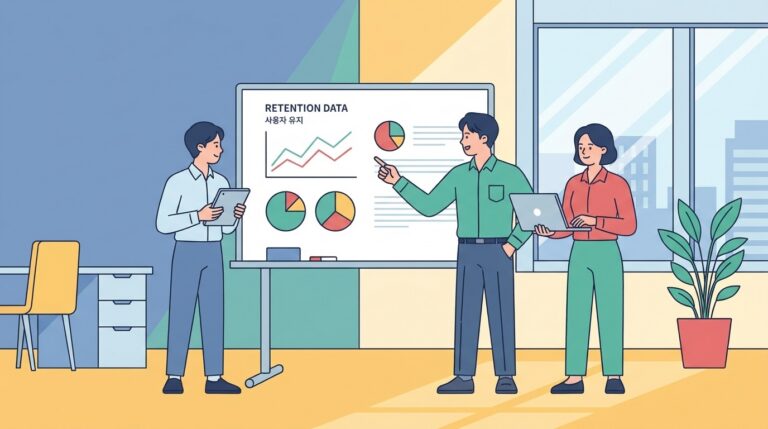
안녕하세요! 매일한글 (Daily Hangul) Editor here! Picture this: You are sitting in a sleek glass conference room in Pangyo—Korea’s buzzing Silicon Valley. Your monitor displays a split reality: a soaring upward curve of new user registrations over the past three months, right next to a stomach-dropping plunge in 30-day user retention. The air feels heavy. Your team leader sighs, taps a stylus against the tablet screen, and says, “자, 긴급 회의 시작하죠 (Now, let’s start the emergency meeting).”
If you have ever felt your stomach drop during a high-stakes Korean business meeting, you are definitely not alone! Navigating corporate Korean is notoriously tricky because it is not just about translating “churn rate” or “cohort analysis” into Korean; it is about knowing how to address sudden performance crises without pointing fingers, using the exact polished vocabulary that commands immediate professional respect. Many of our intermediate learners tell us, “I can chat about my weekend over beer, but the moment a KPI drops, I freeze!” Today’s guide is built from real corporate case studies and feedback from non-native professionals working in Seoul tech startups. By the end of this masterclass, you will speak with the poise, analytical sharpness, and collaborative empathy of a seasoned Korean product strategist.
Phase 2: Core 3 Expressions Deep Dive
1. 잔존율이 눈에 띄게 떨어지고 있어요 (Janjonyuri nune ttwige tteoreojigo isseoyo)
- Pronunciation: [Jan-jon-yul-i nu-ne ttwi-ge tteo-reo-ji-go i-sseo-yo] (Think: “Jan” like January, “jon” like zone, and “nu-ne ttwi-ge” like sounds caught between ‘noo-neh’ and ‘twee-geh’)
- Meaning: Literal: “The retention rate is visibly falling.” / Nuance: “Our retention numbers are suffering a steep, undeniable drop that demands immediate attention.”
- K-Culture Moment: In the K-Drama Start-Up (스타트업), when the characters at Sandbox realize their app downloads do not match active recurring users, this exact phrase fills the brainstorming room with urgency.
- Editor’s Insight: “눈에 띄게” (nune ttwige) literally means “jumping into one’s eye.” Using this before a negative metric highlights the urgency of the trend without sounding overly alarmist or blaming a specific team member.
- Situation Spectrum: Casual 🚫 | Semi-formal ⚠️ | Formal ✅
- 🤔 Think About It: Why does Korean business speech favor visual metaphors like “jumping into the eye” rather than cold statistical statements like “dropped by 14%” in opening statements?
2. 이탈 원인을 다각도로 분석해 봐야 합니다 (Ital wonineul dagakdoro bunseokhae bwaya hamnida)
- Pronunciation: [I-tal wo-nin-eul da-gak-do-ro bun-seok-hae bwa-ya ham-ni-da] (Think: “Ee-tahl wun-in-ul dah-gahk-doh-roh boon-suk-heh bwah-yah hahm-nee-dah”)
- Meaning: Literal: “We must analyze the departure causes from multiple angles.” / Nuance: “We should not jump to hasty conclusions; let’s conduct a holistic root-cause churn analysis.”
- K-Culture Moment: Frequently heard in business thrillers like Agency (대행사) when an account director pulls together cross-functional teams to diagnose sudden customer flight.
- Editor’s Insight: “다각도로” (dagakdoro) combines da (many) and gakdo (angles). In Korean corporate hierarchy, using this phrase signals mature leadership because it encourages marketing, UI/UX, and development teams to share perspectives collaboratively.
- Situation Spectrum: Casual 🚫 | Semi-formal ⚠️ | Formal ✅
- 🤔 Think About It: In Western meetings, people often zero in on “who owns the problem.” Why does Korean corporate phrasing prioritize examining “all angles” together as a collective effort?
3. 초기 이탈을 방어할 묘책이 필요해요 (Chogi itareul bangeohal myochaegi piryohaeyo)
- Pronunciation: [Cho-gi i-tal-eul bang-eo-hal myo-chaeg-i pi-ryo-hae-yo] (Think: “Cho-gee ee-tahl-ul bahng-uh-hahl myoh-check-ee pee-ryoh-heh-yoh”)
- Meaning: Literal: “We need an ingenious scheme to defend against early departure.” / Nuance: “We urgently need a breakthrough, clever tactic to plug the leaks in our onboarding phase.”
- K-Culture Moment: Used when startup leads pitch creative turnaround ideas after an intense sprint review, reminiscent of scenes in Search: WWW (검색어를 입력하세요 WWW).
- Editor’s Insight: “묘책” (myochaek) carries the nuance of a clever, unconventional solution rather than just standard operating procedure (“대책”). Pair it with “방어하다” (to defend/shield) to show you view user churn as an active threat to company survival.
- Situation Spectrum: Casual ⚠️ | Semi-formal ✅ | Formal ✅
- 🤔 Think About It: How does framing retention as “defense” (방어) change the team’s psychological urgency compared to calling it “maintenance” (유지)?
Phase 3: Textbook Korean vs Real Korean
Situation 1: Reporting the metric drop during a slide presentation
- 📖 교과서 한국어 (Textbook Korean): 잔존율 수치가 이전보다 감소했습니다. (Janjonyul suchiga ijeonboda gamsohaesseumnida. / The retention rate numeric value has decreased compared to before.)
- 🗣️ 진짜 한국어 (Real Korean): 1개월 차 리텐션이 완전히 꺾였어요. (Ilgaewol cha ritensyeoni wanjeonhi kkeokkyeosseoyo. / Our month-one retention has completely snapped downward.)
- 💡 왜 다를까?: While textbook Korean relies on Sino-Korean nominal verbs like “감소했습니다,” modern Korean tech professionals blend global industry terminology (“리텐션”) with expressive native verbs like “꺾이다” (to bend or snap sharply) to convey dramatic momentum on a line chart.
Situation 2: Emphasizing the need to fix retention before acquiring new users
- 📖 교과서 한국어 (Textbook Korean): 신규 고객보다 기존 고객 유지가 중요합니다. (Singyu gogaekboda gijon gogaek yujiga jung-yohamnida. / Retaining existing customers is more important than new customers.)
- 🗣️ 진짜 한국어 (Real Korean): 밑 빠진 독에 물 붓기라, 빠져나가는 구멍부터 틀어막아야 해요. (Mit ppajin doge mul butgira, ppajyeonaganeun gumeongbuteo teureomagaya haeyo. / It’s like pouring water into a cracked jar; we have to plug the leak first.)
- 💡 왜 다를까?: Korean executives love evocative proverbs like “밑 빠진 독에 물 붓기” (pouring water into a bottomless jar) to express burnt marketing budgets. Using this metaphor proves you understand true business ROI and local rhetorical culture.
Phase 4: K-Culture Deep Dive & Non-Verbal Manners
4-1. 눈치 (Nunchi) & Meeting Etiquette in High-Pressure Crises
When breaking bad metrics to team leaders or stakeholders:
1. The Posture of Shared Accountability: Never slouch or lean aggressively forward when delivering poor churn stats. Keep both hands visible resting gently on your laptop keyboard or binder. Pointing with an index finger at a negative chart on the slide screen can be interpreted as accusatory; instead, gesture toward the screen with an open palm facing upward.
2. The Softening Buffer: When proposing that the drop is due to poor onboarding or product flaws, always cushion your statement with “~인 것으로 파악됩니다” (It appears to be identified as…) or “조심스럽지만 ~로 보입니다” (Cautiously speaking, it seems like…). This preserves organizational harmony while delivering sharp analysis.
4-2. Culture Code: The Pangyo Post-Mortem Spirit
In modern Korean tech hubs like Pangyo Techno Valley and Teheran-ro in Gangnam, failure analysis meetings are no longer traditional hierarchical reprimand sessions. Startups have embraced a hybrid corporate culture influenced by Silicon Valley agility and traditional Korean jeong (collective bonding). Even in an emergency meeting (긴급 회의), the ultimate conclusion must reinforce unity: “우리가 함께 해결책을 찾아봅시다” (Let’s find the solution together). The goal is rapid, data-informed triage without isolating individual contributors.
Phase 5: Real-Life Roleplay Scenario
Setting: Conference Room B at ‘NextWave Labs’, an ed-tech mobile startup based in Gangnam. An emergency meeting is underway.
Characters:
* 팀장 민우 (Team Leader Min-woo): Sharp, metric-focused, but values practical solutions over blame.
* 나 / 지우 (You / Ji-woo): Growth Marketer & Data Analyst presenting the retention report.
— Dialogue —
1. 팀장 민우: [심각한 표정으로 차트를 응시하며] 지우 님, 3개월간 유입은 사상 최대인데 4주 차 리텐션 수치가 왜 이렇죠? (Ji-woo nim, 3gaewolgan yuibeun sasang choedaeinde saju cha ritensyeon suchiga wae ireotjyo? / Ji-woo, our acquisition over the last three months hit an all-time high, but why do week-four retention figures look like this?)
2. 나 (Ji-woo): [태블릿을 두 손으로 짚고 차분하게 슬라이드를 넘기며] 네, 팀장님. 보시다시피 신규 가입 후 1개월 차 잔존율이 눈에 띄게 떨어지고 있습니다. (Ne, timjangnim. Bosidasipi singyu gaip hu ilgaewol cha janjonyuri nune ttwige tteoreojigo itseumnida. / Yes, Team Leader. As you can see, our month-one retention rate is noticeably dropping after initial sign-up.)
3. 팀장 민우: [안경을 만지작거리며 한숨을 쉰다] 마케팅비는 두 배로 태웠는데, 밑 빠진 독이었군요. 원인이 뭡니까? (Maketingbineun du baero taewonneunde, mit ppajin dogieotgunyo. Wonini mwomnikka? / We burned twice the marketing budget, but it was just pouring water into a bottomless jar. What is the cause?)
4. 나 (Ji-woo): [데이터 히트맵을 화면에 띄우며] 이탈 원인을 다각도로 분석해 봤는데요, 프로모션 유입 고객의 첫 주 기능 이탈률이 65%에 달합니다. (Ital wonineul dagakdoro bunseokhae bwanneundeyo, peuromosyeon yuip gogaegui cheot ju gineung itallyuri yuksibo-peosenteue dalhamnida. / We analyzed the churn causes from multiple angles; the first-week feature drop-off rate for promotion-acquired users reaches 65%.)
5. 팀장 민우: [턱을 괴며 메모를 적는다] 온보딩 과정에서 우리 서비스의 진짜 가치를 못 느끼고 나간다는 거네요. (Onboding gwajeong-eseo uri seobiseuui jinjja gachireul mot neukkigo nagandaneun geoneyo. / That means they are leaving during onboarding without experiencing our service’s real value.)
6. 나 (Ji-woo): [고개를 끄덕이며 단호한 눈빛으로] 맞습니다. 그래서 신규 유입보다 초기 이탈을 방어할 묘책이 먼저 필요합니다. (Masseumnida. Geuraeseo singyu yuipboda chogi itareul bangeohal myochaegi meonjeo piryohamnida. / Exactly. That is why rather than acquiring more users, an ingenious plan to defend against early churn is our first priority.)
7. 팀장 민우: [살짝 미소를 띠며 호기심 어린 목소리로] 좋습니다. 지우 님이 준비한 구체적인 리텐션 방어 전략은 뭡니까? (Jotesseumnida. Ji-woo nimi junbihan guchejeogin ritensyeon bangeo jeonryageun mwomnikka? / Good. What specific retention defense strategy did you prepare, Ji-woo?)
8. 나 (Ji-woo): [다음 슬라이드를 자신감 있게 가리키며] 온보딩 첫 주 미션 리워드와 푸시 알림 타이밍을 전면 개편하는 안을 가져왔습니다. (Onboding cheot ju misyeon riwodeuwa pusi allim taiming-eul jeonmyeon gaepyeonhaneun aneul gajyeowasseumnida. / I brought a proposal to completely overhaul our first-week onboarding mission rewards and push notification timing.)
🔀 Interactive Decision Point
How would you respond to Min-woo if he questions your push notification overhaul? Choose your next response:
- Choice A: “팀장님이 지난달에 지시하신 푸시 문구가 너무 식상해서 고객들이 다 앱을 삭제했어요.” (Timjangnimi jinandare jisihasin pusi mungguga neomu siksanghaeseo gogaekdeuri da aebeul sakjehaesseoyo.)
- Choice B: “A/B 테스트 데이터를 바탕으로 오픈율이 가장 높았던 온보딩 시점을 타겟팅하여 리텐션을 단계별로 회복시키겠습니다.” (A/B teseuteu deiteoreul batangeuro opeunyuri gajang nop-atdeon onboding sijeomeul taget-tinghayeo ritensyeoneul dangyebyeollo hoeboksikigesseumnida.)
- Choice C: “솔직히 마케팅 타겟이 완전히 잘못 설정되어서 개발팀이 아무리 고쳐도 가입자 유지는 어렵습니다.” (Soljiki maketing tagesi wanjeonhi jalmot seoljeongdoeeoseo gaebaltimi amuri gochyeodo gaipja yujineun eoryeopseumnida.)
— Choice Feedback —
* Choice A (Bad ❌): Accuses the team leader directly in a public meeting. Destroys rapport and violates hierarchical tact.
* Choice B (Best ✅): Professional, grounded in empirical data (A/B test), shows proactive problem-solving and structured methodology.
* Choice C (Risk ⚠️): Passes the blame onto the marketing department, sparking inter-departmental conflict during a critical crisis.
Phase 6: 10-Second Emotion Shadowing Drill
Master the exact cadence and emotion of a strategic Korean professional. Practice pausing at each slash (/):
[😰 심각하고 차분하게 / Serious and composed]
신규 가입자는 늘었지만, / 1개월 차 잔존율이 / 눈에 띄게 떨어지고 있습니다.
(Singyu gaipjaneun neureotjiman, / ilgaewol cha janjonyuri / nune ttwige tteoreojigo itseumnida.)-
[🧐 날카롭게 분석하며 / Sharp and analytical]
단순한 이탈이 아니라, / 온보딩 구간의 허들을 / 다각도로 분석해 봐야 합니다.
(Dansunhan itali anira, / onboding guganui heodeureul / dagakdoro bunseokhae bwaya hamnida.) -
[💡 희망차고 단호하게 / Inspiring and decisive]
지금은 유입보다 / 빠져나가는 유저를 지킬 / 확실한 묘책을 실행할 때입니다!
(Jigeumeun yuipboda / ppajyeonaganeun yujeoreul jikil / hwaksilhan myochaegeul silhaenghal ttae-imnida!)
Phase 7: K-Culture Mini Dictionary
- 이탈률 (Itallyul): Churn Rate / Bounce Rate. Essential KPI term used in both digital marketing and product analytics across all Seoul corporate boardrooms.
- 잔존율 / 리텐션 (Janjonyul / Ritensyeon): Retention Rate. While “잔존율” is the standard term on formal documentation, tech and startup workspaces frequently borrow “리텐션”.
- 록인 효과 (Roking Hyogwa): Lock-in Effect. The business strategy of making switching costs high or rewards compelling so that users remain locked into your platform.
- 골든타임 (Goldeuntaim): The Golden Window. Borrowed from medical terminology, Korean tech teams use this constantly to describe the critical initial period (e.g., first 3 days after sign-up) to activate a user before they churn permanently.
Phase 8: Professional’s Survival Kit
Top 3 Meeting Survival Phrases
- 자료 화면 띄우겠습니다. (Jaryo hwamyeon ttiu-gesseumnida.)
Meaning: “I will bring up the presentation slide on screen now.”
Pro Tip: Say this right before screen-sharing in Zoom or switching the projector HDMI to establish immediate command of the room. - 이 부분은 논의가 좀 더 필요해 보입니다. (I bubuneun nonuiga jom deo piryohae boimnida.)
Meaning: “It appears this point requires a bit more discussion.”
Pro Tip: A polite, high-level way to de-escalate an argument or table an unresolved topic for the next sync. - 오늘 안으로 정리해서 공유드리겠습니다. (Oneul aneuro jeongnihaeseo gong-yudeurigesseumnida.)
Meaning: “I will summarize and share this with you before the end of the day.”
Pro Tip: The golden wrap-up line for assigning yourself action items without making empty promises.
Editor’s Business Productivity Note
When collaborating with Korean teams, seamless integration matters. Make sure you explore 원티드 스페이스 협업 도구 둘러보기 to see how modern Korean teams handle corporate attendance and workflow management, and familiarize yourself with 노션 한국어 템플릿 가이드 확인하기 to master how Korean PMs structure their sprint documents and KPI post-mortems.
Phase 9: “한 발 더 깊이” (One Step Deeper: Thinking Question)
In Korean corporate psychology, a drop in metrics is rarely treated as an individual person’s single failure; it is considered a vulnerability in the collective defense of the organization. Notice how Korean speakers naturally say “우리 서비스” (our service) and “우리 팀의 과제” (our team’s task) instead of “내 프로젝트” (my project). When crisis strikes, shifting focus from “Who caused this?” to “How do we shield our perimeter together?” is the hallmark of true cultural competence in Korea.
💬 Your Turn: How does your home culture navigate discussing declining metrics during executive meetings? Do you focus immediately on personal accountability, or do you lean into systemic, collaborative problem-solving? Share your thoughts below!
Phase 10: FAQ & Common Mistakes
Q: Can I just use English terms like “Churn” and “Cohort” during a Korean meeting?
A: Yes! In IT, gaming, and digital marketing, terms like “코호트 분석” (cohort analysis), “이탈 (churn)”, and “리텐션 (retention)” are standard jargon. However, always conjugate your verbs and frame your sentences in polite Korean honorifics (해요체/하십시오체) to maintain corporate decorum.
Q: What is the polite way to disagree with a senior manager’s churn hypothesis?
A: Use the “Yes, and…” technique framed in Korean humility: “팀장님 말씀도 맞지만, 데이터 추이를 조금 더 살펴보면 다른 측면도 있는 것 같습니다” (You make a great point, Team Leader, but looking a bit closer at the data trends, it seems there may be another aspect as well).
Q: Is “밑 빠진 독에 물 붓기” acceptable in a formal presentation?
A: It is acceptable and very persuasive if delivered with a confident, analytical tone by a project manager summarizing ROI inefficiency. However, avoid using it to describe someone else’s specific pet project directly, as that can sound insulting.
🚨 Common Mistakes Alert
- Mistake: Saying “손님이 도망갔어요” (Customers ran away).
Correction: Always use “고객 이탈이 발생했습니다” (Customer churn occurred). “도망가다” is too colloquial and comical for a business presentation. - Mistake: Using informal casual talk (반말) when asking a colleague for data during a presentation: “데이터 줘” (Give me data).
Correction: Even with peers, keep business polish in front of leadership: “관련 데이터를 공유해 주실 수 있을까요?” (Could you share the relevant data?). - Mistake: Translating “Let’s fire that agency” directly as “그 대행사를 해고합시다”.
Correction: Use corporate phrasing: “해당 대행사와의 계약 조율이나 대행사 교체를 검토해야 합니다” (We should review contract terms or consider replacing the agency).
Phase 11: Action Mission & Engagement
- 🥉 Bronze Level (Solo Practice): Record yourself saying Expression 1 (“잔존율이 눈에 띄게 떨어지고 있어요”) 3 times using the emotion shadowing guide in Phase 6.
- 🥈 Silver Level (Community Share): Write a 2-sentence comment below proposing a retention idea for a music streaming service using the word “묘책” (myochaek) and “방어하다” (bangeohada)!
- 🥇 Gold Level (Real-World Application): In your next Korean workplace sync or study session, introduce your chart by stating “자료 화면 띄우겠습니다” and explain one metric change using “다각도로 분석해 봤습니다”!
🎮 K-Culture Mission: Watch an episode of a modern office drama like Misaeng (미생) or Agency (대행사). Identify at least two scenes where someone uses the metaphor of an “angle” (각도) or “defense” (방어) during a project pitch!
Phase 12: Interactive Quiz Challenge
Test your mastery of Korean retention meeting strategies! Try to answer before checking the explanations below.
- Situational Judgment: You noticed that users churn within 3 days after download. What is the most professional way to announce this in an executive sync?
- (A) 3일 만에 고객들이 도망치고 있으니 큰일 났습니다.
- (B) 신규 가입 후 3일 차 골든타임 구간의 이탈률을 집중적으로 방어해야 합니다.
- (C) 마케팅팀이 엉터리 유저만 데려와서 3일 만에 다 나갔어요.
- Fill in the Blank: “밑 빠진 독에 물 붓기라, 신규 유입보다 빠져나가는 ______부터 틀어막아야 해요.”
- (A) 구멍 (B) 수도꼭지 (C) 문
- True or False Cultural Check: In Korean startups, it is polite to point directly with your index finger at the coworker responsible for poor retention stats so leadership knows who will fix it.
- True / False?
👉 Click to reveal answers & explanations!
- Answer: (B)
- Explanation: (B) uses professional corporate terminology (“골든타임”, “이탈률”, “집중적으로 방어”) while maintaining collaborative professionalism. (A) is overly dramatic and colloquial, while (C) aggressively shifts blame to colleagues.
- Answer: (A) 구멍 (Hole)
- Explanation: The famous Korean proverb references plugging the hole in a bottomless or cracked clay jar (“밑 빠진 독에 물 붓기”).
- Answer: False
- Explanation: Pointing fingers at coworkers breaks teamwork and violates non-verbal meeting etiquette. Always address issues as systemic problems and present slides using an open palm.
- Explanation: Pointing fingers at coworkers breaks teamwork and violates non-verbal meeting etiquette. Always address issues as systemic problems and present slides using an open palm.
🎬 Watch Our Daily Videos! (Daily Hangul Official Instagram)
Review the expressions you learned in this article with our fun daily short videos! Check out native pronunciation and real-life nuances in action.
- Instagram @dailyhangul_en







