

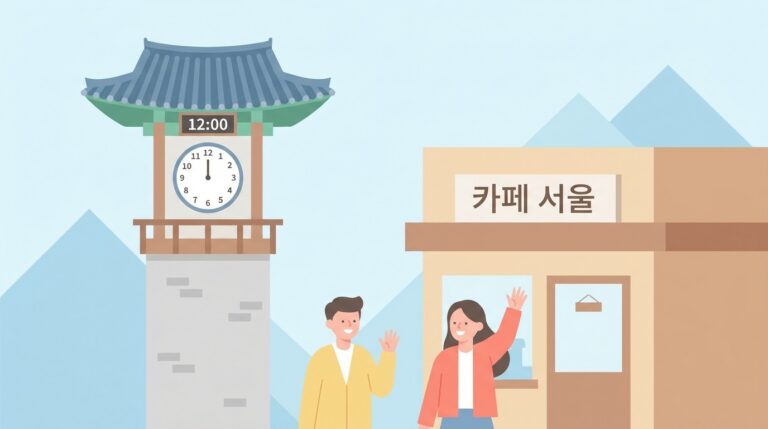
Master Noon in Seoul: How to Say ‘It is 12:00 Noon’ Like a Local
Phase 1: Empathy (Story Opening)
안녕하세요! 매일한글 에디터입니다.
Imagine this: You are standing in the bustling heart of Gangnam at 11:58 AM. Around you, office workers pour out of glass towers like clockwork, heading straight toward the aroma of bubbling kimchi jjigae and crispy tonkatsu. Your Korean friend turns to you with a hungry smile and asks, “지금 몇 시예요? (Jigeum myeot si-ye-yo? / What time is it now?)” You glance down at your phone: 12:00.
Suddenly, your mind freezes. Is twelve ship-i (십이)? Or is it yeol-du (열두)? Do you say am or pm? As seconds tick away, your friend giggles and says, “정오 열두 시예요! (Jeong-o yeol-du si-ye-yo!)” Telling time in Korean is one of the very first hurdles beginner learners trip over because Korean uses two different number systems simultaneously. But once you master saying 12:00 noon, you hold the golden key to lunch dates, concert tickets, and midday appointments across Korea. Based on real feedback from hundreds of our beginner students, this guide breaks down the midday clock into painless, bite-sized steps.
Phase 2: Core Expressions (Top 3 Breakdown)
1. 정오 열두 시예요 (Jeong-o yeol-du si-ye-yo)
- Pronunciation: [Jeong-o yeol-du si-ye-yo] (Sounds like: “Chung-oh yuhl-doo she-yeh-yo”)
- Meaning: Literal: “It is midday twelve o’clock.” | Real Nuance: “It is exactly 12:00 noon.”
- K-Culture Moment: You will hear radio hosts on KBS Cool FM chime this sentence right as their midday music show begins.
- Editor’s Insight: Korean hours always use Native Korean numbers (열두 = 12), never Sino-Korean numbers. 정오 (Jeong-o) specifically means noon, preventing any confusion with midnight.
- Situation Spectrum: Casual: ✅ | Semi-formal: ✅ | Formal: ✅
- 🤔 Think About It: Why does Korean retain two separate number systems for counting hours (Native) versus minutes (Sino-Korean)? Does your mother tongue change counting systems depending on the object?
2. 점심 먹을 시간이에요 (Jeomsim meog-eul sigan-i-e-yo)
- Pronunciation: [Jeom-sim meo-geul si-ga-ni-e-yo] (Sounds like: “Jum-sheem mug-eul she-gahn-ee-eh-yo”)
- Meaning: Literal: “It is time to eat lunch.” | Real Nuance: “Lunchtime is finally here!”
- K-Culture Moment: In K-dramas like Business Proposal, office teams declare this phrase simultaneously before dashing to reserve seats at popular restaurants.
- Editor’s Insight: 점심 (Jeomsim) means lunch, and 시간 (Sigan) means time. Beginners love this phrase because it connects time directly with Korea’s favorite topic: food!
- Situation Spectrum: Casual: ✅ | Semi-formal: ✅ | Formal: ⚠️ (Use -sigan-imnida in strict corporate settings)
- 🤔 Think About It: In Korea, asking “Have you eaten?” is a common greeting. How does tying midday to mealtime showcase Korean hospitality?
3. 열두 시에 만나요 (Yeol-du si-e man-na-yo)
- Pronunciation: [Yeol-du si-e man-na-yo] (Sounds like: “Yuhl-doo she-eh mahn-nah-yo”)
- Meaning: Literal: “Meet at twelve o’clock.” | Real Nuance: “Let’s meet at 12:00.”
- K-Culture Moment: A classic KakaoTalk text sent when confirming a weekend lunch appointment in Hongdae or Seongsu.
- Editor’s Insight: The tiny particle 에 (-e) works just like English “at” in time expressions. Attach it directly to the hour (열두 시에).
- Situation Spectrum: Casual: ✅ | Semi-formal: ✅ | Formal: ⚠️
- 🤔 Think About It: How does setting an appointment at “sharp noon” reflect modern urban life compared to flexible traditional time concepts?
Phase 3: Textbook Korean vs. Real Korean
Situation 1: Telling someone the time right on the dot
- 📖 교과서 한국어 (Textbook Korean): 지금 정확히 정오 열두 시입니다. (Jigeum jeonghwakhi jeong-o yeol-du si-imnida. / It is precisely 12:00 noon right now.)
- 🗣️ 진짜 한국어 (Real Korean): 딱 열두 시예요! (Ttak yeol-du si-ye-yo! / It’s 12 on the dot!)
- 💡 왜 다를까? (Why is it different?): Native speakers rarely say “정확히 (precisely)” in casual chats. Instead, they use the energetic sound word 딱 (ttak), which sounds like snapping fingers to convey exactness.
Situation 2: Inviting someone to grab lunch at noon
- 📖 교과서 한국어 (Textbook Korean): 열두 시에 점심 식사를 하시겠습니까? (Yeol-du si-e jeomsim siksa-reul hasigesseumnikka? / Would you like to have midday meal at twelve o’clock?)
- 🗣️ 진짜 한국어 (Real Korean): 열두 시에 밥 먹으러 가요! (Yeol-du si-e bap meog-eureo gayo! / Let’s go grab food at 12!)
- 💡 왜 다를까? (Why is it different?): Textbook phrases sound like an official banquet invitation. Real Koreans use 밥 (bap) to mean any meal, creating instant warmth and friendliness.
Phase 4: K-Culture Deep Dive & Non-Verbal Manners
4-1. 눈치 (Nunchi) & Body Language at 12:00
In Korea, 12:00 PM is sacred. If you are meeting someone or wrapping up a morning meeting, check your phone at 11:55 AM. When the clock strikes twelve, make soft eye contact and give a slight nod. Don’t stare at your watch repeatedly; instead, show subtle anticipation by putting away your pens or opening your messaging app. This shows quick 눈치 (nunchi)—sensing the group’s collective hunger without making an awkward fuss.
4-2. The “Lunch Rush Sprint” (점심시간 문화)
Between 11:55 AM and 12:05 PM, Korea experiences the daily phenomenon known as the lunch sprint. Popular soup eateries and BBQ spots near subway stations fill up in seconds. If someone sets an appointment for 열두 시 (yeol-du si), being even five minutes late might mean waiting in a 30-minute queue outside in the freezing winter or humid summer!
Phase 5: Real-World Roleplay Scenario
- Setting: Outside Exit 3 of Gangnam Station. Workers are flooding the sidewalks.
- Characters:
- 민지 (Minji): Your energetic Korean coworker who knows all the best lunch spots.
- 나 (You): An eager beginner learning the ropes of midday life in Seoul.
- 민지: 혹시 지금 몇 시예요? (Hoksi jigeum myeot si-ye-yo?)
🎭 Tapping her wristwatch with an eager look.
“Excuse me, what time is it now?” - 나: 잠시만요… 정오 열두 시예요! (Jamsimanyo… Jeong-o yeol-du si-ye-yo!)
🎭 Checking your phone screen and smiling confidently.
“Just a moment… It is 12:00 noon!” - 민지: 와, 벌써 열두 시예요? 배고파요! (Wa, beolsseol yeol-du si-ye-yo? Baegopayo!)
🎭 Placing a hand over her stomach dramatically.
“Wow, it’s 12 already? I’m starving!” - 나: 저도 배고파요. 점심 먹을 시간이에요! (Jeodo baegopayo. Jeomsim meog-eul sigan-i-e-yo!)
🎭 Nodding enthusiastically.
“Me too. It’s time for lunch!” - 민지: 좋아요! 우리 뭐 먹을까요? 김치찌개 어때요? (Joayo! Uri mwo meog-eulkkayo? Gimchijjigae eottaeyo?)
🎭 Pointing toward a bustling restaurant alley.
“Great! What should we eat? How about Kimchi stew?” - 나: 좋아요. 열두 시 반까지 먹을 수 있어요? (Joayo. Yeol-du si ban-kkaji meog-eul su isseoyo?)
🎭 Curiously checking the lunch duration.
“Sounds good. Can we finish eating by 12:30?” - 민지: 그럼요! 바로 저기예요. 빨리 가요! (Geureomyo! Baro jeogi-ye-yo. Ppalli gayo!)
🎭 Walking briskly toward the entrance.
“Of course! It’s right over there. Let’s hurry!” - 나: 네, 지금 바로 가요! (Ne, jigeum baro gayo!)
🎭 Following her stride into the restaurant.
“Yes, let’s go right now!”
🔀 Interactive Decision Fork
Minji asks you what time you should meet tomorrow for coffee.
* Choice A: “내일 십이 시에 만나요! (Naeil sip-i si-e man-na-yo!)”
Feedback (Bad): While Minji understands, using Sino-Korean 십이 (12) for hours sounds unnatural and clunky to native ears.
* Choice B: “내일 열두 시에 만나요! (Naeil yeol-du si-e man-na-yo!)”
Feedback (Best!): Flawless! Native Korean numbers combined with -e man-na-yo is natural, polite, and spot-on.
* Choice C: “내일 정오에 가요! (Naeil jeong-o-e gayo!)”
Feedback (Risk): Grammatically acceptable, but saying just 정오에 (at noon) in casual conversations sounds a bit literary or overly formal.
Phase 6: 10-Second Emotion Shadowing Drill
Read these aloud while mimicking the emotional tone marks and following the / pause breaks!
[😊 Relieved and cheerful]
지금 / 딱 열두 시예요!
(Jigeum / ttak yeol-du si-ye-yo!)
“It’s right now / exactly twelve o’clock!”-
[😋 Excited and hungry]
드디어 / 점심 먹을 시간이에요!
(Deudio / jeomsim meog-eul sigan-i-e-yo!)
“Finally / it’s time for lunch!” -
[🤝 Friendly and confident]
우리 / 정오 열두 시에 만나요!
(Uri / jeong-o yeol-du si-e man-na-yo!)
“Let’s / meet at 12:00 noon!”
Phase 7: K-Culture Mini Dictionary
- 점심시간 (Jeomsim-sigan) | Lunch break
The sacred 12:00 PM to 1:00 PM hour in offices and schools where work stops completely. - 정각 (Jeong-gak) | Sharp / On the hour
Used when confirming precise timing (e.g., “열두 시 정각에 봐요” = “See you at 12:00 sharp”). - 칼퇴 (Kaltwae) | Leaving work right on the dot
Derived from “칼 (knife)” + “퇴근 (leaving work)”; cutting off work with razor precision when time comes. - 약속 (Yaksok) | Appointment / Plans
Refers to any social engagement with friends, colleagues, or dates.
Phase 8: Survival Kit for Travelers
Top 3 Midday Survival Phrases
- 몇 시에 문 열어요? (Myeot si-e mun yeoreoyo?)
Pronunciation: [Myeot si-e mun yeo-reo-yo?]
Pro Tip: Use this at restaurant doors when you arrive early before noon. - 열두 시 예약했어요. (Yeol-du si yeyak-haesseoyo.)
Pronunciation: [Yeol-du si ye-yak-haes-seo-yo.]
Pro Tip: Hand this sentence to the host at popular Gangnam or Hongdae eateries. - 열두 시까지 갈게요. (Yeol-du si-kkaji gal-ge-yo.)
Pronunciation: [Yeol-du si-kka-ji gal-ge-yo.]
Pro Tip: Perfect KakaoTalk reply when you are running slightly behind schedule.
Editor’s Travel Note
Always search for lunch destinations using the Naver Map App Download rather than Google Maps, which frequently lacks real-time lunch break hours in South Korea. If you plan to eat at famous K-food spots between 12:00 and 1:00 PM, arrive either at 11:45 AM or after 1:15 PM to avoid long queues.
Phase 9: One Step Deeper (Thinking Prompt)
In Korean culture, sharing a meal at noon is far more than physical nourishment; it is an act of building 정 (Jeong)—communal bonding. Eating alone was historically unusual in Korea, which is why midday lunch breaks remain an intensely social daily ritual. When you say “열두 시예요 (It is 12 o’clock),” you are not merely reading digits on a screen; you are signaling a shared moment of pause and camaraderie.
💬 Your Turn: What time is the universal lunch break in your home country? Does your culture prefer eating quickly with colleagues or enjoying a quiet break alone? Share your thoughts below!
Phase 10: FAQ & Common Mistakes
Q: Can I say “십이 시 (Sip-i si)” instead of “열두 시 (Yeol-du si)”?
A: No! In Korean, the hour is always counted using Native Korean numbers (하나, 둘, 셋… 열둘). Saying 십이 시 (Sip-i si) sounds like saying “It is twelveth hour” in English.
Q: How do I tell the difference between 12:00 noon and 12:00 midnight?
A: Use 정오 (Jeong-o) for 12:00 noon and 자정 (Jajeong) for 12:00 midnight. Alternatively, add 낮 (Nat – daytime) or 밤 (Bam – nighttime): 낮 열두 시 (12 PM) vs 밤 열두 시 (12 AM).
Q: What is the word for minutes when the time is 12:15?
A: For minutes, switch to Sino-Korean numbers! Twelve is 열두 (Native), and fifteen minutes is 십오 분 (Sino-Korean): “열두 시 십오 분 (Yeol-du si sip-o bun).”
🚨 Common Mistakes Alert Board
- ❌ Mistake 1: Saying “십이 시예요 (Sip-i si-ye-yo)” for 12 o’clock.
👉 Correct Action: Always say 열두 시예요 (Yeol-du si-ye-yo). - ❌ Mistake 2: Forgetting the time particle “에 (-e)” when arranging a meeting time.
👉 Correct Action: Attach it directly: 열두 시에 (at 12:00). - ❌ Mistake 3: Confusing 정오 (Noon) with 자정 (Midnight).
👉 Correct Action: Remember 오 (午) relates to afternoon (오후), so 정오 is daytime noon!
Phase 11: Action Missions
- 🥉 Bronze Mission (Solo Practice): Set an alarm on your phone for 12:00 PM today. When it rings, look at the screen and shout: “정오 열두 시예요!”
- 🥈 Silver Mission (Social Connection): Record a 5-second voice note saying “열두 시에 만나요! (Let’s meet at 12:00)” and send it to your study buddy or language exchange partner.
- 🥇 Gold Mission (Real Life Execution): Next time you order lunch or make plans, check the time in Korean before looking at the English translation!
- 🎮 K-Culture Mission: Watch any office K-drama (like Misaeng or King the Land). Pause when employees look at the clock for lunch and listen for the number 열두 (yeol-du)!
Phase 12: Interactive Quiz Challenge
1. Situation Judgment: You want to text your friend to meet at 12:00 noon sharp. Which message is the most natural?
(A) 내일 십이 시에 봐요
(B) 내일 열두 시에 만나요
(C) 내일 자정에 만나요
2. Fill in the Blank:
지금 딱 ________ 열두 시예요! (It is exactly 12:00 noon right now!)
3. True or False:
In Korean, both the hour and the minute are counted using Sino-Korean numbers (일, 이, 삼, 사…).
👉 Click to reveal answers & explanations!
- Answer: (B)
Explanation: Hours require Native Korean numbers (열두). (A) incorrectly uses Sino-Korean (십이), and (C) means midnight (자정)! -
Answer: 정오 (Jeong-o)
Explanation: 정오 means noon/midday. Full sentence: 지금 딱 정오 열두 시예요! -
Answer: False
Explanation: Hours use Native Korean numbers (한 시, 두 시… 열두 시), while minutes use Sino-Korean numbers (일 분, 이 분…).
🎬 Watch Our Daily Videos! (Daily Hangul Official Instagram)
Review the expressions you learned in this article with our fun daily short videos! Check out native pronunciation and real-life nuances in action.
- Instagram @dailyhangul_en







