

Phase 1: Empathy (Welcome to the Real Korean Life!)
안녕하세요! (Annyeonghaseyo!) Editor from Daily Hangul here, your trusted Korean cultural navigator for over a decade.
Picture this: You just moved into your cozy new one-room (원룸 – studio apartment) in Seoul. You’ve set up your desk, your fairy lights, and your mini-fridge. Craving fresh vitamins after days of instant ramyun, you excitedly walk into the neighborhood mart (마트). But then… panic sets in. The watermelons are the size of boulder rocks, apples come in 5-kilogram bulk sacks, and bananas are sold in massive bunches of twelve!
If you buy that giant melon, you’ll literally have to sleep next to it because it won’t fit into your mini-fridge. And eating the same fruit for two straight weeks? Total recipe for food waste. Many of our international students and expats tell us: “I just wanted one peach or a small bowl of watermelon, but I didn’t know how to ask if they sold smaller portions, so I walked out with empty hands!”
Don’t worry! In today’s Korea, where solo living (자취 – Jachwi) is the mainstream lifestyle, markets are packed with smart solutions—if you know what to look for and what to say. Today, you’ll master how to ask for single-serving items, spot sweet evening discounts, and shop like a savvy Seoulite!
Phase 2: Core 3 Expressions Breakdown
Here are the top 3 lifesaver expressions you need when navigating the fresh food aisles:
1. 소포장된 과일 있어요? (Sopojangdoen gwail isseoyo?)
- Pronunciation: [Sopojangdoen gwail isseoyo?] (Think: “So-po-jang-den gwa-eel ee-ssuh-yo?”)
- Meaning: “Do you have small-packaged fruit?” (소 = small, 포장 = packaging, 과일 = fruit)
- K-Culture Moment: You’ll hear this often in lifestyle K-Dramas like Let’s Eat (식샤를 합시다) or variety show I Live Alone (나 혼자 산다), where busy singles hunt for grab-and-go produce.
- Editor’s Insight: 소포장 (Sopojang) is the golden keyword for singles. Rather than asking for “one apple” (which might sound awkward if it’s pre-bagged), asking for 소포장 politely prompts the clerk to point you toward the single-serving section.
- Situation Spectrum: Casual ⚠️ | Semi-formal ✅ | Formal ✅
- 🤔 Think About It: In many Western supermarkets, you can freely pick just one loose apple from a giant bin. In Korea, why are many fruits pre-packaged in sets or plastic containers?
2. 혼자 먹기에 딱 좋아요. (Honja meokgie ttak joayo.)
- Pronunciation: [Honja meokgie ttak joayo.] (Think: “Hon-ja muk-gee-eh ttak jo-ah-yo.”)
- Meaning: “It’s just right for eating alone.”
- K-Culture Moment: When a mart clerk recommends a mini watermelon (애플수박 – Apple Watermelon) and says it’s great for one person, you nod and reply with this warm sentence!
- Editor’s Insight: The magic word here is 딱 (ttak)! It’s an adverb that expresses that something fits spot-on, like a key sliding right into a lock. Saying 딱 좋아요 makes you sound remarkably natural and conversational.
- Situation Spectrum: Casual ⚠️ | Semi-formal ✅ | Formal ✅
- 🤔 Think About It: Korean culture values harmonious moderation. What single word in your native language creates that satisfying feeling of “just right”?
3. 이거 오늘까지예요? (Igeo oneulkkajiyeyo?)
- Pronunciation: [Igeo oneulkkajiyeyo?] (Think: “Ee-guh oh-neul-kka-jee-yeh-yo?”)
- Meaning: “Is this (good) until today?” / “Does this expire today?”
- K-Culture Moment: Seen an auntie (이모님 – Imonim) slap a bright yellow 30% discount sticker on a pre-cut fruit container at 8:30 PM? You gently pick it up and confirm the date.
- Editor’s Insight: At level A2, you don’t need complicated phrases like 유통기한이 언제까지입니까?. Simply point to the item and ask 오늘까지예요? (Until today?) or 내일까지예요? (Until tomorrow?). It’s polite, crisp, and direct.
- Situation Spectrum: Casual ⚠️ | Semi-formal ✅ | Formal ✅
- 🤔 Think About It: Korea recently transitioned from “Sell-by date” (유통기한) to “Use-by date” (소비기한) to reduce food waste. How does your home country mark fresh fruit?
Phase 3: Textbook Korean vs. Real Korean
| Situation | 📖 Textbook Korean | 🗣️ Real Korean | 💡 Why It Differs |
|---|---|---|---|
| Looking for small sizes | 이 과일은 1인분 포장입니까? (Is this fruit a 1-portion package?) | 이거 소포장 있어요? (Do you have this in a small pack?) | Real locals don’t say “1-portion fruit package”; they use the handy industry noun 소포장 (small-pack). |
| Asking about discounts | 가격 할인을 언제 합니까? (When do you conduct a price discount?) | 마감 세일 언제부터 해요? (When does the closing sale start?) | Supermarkets have an official nickname for evening markdowns: 마감 세일 (Magam Se-il – Closing Sale). Use the exact term! |
Phase 4: K-Culture Deep Dive & Non-Verbal Manners
4-1. Nunchi (눈치) & Supermarket Gestures
- The Two-Finger Point: When asking about a specific item across the produce display, avoid pointing with an aggressive single index finger. Open your palm slightly or gesture gently with both fingers.
- The Two-Handed Inspect: In Korea, casually squeezing or tapping fresh fruits with one hand can draw sharp glances from mart managers. If you want to check the ripeness of a packaged melon or persimmon, pick up the tray gently with both hands.
- Clearance Sticker Courtesy: When you see a staff member with a barcode sticker gun applying discount stickers around 8:30 PM–9:30 PM, don’t hover aggressively right over their shoulder. Stand a step back, wait with quick Nunchi, and pick up the item once they finish labeling the tray!
4-2. Culture Code: The Rise of Jachwi (자취) & Honjok (혼족)
Traditionally, Korean cuisine was designed around extended families sharing big banquets and full crates of seasonal produce. But today, more than 34% of Korean households are 1인 가구 (single-person households)! This social transformation gave birth to adorable innovations like:
* 애플수박 (Apple Watermelon): A miniature watermelon the size of a grapefruit that you can peel like an apple.
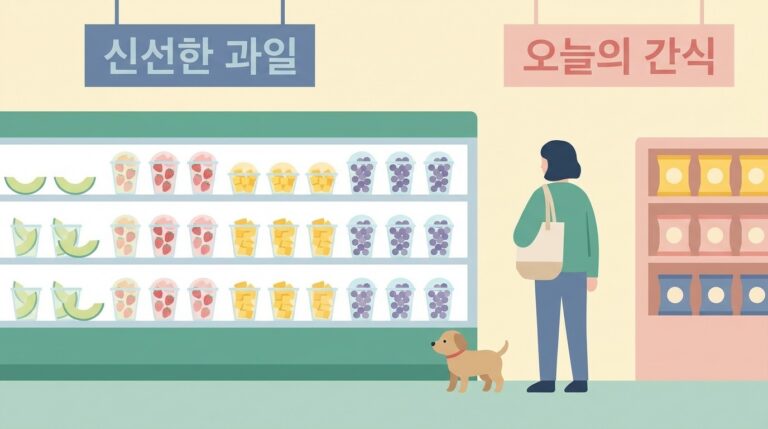
* 컵과일 (Cup Fruit): Bite-sized medleys of muscat grapes, cherry tomatoes, and apples found at convenience stores and corner marts.
Shopping for one is no longer lonely in Korea—it’s trendy, smart, and eco-friendly!
Phase 5: Real-Life Roleplay Scenario
Setting: 8:45 PM at a neighborhood supermarket (럭키마트 – Lucky Mart) near Hongik University. Alex is browsing the fruit section after evening Korean class.
Characters:
* Alex (알렉스): Exchange student living alone in a studio.
* Mart Staff (마트 직원): Friendly neighborhood staff organizing the produce display.
Alex: 저기요, 수박 너무 큰데 작은 건 없나요?
(Jeogiyo, subak neomu keunde jageun geon eomnayo?)
"Excuse me, the watermelons are too big; do you have smaller ones?"
🎭 [Paws slightly at the giant melon, looking overwhelmed]

Staff: 아, 저쪽에 조각 수박 소포장된 거 있어요!
(A, jeojjoge jogak subak sopojangdoen geo isseoyo!)
"Ah, over there we have sliced watermelon in small packages!"
🎭 [Points with an open palm toward the refrigerated display shelf]

Alex: 아! 소포장된 과일이 혼자 자취하면서 먹기에 딱 좋아요.
(A! Sopojangdoen gwail-i honja jachwihamyeonseo meokgie ttak joayo.)
"Ah! Small-packaged fruit is just right for eating while living alone."
🎭 [Beams with relief and picks up a small sealed container]

Staff: 맞아요. 요즘 혼자 사는 분들이 그거 제일 많이 사가요.
(Majayo. Yojeum honja saneun bundeuri geugeo jeil mani sagayo.)
"That's right. People living alone buy that the most these days."
🎭 [Nods warmly while holding a yellow discount pricing gun]

Alex: 혹시 이거 오늘까지예요?
(Hoksi igeo oneulkkajiyeyo?)
"By any chance, is this good until today?"
🎭 [Points politely at the date printed on the bottom sticker]

Staff: 네, 그래서 방금 30% 마감 세일 스티커 붙였어요!
(Ne, geuraeseo banggeum samsip-peosenteu magam se-il seutikeo buchyeosseoyo!)
"Yes, so I just attached a 30% closing sale sticker to it!"
🎭 [Smiles proudly at the freshly discounted price]

Alex: 와, 득템했네요! 이거로 계산해 주세요.
(Wa, deuktemhaenneyo! Igeoro gyesanhae juseyo.)
"Wow, what a great find! Please ring this one up for me."
🎭 [Places the container carefully on the checkout counter]

Staff: 네! 봉투 필요하세요?
(Ne! Bongtu piryohaseyo?)
"Sure! Do you need a plastic bag?"
🎭 [Hands paused over the bagging rack ready to scan]
🔀 Interactive Choice Point: How do you respond to “봉투 필요하세요?”
- Option A: “네, 종량제 봉투로 한 장 주세요.” (Yes, please give me one standard prepaid trash bag.)
- 👉 Feedback: [BEST] Perfect Seoul living hack! Standard grocery bags in Korea can be reused as district trash bags (종량제 봉투). You save money and avoid wasting plastic!
- Option B: “아니요, 가방에 넣어 갈게요.” (No, I will put it in my backpack.)
- 👉 Feedback: [GOOD] Very natural and eco-friendly! Saves you 50–100 KRW.
- Option C: “비닐봉투 그냥 공짜로 하나만 줘요.” (Just give me a plastic bag for free.)
- 👉 Feedback: [BAD / SOCIAL RISK] Large marts and convenience stores in Korea are legally forbidden from giving out free single-use shopping bags. Asking for free plastic can make the cashier very uncomfortable!
Phase 6: 10-Second Emotional Shadowing Drill
Practice reading these out loud! Pay attention to the slash pauses / and feel the emotion:
[😊 Bright & Relieved]
소포장된 과일이 / 혼자 자취하면서 / 먹기에 딱 좋아요!
(Sopojangdoen gwail-i / honja jachwihamyeonseo / meokgie ttak joayo!)-
[👀 Curious & Polite]
저기요, / 이거 혹시 / 오늘까지예요?
(Jeogiyo, / igeo hoksi / oneulkkajiyeyo?) -
[🤩 Delighted & Triumphant]
와! / 마감 세일 스티커 / 붙어 있네요!
(Wa! / Magam se-il seutikeo / buteo inneyo!)
Phase 7: K-Culture Mini Dictionary
- 자취 (Jachwi) – Living independently away from family, typically in a studio apartment or officetel. Often associated with cozy freedom and budget grocery adventures.
- 소포장 (Sopojang) – Small-portion or single-serving packaging. A must-know term when you want to avoid oversized produce.
- 마감 세일 (Magam Se-il) – Clearance or evening markdown sale, usually occurring 1–2 hours before a grocery store closes.
- 조각 과일 (Jogak Gwail) – Pre-cut fresh fruit (e.g., sliced melons, pineapple spears) sealed in hygienic plastic cups or trays.
Phase 8: Traveler’s Survival Kit
Top 3 Survival Phrases
- 이거 할인돼요? (Igeo hal-indwaeyo?)
- Meaning: “Is this discounted?”
- Pro Tip: Useful when you see a yellow/red sticker on an item but want to confirm the discount at the register.
- 조각 과일 어디 있어요? (Jogak gwail eodi isseoyo?)
- Meaning: “Where is the pre-cut fruit?”
- Pro Tip: Say this to find instant, peel-free fruit tubs in the chilled produce section.
- 영수증은 버려주세요. (Yeongsujeung-eun beoryeojuseyo.)
- Meaning: “Please discard the receipt.”
- Pro Tip: Keep your pockets tidy! Cashiers always ask if you want your paper slip.
Editor’s Travel Note
- Navigation Tip: In Korea, Google Maps frequently lacks indoor floorplans and neighborhood details. Install the Naver Map Application to search for nearby 동네 마트 (neighborhood marts) or 대형마트 (hypermarkets like E-Mart, Homeplus, Lotte Mart).
- Golden Hour for Bargains: For the freshest 마감 세일 discounts (often 20% to 50% off cut fruits, kimbap, and sushi), visit between 8:30 PM and 9:30 PM!
Phase 9: Step Deeper (Food for Thought)
For generations, Korean culture centered on 정 (Jeong – affectionate communal bonding) and big family gatherings where large sacks of rice and entire boxes of apples were shared among neighbors. But today’s Korea has rapidly embraced the convenience of solo living. Small packaging isn’t seen as lonely; it’s respected as an independent, eco-conscious choice. When grocery stores craft miniature watermelons and pre-cut fruit cups, they are embracing a respectful society that caters to personal freedom and modern lifestyles.
💬 Your Turn: How does grocery shopping for solo living compare in your home country? Do supermarkets cater to single people, or are you forced to buy in bulk? Drop your thoughts in the comments below!
Phase 10: FAQ & Common Mistakes
Q: What is the real difference between 유통기한 and 소비기한?
A: 유통기한 (Sell-by date) is the deadline for stores to display and sell the product to consumers. 소비기한 (Use-by date) is the actual safe consumption window for the buyer when stored properly. Korea officially adopted 소비기한 on packaged goods, so you know exactly how long food remains safe in your fridge!
Q: Can I wash and eat fruit with Korean tap water?
A: Yes! Tap water in Korea is purified and strictly monitored. It is completely safe to rinse fruits, vegetables, and kitchenware under running tap water.
Q: Can I ask for a discount at 24-hour convenience stores (CU, GS25, 7-Eleven)?
A: No. Major convenience stores operate on rigid computerized franchise systems. Unlike local marts that paste manual 마감 세일 stickers, convenience store clerks cannot alter the price at the counter unless there is an app-based clearance promotion (like “Last Order” or “Green Sale”).
🚨 Common Mistakes Alert (외국인 학습자의 흔한 실수 TOP 3)
- Mistake: Pointing at a packaged tray of 6 peaches and asking “하나만 빼서 살 수 있어요?” (Can you take just one out to sell?).
- Correct Action: If an item is wrapped in sealed film, mart clerks usually cannot break open the packaging. Look for the designated 소포장 or 낱개 판매 (individual item sales) shelf instead.
- Mistake: Throwing leftover fruit peelings into the regular trash bag (일반쓰레기).
- Correct Action: In Korea, fruit scraps (banana peels, melon rinds, apple skins) belong to 음식물 쓰레기 (Food Waste)! Make sure to sort them into designated food waste bags.
- Mistake: Tapping watermelons loudly (통통 소리) in crowded mart aisles.
- Correct Action: While Koreans do tap watermelons to check hollow reverberation, doing it excessively or knocking on small pre-cut packages can bruise the fruit. Inspect visual stripes and firmness instead!
Phase 11: Action Missions
- 🥉 Bronze Mission (Solo Vocal Drill): Stand in front of your mirror and say “소포장된 과일이 혼자 자취하면서 먹기에 딱 좋아요!” 3 times smoothly in under 10 seconds.
- 🥈 Silver Mission (Social Media Snap): Next time you grab a cup of pre-cut fruit or a mini fruit snack, post an Instagram story with the caption: “혼자 먹기에 딱 좋아요! 🍎 #자취생 #DailyHangul”.
- 🥇 Gold Mission (Real-Life Mart Run): Head to a nearby Korean market or Asian supermarket after 8:00 PM. Find a product with a discount sticker and complete your purchase using the sentence: “이거 오늘까지예요?”
🎮 K-Culture Mission: Watch an episode of MBC’s variety show I Live Alone (나 혼자 산다). Look out for the cast members opening their mini-fridges and spot how many small-packaged foods (소포장 식품) you can identify!
Phase 12: Interactive Quiz Challenge
1. Situational Choice
You are living alone in Sinchon and want to buy fresh strawberries, but you only see a giant 1kg family box. What is the most natural A2 Korean phrase to ask the clerk?
* A) 이거 공짜로 조금만 주세요.
* B) 소포장된 딸기 있어요?
* C) 왜 이렇게 많이 팔아요?
2. Fill-in-the-Blank
Fill in the missing magic adverb that means “perfectly / spot-on”:
* “이 사과 크기가 혼자 먹기에 ( ______ ) 좋아요!”
(This apple size is just right for eating alone!)
3. True or False (Culture Check)
True or False: In Korean supermarkets, if you shop around 8:30 PM–9:00 PM, you can often find pre-cut fruit trays labeled with 마감 세일 stickers at a cheaper price.
* (True / False)
👉 Click here to reveal answers & explanations!
- Answer: B (소포장된 딸기 있어요?)
- Explanation: Asking 소포장된 [과일] 있어요? is the polite and standard way to check if single-serving packs are available. (A means “Give me a little for free”, which is rude; C means “Why do you sell so much?”, which is confrontational!)
- Answer: 딱 (ttak)
- Explanation: 딱 좋아요 is the idiomatic native phrase for “just right / spot-on”.
- Answer: True
- Explanation: Supermarkets markdown perishable fresh food items in the evening during the famous 마감 세일 (closing clearance) window!
- Explanation: Supermarkets markdown perishable fresh food items in the evening during the famous 마감 세일 (closing clearance) window!
🎬 Watch Our Daily Videos! (Daily Hangul Official Instagram)
Review the expressions you learned in this article with our fun daily short videos! Check out native pronunciation and real-life nuances in action.
- Instagram @dailyhangul_en







