

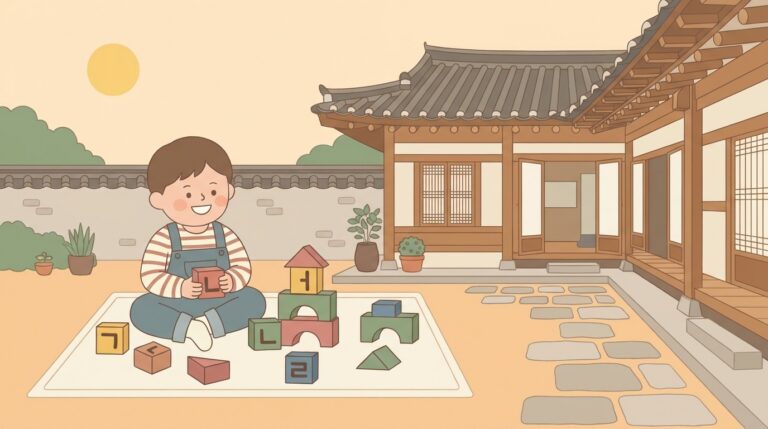
The First Step into Hangul: Unlock Korean with ‘아’ (a) and ‘아이’ (ai)
Phase 1: 공감 (Story-Immersive Opening)
안녕하세요! 매일한글 에디터입니다. (Hello! I am your Daily Hangul editor.)
Picture this: You are curled up on your sofa watching your favorite K-Drama. Suddenly, the lead character stumbles over a curb, drops their iced americano, and gasps a dramatic ‘아! (Ah!)’ followed by an exasperated ‘아이고! (Aigo!)’. A few minutes later, a little niece runs onto the screen, and everyone coos, ‘어머, 아이가 참 예쁘네! (Eomeo, aiga cham yeppeune! / Oh, what a pretty child!)’. You hear these sounds everywhere in K-Dramas, variety shows, and K-Pop lyrics, yet the moment you open a typical language textbook, you are bombarded with rigid phonetics charts that make your head spin.
Many of our beginner students tell us: “Korean writing looks like abstract geometric art! How do I know where to start without feeling overwhelmed?” Here is our secret: you start with the sun. In Korean, the vowel ㅏ (a) is designed after the radiant morning sun rising in the east. It is the clearest, brightest, and most natural open-mouth sound human beings make. When paired with the silent placeholder consonant ㅇ, it becomes 아 (a). Add the simple vertical pillar vowel ㅣ (i), and you instantly unlock the word 아이 (ai)—which means ‘child’.
By the end of this guide, you won’t just memorize shapes; you will feel the cultural heartbeat behind the most fundamental sounds in the Korean language. Let’s make this journey intuitive, fun, and immediately usable!
Phase 2: 핵심 표현 3선 심층 분석 (Top 3 Core Expressions)
1. 아이 (Ai)
- Pronunciation: [a-i] (Sounds just like the English word ‘eye’ or saying ‘ah’ and ‘ee’ smoothly together)
- Meaning: Literally “child” or “kid”; metaphorically symbolizes innocence, purity, and new beginnings.
- K-Culture Moment: Think of South Korea’s iconic solo artist IU (아이유). Her stage name blends 아이 (I) and 유 (You) to mean “You and I become one through music.”
- Editor’s Insight: While textbook definitions list 아이 (ai) as “child,” in everyday spoken Korean, locals often shorten it affectionately to 애 (ae) when speaking informally with close friends. However, 아이 (ai) carries a poetic, warm, and gentle tone.
- Situation Spectrum: Casual ✅ | Semi-formal ✅ | Formal ✅
- 🤔 Think About It: In English, we distinguish sharply between infant, toddler, and child. Korean culture often views childhood as an interconnected state of growing innocence. How does your native language reflect the stages of growing up?
2. 아! (A!)
- Pronunciation: [a] (Like opening your mouth for a doctor: ‘Ah!’)
- Meaning: Literally “Ah!”; expresses sudden realization, understanding, or a gentle lightbulb moment.
- K-Culture Moment: In reality TV shows like Running Man, whenever a member finally solves a puzzle clue, subtitles splash a huge 아~! (A~!) across the screen.
- Editor’s Insight: Pitch matters! A high-pitched, rising 아? (A?) means “Wait, really?”, while a falling, relaxed 아~ (A~) signals “Aha, I totally get it now.”
- Situation Spectrum: Casual ✅ | Semi-formal ✅ | Formal ⚠️ (Best accompanied by polite nodding)
- 🤔 Think About It: A single open vowel can replace an entire sentence of agreement. Why do you think high-context cultures like Korea rely so heavily on tone and breath?
3. 아이고 (Aigo)
- Pronunciation: [a-i-go] (Sounds like ‘Ah-ee-go’; rhythmic and expressive)
- Meaning: “Oh dear!”, “Good grief!”, or “Oh my goodness!”
- K-Culture Moment: Every K-Drama grandmother (할머니 / Halmeoni) sitting down onto the floor, rubbing her knees with a heartfelt “아이고~ 삭신이야! (Aigo~ my aching joints!)”.
- Editor’s Insight: 아이고 (Aigo) is the emotional Swiss Army knife of Korea. You can use it when you are exhausted, when you see an adorable baby, or when someone tells you shocking gossip.
- Situation Spectrum: Casual ✅ | Semi-formal ✅ | Formal 🚫
- 🤔 Think About It: English speakers say “Oh my God!” which invokes a higher power. 아이고 (Aigo) originates from an instinctual release of breath. What emotional sighs exist in your culture?
Phase 3: 교과서 한국어 vs 진짜 한국어 (Textbook vs. Real Korean)
Situation 1: When you finally understand what someone is explaining
- 📖 교과서 한국어: 이해했습니다. (Ihaehaetseumnida. / I have understood.)
- 🗣️ 진짜 한국어: 아, 그래요? (A, geuraeyo? / Ah, really? / Ah, I see!)
- 💡 왜 다를까?: Textbook phrases sound like you are signing a military contract. Real native speakers use soft vocal acknowledgments like 아 (A) combined with a gentle rising intonation to show active listening.
Situation 2: When you spot an adorable toddler at a cafe
- 📖 교과서 한국어: 저 아이는 귀엽습니다. (Jeo aineun gwiyeopseumnida. / That child is cute.)
- 🗣️ 진짜 한국어: 어머, 아이가 너무 귀여워요! (Eomeo, aiga neomu gwiyeowoyo! / Oh my, the child is so cute!)
- 💡 왜 다를까?: Korean emotions are shared communally. Adding the exclamation 어머 (Eomeo / Oh my) before noticing the 아이 (child) conveys spontaneous warmth rather than clinical observation.
Phase 4: K-Culture 딥다이브 & 비언어적 매너 (Culture Deep Dive & Gestures)
4-1. 눈치 (Nunchi) & Gestures
When producing the sound 아 (a), Korean pronunciation etiquette requires your jaw to drop vertically rather than stretching wide horizontally. Relax your shoulders. When reacting with 아! (A!) during a conversation, slightly tilt your head forward in an affirmative nod. This physical gesture signals to the speaker: “I am engaged, tracking your words, and showing respect.” Pointing directly at a child (아이) with your index finger is considered impolite; instead, gesture gently with an open palm facing upward.
4-2. The Cosmic Philosophy of King Sejong’s Vowels
King Sejong the Great created Hangul in 1443 with deep philosophical intent. Vowels represent three foundational elements of Eastern philosophy:
1. ㆍ (Heaven / Sun)
2. ㅡ (Flat Earth)
3. ㅣ (Upright Human)
The vowel ㅏ (a) consists of the upright human (ㅣ) with the bright sun (ㆍ) shining to the east (right side). In Korean linguistics, this is called a 양성모음 (Yang-seong moeum / Bright Vowel). It carries positive, radiant, and open emotional energy. This is why words starting with 아 (a)—like 아이 (ai / child) and 아침 (achim / morning)—spark feelings of freshness and hope!
Phase 5: 실전 롤플레이 시나리오 (Interactive Real-World Roleplay)
Setting: A sunny bench at Yeouido Hangang Park in Seoul. A friendly local grandmother (Halmeoni) is sitting nearby holding the hand of her bouncy 4-year-old granddaughter holding a pinwheel.
- Grandmother: 아이고, 날씨가 참 좋네요! (Aigo, nalssiga cham jonneyo! / [🎭 Smiling warmly, looking up at the sky] Oh my, the weather is wonderful!)
- You: 아, 네! 정말 따뜻해요. (A, ne! Jeongmal ttatteuthaeyo. / [🎭 Nodding respectfully with a bright smile] Ah, yes! It is truly warm.)
- Grandmother: 한국말 잘하시네! 혼자 여행 왔어요? (Hangukmal jalhasine! Honja yeohaeng wasseoyo? / [🎭 Patting the bench beside her] You speak Korean so well! Did you come travel alone?)
- You: 네, 한국 문화가 너무 좋아요. (Ne, hanguk munhwaga neomu joayo. / [🎭 Placing a hand over your heart] Yes, I love Korean culture so much.)
- Child: 할머니, 바람개비 돌아가! (Halmeoni, baramgaebi doraga! / [🎭 Spinning around holding up her pinwheel] Grandma, look! The pinwheel is spinning!)
- Grandmother: 아이가 신났네, 미안해요 시끄럽죠? (Aiga sinnanne, mianhaeyo sikkeureopjyo? / [🎭 Chuckling softly, gently brushing the kid’s hair] The child is so excited, sorry, is she being loud?)
- You: 아니에요! 아이가 너무 귀여워요. (Anieyo! Aiga neomu gwiyeowoyo. / [🎭 Looking at the girl with gentle eyes, waving softly] Not at all! The child is so cute.)
- Grandmother: 고마워요, 즐거운 여행 해요! (Gomawoyo, jeulgeoun yeohaeng haeyo! / [🎭 Handing you a small tangerine from her basket] Thank you, have a wonderful trip!)
🔀 Interactive Choice Point
The grandmother offers you the tangerine. What do you say?
- Option A: “아, 감사합니다! 잘 먹겠습니다! (A, gamsahamnida! Jal meokgetseumnida!)”
- Option B: “아이고, 괜찮습니다. (Aigo, gwaenchansumnida.)”
- Option C: “응, 줘. (Eung, jwo.)”
Feedback:
* Option A (Best): Perfect! Starting with a grateful “아!” and accepting with two hands while saying “잘 먹겠습니다” demonstrates top-tier Korean etiquette.
* Option B (Risk): While polite, declining firmly might make the sweet grandma feel disappointed. In Korea, accepting small food gifts from elders with gratitude is warmer.
* Option C (Bad): Extremely rude banmal (informal speech)! Never use this with an elder.
Phase 6: 10초 감정 섀도잉 드릴 (10-Second Emotion Shadowing)
Practice these aloud! Pay attention to the pauses (/) and the emotional cues:
[😊 Realization & Friendly]- 아~ / 그렇군요! (A~ / geureokgunyo! / Ah~ / I see!)
[🥺 Tender Affection]- 아이 / 참 귀엽다… (Ai / cham gwiyeopda… / The child is / truly cute…)
[😲 Sudden Surprise & Relief]- 아이고! / 깜짝이야! (Aigo! / kkamjjagiya! / Oh my! / You startled me!)
Phase 7: K-Culture 미니 사전 (Mini Dictionary)
- 모음 (Moeum) | Vowel | Literally translates to “mother sound” (母音). In Korean linguistic tradition, vowels are the nurturing core that breathes life into consonants.
- 아기 (Agi) | Baby / Infant | Used for newborns and toddlers; often used as a playful nickname in close romantic relationships.
- 아이 (Ai) | Child / Kid | A pure Korean word referring to young children, embodying playfulness and innocence.
- 아이돌 (A-i-dol) | K-Pop Idol | Borrowed from the English word ‘idol’, but uniquely pronounced with clear Korean syllabic precision: Ah-ee-dol.
Phase 8: 여행자를 위한 생존 키트 (Traveler Survival Kit)
Top 3 Survival Expressions
- 아, 저기요! (A, jeogiyo!)
- Romanization: A, jeo-gi-yo!
- Pro Tip: Use this to get a waiter’s attention in any busy Korean restaurant. The gentle ‘아’ softens the call.
- 아, 이거 얼마예요? (A, igeo eolmayeyo?)
- Romanization: A, i-geo eol-ma-ye-yo?
- Pro Tip: When browsing traditional street markets like Gwangjang Market, pointing gently and saying this will get you instant pricing.
- 아, 네! 맞아요. (A, ne! Majayo.)
- Romanization: A, ne! Ma-ja-yo.
- Pro Tip: Perfect confirmation phrase when a taxi driver or cashier asks if your destination or order is correct.
Editor’s Travel Note
When navigating the bustling streets of Seoul, Google Maps often provides inaccurate walking directions due to domestic mapping data regulations. Make sure you complete your Naver Map app download before landing at Incheon Airport. It works seamlessly in English and lets you bookmark subway exits and trendy cafes!
Phase 9: “한 발 더 깊이” (Cultural Reflection Essay)
In Hangul, vowels are not merely arbitrary letters created to transcribe acoustic noise; they were engineered as a philosophical reflection of harmony between nature and humanity. King Sejong created vowels so that even a commoner could learn them in a single morning. When you articulate 아 (a), you are literally reenacting the ancient concept of opening your chest toward the rising light. Language is not just grammar—it is an invitation into a society’s worldview.
💬 Your Turn: What is the very first Korean word you ever recognized by ear? Drop your story in the comments below!
Phase 10: FAQ & 흔한 실수 방지 (FAQ & Common Mistakes)
Q: Why does ‘아’ have a circle (ㅇ) in front of it if it only sounds like ‘a’?
A: In Hangul, every syllable block must contain at least one consonant and one vowel. When a syllable starts with a vowel sound, the silent letter ㅇ (ieung) acts as a polite placeholder—like an empty chair saving a seat!
Q: What is the difference between 아이 (ai) and 아기 (agi)?
A: 아기 (agi) specifically denotes a baby or infant who cannot walk or talk yet. 아이 (ai) refers to children who can walk, run, and converse.
Q: Is 아이고 (aigo) rude to say around bosses or professors?
A: It is not inherently profane, but it is considered overly informal and dramatic. In formal meetings, avoid sighing “아이고”; save it for comfortable settings with friends, peers, or informal daily encounters.
🚨 Common Mistakes (흔한 실수 TOP 3)
- Pronouncing ㅏ like the English ‘a’ in ‘cat’: This sounds flat and nasal. Keep your jaw dropped low and open like the ‘a’ in father.
- Writing the stroke order backward: Always draw the vertical line first (top to bottom), then the short horizontal bar (left to right). Correct stroke order prevents your handwriting from looking tilted.
- Forgetting the placeholder ㅇ: Writing just ㅏ in a sentence is incorrect. Always write 아 when it stands as an independent syllable!
Phase 11: 액션 미션 & 참여 유도 (Action Missions)
- 🥉 Bronze Level: Stand in front of a mirror, open your jaw wide, and say 아 (a) and 아이 (ai) 5 times with a bright, welcoming smile.
- 🥈 Silver Level: Open your social media or notes app and type the letters ㅇ + ㅏ = 아 and ㅇ + ㅣ = 이 on a Korean mobile keyboard.
- 🥇 Gold Level: Watch one K-Drama episode or variety clip today, listen carefully for someone saying “아!” or “아이고!”, and shadow their exact intonation right away!
- 🎮 K-Culture Mission: Look up the lyrics of IU’s song Eight or Celebrity, and spot how many times the syllable block 아 appears in the text!
Phase 12: 인터랙티브 퀴즈 챌린지 (Interactive Quiz Challenge)
- Situational Judgment: You enter a small bakery in Hongdae and the baker hands you a fresh warm pastry sample. What is the most natural immediate reaction?
- A) 아이고, 싫어요. (Aigo, sileoyo.)
- B) 아, 감사합니다! (A, gamsahamnida!)
- C) 아이 귀엽다. (Ai gwiyeopda.)
- Fill in the Blank:
- King Sejong designed the vowel ㅏ to represent a human standing beside the rising _____.
- True / False Culture Quiz:
- The placeholder letter ㅇ makes a strong ‘G’ sound when placed before the vowel ㅏ.
👉 Click here to reveal answers & explanations!
- Answer: B | Exclaiming “아, 감사합니다!” shows polite gratitude with natural native enthusiasm. (Option A means “Oh dear, I dislike this,” and Option C means “The child is cute.”)
- Answer: Sun (Heaven / ㆍ) | The small dot/dash pointing right symbolizes the bright sun rising in the east.
- Answer: False | When placed at the start of a syllable before a vowel, ㅇ is completely silent and acts merely as a visual placeholder!
🎬 Watch Our Daily Videos! (Daily Hangul Official Instagram)
Review the expressions you learned in this article with our fun daily short videos! Check out native pronunciation and real-life nuances in action.
- Instagram @dailyhangul_en







