

Phase 1: Empathy (Story-Driven Opening)
안녕하세요! 매일한글 에디터입니다. (Hello! I’m your Daily Hangul editor.)
Imagine this: you’ve finally ordered that limited-edition K-pop album, viral K-beauty serum from Olive Young, or must-have snacks from a Korean online store. You receive a confirmation message on KakaoTalk with a 12-digit number, but your phone screen looks like an ocean of fast-moving Korean characters. You open the courier page, stare at the search bar, and wonder: Where do I paste this number? What stage is my package at? How do I tell my Korean roommate or Airbnb host that it’s arriving today?
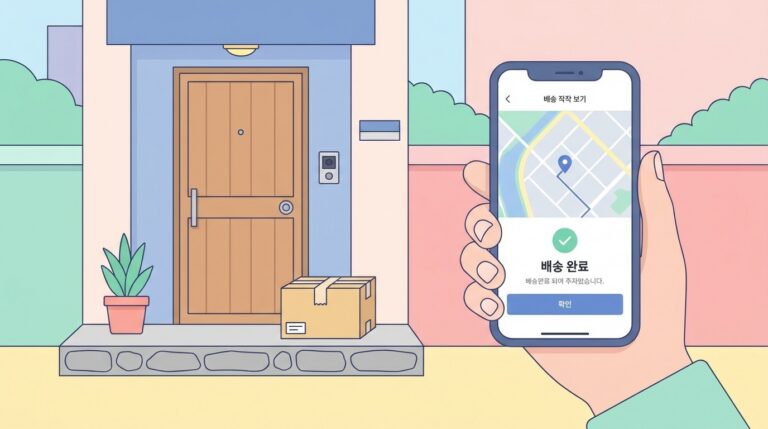
Many Korean language learners tell us, “I learned how to introduce my family and order coffee at A1, but the moment I try to track a parcel in Seoul, I feel completely lost!” In South Korea, where the world’s fastest delivery system—often called Palli-Palli (hurry-hurry) rocket delivery—powers daily life, knowing how to track a package is an essential superpower. In this guide, tailored specifically for A2 elementary learners, we’ll turn confusing logistics vocabulary into natural, friendly conversational Korean so you can confidently say: “Checking the tracking number, it says it’s out for delivery now!”
Phase 2: Top 3 Core Expressions in Depth
1. 송장 번호로 조회해 보니까 (Songjang beonhoro johuihae bonikka)
- Pronunciation: [Song-jang beon-ho-ro jo-hoe-hae bo-ni-kka] (Think of song like a melody, jang like jazz, and bonikka sounding rhythmically like “bony-car”).
- Meaning: Literal: “Because I looked it up with the invoice number…” / Real Nuance: “When I checked using the tracking number…” (Setting the context before sharing findings).
- K-Culture Moment: You’ll hear this constantly in modern K-Dramas when a character nervously tracks a package containing a crucial birthday gift or a secret detective tool!
- Editor’s Insight: 송장 번호 (Songjang beonho) specifically refers to the courier’s tracking or waybill number. The ending -(으)니까 is your best friend at the A2 level to say “I checked and found out that…”
- Situation Spectrum: Casual ✅ | Semi-formal ✅ | Formal ⚠️
- 🤔 Think About It: In English, we simply say “I tracked it.” Korean often explicitly specifies the tool or method (송장 번호로 – by tracking number), reflecting a detail-oriented communication style.
2. 지금 배송 출발했다고 나와요 (Jigeum baesong chulbalhaetdago nawayo)
- Pronunciation: [Ji-geum bae-song chul-bal-haet-da-go na-wa-yo] (Jigeum rhymes with “sea-gum”, baesong sounds like “bay-song”).
- Meaning: Literal: “Right now delivery departed, it comes out.” / Real Nuance: “It says (on the screen) that it’s out for delivery right now.”
- K-Culture Moment: Used whenever you check Coupang or CJ Logistics status updates and turn to your flatmate with excited eyes.
- Editor’s Insight: The phrase ~다고 나와요 (~dago nawayo) literally translates to “it comes out that…”. Koreans frequently use this when reading information off a screen, an app, or a receipt instead of claiming personal authority.
- Situation Spectrum: Casual ✅ | Semi-formal ✅ | Formal ✅
- 🤔 Think About It: Notice how Korean quotes third-party sources or automated screens smoothly with ~다고 나와요. Does your native language separate personal sight from screen readouts like this?
3. 문 앞에 두고 가 주세요 (Mun ape dugo ga juseyo)
- Pronunciation: [Mun a-pe du-go ga ju-se-yo] (Mun like “moon”, ape like “ah-peh”, dugo like “do-go”).
- Meaning: Literal: “Please put it in front of the door and go.” / Real Nuance: “Please leave it at my doorstep.”
- K-Culture Moment: Delivery drivers in Korea will often send you a quick text asking where to drop the package. Typing this exact sentence is standard daily life in Seoul!
- Editor’s Insight: In Korea, contactless doorstep delivery is the default norm. 두고 가다 (dugo gada) means “leave and go.” Adding ~아/어 주세요 turns it into a warm, polite request.
- Situation Spectrum: Casual 🚫 | Semi-formal ✅ | Formal ✅
- 🤔 Think About It: Why does Korean say “leave and go” rather than just “leave”? Korean verbs often link two actions (두다 to place + 가다 to leave) to describe the full sequence of an event.
Phase 3: Textbook Korean vs. Real Korean
Situation 1: Asking if a package has arrived
- 📖 교과서 한국어: 택배가 도착하였습니까? (Taekbaega dochakhayeossseumnikka? – Has the parcel arrived?)
- 🗣️ 진짜 한국어: 택배 왔어요? (Taekbae wasseoyo? – Did the parcel come?)
- 💡 왜 다를까?: Textbook Korean relies heavily on formal Sino-Korean verbs like 도착하다 (dochakhada – to arrive). In daily casual conversation, native speakers almost always use the simple, lively pure-Korean verb 오다 (oda – to come).
Situation 2: Stating that you are currently tracking the order
- 📖 교과서 한국어: 현재 화물의 위치를 추적하고 있습니다. (Hyeonjae hwamurui wichireul chujeokhago itseumnida. – I am currently tracking the location of the freight.)
- 🗣️ 진짜 한국어: 배송 조회해 보고 있어요. (Baesong johuihae bogo isseoyo. – I’m checking the delivery status.)
- 💡 왜 다를까?: “화물 (Freight)” and “추적 (Trace/Track)” sound like you are operating a shipping harbor! Natural speakers simply combine 배송 (delivery) with 조회하다 (to look up/inquire).
Phase 4: K-Culture Deep Dive & Non-Verbal Manners
4-1. 눈치 (Nunchi) & Delivery Etiquette
In Korea, delivery drivers work under intense schedules to deliver millions of parcels within 24 hours. Because of this:
* Don’t wait by the door to open it instantly: When you hear the doorbell ring and a shout of “택배요!” (Taekbae-yo! – Parcel!), you do not need to rush to open the door right in their face. In fact, many drivers prefer leaving it on the doorstep and walking away immediately to maintain speed and safety.
* Texting over calling: If a driver texts you a picture of your package outside your door, a polite one-line reply like “감사합니다! 수고하세요! (Gamsahamnida! Sugohaseyo! – Thank you! Keep up the great work!)” demonstrates high-level 눈치 (Nunchi) and etiquette.
4-2. The Marvel of “Ppalli-Ppalli” Delivery Culture
Korea’s parcel delivery infrastructure is a central pillar of modern urban life. Companies like Coupang offer 로켓배송 (Rocket Delivery) where ordering at 11:00 PM guarantees the package sits outside your apartment door before 7:00 AM the next morning. Furthermore, Korea has one of the world’s highest safety rates for parcel delivery: packages sit untouched outside apartment doors in hallways for hours without being stolen, thanks to widespread CCTV and deep-rooted civic trust.
Phase 5: Real-Life Roleplay Scenario
- Setting: A modern, sunlit shared studio apartment in Mapo-gu, Seoul. Alex is waiting for an essential concert merchandise package before heading to Hongdae.
- Characters:
- Alex (알렉스): An excited international student living in Seoul.
- Minji (민지): Alex’s Korean flatmate who knows all the online shopping tricks.
Turn 1
Alex: 민지 씨, 혹시 택배 기사님 다녀가셨어요? (Minji ssi, hoksi taekbae gisanim danyeogisyeosseoyo?)
“Minji, did the delivery driver stop by already?”
🎭 (Poking head out of bedroom, looking slightly anxious)
Turn 2
Minji: 아니요, 아직 안 오신 것 같아요. 알렉스 씨 뭐 시켰어요? (Aniyo, ajik an osin geot gatayo. Alex ssi mwo sikyeosseoyo?)
“No, I don’t think he’s arrived yet. What did you order, Alex?”
🎭 (Sipping iced Americano on the couch)
Turn 3
Alex: 오늘 콘서트 갈 때 입을 옷이에요! 오늘 꼭 와야 해요. (Oneul konseoteu gal ttae ibeul osieyo! Oneul kkok waya haeyo.)
“It’s the clothes I need to wear to the concert today! It definitely must arrive today.”
🎭 (Clutching phone tightly)
Turn 4
Minji: 쇼핑몰 앱에서 배송 조회 한번 해 봤어요? (Shopping mall aebeseo baesong johui hanbeon hae bwasseoyo?)
“Did you try checking the tracking status in your shopping mall app?”
🎭 (Pointing toward Alex’s phone screen)
Turn 5
Alex: 네, 송장 번호로 조회해 보니까 지금 배송 출발했다고 나와요! (Ne, songjang beonhoro johuihae bonikka jigeum baesong chulbalhaetdago nawayo!)
“Yes! Checking the tracking number, it says it’s out for delivery now!”
🎭 (Eyes widening as the status bar turns green on screen)
Turn 6
Minji: 출발했으면 보통 한두 시간 안에 문 앞에 도착해요. (Chulbalhaesseumyeon botong handu sigan ane mun ape dochakhaeyo.)
“If it’s out for delivery, it usually arrives in front of the door within an hour or two.”
🎭 (Nodding with a reassuring smile)
Turn 7
Alex: 정말 다행이에요! 기사님께 문자 오면 문 앞에 두고 가 달라고 답장할게요. (Jeongmal dahaeng-ieyo! Gisanimkke munja omyeon mun ape dugo ga dallago dapjanghalgeyo.)
“What a relief! If the driver texts me, I’ll reply asking him to leave it at the door.”
🎭 (Sighing happily in relief)
Turn 8
Minji: 완벽해요! 준비하고 있으면 금방 올 거예요. (Wanbyeokhaeyo! Junbihago isseumyeon geumbang ol geoyeyo.)
“Perfect! If you get ready, it’ll be here in no time.”
🎭 (Giving an encouraging thumbs-up)
🔀 Interactive Decision Branch
The delivery courier sends you an SMS: “고객님, 부재중이신가요? 물건 어디에 둘까요? (Customer, are you away? Where should I leave the item?)” How do you respond?
- Choice A: “문 앞에 두고 가 주세요! 감사합니다. (Mun ape dugo ga juseyo! Gamsahamnida.)”
- Choice B: “왜 전화 안 하고 문자만 보내요? (Wae jeonhwa an hago munjaman bonaeyo?)”
- Choice C: “그냥 거기 서 계세요. (Geunyang geogi seo gyeseyo.)”
Detailed Feedback:
* Choice A (Best!): Polite, clear, and perfectly matches modern Korean doorstep delivery etiquette. The driver can drop the item safely and move to their next stop.
* Choice B (Bad!): Aggressive and culturally tone-deaf. Delivery drivers send quick automated texts precisely to be efficient; questioning why they didn’t voice-call creates friction.
* Choice C (Risk!): Extremely rude. This literally commands the driver: “Just stand right there.” It treats the courier disrespectfully and violates polite Korean honorific norms.
Phase 6: 10-Second Emotional Shadowing Drill
Read each sentence out loud, taking a half-second breath at every / mark and embracing the emotional marker:
[🤔 Curious & Focused]
송장 번호로 / 조회해 보니까… (Songjang beonhoro / johuihae bonikka…)-
[😊 Relieved & Excited]
지금 / 배송 출발했다고 나와요! (Jigeum / baesong chulbalhaetdago nawayo!) -
[🙏 Polite & Friendly]
기사님, / 문 앞에 / 두고 가 주세요! (Gisanim, / mun ape / dugo ga juseyo!)
Phase 7: K-Culture Mini Dictionary
- 택배 (Taekbae) | Courier service / Parcel delivery
The bread and butter of modern Korean convenience. Used for both the actual parcel and the delivery system. - 송장 번호 (Songjang beonho) | Tracking number / Waybill number
The 10 to 13-digit number issued when a package is registered with a courier company. - 배송 조회 (Baesong johui) | Delivery inquiry / Order tracking
The button or action on mobile shopping apps used to check current parcel stages. - 문 앞 (Mun ap) | In front of the door / Doorstep
The most common drop-off location specified by residents in Korea for safe, contactless handover.
Phase 8: Traveler’s Survival Kit
Survival Phrases TOP 3
- 배송 언제 와요? (Baesong eonje wayo?)
Pronunciation: [Bae-song eon-je wa-yo?]
Pro Tip: Use this with your host or customer support when you need a simple estimated arrival window. - 문 앞에 놓아주세요. (Mun ape no-a-ju-se-yo.)
Pronunciation: [Mun a-pe no-ah-ju-seh-yo.]
Pro Tip: A polite alternative to 두고 가 주세요. 놓다 (nota) means “to lay/place down.” - 택배 보관함에 넣어주세요. (Taekbae bogwanhame neoeojuseyo.)
Pronunciation: [Taek-bae bo-gwan-ha-me neo-eo-ju-se-yo.]
Pro Tip: If your officetel, dormitory, or apartment has automated parcel lockers (택배 보관함), text this to the courier.
Editor’s Travel Note
- Recommended Tools: If you are staying long-term in Korea, explore the official CJ Logistics Tracking App on Naver by searching “택배배송조회”. You can paste any Korean courier tracking number right into Naver’s search bar without logging into individual logistics sites.
- Address Tip: Always keep your room number (호수 – hosu) and building door password (공동현관 비밀번호) handy when ordering food or parcels in Korea.
Phase 9: Step Deeper (Cultural Reflection)
South Korea’s parcel tracking culture reveals a profound societal contract built on mutual speed and shared trust. In many global cities, leaving a high-value laptop or branded sneakers outside an apartment door for five hours would be considered an invitation for theft. In Korea, however, dense urban apartment layouts, ubiquitous CCTV cameras, and collective respect for personal belongings have made the doorstep an extension of one’s private living room. When you master these delivery phrases, you are not just learning logistical terms; you are actively engaging with one of the most high-trust urban ecosystems in the modern world.
💬 Your Turn: Have you ever ordered something online while traveling in Korea, or received a delivery text that you had to decode? Share your experience in the comments below!
Phase 10: FAQ & Common Mistakes
Q: Can I use “트래킹 넘버 (tracking number)” instead of “송장 번호 (songjang beonho)”?
A: While young clerks or bilingual friends will understand “트래킹 넘버”, official customer service portals, shopping apps, and older logistics staff exclusively use 송장 번호 (Songjang beonho). Learning the authentic Korean term ensures you never run into communication misunderstandings.
Q: What is the difference between “배송 중 (baesong jung)” and “배송 출발 (baesong chulbal)”?
A: 배송 출발 (Baesong chulbal) means the parcel has physically departed the local sorting hub or warehouse. 배송 중 (Baesong jung) means it is currently in transit—often riding in the driver’s delivery truck on its way to your specific neighborhood.
Q: What should I say if the tracking says “배송 완료 (Delivery Complete)” but there is no package at my door?
A: Don’t panic! Check around your shoe closet, security desk (경비실 – gyeongbisil), or parcel locker (택배 보관함). If it’s still missing, you can text the driver: “배송 완료라고 나오는데 물건이 없어요. 확인 부탁드립니다. (It says delivered, but the item isn’t here. Please check for me.)”
🚨 흔한 실수 (Common Mistakes) Warning Board
- Mistake: Saying “택배를 추적해요 (Taekbaereul chujeokhaeyo)”
- Why it’s unnatural: 추적하다 sounds like a police detective hunting a criminal fugitive!
- Correct Action: Say 배송 조회해요 (Baesong johuihaeyo).
- Mistake: Telling the driver “문 밖에 버리세요 (Mun bakke beoriseyo)”
- Why it’s unnatural: 버리다 means “to throw away/discard as trash!”
- Correct Action: Say 문 앞에 두고 가 주세요 (Mun ape dugo ga juseyo).
- Mistake: Forgetting to state the tracking number when asking customer service.
- Why it’s unnatural: Asking “제 택배 어디예요? (Where is my parcel?)” without context leaves agents helpless.
- Correct Action: Prepend your question with: 송장 번호는 ~번이에요. (The tracking number is ~.)
Phase 11: Action Missions
- 🥉 Bronze Mission (Solo Practice): Read the 3 Core Expressions aloud 3 times each while looking at your own smartphone screen.
- 🥈 Silver Mission (Social Share): Share your favorite online shopping phrase from this post on your Instagram Story or X (Twitter) and tag
@DailyHangul! - 🥇 Gold Mission (Real-world Execution): The next time you order an item online or track a shipment, open the tracking window and narrate the status aloud in Korean: “송장 번호로 조회해 보니까 지금 배송 출발했다고 나와요!”
🎮 K-Culture Mission: Watch an episode of a modern slice-of-life K-Drama (like Hospital Playlist or Business Proposal). Spot a scene where someone rings the intercom shouting “택배요!” and observe what the character does next!
Phase 12: Interactive Quiz Challenge
Question 1: Situational Choice
You want to tell your host that according to your phone screen, the package is already out for delivery. Which phrase is the most natural?
* A) 지금 배송 출발했다고 나와요.
* B) 지금 배송이 도망쳤어요.
* C) 지금 배송을 추적당했어요.
Question 2: Fill in the Blank
Complete the sentence to mean: “Please leave it at the doorstep.”
“문 [ ] 두고 가 주세요.”
Question 3: True / False Cultural Check
In Korea, it is considered rude if you don’t open the door immediately when the parcel courier shouts “택배요!” and rings the bell. (True / False)
Click to reveal answers & explanations!
- Question 1 Answer: A
Explanation: “지금 배송 출발했다고 나와요” correctly uses the indirect quotation ~다고 나와요 to report screen status. Choice B means “the delivery escaped”, and Choice C means “the delivery was tracked by someone else!” - Question 2 Answer: 앞에 (ape)
Explanation: “문 앞에 (Mun ape)” means “in front of the door / at the doorstep.” - Question 3 Answer: False
Explanation: It is completely normal and acceptable to let the driver leave the parcel outside the door. Couriers often prefer contactless drop-offs to maintain their fast schedule!
🎬 Watch Our Daily Videos! (Daily Hangul Official Instagram)
Review the expressions you learned in this article with our fun daily short videos! Check out native pronunciation and real-life nuances in action.
- Instagram @dailyhangul_en







