

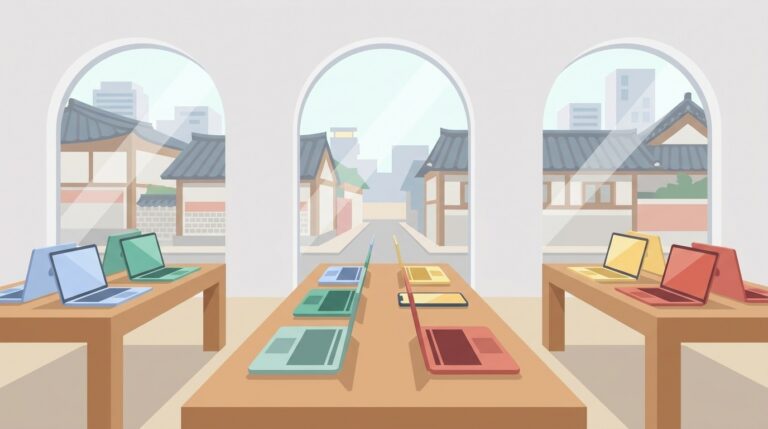
How to Compare Gadgets in Korea and Never Miss Out on Your Free Warranty
Phase 1: 공감 (Story-Driven Opening)
안녕하세요! 매일한글 에디터입니다. (Hello! This is your Daily Hangul editor.)
Picture this: You are standing inside a blindingly bright, futuristic electronics store in Yongsan or Gangnam. Glass displays glow with the latest foldable smartphones and feather-light laptops. You see a chic Korean college student effortlessly comparing camera specs with a smiling staff member. You want to upgrade your tech, too! You step up to the counter, point at a sleek laptop, and the clerk smiles warmly, speaking rapidly: “무상 수리 보증 기간은 구매일로부터 1년이에요.”
Suddenly, your mind freezes. Musang? Bojeung? Does that mean free? Or does it mean I have to pay after a year? Did they say I have one year, or do I only have one week?
Many of our learners tell us that electronics shopping in Korea feels like navigating an episode of Start-Up without English subtitles. You understand basic greetings, but the moment technical jargon and retail policy enter the chat, panic sets in. Don’t worry! In Korea, after-sales service and customer care are practically an art form. Mastering this simple phrase not only protects your wallet—it gives you the confidence to explore Seoul’s buzzing tech hubs like an insider. Based on real classroom scenarios and real-world student questions, this guide will make sure you never miss out on your warranty rights again.
Phase 2: 핵심 표현 3선 심층 분석 (Top 3 Expressions Deep Dive)
1. 무상 수리 보증 기간은 구매일로부터 1년이에요
- Pronunciation: Musang suri bojeung giganeun gumaeillobuteo illyeonieyo. (Sounds like: moo-sahng soo-ree boh-jeung gee-gahn-eun goo-meh-eel-loh-boo-tuh eel-lyuhn-ee-eh-yo)
- Meaning:
- Literal: “Free-of-charge repair guarantee period from purchase date one year is.”
- Natural Nuance: “The free warranty repair period is one year from the date of purchase.”
- K-Culture Moment: Think of classic K-drama office scenes where a panicked assistant rushes into the service center clutching the CEO’s cracked phone, pleading for a quick fix before the warranty expires.
- Editor’s Insight: Notice the word 무상 (musang). In Korean, 무 (mu) means “none/without” and 상 (sang) relates to cost or compensation. Therefore, 무상 수리 (musang suri) specifically means “free repair.” Its opposite is 유상 수리 (yusang suri), where 유 (yu) means “exists”—meaning you have to pay out of pocket!
- Situation Spectrum:
- Casual (반말): 🚫 무상 수리 1년이야 (Only with close friends)
- Semi-formal (해요체): ✅ 무상 수리 보증 기간은 1년이에요 (Standard polite store conversation)
- Formal (하십시오체): ✅ 무상 수리 보증 기간은 구매일로부터 1년입니다 (Official clerk announcement)
- 🤔 Think About It: In many Western countries, extended warranties are upsold aggressively at checkout. In Korea, comprehensive 1-year coverage is practically an unspoken standard of business honor. How does this reflect the Korean commitment to consumer peace of mind?
2. 배터리 수명이랑 화면 크기 비교해 주세요
- Pronunciation: Baeteori sumyeong-irang hwamyeon keugi bigyohae juseyo. (Sounds like: beh-tuh-ree soo-myuhng-ee-rahng hwah-myuhn koo-gee bee-gyoh-heh joo-seh-yo)
- Meaning:
- Literal: “Battery lifespan-and screen size compare please.”
- Natural Nuance: “Please compare the battery life and screen size for me.”
- K-Culture Moment: Like an idol fan comparing two different concert streaming tablets at a tech lounge, wanting the best battery endurance for multi-hour livestreams!
- Editor’s Insight: The particle ~랑/이랑 (~rang/irang) is your everyday friendly glue meaning “and” or “with.” Attaching 비교해 주세요 (bigyohae juseyo) turns any two features into an instant comparison request without complicated grammar.
- Situation Spectrum:
- Casual: 🚫 이거 둘 다 비교해 줘 (Too blunt with staff)
- Semi-formal: ✅ 배터리 수명이랑 화면 크기 비교해 주세요 (Perfect for store visits)
- Formal: ✅ 두 제품의 성능을 비교해 주시겠습니까? (Polite business tone)
- 🤔 Think About It: Why does Korean rely on polite request verbs like ~해 주세요 (please do for me) rather than direct commands? It creates a warm bond between customer and service provider.
3. 영수증이 있어야 무상 서비스가 되나요?
- Pronunciation: Yeongsujeung-i isseoya musang seobiseuga doenayo? (Sounds like: yuhng-soo-jeung-ee ees-suh-yah moo-sahng suh-bee-seu-gah dweh-nah-yo?)
- Meaning:
- Literal: “Receipt must exist for free service to become possible?”
- Natural Nuance: “Do I need the receipt to get free service?”
- K-Culture Moment: You purchased a cute wireless mouse or earbuds in Hongdae, and you wonder whether tucking that tiny printed paper into your wallet is truly necessary.
- Editor’s Insight: The grammar pattern ~어야/아야 되다 (~eoya/aya doeda) expresses necessity (“must have / must be”). In Korea, many digital devices track warranty through the serial number, but paper or electronic receipts are still king if the serial number was not registered at purchase!
- Situation Spectrum:
- Casual: ⚠️ 영수증 있어야 돼? (Friends only)
- Semi-formal: ✅ 영수증이 있어야 무상 서비스가 되나요? (Natural & polite)
- Formal: ✅ 영수증을 지참해야 무상 처리가 가능합니까? (Very official)
- 🤔 Think About It: Korea is nearly 100% cashless, yet the humble receipt (영수증) remains a vital legal document for customer protection. Does your home country prioritize physical receipts or digital records?
Phase 3: 교과서 한국어 vs 진짜 한국어 (Textbook vs. Real Korean)
Scenario 1: Asking if a device can be repaired under warranty
- 📖 교과서 한국어 (Textbook):
- 이 제품은 보증 수리를 지원합니까? (I jepumeun bojeung surireul jiwonhamnikka? – “Does this product support warranty repair?”)
- 🗣️ 진짜 한국어 (Real Life):
- 이거 한국에서 A/S 돼요? (Igeo hangug-eseo e-i-eseu dwaeyo? – “Can I get A/S [repair service] for this in Korea?”)
- 💡 왜 다를까? (Why the difference?):
- Koreans almost universally call post-purchase repairs and warranty care “A/S” (Konglish for “After Service”). Asking if A/S 돼요? is instantly understood by any clerk, whereas 보증 수리를 지원합니까 sounds like reading an instruction manual aloud!
Scenario 2: Asking which laptop has the best value for money
- 📖 교과서 한국어 (Textbook):
- 가격 대비 성능이 우수한 컴퓨터는 어느 것입니까? (Gagyeok daebi seongneung-i usuhan keompyuteoneun eoneu geosimnikka? – “Which computer has superior performance relative to price?”)
- 🗣️ 진짜 한국어 (Real Life):
- 어떤 게 제일 가성비 좋아요? (Eotteon ge jeil gaseongbi joayo? – “Which one has the best value for money?”)
- 💡 왜 다를까? (Why the difference?):
- The modern compound word 가성비 (gaseongbi) combines 가격 (price) + 성능 (performance) + 비 (ratio). It is the most popular buying metric in modern Korea for everything from laptops to lunchboxes.
Phase 4: K-Culture 딥다이브 & 비언어적 매너 (K-Culture Deep Dive & Non-Verbal Manners)
4-1. 눈치 (Nunchi) & Gestures
- The Two-Handed Tech Hand-off: When handing your smartphone, laptop, or payment card to a Korean sales consultant, always support your right forearm with your left hand, or hold the item with both hands. It instantly signals respect and care.
- The Attentive Nod (끄덕임): When the clerk explains the warranty terms (무상 수리 보증 기간…), do not stare blankly. Nod rhythmically and use soft verbal affirmations like “네, 네” (Ne, ne / “Yes, understood”). This demonstrates good nunchi (social awareness), reassuring the staff that their explanation is landing.
4-2. Cultural Code Analysis: The Legend of Korean “A/S Culture”
In South Korea, after-sales service is not just an administrative chore; it is the ultimate battlefield for brand loyalty. Brands like Samsung and LG built their empires on sprawling, ultra-fast service centers where technicians hand you complimentary coffee and repair broken screens in under 30 minutes. If you ever watch Korean variety shows or vlogs, you will hear people judge tech products by one crucial standard: “A/S가 편한가?” (Is getting repairs convenient?). Knowing your warranty timeline (구매일로부터 1년 — 1 year from purchase) ensures you can participate in this world-class consumer ecosystem seamlessly.
Phase 5: 실전 롤플레이 시나리오 (Real-Life Roleplay Scenario)
Setting: A sleek electronic superstore in Sinchon.
Characters:
* Min-jun (민준): An energetic, tech-savvy floor manager wearing a navy lanyard.
* Alex (알렉스): An international exchange student looking for a reliable study laptop.
- 민준 (Min-jun): 어서 오세요! 어떤 제품 찾으세요?
(Eoseo oseyo! Eotteon jepum chajeuseyo?)
🎭 Smiling brightly and gesturing toward the laptop display table
“Welcome! What kind of product are you looking for?” -
알렉스 (Alex): 가벼운 노트북 보고 있어요. 이거 배터리 수명 길어요?
(Gabyeoun notebuk bogo isseoyo. Igeo baeteori sumyeong gireoyo?)
🎭 Pointing gently with two fingers at an ultra-slim laptop
“I’m looking for a light laptop. Does this one have a long battery life?” -
민준 (Min-jun): 네, 한 번 충전하면 18시간 쓸 수 있어요. 무게도 1kg 미만이에요.
(Ne, han beon chungjeonhamyeon yeol-yeodeol sigan sseul su isseoyo. Mugedo il-kilogeuram mimanieyo.)
🎭 Picking up the laptop smoothly to show how light it is
“Yes, once charged, you can use it for 18 hours. It’s also under 1 kilogram.” -
알렉스 (Alex): 와, 진짜 가볍네요! 그런데 혹시 고장 나면 어떻게 해요?
(Wa, jinjja gabyeomneyo! Geureonde hoksi gojang namyeon eotteoke haeyo?)
🎭 Tilting head slightly with a thoughtful, curious expression
“Wow, it really is light! But what happens if it breaks down?” -
민준 (Min-jun): 무상 수리 보증 기간은 구매일로부터 1년이에요. 전국 서비스 센터에서 수리받으실 수 있어요.
(Musang suri bojeung giganeun gumaeillobuteo illyeonieyo. Jeonguk seobiseu senteo-eseo suribadeusil su isseoyo.)
🎭 Handing an official warranty brochure with both hands
“The free warranty repair period is one year from the purchase date. You can get it repaired at any service center nationwide.” -
알렉스 (Alex): 다행이네요! 영수증이 있어야 무상 서비스가 되나요?
(Dahaeng-ineyyo! Yeongsujeung-i isseoya musang seobiseuga doenayo?)
🎭 Reaching into a wallet as if checking for space
“What a relief! Do I need the receipt to get free service?” -
민준 (Min-jun): 영수증을 찍어 두시거나 모바일 멤버십으로 등록하시면 종이 영수증이 없어도 괜찮아요!
(Yeongsujeung-eul jjigeo dusigeona mobail membeosib-euro deungnokhasimyeon jong-i yeongsujeung-i eopseodo gwaenchanayo!)
🎭 Tapping a QR code sticker on the counter
“If you take a photo of the receipt or register with your mobile membership, you don’t even need the paper receipt!” -
알렉스 (Alex): 정말 편리하네요. 이걸로 살게요!
(Jeongmal pyeonrihaneyo. Igeollo salgeyo!)
🎭 Nodding with a confident, satisfied smile
“That’s so convenient. I’ll take this one!”
🔀 인터랙티브 분기점 (Interactive Branching Point)
Imagine the clerk just told you the warranty period. What do you reply?
- Option A: “외국인도 똑같이 1년 동안 무상 수리 받을 수 있어요?” (Can foreigners get free repairs for 1 year too?)
- Outcome (Best): 🌟 Excellent! The clerk will gladly confirm that international buyers in Korea receive identical consumer rights as long as the device was purchased domestically.
- Option B: “1년 지나면 그냥 버려야 돼요?” (Do I just throw it away after 1 year?)
- Outcome (Bad): 😅 Awkward silence! The clerk will look confused and explain that after one year, you can still get it repaired—it just becomes 유상 수리 (paid repair).
- Option C: “고장 나면 공짜로 새 거 줘요?” (If it breaks, do you give me a brand-new one for free?)
- Outcome (Risk): ⚠️ Risk of sounding entitled! In Korean retail, free repair (무상 수리) is standard, but demanding an instant replacement (무상 교환) usually applies only to severe factory defects discovered within the first 14 days.
Phase 6: 10초 감정 섀도잉 드릴 (10-Second Emotional Shadowing Drill)
Practice these lines with rhythm, pausing at / and embodying the emotion tag:
[😊 호기심 가득하고 밝게 - Curious & Upbeat]
배터리 수명이랑 / 화면 크기 / 비교해 주세요!
(Baeteori sumyeong-irang / hwamyeon keugi / bigyohae juseyo!)-
[🤔 진지하고 꼼꼼하게 - Serious & Attentive]
무상 수리 보증 기간은 / 구매일로부터 / 1년이에요?
(Musang suri bojeung giganeun / gumaeillobuteo / illyeonieyo?) -
[😌 안도하며 정중하게 - Relieved & Polite]
아, 다행이네요! / 영수증 사진 / 찍어 둘게요.
(A, dahaeng-ineyyo! / Yeongsujeung sajin / jjigeo dulgeyo.)
Phase 7: K-Culture 미니 사전 (Mini Dictionary)
- 무상 수리 (Musang Suri) | Free Warranty Repair
Usage: Repairs covered entirely by the manufacturer due to hardware defects, not accidental drops or water damage. - 보증 기간 (Bojeung Gigan) | Warranty Period
Usage: The legally mandated or contractually guaranteed timeframe during which your purchase is protected. - 가성비 (Gaseongbi) | Cost-Effectiveness / Value for Money
Usage: Used by younger Koreans in tech shops, restaurants, and shopping to describe great performance at a reasonable price. - A/S 센터 (E-i-eseu Senteo) | Customer Service & Repair Center
Usage: The physical repair shop where tech products are evaluated and fixed by certified engineers.
Phase 8: 여행자를 위한 생존 키트 (Traveler’s Survival Kit)
서바이벌 표현 TOP 3 (Top 3 Survival Expressions)
- 이거 한국에서 산 영수증이에요.
(Igeo hangug-eseo san yeongsujeung-ieyo.)
Pro Tip: Show this at the A/S counter to quickly establish your purchase date without speaking complex Korean. - 액정이 깨졌는데 수리비 얼마예요?
(Aekjeong-i kkaejyeonneunde suribi eolmayeyo?)
Pro Tip: Use this phrase when you crack your screen (액정) to ask for a repair quote. - 택스 리펀 받을 수 있어요?
(Taekseu ripeon badeul su isseoyo?)
Pro Tip: Ask this at checkout to claim your tourist tax refund directly on your passport.
Editor’s Travel Note
- Navigation Tip: Finding the nearest electronics repair center is a breeze if you download the Naver Map application on your phone and search for keywords like “삼성전자서비스” (Samsung Service) or “LG전자서비스센터”.
- Translation Companion: For scanning dense warranty cards written in tiny Korean text, install the Papago mobile translator to capture and translate printed guarantees instantly.
- Tax Refund Reminder: Bring your physical passport when shopping at large electronics malls (like Electro Mart, Himart, or flagship brand outlets). Many offer immediate tax deductions right at the cash register!
Phase 9: “한 발 더 깊이” (Cultural Reflection Essay)
In modern Korea, the relationship between buyer and seller does not end when the payment notification chimes on your phone. It begins there. The principle of 무상 보증 (free warranty) represents an implicit social contract rooted in collective accountability and pride in domestic manufacturing. Because Korea is ultra-connected and highly digitized, a brand’s reputation can rise or fall based on viral customer service reviews shared on community forums. When a company promises that “무상 수리 보증 기간은 구매일로부터 1년이에요,” it is not merely fulfilling a legal obligation—it is pledging its name to your daily satisfaction.
💬 Your Turn: Have you ever experienced tech repair in your home country versus abroad? How would you feel walking into a Korean A/S center? Share your thoughts in the comments below!
Phase 10: FAQ & 오해 방지 (FAQ Schema)
Q: Does the 1-year free warranty cover water damage or dropping my phone on concrete?
A: No. 무상 수리 (free repair) strictly covers internal component malfunctions, battery failure, or factory defects. Damage caused by user negligence (소비자 과실) requires 유상 수리 (paid repair).
Q: If I buy a Korean laptop, will the warranty work in my home country?
A: It depends on the brand’s international warranty policy (글로벌 워런티). While some flagship laptops offer worldwide coverage, certain budget models or localized tablet editions only support warranty claims inside South Korea.
Q: Can I register the warranty without a Korean resident registration number (ARC)?
A: Yes! Most major electronic stores can link your warranty to your passport number or simply honor the date stamped on your paper or digital purchase receipt.
🚨 흔한 실수 (Common Mistakes) Warning Board
- Mistake 1: Throwing away your paper receipt immediately.
Correct Action: Snap a clear photo of the receipt showing the store name, date, and product serial number before discarding it. - Mistake 2: Asking for a “guarantee” using English (개런티).
Correct Action: Use the Korean word 보증 (bojeung) or simply ask A/S 돼요? - Mistake 3: Assuming accessories (cables, adapters) have the same warranty as the main device.
Correct Action: Accessories often have shorter coverage periods (such as 6 months). Always ask: 충전기도 1년이에요? (Is the charger also covered for 1 year?).
Phase 11: 액션 미션 & 참여 유도 (Action Missions)
- 🥉 Bronze Mission (Solo Practice): Read the core sentence (무상 수리 보증 기간은 구매일로부터 1년이에요) out loud three times using the shadowing drill in Phase 6.
- 🥈 Silver Mission (Social Challenge): Take a photo of an electronic device near you, write its key spec in Korean (배터리 수명, 화면 크기), and tag
#DailyHangulon Instagram or Threads! - 🥇 Gold Mission (Real-World Test): Next time you visit a tech store or browse a Korean online shopping site (like Coupang or Naver Shopping), find the warranty section and locate the words 무상 and 1년.
- 🎮 K-Culture Mission: Watch a contemporary office K-drama and listen closely for the abbreviation “A/S” or the phrase “영수증” during shopping or errand scenes!
Phase 12: 인터랙티브 퀴즈 챌린지 (Interactive Quiz Challenge)
Quiz 1. Situation Judgment
You dropped your brand-new phone in the sink on day 30 after purchasing it. You visit the repair center. Can you demand 무상 수리?
* A) Yes, because it has been less than one year.
* B) No, because water damage is user negligence (소비자 과실) and requires 유상 수리.
* C) Yes, but only if you bring a paper receipt.
Quiz 2. Fill-in-the-Blank
Complete the sentence meaning: “Please compare the battery life and screen size.”
* 배터리 수명이랑 화면 크기 ________ 주세요.
(Hint: The Korean verb for ‘compare’ in polite request form)
Quiz 3. True / False Cultural Check
True or False? In Korea, you should hand your credit card or warranty documents to store clerks using just one hand to look cool and casual.
👉 Click to reveal answers & explanations!
- Quiz 1 Answer: B. 무상 수리 covers manufacturer defects, not accidental water submersion!
- Quiz 2 Answer: 비교해 (bigyohae). Together it reads: 비교해 주세요 (Please compare).
- Quiz 3 Answer: False. Always use two hands (or support your forearm) when handing over cards or important documents in Korea to show politeness and mutual respect!
🎬 Watch Our Daily Videos! (Daily Hangul Official Instagram)
Review the expressions you learned in this article with our fun daily short videos! Check out native pronunciation and real-life nuances in action.
- Instagram @dailyhangul_en






