

Phase 1: 공감 (Story Opening)
안녕하세요! 매일한글 에디터입니다.
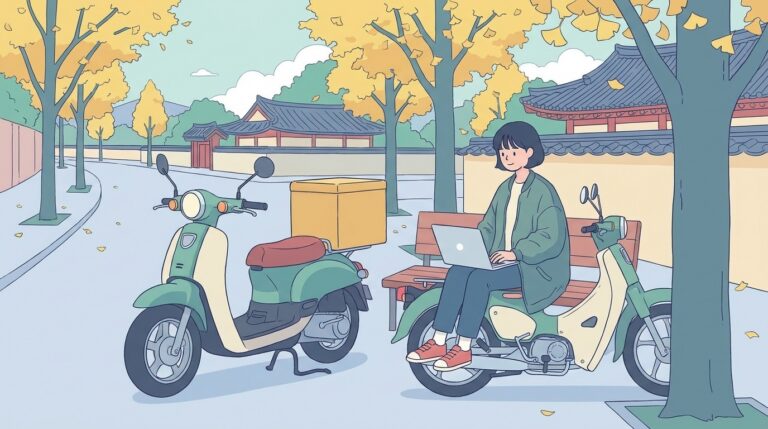
Picture this scene from a popular K-Drama: a young 20-something in Seoul grabs an iced Americano, snaps a phone onto a scooter mount or opens a laptop at a sunlit cafe in Seongsu-dong, and takes a deep, peaceful breath. There are no frantic 8:50 AM subway sprints, no scowling department head tracking badge swipes, and no mandatory post-work company dinners (hoesik). In Korea today, platform work—spanning food delivery riders, quick-call drivers (daeri), and digital freelancers—has transformed how an entire generation views labor.
If you’ve ever thought about freelancing or gigging in Korea, you’ve probably felt that electrifying appeal: absolute freedom over your own clock. But when chatting with Korean peers, trying to articulate this lifestyle often feels clumsy. Many intermediate learners stumble between sounding overly formal like a government white paper or accidentally sounding unemployed! Over the years, countless learners have told me, “I wanted to explain that I love gig work because I don’t have a boss, but my Korean sounded either rude or completely defensive.” Today’s guide solves that exact pain point. Let’s master the nuanced, authentic Korean expressions that showcase the perks of platform independence while sounding like a savvy local.
Phase 2: 핵심 표현 3선 심층 분석 (Top 3 Core Expressions)
1. 정해진 출퇴근 시간이 없어서 좋아요 (Jeonghaejin chultoogeun sigani eopseoseo joayo)
- Pronunciation: [Jeong-hae-jin chul-ttoe-geun shi-gan-i eop-seo-seo jo-ah-yo] (Think of ‘chul’ like ‘chill’ with an ‘uh’ sound, and ‘ttoe’ like ‘to’ pronounced with snappy vocal cord tension)
- Meaning: “It’s great because there are no set commuting hours.” (Literal: Fixed leave-and-arrive work hours do not exist, so it is liked.)
- K-Culture Moment: Seen frequently in slice-of-life YouTube vlogs titled “20-something Seoul N-Jobler Day in the Life,” where creators celebrate sipping morning coffee at 10 AM while office commuters are already three hours into meetings.
- Editor’s Insight: 출퇴근 (chultoogeun) bundles both going to work (chulgeun) and leaving work (toegeun). Saying 정해진 출퇴근 시간 refers directly to the dreaded Korean 9-to-6 rat race.
- Situation Spectrum:
- Casual: ✅ (정해진 출퇴근 시간 없어서 짱 좋아)
- Semi-formal: ✅ (정해진 출퇴근 시간이 없어서 좋아요)
- Formal: ✅ (정해진 출퇴근 시간이 없다는 점이 가장 큰 장점입니다)
- 🤔 Think About It: In many Western contexts, people say “I make my own schedule.” In Korea, emphasizing the absence of 출퇴근 highlights escaping the physical, exhausting ordeal of crowded Seoul subway transfers.
2. 상사 눈치 안 보고 일해요 (Sangsa nunchi an bogo ilhaeyo)
- Pronunciation: [Sang-sa noon-chee an bo-go eel-hae-yo] (Pronounce ‘nunchi’ like ‘noon’ + ‘cheese’ without the final -se)
- Meaning: “I work without having to walk on eggshells around a boss.” (Literal: I work without reading a supervisor’s facial cues.)
- K-Culture Moment: Every office worker in dramas like Misaeng or My Liberation Notes spends half their energy monitoring the mood of their bujangnim (department director). Platform workers use this phrase with genuine pride.
- Editor’s Insight: 눈치를 보다 means scanning someone’s micro-expressions to gauge approval or displeasure. Negating it with 안 보고 conveys immense psychological liberation from traditional hierarchical pressure.
- Situation Spectrum:
- Casual: ✅ (상사 눈치 안 봐서 너무 편해)
- Semi-formal: ✅ (상사 눈치 안 보고 일해서 편해요)
- Formal: ⚠️ (In professional interviews, soften to: 수직적인 위계질서 대신 자율적으로 업무를 수행해요)
- 🤔 Think About It: Why does Korean have a single dedicated word (nunchi) for situational radar? How does removing nunchi from daily work redefine one’s mental wellness?
3. 원하는 시간과 장소에서 자유롭게 일해요 (Wonhaneun sigangwa jangso-eseo jayurobge ilhaeyo)
- Pronunciation: [Won-ha-neun shi-gan-gwa jang-so-eh-seo ja-yoo-rop-ge eel-hae-yo] (Roll into ‘jayu’ like ‘jazz’ without the buzz, clear ‘yu’)
- Meaning: “I work freely at whatever time and place I choose.”
- K-Culture Moment: Used by cafe digital nomads working on laptops in Jeju or delivery couriers turning on app dispatches only after their midday workout.
- Editor’s Insight: 자유롭게 (freely) paired with the connective particle -과 (and) demonstrates fluent B2-level syntax. It frames gig work not as unstable hustle, but as an intentional lifestyle choice.
- Situation Spectrum:
- Casual: ✅ (내가 원하는 때랑 장소에서 자유롭게 해)
- Semi-formal: ✅ (원하는 시간과 장소에서 자유롭게 일해요)
- Formal: ✅ (원하는 시간과 장소에서 자율적으로 업무를 진행할 수 있습니다)
- 🤔 Think About It: Does “freedom” in work carry the same weight in an individualistic society as it does in a culture historically grounded in collective team cohesion?
Phase 3: 교과서 한국어 vs 진짜 한국어 (Textbook vs. Real Korean)
Situation 1: Explaining your flexible schedule
- 📖 교과서 한국어: 저는 정형화된 근무 일정을 따르지 않고 독립적으로 일정을 수립합니다. (Jeoneun jeonghyeonghwadoen geunmu iljeongeul ttareuji anko dongnipjeogeuro iljeongeul suriphamnida. / I do not follow a standardized work schedule and establish my itinerary independently.)
- 🗣️ 진짜 한국어: 그냥 제 스케줄 맞춰서 내 맘대로 시간 짜서 일해요. (Geunyang je seukejul matchwoseo nae mamdaero sigan jjaseo ilhaeyo. / I just match my schedule and set my hours however I feel like.)
- 💡 왜 다를까?: Korean textbooks love stiff Hanja roots (수립, 정형화). Real people use expressive native constructions like 내 맘대로 (as I please) and 시간을 짜다 (to knit/craft one’s hours).
Situation 2: Explaining why you don’t miss corporate life
- 📖 교과서 한국어: 저는 직장 상사의 지휘 및 감독 체계에서 벗어나 일하는 것을 선호합니다. (Jeoneun jikjang sangsaui jihwi mit gamdok chegye-eseo beoseona ilhaneun geoseul seonhohamnida. / I prefer working detached from the supervisory and oversight system of workplace superiors.)
- 🗣️ 진짜 한국어: 위에서 잔소리하는 사람 없으니까 스트레스가 싹 사라졌어요. (Wieseo jansorihaneun saram eopseunikka seuteureseuga ssak sarajyeosseoyo. / Since there’s no one above me nagging, my stress completely vanished.)
- 💡 왜 다를까?: Native speakers refer to bosses colloquially as 위에서 (“from above”) and describe micromanagement as 잔소리 (nagging). The adverb 싹 adds vivid sensory completion.
Phase 4: K-Culture 딥다이브 & 비언어적 매너 (Deep Dive & Non-Verbal Manners)
4-1. 눈치 (Nunchi) & Professional Courtesy
Even without a physical manager peering over your desk, platform workers navigate a different kind of nunchi. When fulfilling tasks—whether delivering through an app or sending creative deliverables:
* The “Pali-Pali” Acknowledgement: When accepting gigs or responding to clients on messenger platforms, promptness is the ultimate courtesy. Even a two-second acknowledgement like “네, 확인했습니다! 바로 진행하겠습니다” (Yes, confirmed! Proceeding right away) builds tremendous trust.
* Physical Gesture at Pickups: When gig riders or mobile freelancers meet cafe owners or pickup managers, a crisp 15-degree head nod while holding your phone screen forward shows efficiency without arrogance.
4-2. The Rise of the “N-Jobler” (엔잡러)
In Korea, platform labor isn’t viewed merely as a stopgap; it has sparked the nationwide N-Jobler movement. Influenced by hyper-connected mobile platforms like Baemin Connect, Kakao T, and Kmong, many young Koreans combine freelance design with evening delivery runs or weekend rideshare driving. It is considered clever, resilient, and trendy—a distinct departure from the historical stigma against non-salaried occupations.
Phase 5: 실전 롤플레이 시나리오 (Real-Life Roleplay)
Setting: A vibrant 24-hour cafe in Gangnam. You are chatting with Min-ho (민호), a former corporate marketer who transitioned into app-based freelance design and delivery dispatch.
- 민호 (Min-ho): 🎭 노트북을 닫고 기지개를 켜며 아이스 아메리카노를 마신다 (Closes his laptop, stretches, and sips his iced Americano)
오늘 작업 드디어 끝났다! 넌 요즘 일하는 건 어때? 회사 생활보다 좀 나아?
(Oneul jageop deudieo kkeutnatda! Neon yojeum ilhaneun geon eottae? Hoesa saenghwalboda jom naa? / Finally done with today’s work! How’s your gig work going these days? Better than corporate life?) -
You (학습자): 🎭 미소를 지으며 휴대폰의 플랫폼 대시보드를 보여준다 (Smiling, showing the platform dashboard on your phone)
완전 만족해요. 정해진 출퇴근 시간이 없어서 진짜 살 것 같아요.
(Wanjeon manjokhaeyo. Jeonghaejin chultoogeun sigani eopseoseo jinjja sal geot gatayo. / Totally satisfied. Not having set commute hours honestly makes me feel alive.) -
민호 (Min-ho): 🎭 격하게 고개를 끄덕이며 공감한다 (Nods vigorously in deep empathy)
맞아, 아침 9호선 지옥철 안 타는 것만으로도 수명 연장되는 기분이지?
(Maja, achim guhogeon jiokcheol an taneun geonmaneurodo sumyeong yeonjangdoeneun gibuniji? / Right? Just not boarding that hellish Line 9 morning subway feels like adding years to your lifespan, doesn’t it?) -
You (학습자): 🎭 가벼운 손짓을 하며 홀가분한 표정을 짓는다 (Gesticulating lightly with an unburdened look)
그것도 그렇고, 무엇보다 상사 눈치 안 보고 일하는 게 제일 커요.
(Geugeotdo geureoko, mueotboda sangsa nunchi an bogo ilhaneun ge jeil keoyo. / That too, but above all, working without having to read a boss’s mood is the biggest win.) -
민호 (Min-ho): 🎭 커피잔을 내려놓으며 진지한 눈빛으로 묻는다 (Puts down his cup and asks with a thoughtful gaze)
그래도 가끔 수입이 불규칙하거나 혼자 일해서 불안할 때는 없어?
(Geuraedo gakkeum suibi bulgyuchikhageona honja ilhaeseo buranhal ttaeneun eopseo? / Still, don’t you ever feel anxious when income fluctuates or because you work all alone?) -
You (학습자): 🎭 차분하고 자신감 있는 목소리로 (With a calm, confident voice)
조금은요. 그래도 제가 원하는 시간과 장소에서 자유롭게 일하면서 조절할 수 있으니까 괜찮아요.
(Jogeumeunyo. Geuraedo jega wonhaneun sigangwa jangso-eseo jayurobge ilhamyeonseo jojeolhal su isseunikka gwaenchanayo. / A little bit. But since I can work freely at the times and places I want and adjust the pace, it’s fine.) -
민호 (Min-ho): 🎭 엄지손가락을 치켜세우며 (Giving a high thumbs-up)
자기 절제만 잘하면 플랫폼 노동만큼 속 편한 일도 없지. 오늘 수고했으니 맛있는 거 먹으러 가자!
(Jagi jeoljeman jalhamyeon peullaetpom nodongmankeum sok pyeonhan ildo eopji. Oneul sugohaesseuni masinneun geo meogeureo gaja! / As long as you have good self-discipline, nothing gives peace of mind like gig work. You worked hard today, let’s grab delicious food!) -
You (학습자): 🎭 가방을 챙기며 밝게 웃는다 (Packing your bag and smiling brightly)
좋아요! 오늘은 제가 먹고 싶은 시간에 자유롭게 먹을래요!
(Joayo! Oneureun jega meokgo sipeun sigane jayurobge meogeullaeyo! / Sounds great! Today, I’m eating at whatever time I want!)
🔀 Interactive Choice Point
Min-ho asks: “그래도 가끔 상사나 동료가 그립진 않아?” (Don’t you miss having a boss or team members sometimes?) How do you respond?
- Option A: “전혀요! 잔소리 듣는 것보다 혼자 원하는 만큼 페이스 조절하는 게 백배 편해요.” (Jeonhyeoyo! Jansori deunneun geotboda honja wonhaneun mankeum peiseu jojeolhaneun ge baekbae pyeonhaeyo. / Not at all! Controlling my own pace as much as I want is a hundred times better than listening to nagging.)
👉 Feedback (Best): Perfect balance! It highlights personal agency and uses conversational emphasis (백배 편해요). Sounds natural and confident. - Option B: “저는 인간관계를 혐오해서 혼자 일하는 시스템이 이론적으로 우수합니다.” (Jeoneun ingangwangyereul hyeomohayeo honja ilhaneun siseutemi ironjeogeuro usuhapnida. / I loathe human relationships, so working alone is theoretically superior.)
👉 Feedback (Bad): Overly academic, socially awkward, and alarming. It will make your Korean friend worried about your social well-being! - Option C: “상사 있으면 돈은 더 많이 벌 텐데 조금 후회돼요.” (Sangsa isseumyeon doneun deo mani beol tende jogeum huhoedwaeyo. / If I had a boss I might make more money, so I regret it a bit.)
👉 Feedback (Risk): Weak nuance. It sounds like you lack commitment to your independent path and misrepresents gig economy dynamics.
Phase 6: 10초 감정 섀도잉 드릴 (Emotional Shadowing Drill)
Practice these lines out loud, hitting the intonation pauses marked by / with genuine emotional immersion!
- [😌 홀가분하고 후련하게 – Relieved & Carefree]
정해진 출퇴근 시간이 없으니까 / 아침마다 / 마음이 너무 편해요.
(Jeonghaejin chultoogeun sigani eopseunikka / achimmada / maeumi neomu pyeonhaeyo.)
“Since there are no set commuting hours / every single morning / my heart feels so at ease.” -
[😎 당당하고 통쾌하게 – Proud & Liberated]
누구 눈치도 안 보고 / 내가 원하는 만큼만 일할 수 있어요!
(Nugu nunchido an bogo / naega wonhaneun mankeumman ilhal su isseoyo!)
“Without reading anyone’s mood / I can work precisely as much as I desire!” -
[🧘 차분하고 성숙하게 – Calm & Balanced]
시간과 장소를 / 자유롭게 조절하면서 / 제 페이스를 지켜요.
(Sigangwa jangsoreul / jayurobge jojeolhamyeonseo / je peiseureul jikyeoyo.)
“By freely adjusting my time and place / I preserve my personal rhythm.”
Phase 7: K-Culture 미니 사전 (Mini Dictionary)
- 엔잡러 (N-jableo)
- Definition: A multi-jobber or slash-worker engaging in multiple income streams (gig driving + freelancing + e-commerce).
- Usage: Widely used in modern Korean media to describe proactive self-starters managing multiple gigs.
- 긱 워커 (Gig wokeo)
- Definition: Platform/gig worker operating on temporary contract-based on-demand services.
- Usage: Standard terminology in Korean news, business talks, and labor policy debates.
- 눈치 (Nunchi)
- Definition: Tact, situational social radar, and the art of sensing other people’s unspoken feelings.
- Usage: In workplace conversations, 눈치 보다 means feeling stifled under hierarchy; 눈치 안 보다 means working on your own terms.
- 자율근무 (Jayul-geunmu)
- Definition: Autonomous/flexible working system.
- Usage: Used when professionally characterizing platform freedom without sounding informal.
Phase 8: 여행자 & 체류자를 위한 생존 키트 (Survival Kit)
Survival Expressions TOP 3
- 혹시 픽업 시간 조절 가능한가요? (Hoksi pik-eop sigan jojeol ganeunghangayo?)
- Meaning: “By any chance, is it possible to adjust the pickup time?”
- Pro Tip: Indispensable if you do delivery or parcel pickups; softening with 혹시 avoids sounding demanding.
- 마감 기한을 조금만 조정할 수 있을까요? (Magam gihaneul jogeumman jojeonghal su isseulkkayo?)
- Meaning: “Could we slightly adjust the project deadline?”
- Pro Tip: Use this when freelance gigs overlap. It sounds polite and responsible.
- 앱 오류 때문에 확인이 늦었습니다. (Aep oryu ttaemune hwag设定i neujeotseumnida.)
- Meaning: “My confirmation was delayed due to an app glitch.”
- Pro Tip: The ultimate polite save when platform notification lags cause a missed gig window.
Editor’s Travel & Expat Note
To understand or experience gig infrastructure in Korea, navigate like a resident. Download services like the 카카오 T 앱 다운로드 for designated drivers (daeri) and quick parcel delivery, or examine how food order dispatch operates via the 배달의민족 공식 웹사이트. For foreign residents holding valid working visas (F-visas), platforms like Soomgo offer freelance tutoring and skill swaps.
Phase 9: “한 발 더 깊이” (Cultural Reflection)
In conventional Korean corporate culture, your identity was tied to your corporate badge (sa-won-jeung) and your desk location inside a rigid departmental floor plan. The collective took precedence over the individual, and leaving your desk before your manager (kal-toegeun) was once considered a quiet rebellion. The surge of platform labor represents a philosophical shift: young Koreans are trading corporate security for bodily autonomy and mental peace.
Yet, this freedom carries a dual reality—autonomy without institutional safety nets means self-discipline is your only manager. As Koreans say, “자유에는 책임이 따른다” (With freedom comes responsibility).
💬 Your Turn: In your home country, do people value having a predictable corporate hierarchy, or is flexible gig autonomy considered the ideal? Share your view in the comments below using the Korean word 자유 (freedom)!
Phase 10: FAQ & 흔한 실수 (FAQ & Mistakes)
Q: Can I use “상사 눈치 안 봐요” in a formal job interview?
A: Be careful! While accurate among friends, hiring managers might misinterpret it as an inability to collaborate with superiors. Instead, say: “자율적인 환경에서 주도적으로 성과를 내는 업무 방식을 선호합니다” (I prefer working autonomously where I proactively deliver results).
Q: What is the difference between 프리랜서 and 플랫폼 노동자?
A: While overlapping, 프리랜서 (freelancer) usually connotes knowledge/creative specialists (translators, developers, designers), whereas 플랫폼 노동자 (platform worker) broadly covers app-mediated logistics, mobility, and service workers (riders, drivers, micro-taskers).
Q: How do I say I have no set commute without sounding unemployed?
A: Say: “원격으로 자율 근무하고 있어요” (I am working autonomously remotely) or “프로젝트 기반으로 자유롭게 일하고 있어요” (I work flexibly on a project basis). This makes your professional capability unmistakable.
🚨 흔한 실수 (Common Mistakes) Warning Board
- Mistake: Saying “저는 사장이 싫어서 일 안 해요” (I don’t like bosses so I don’t work).
Correct Action: “상사의 간섭 없이 독립적으로 일하는 편이에요.” (I tend to work independently without managerial micromanagement.) - Mistake: Confusing 출퇴근 (commute) with 출장 (business trip). Saying “출장이 없어서 좋아요” means you dislike traveling for business!
Correct Action: “정해진 출퇴근 시간이 없어서 좋아요.” - Mistake: Pronouncing 눈치 as 누치 (Nuchi).
Correct Action: Ensure the nasalnsound in the first syllable is crisp: 눈-치 (Noon-chee).
Phase 11: 액션 미션 & 참여 유도 (Action Missions)
- 🥉 Bronze Mission (Solo Practice): Stand in front of your mirror and repeat 3 times with a relaxed smile: “정해진 출퇴근 시간이 없어서 정말 자유로워요!”
- 🥈 Silver Mission (Social Media): Post a photo of your desk, coffee, or walking path with the hashtag
#매일한글 #자율근무 #상사눈치NOand tag your work hours in Korean. - 🥇 Gold Mission (Real Life): Next time you meet a Korean friend or language exchange partner, explain your ideal workday using “원하는 시간과 장소에서” and observe their reaction!
- 🎮 K-Culture Mission: Watch an episode of a recent Seoul-based youth drama (e.g., Record of Youth) and spot how part-time and delivery hustlers greet one another.
Phase 12: 인터랙티브 퀴즈 챌린지 (Interactive Quiz)
1. Situational Judgment:
You want to politely tell an acquaintance that you love gig work because you don’t have to stress over what a manager thinks of you. Which phrase is best?
* A) 상사 눈치 안 보고 일할 수 있어서 스트레스가 적어요.
* B) 사장님이 없으니까 하루 종일 잠만 자도 돼요.
* C) 저는 상사를 무시하는 스타일이라서요.
2. Fill in the Blank:
“플랫폼 노동의 가장 큰 매력은 내가 (________) 시간과 장소에서 일할 수 있다는 점이에요.”
* A) 버리는
* B) 원하는
* C) 쫓기는
3. True or False:
In Korean culture, the word 출퇴근 only refers to arriving at the office in the morning.
* [ ] True
* [ ] False
👉 Click to reveal answers & explanations!
- Answer: A
Explanation: Option A naturally conveys mental relief without appearing irresponsible (Option B) or aggressive (Option C). -
Answer: B (원하는 – desired/chosen)
Explanation: 원하는 시간과 장소 is the quintessential Korean phrase meaning “the time and place of your choice.” -
Answer: False
Explanation: 출퇴근 combines 출근 (arriving at work) and 퇴근 (leaving work). It encompasses the entire daily commute cycle!
🎬 Watch Our Daily Videos! (Daily Hangul Official Instagram)
Review the expressions you learned in this article with our fun daily short videos! Check out native pronunciation and real-life nuances in action.
- Instagram @dailyhangul_en







