

안녕하세요! 매일한글 에디터입니다.
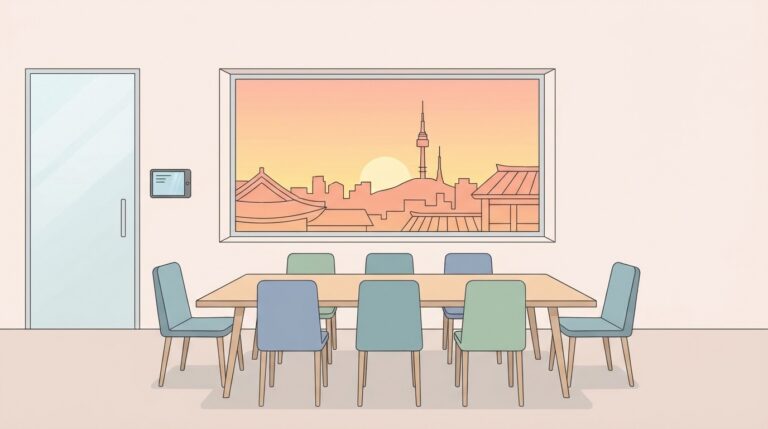
Have you ever watched a high-stakes Korean office drama like Misaeng or King the Land and noticed how frantic characters get over conference rooms? Picture this: Your team leader asks if the meeting room is secured for today’s urgent presentation. You want to confidently announce that everything is set up, perfectly accommodating your team of six for the exact duration needed. But suddenly, your mind freezes. How do you describe room capacity? What is the natural way to say you’ve already completed the reservation without sounding like an automated email?
Many beginner learners struggle with compound business sentences that connect numbers, locations, and past actions. In this guide, drawn directly from real workplace coaching sessions, you will master the exact phrase: 6명이 들어갈 수 있는 3층 중회의실을 두 시간 동안 예약해 두었습니다 (I booked the 3rd-floor medium conference room that seats 6 people for two hours). By the end of this article, you will handle office scheduling like a pro, earning praise for your sharp business Korean and your impeccable workplace cultural manners!
Phase 2: Core Expressions Breakdown
1. 6명이 들어갈 수 있는 회의실 (Yuk-myeong-i deureogal su inneun hoeuishil)
- Pronunciation: [Yuk-myeong-i deu-reo-gal su in-neun hoe-ui-shil] (Think: “Yook-myung-ee dew-ruh-gahl soo een-noon hweh-ee-sheel”)
- Meaning: Literal: “Meeting room where six people can enter” / Nuance: “A conference room that seats six people.”
- K-Culture Moment: In corporate K-dramas, you often hear the junior associate reporting room capacity using
~명이 들어갈 수 있는when cross-checking with the guest list. - Editor’s Insight: The pattern
[Verb stem] + (으)ㄹ 수 있는 [Noun]describes an object’s capability or capacity. Instead of clumsily saying “This room is big enough,” attaching this modifier directly to회의실shows polished grammar. - Situation Spectrum: Casual: ⚠️ | Semi-formal: ✅ | Formal: ✅
- 🤔 Think About It: Notice how Korean emphasizes the action of people entering and fitting (
들어갈 수 있는) rather than using a static verb like “seats” or “holds”. How does your native language describe space capacity?
2. 예약해 두었습니다 (Yeyakhae dueotseumnida)
- Pronunciation: [Ye-yak-hae du-eot-seum-ni-da] (Think: “Yeh-yahk-heh doo-uht-soom-nee-dah”)
- Meaning: Literal: “I reserved and put/left it” / Nuance: “I have booked it in advance (and it remains secured).”
- K-Culture Moment: When a manager asks, “Did you take care of that room?”, an efficient assistant answers with
-해 두었습니다to assure the manager they do not need to worry. - Editor’s Insight: The helper verb
-아/어 두다indicates doing an action in advance and maintaining that finished state. Saying simply예약했습니다means “I reserved it,” but예약해 두었습니다delivers the nuance: “I took care of it beforehand for our upcoming use.” - Situation Spectrum: Casual: 🚫 | Semi-formal: ⚠️ | Formal: ✅
- 🤔 Think About It: Why does Korean workplace communication value grammatical markers that highlight proactive foresight?
3. 두 시간 동안 쓸 수 있어요 (Du sigan dongan sseul su isseoyo)
- Pronunciation: [Du si-gan dong-an sseul su i-sseo-yo] (Think: “Doo shee-gahn dong-ahn sool soo ee-ssuh-yo”)
- Meaning: Literal: “Can use during two hours” / Nuance: “We can use it for two hours.”
- K-Culture Moment: Colleagues chatting over instant messenger or coffee right before a workshop, sharing how much block time they actually have available.
- Editor’s Insight:
동안means “during” or “for a period of time.” When paired with쓸 수 있어요(can use), it conveys clear boundary-setting so teammates know when the presentation must wrap up. - Situation Spectrum: Casual: ✅ | Semi-formal: ✅ | Formal: ⚠️
- 🤔 Think About It: Specifying precise timeframes upfront avoids schedule clashes in high-density office environments like Seoul’s Gangnam or Yeouido tech hubs.
Phase 3: Textbook Korean vs. Real Korean
Situation 1: Telling your team the room is booked
- 📖 교과서 한국어 (Textbook Korean): 회의실을 예약했습니다. (Hoeuishireul yeyakhaetseumnida.) – I reserved the meeting room.
- 🗣️ 진짜 한국어 (Real Korean): 회의실 예약 잡아 뒀습니다! (Hoeuishil yeyak jaba dwotseumnida!) – I locked down the meeting room reservation already!
- 💡 왜 다를까? (Why the difference?): In daily office talk, Koreans frequently use the vivid verb
잡다(to grab/hold) alongside-아/어 두다to mean “securing a spot/slot ahead of time.”
Situation 2: Asking what time works best for everyone
- 📖 교과서 한국어 (Textbook Korean): 몇 시에 회의를 시작합니까? (Myeot sie hoeuireul sijakhapnikka?) – What time do you start the meeting?
- 🗣️ 진짜 한국어 (Real Korean): 몇 시가 편하세요? (Myeot siga pyeonhaseyo?) – What time is most comfortable for you?
- 💡 왜 다를까? (Why the difference?): Asking when someone is “comfortable” (
편하다) reflects Korean workplace etiquette that prioritizes politeness and respect for the other person’s schedule.
Phase 4: K-Culture Deep Dive & Non-verbal Etiquette
4-1. Nunchi & Physical Etiquette in Meeting Rooms
In Korean corporate settings, booking a room is only half the battle. Your 눈치 (Nunchi – situational awareness) matters just as much:
* The 5-Minute Grace Exit: Even if you booked the room until 3:00 PM, etiquette dictates wrapping up by 2:55 PM. Leaving the whiteboard wiped clean and chairs tucked in is expected courtesy for the next group.
* Two-Handed Device Handling: When hooking up a laptop or handing an HDMI cable to a senior colleague, use both hands or support your right forearm with your left hand.
* Room Hierarchy: Never take the “head of the table” (상석 – sangseok) or the seat furthest from the entrance unless directed; that spot is traditionally reserved for the highest-ranking manager or client.
4-2. Culture Code: The Art of “센스” (Sense)
In Korea, being praised as someone with 센스 (sense) is the highest workplace compliment. Having “sense” means anticipating needs before being told: turning on the air conditioner or heater five minutes early, checking that the projector remote works, and setting up notepads and water bottles before attendees arrive.
Phase 5: Real-world Roleplay Scenario
- Setting: 10:00 AM at a tech startup in Pangyo. Team Leader Min (민 팀장님), known for being punctual, approaches your desk before a client sync.
민 팀장 (Team Leader Min): 민우 씨, 오늘 오후 바이어 미팅 준비는 다 됐어요?
(Minwoo-ssi, oneul ohu baieo miting junbineun da dwaesseoyo?)
“Minwoo, is everything ready for the buyer meeting this afternoon?”
🎭 Looking up from his tablet with an inquisitive, expectant glance
민우 (You): 네, 팀장님! 6명이 들어갈 수 있는 3층 중회의실을 두 시간 동안 예약해 두었습니다.
(Ne, timjangnim! Yuk-myeong-i deureogal su inneun sam-cheung junghoeuishireul du sigan dongan yeyakhae dueotseumnida.)
“Yes, Team Leader! I booked the 3rd-floor medium conference room that seats 6 people for two hours.”
🎭 Standing up slightly, holding the printed meeting agenda with both hands
민 팀장 (Team Leader Min): 아, 그래요? 3층 중회의실에 빔프로젝터 잘 작동하죠?
(A, geuraeyo? Sam-cheung junghoeuishire beam-projector jal jakdonghajyo?)
“Ah, really? The beam projector in the 3rd-floor room works fine, right?”
🎭 Nodding with a satisfied smile
민우 (You): 네, 케이블이랑 스크린 작동 여부도 미리 확인해 뒀습니다.
(Ne, keibeur-irang seukeurin jakdong yeobudo miri hwaginhae dwotseumnida.)
“Yes, I already verified that the cables and projector screen are working properly.”
🎭 Answering in a steady, confident tone
민 팀장 (Team Leader Min): 역시 민우 씨 센스 있네. 미팅 자료는 몇 부 출력할까요?
(Yeoksi Minwoo-ssi senseu inne. Miting jaryoneun myeot bu chullyeokhalkkayo?)
“As expected, you’ve got great sense, Minwoo. How many copies of the agenda should we print?”
🎭 Relaxing his posture and giving an approving nod
민우 (You): 참석자가 5명이니까 여유 있게 7부 뽑아 놓겠습니다.
(Chamseokjaga daseot-myeong-inikka yeoyu itge ilgop bu ppoba nokeotseumnida.)
“Since there are 5 attendees, I will print 7 copies just in case.”
🎭 Making a quick note on a memo pad
민 팀장 (Team Leader Min): 완벽해요. 그럼 2시 50분에 3층에서 봐요!
(Wanbyeokhaeyo. Geureom du-si osip-bune sam-cheung-eseo bwayo!)
“Perfect. See you on the 3rd floor at 2:50 PM then!”
🎭 Smiling warmly before turning toward his office
민우 (You): 네, 미리 가서 세팅해 놓겠습니다!
(Ne, miri gaseo setinghae nokeotseumnida!)
“Yes, I will go down ahead of time and set everything up!”
🎭 Giving a polite 30-degree bow
🔀 Interactive Decision Point
Team Leader Min suddenly texts you: “Our client wants to bring two additional engineers. Can our room hold 8 people?” How do you respond?
* Option A: “죄송하지만 6인실이라서 안 됩니다.” (Sorry, but it’s a 6-person room so no.)
* Option B: “제가 지금 바로 대회의실로 변경 가능한지 확인해 보겠습니다!” (I will check right now if we can switch to the large conference room!)
* Option C: “그냥 의자 두 개 더 가져오면 돼요.” (We can just drag two more chairs inside.)
Feedback:
* Option A (Bad): Too rigid. In Korean business culture, flat-out refusing without offering an alternative shows a lack of initiative.
* Option B (Best!): Professional and proactive. You acknowledge the change immediately and seek an accommodating solution.
* Option C (Risk): Squeezing extra chairs into a small room makes important clients feel cramped and unwelcomed.
Phase 6: 10-Second Emotion Shadowing Drill
Practice these lines out loud, matching the rhythm and emotional cues marked by / pauses:
[💼 프로페셔널하고 차분하게 - Professional and Composed]
6명이 들어갈 수 있는 / 3층 중회의실을 / 두 시간 동안 / 예약해 두었습니다.
(Yuk-myeong-i deureogal su inneun / sam-cheung junghoeuishireul / du sigan dongan / yeyakhae dueotseumnida.)-
[⚡ 신속하고 든든하게 - Quick and Dependable]
제가 지금 바로 / 빈 회의실이 있는지 / 체크해 볼게요!
(Jega jigeum baro / bin hoeuishiri inneunji / chekeuhae bolgeyo!) -
[🤝 공손하고 깔끔하게 - Courteous and Crisp]
회의 시작 10분 전에 / 미리 가서 / 세팅해 놓겠습니다.
(Hoeui sijak sip-bun jeone / miri gaseo / setinghae nokeotseumnida.)
Phase 7: K-Culture Mini Dictionary
- 중회의실 (Junghoeuishil) | Medium Conference Room
- Essential workplace vocabulary. Meeting rooms are usually split into 소회의실 (small: 2–4 people), 중회의실 (medium: 6–10 people), and 대회의실 (large/boardroom: 12+ people).
- 사전 준비 (Sajeon junbi) | Advance Preparation
- A vital Korean organizational value. Doing thorough sajeon junbi prevents unexpected technical or seating hiccups.
- 세팅하다 (Setinghada) | To set up (Konglish)
- Widely used in Korean offices for getting equipment, presentations, water bottles, and hand-outs ready before a session.
- 예약 현황판 (Yeyak hyeonhwangpan) | Room Reservation Status Board
- Refers to the tablet display mounted outside meeting rooms showing current occupancy and reservations.
Phase 8: Survival Kit for Travelers & Expats
Top 3 Survival Expressions for Shared Spaces & Study Cafes
- 혹시 여기 예약되어 있나요? (Hoksi yeogi yeyakdoe-eo innayo?)
- Is this space reserved by any chance?
- Pro Tip: Perfect when checking open cubicles in Korean coworking hubs or study cafes.
- 두 시간 이용권으로 결제할게요. (Du sigan iyong-gwoneuro gyeoljehalgeyo.)
- I would like to pay for a two-hour pass, please.
- Pro Tip: Standard phrase when using modern hourly workspace kiosks in Seoul.
- 빔프로젝터 연결선 어디에 있어요? (Beam-projector yeongyeolseon eodie isseoyo?)
- Where is the projector connection cable?
- Pro Tip: Useful when the HDMI adapter is tucked away inside a conference desk pod.
Editor’s Travel Note
Need to find a quiet space for a remote Zoom meeting while traveling in Korea? Check out hourly rental apps such as using the 스페이스클라우드 회의실 예약 플랫폼 확인하기 or searching for nearby coworking spots via 네이버 지도 앱 다운로드. Both platforms let you filter rooms by capacity, projector availability, and soundproofing.
Phase 9: “한 발 더 깊이” (One Step Deeper)
In Korean corporate life, scheduling is fundamentally about 배려 (Baeryeo – consideration for others). When you announce that a room has been reserved using the structure -아/어 두다, you are sending a subtle social signal: “I respect your time, and I have already cleared away friction so our team can succeed together.” Korean companies operate with remarkable collective speed (빨리빨리), but that speed is only possible because junior and senior members alike prioritize invisible groundwork.
💬 Your Turn: How are meeting reservations handled in your home culture? Do people casually grab open rooms, or is every minute reserved days in advance? Share your thoughts below!
Phase 10: FAQ & Avoiding Misunderstandings
Q: What is the difference between ‘예약했어요’ and ‘예약해 뒀어요’?
A: While 예약했어요 simply states the past fact that you booked a room, 예약해 뒀어요 (or formally 예약해 두었습니다) highlights that you completed the booking ahead of time specifically so it is ready and waiting for current or future use.
Q: Can I use ‘사람’ instead of ‘명’ when stating room capacity?
A: While people understand 6사람 in casual conversation, 명 (myeong) is the standard, polite counter for counting people. In business contexts, always say 6명 (yuk-myeong).
Q: How do I say ‘room for two hours’ versus ‘two o’clock’?
A: Remember that 두 시 means “two o’clock” (a specific point in time), whereas 두 시간 means “two hours” (a duration of time). To say “for two hours,” combine it with 동안: 두 시간 동안.
🚨 Common Mistakes Alert
- ❌ Mistake 1: Saying “두 시 동안 예약했어요” when you mean two hours.
- 👉 Correct Action: Say
두 시간 동안(Du sigan dongan) for duration, and save두 시for points on the clock.
- 👉 Correct Action: Say
- ❌ Mistake 2: Using informal endings with your team lead (e.g., “예약해 뒀어”).
- 👉 Correct Action: Always keep the formal polite ending
-습니다or polite-어요:예약해 두었습니다or예약해 뒀어요.
- 👉 Correct Action: Always keep the formal polite ending
- ❌ Mistake 3: Forgetting to wipe the digital board or turn off the screen when leaving.
- 👉 Correct Action: Always leave the room in its original state 5 minutes before your time expires to demonstrate professional 눈치.
Phase 11: Action Missions & Engagement
- 🥉 Bronze Mission (Solo Practice): Read our 10-second shadowing drill aloud 3 times, paying close attention to the pause after
중회의실을. - 🥈 Silver Mission (Community Share): Leave a comment below translating this sentence into Korean: “I booked a 4-person room for one hour.”
- 🥇 Gold Mission (Real Life Application): The next time you visit a Korean cafe, library, or coworking space, ask the staff: “혹시 4명이 들어갈 수 있는 자리 있어요?” (Do you have a spot that fits 4 people?)
- 🎮 K-Culture Mission: Watch an episode of an office K-drama (like Misaeng or Agency) and listen for when characters say words containing
회의실or예약!
Phase 12: Interactive Quiz Challenge
Q1. (Scenario Judgment) Your supervisor asks if the presentation room is ready. Which sentence sounds most proactive and professional?
a) 회의실에 그냥 가요. (Let’s just go to the meeting room.)
b) 회의실을 두 시간 동안 예약해 두었습니다. (I booked the conference room for two hours in advance.)
c) 몇 시에 회의할 건가요? (What time are you going to hold the meeting?)
Q2. (Fill in the Blank) Complete the sentence: “A room that fits 8 people”
8명이 [ ] 회의실
Q3. (True or False) In Korean offices, leaving a meeting room exactly at your scheduled end time with the lights still on is considered polite behavior. (True / False)
👉 Click to reveal answers & explanations!
- A1: b) 회의실을 두 시간 동안 예약해 두었습니다. It uses the proactive
-해 두었습니다structure to give reassurance. - A2: 들어갈 수 있는 (deureogal su inneun – capable of entering/fitting).
- A3: False! Korean workplace manners expect you to finish 5 minutes early, clean the whiteboard, turn off projectors, and tuck in chairs.
🎬 Watch Our Daily Videos! (Daily Hangul Official Instagram)
Review the expressions you learned in this article with our fun daily short videos! Check out native pronunciation and real-life nuances in action.
- Instagram @dailyhangul_en






