

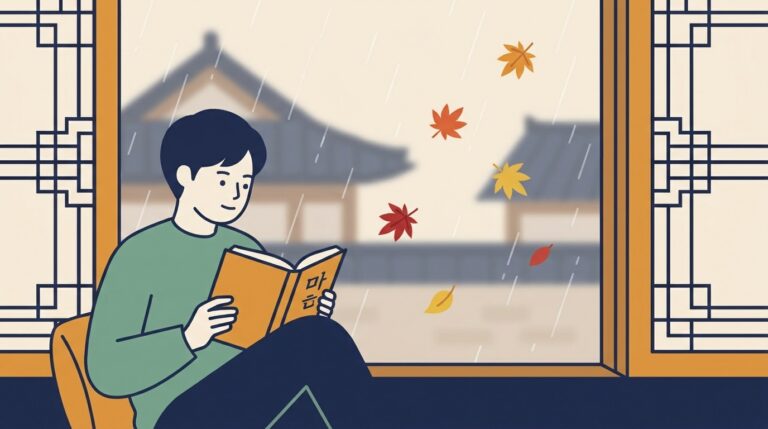
Phase 1: 공감 (Story-driven Opening)
안녕하세요! 매일한글 에디터입니다.
Have you ever walked through the quiet, rain-slicked alleys of Paju Book City or browsed the dimly lit corner of an indie bookstore in Yeonnam-dong, holding a Korean modern novel like Han Kang’s Human Acts (소년이 온다) or Cho Se-hui’s The Dwarf (난장이가 쏘아올린 작은 공), only to feel a profound, heavy silence settle over your chest? You understand all the individual vocabulary words—you’ve passed TOPIK Level 6, you read editorial columns with ease, and you know how to dissect relative clauses. Yet, when you try to discuss the novel in a Korean literary seminar or with Korean friends at a wine salon, you suddenly freeze.
You want to say something far more profound than “The story was sad.” You want to articulate how Korean literature refuses to look away from historical trauma—how division literature (분단문학) and industrialization narratives (산업화 서사) evolved into an unflinching, intimate exploration of the fragile individual ego. One of our C2 learners, Julien from Paris, once confessed: “I knew all the political facts about the Gwangju Uprising and the 1970s labor struggles, but when I tried to express how the author handled human dignity, I sounded like a dry history textbook. I lacked the poetic, critical discourse markers that native Korean intellectuals use effortlessly.”
That stops today. Navigating high-register literary Korean isn’t about memorizing archaic idioms; it’s about mastering the exact linguistic brushstrokes that capture “holding an unflinching gaze at fragile dignity.” By the end of this guide, you will possess the authentic, nuanced vocabulary required to analyze contemporary Korean fiction with the sensitivity and depth of a Seoul literary critic. Let’s step beyond grammar drills and dive right into the soul of Korean storytelling.
Phase 2: 핵심 표현 3선 심층 분석
1. 끝내 응시하다 (Kkeutnae eungsihada)
- Pronunciation: [Kkeut-nae eung-si-ha-da] (Think of kkeut like ‘cut’ with a sharp ‘k’, nae like ‘net’ without the ‘t’, and eung-si like saying ‘ung’ in ‘lung’ followed by ‘she’)
- Meaning: Literally “to stare until the very end,” but contextually “to hold an unflinching gaze on an uncomfortable, painful reality without looking away.”
- K-Culture Moment: Frequently used by literary critics on KBS’s book broadcast Book with Readers or in cultural essays to describe authors who do not grant cheap happy endings, choosing instead to bear witness to systemic trauma.
- Editor’s Insight: In everyday English, we might say “confronting the truth,” but in literary Korean, 응시하다 implies an intense visual and ethical commitment. Adding 끝내 (to the bitter end, despite all odds) elevates the verb into a moral stance—refusing ethical cowardice.
- Situation Spectrum: Casual 🚫 | Semi-formal ⚠️ | Formal/Literary ✅
- 🤔 Think About It: Why does Korean culture value “not averting one’s eyes” (외면하지 않음) over hasty reconciliation? How does this reflect Korea’s turbulent 20th-century history?
2. 역사의 소용돌이에 휩쓸리다 (Yeoksa-ui soyongdori-e hwipsseullida)
- Pronunciation: [Yeok-sa-eui so-yong-do-ri-e hwip-sseul-li-da] (Yeok-sa sounds like ‘yuck-sah’, so-yong-do-ri rolls like ‘so-young-doh-ree’, and hwipsseullida feels like a sudden whip of wind: ‘whip-seul-lee-dah’)
- Meaning: Literally “to be swept up into history’s whirlpool”; nuanced as “being utterly powerless as an individual against the crushing momentum of macro-historical tragedy.”
- K-Culture Moment: The quintessential motif in period dramas like Mr. Sunshine or Pachinko, where ordinary people’s intimate romances and domestic dreams are shattered by colonization, division, or war.
- Editor’s Insight: Notice the passive-causative dynamic in 휩쓸리다. The grammatical structure places the individual as an affected subject rather than an agent. It evokes visceral empathy rather than passing judgment on human vulnerability.
- Situation Spectrum: Casual 🚫 | Semi-formal ⚠️ | Formal/Literary ✅
- 🤔 Think About It: In Western narratives, protagonists often triumph over historical adversity. Why do Korean literary masterworks emphasize the sheer devastation of the individual caught in macro-forces?
3. 부서지기 쉬운 존엄을 보듬다 (Buseojigi swiun joneom-eul bodeumda)
- Pronunciation: [Bu-seo-ji-gi swi-un jo-neom-eul bo-deum-da] (Bu-seo-ji-gi rhymes with ‘boo-ser-jee-gee’, swi-un like ‘she-oon’, and bo-deum-da sounds gentle and warm: ‘boh-deum-dah’)
- Meaning: Literally “to embrace/cradle fragile dignity”; nuanced as “extending tender, empathetic solidarity toward human souls battered by violence.”
- K-Culture Moment: Heard in director interviews at the Busan International Film Festival (BIFF) or in literary commentary discussing contemporary female authors like Han Kang, Kim Ae-ran, or Choi Eun-young.
- Editor’s Insight: 보듬다 is a tactile, maternal word—it means to wrap one’s arms around someone to keep them warm or protect them from falling. Pairing it with 부서지기 쉬운 존엄 (fragile dignity) produces an evocative contrast between brutal destruction and delicate human love.
- Situation Spectrum: Casual 🚫 | Semi-formal ✅ | Formal/Literary ✅
- 🤔 Think About It: How does your native language describe the protection of human dignity? Is it legalistic (defending rights) or relational and tactile (embracing/cradling), like in Korean?
Phase 3: 교과서 한국어 vs 진짜 한국어
Situation 1: Expressing how deeply a tragic novel affected you
- 📖 교과서 한국어 (Textbook Korean):
이 소설은 비극적 역사 속에서 인간 소외를 다루어 감동적입니다. (I soseor-eun bigeukjeok yeoksa sog-eseo ingan sowaereul darueo gamdongjeog-imnida.)
“This novel is touching because it deals with human alienation in tragic history.” - 🗣️ 진짜 한국어 (Authentic C2 Korean):
거대한 역사의 폭력 앞에서 한 인간이 어떻게 바스러지는지, 끝내 시선을 거두지 않고 집요하게 파고들더라고요. (Geodaehan yeoksa-ui pongnyeok ap-eseo han ingan-i eotteoke baseureojineunji, kkeutnae siseon-eul geoduji anko jibyohage pagodeuldeoragoyo.)
“It relentlessly delves into how a human being shatters before history’s colossal violence, refusing to avert its gaze until the very end.” - 💡 왜 다를까? (Why the difference?):
Textbook Korean relies on bland, abstract Sino-Korean nouns (소외, 감동). Educated native speakers and critics use sensory, kinetic native verbs (바스러지다, 시선을 거두다, 파고들다) to create vivid resonance.
Situation 2: Analyzing a character’s lingering psychological grief
- 📖 교과서 한국어 (Textbook Korean):
주인공의 슬픈 마음이 오랫동안 기억에 남습니다. (Juingong-ui seulpeun ma-eum-i oraedong-an gieog-e namsumnida.)
“The protagonist’s sad heart remains in my memory for a long time.” - 🗣️ 진짜 한국어 (Authentic C2 Korean):
주인공이 짊어진 내면의 상흔이 책장을 덮은 뒤에도 긴 여운으로 먹먹하게 맴돌아요. (Juingong-i jilmeojin naemyeon-ui sangheun-i chaekjang-eul deopeun dwie-do gin yeo-un-euro meongmeokhage maemdora-yo.)
“The interior scars carried by the protagonist linger like a heavy, suffocating resonance long after closing the book.” - 💡 왜 다를까? (Why the difference?):
Adult Korean literary discussion replaces elementary terms like 슬프다 with visceral emotional concepts like 상흔 (scars), 먹먹함 (choked-up silence), and 여운 (lingering reverberation).
Phase 4: K-Culture 딥다이브 & 비언어적 매너
4-1. 눈치(Nunchi) & Somber Intellectual Decorum
When discussing literary narratives involving real historical trauma—such as the Korean War, the April 3 Jeju Uprising, the May 18 Gwangju Democratization Movement, or the Sewol Ferry tragedy—vocal delivery and physical body language shift drastically.
* The Gentle Lowering of the Gaze (시선 떨구기): When bringing up victims of historical violence, avoid wide, animated gestures or beaming smiles. Maintain a reflective posture, gently tilting your head down slightly and lowering vocal pitch.
* Strategic Silence (말을 아끼는 침묵): In Korean aesthetic discussions, pauses are communicative. Taking a 2-second breath before completing a phrase like “…참 먹먹한 결말이었어요” demonstrates that you are internalizing the gravity of the work, rather than treating human suffering as mere academic trivia.
4-2. Cultural Code: The Narrative Shift from Macro to Micro
Korean modern fiction underwent a monumental tectonic shift:
1. 1950s–1980s (Division & Industrialization): Fiction was dominated by collective ideology, physical survival, and social justice. Authors portrayed systemic brutality—think of the divided village in The Rainy Spell (장마) or factory laborers displaced by rapid modernization in The Dwarf (난장이가 쏘아올린 작은 공).
2. 1990s–Present (Postmodern Interiority & Ethical Witnessing): Following democratization, the focus shifted from sweeping macro-ideologies to individual psychological fractures. Works by authors like Han Kang, Shin Kyung-sook, and Kim Young-ha explore how historical violence imprints itself on the body, memory, and everyday domestic spaces. Human dignity is no longer fought for on barricades; it is tended to in quiet, haunted rooms.
Phase 5: 실전 롤플레이 시나리오
Setting: A quiet independent book salon in Hapjeong, Seoul, on a rainy Thursday evening. You are sitting across from Min-seo, a seasoned literary editor and book curator, discussing contemporary historical fiction.
- 민서: 이번에 읽은 소설, 1980년대를 다뤘잖아요. 독자 입장에서 전개가 다소 무겁게 느껴지진 않으셨어요? (Ibeon-e ilgeun soseol, cheon-gubaek-palsimnyeondae-reul daryeotjanh-ayo. Dokja ipjang-eseo jeon-gaega daso mugeopge neukkyeojijin aneusyeosseoyo?)
“The novel we read this time dealt with the 1980s. As a reader, didn’t the progression feel a bit overwhelmingly heavy?” -
나 (You): 🎭 (담담하게 고개를 끄덕이며 / Nodding calmly and quietly)
솔직히 책장을 넘기기가 고통스러울 만큼 버거웠어요. (Soljikhage chaekjang-eul neomgigiga gotongseureoul mankeum beogeowosseoyo.)
“Honestly, it was burdensome to the point where turning the pages felt painful.” -
민서: 맞아요. 역사적 비극을 다룬 작품들이 대개 그렇듯, 너무 직접적인 묘사는 독자를 지치게 만들기도 하죠. (Majayo. Yeoksajeok bigeuk-eul darun jakpumdeur-i daegae geureoteut, neomu jikjeopjeogin myosaneun dokjareul jichige mandeulgido hajyo.)
“Exactly. As is often the case with works dealing with historical tragedies, overly direct depictions can sometimes exhaust the reader.” -
나 (You): 🎭 (찻잔을 만지작거리며 시선을 모으고 / Holding the teacup, focusing your gaze thoughtfully)
하지만 단순한 고발에 그치지 않고, 거대한 역사의 폭력 앞에서 부서지기 쉬운 인간의 존엄을 끝내 응시하는 태도가 돋보였어요. (Hajiman dansunhan gobar-e geuchiji anko, geodaehan yeoksa-ui pongnyeok ap-eseo buseojigi swiun ingan-ui joneom-eul kkeutnae eungsihaneun taedoga dotboyeosseoyo.)
“However, it didn’t stop at mere denunciation; its stance of holding an unflinching gaze at fragile human dignity before historical violence was truly remarkable.” -
민서: 🎭 (눈이 커지며 깊이 공감하는 표정으로 / Eyes widening, showing deep empathy)
‘끝내 응시한다’는 표현이 참 와닿네요. 작가가 비극을 감상적으로 소비하지 않았다는 뜻이죠? (Kkeutnae eungsihandaneun pyohyeon-i cham wadanne-yo. Jakgaga bigeuk-eul gamsangjeog-euro sob-ihaji anatdaneun tteus-ijyo?)
“The expression ‘holding an unflinching gaze’ really hits home. You mean the author didn’t sentimentally exploit the tragedy, right?” -
나 (You): 🎭 (차분하고 진중한 어조로 / In a composed, earnest tone)
네. 이념 대신 상처받은 개인의 내면과 먹먹한 고통을 온전히 보듬어 안으려 한 점이 현대 소설다운 서사 전략 같아요. (Ne. Inyeom daesin sangcheobadeun gaein-ui naemyeon-gwa meongmeokhan gotong-eul onjeonhi bodeumeo aneuryeo han jeom-i hyeondae soseoldaun seosa jeollyak gat-ayo.)
“Yes. Cradling the bruised inner self of the individual and their choked grief rather than ideology felt like a truly modern narrative strategy.” -
민서: 그렇군요. 분단이나 산업화 시절의 거대 담론에서 벗어나, 이제는 개인의 실존적 상흔에 귀를 기울이는 셈이네요. (Geureokunyo. Bundann-ina saneuphwa sijeor-ui geodae damnon-eseo beoseona, ijeneun gaein-ui siljonjeok sangheun-e gwireul gi-urineun sem-ine-yo.)
“Indeed. Stepping away from the grand narratives of division and industrialization, literature is now listening closely to the existential scars of the individual.” -
나 (You): 🎭 (옅은 미소를 지으며 마무리 / Ending with a gentle, reflective smile)
바로 그 점이 오늘날 한국 소설이 세계 독자들에게도 깊은 울림을 주는 이유 아닐까요. (Baro geu jeom-i oneulnal hanguk soseor-i segye dokjadeur-egedo gipeun ullim-eul juneun iyu anilkkayo.)
“Isn’t that precise quality why Korean fiction resonates so profoundly with global readers today?”
🔀 인터랙티브 분기점 (Interactive Choice)
At Turn 4, Min-seo asks if direct depictions exhausted you. How would you choose to respond?
- Choice A: “너무 폭력적이라 그냥 드라마처럼 자극적이었어요.” (It was too violent, so it just felt sensational like a drama.)
- Feedback [Bad]: Reduces historical tragedy in literature to simple sensationalism, showing a lack of critical vocabulary.
- Choice B: “역사적 사실만 나열해서 소설로서는 별로 재미가 없었습니다.” (It just listed historical facts, so as a novel it wasn’t very entertaining.)
- Feedback [Risk]: Overly blunt and dismissive of the author’s stylistic intent; risks sounding unsympathetic in a Korean intellectual setting.
- Choice C (Selected): “단순한 고발에 그치지 않고, 거대한 역사의 폭력 앞에서 부서지기 쉬운 인간의 존엄을 끝내 응시하는 태도가 돋보였어요.”
- Feedback [Best]: Demonstrates impeccable C2 critical judgment, acknowledging the thematic weight and ethical dignity of the text.
Phase 6: 10초 감정 섀도잉 드릴
Read these sentences aloud following the emotional markers and breath pauses (/):
[😔 묵직하고 담담하게 / Heavy, calm, and solemn]
거대한 역사의 폭력 앞에서 / 한 인간이 느끼는 무력감은 / 결코 가볍지 않습니다.
(Geodaehan yeoksa-ui pongnyeok ap-eseo / han ingan-i neukkineun muryeokgam-eun / gyeolko gabyeopji ansumnida.)
“Before the massive violence of history / the powerlessness an individual feels / is never trivial.”-
[🌿 차분하지만 단호하게 / Serene yet resolute]
작가는 비극을 외면하지 않고 / 끝내 응시함으로써 / 부서진 존엄을 보듬어 안습니다.
(Jakganeun bigeuk-eul oemyeonhaji anko / kkeutnae eungsiham-eorosseo / buseojin joneom-eul bodeumeo ansumnida.)
“Without turning away from tragedy / by holding an unflinching gaze to the end / the author cradles broken dignity.” -
[🥺 깊은 여운을 머금고 / Carrying deep, lingering poignancy]
책장을 덮은 뒤에도 / 그 먹먹한 침묵이 / 가슴속을 오랫동안 맴돕니다.
(Chaekjang-eul deopeun dwie-do / geu meongmeokhan chimmug-i / gaseumsog-eul oraedong-an maemdomnida.)
“Even after closing the book / that choked silence / lingers deep within the heart for a long time.”
Phase 7: K-Culture 미니 사전
-
한 (恨 – Han)
- Translation: Sorrow, accumulated grief, unavenged injustice.
- Usage: Beyond simple sadness, Han represents the collective, historically conditioned melancholy of the Korean people. In modern literature, it is not merely passive suffering, but an active yearning for restoration.
- 먹먹함 (Meongmeokham)
- Translation: A choked-up, heavy state of emotional speechlessness.
- Usage: Used when art or reality renders you unable to speak because your chest feels full of sorrow. “결말을 읽고 가슴이 먹먹해졌다” (“My chest felt heavy and choked after reading the ending”).
- 소외 (疏外 – Sowae)
- Translation: Alienation, marginalization.
- Usage: Key term in 1970s–80s industrialization literature (산업화 소설), referring to how manual workers and rural migrants were alienated from Korea’s economic miracle.
- 거대 담론 (巨大 言論 – Geodae Damnon)
- Translation: Grand narrative / Macro-discourse.
- Usage: Used in literary criticism to refer to overarching political/historical ideologies (nationalism, anti-communism, democratization) which dominated 20th-century literature prior to the postmodern turn toward individual interiority.
Phase 8: 여행자를 위한 생존 키트 (Literary Traveler Edition)
Survival Expressions for Independent Bookstores & Cafés
- 혹시 한국 현대 소설 코너는 어디에 마련되어 있나요?
(Hoksi hanguk hyeondae soseol koneo-neun eodie maryeondoe-eo innayo?)
Pro Tip: Use 마련되어 있나요 instead of 있어요 when visiting curated indie bookstores in Seochon or Yeonnam-dong. It honors the curator’s deliberate arrangement. -
역사적 배경을 섬세하게 다룬 작품을 추천받을 수 있을까요?
(Yeoksajeok baegyeong-eul seomsehage darun jakpum-eul chucheonbadeul su isseulkkayo?)
Pro Tip: This will immediately prompt bookstore owners to recommend literary award winners rather than commercial bestsellers. -
이 책, 읽고 나면 여운이 길게 남는 편인가요?
(I chaek, ilgo namyeon yeo-un-i gilge namneun pyeon-in-gayo?)
Pro Tip: Asking about 여운 (lingering aftertaste/resonance) signals your advanced literary sensitivity.
Editor’s Travel Note: Exploring Seoul’s Literary Geometry
When in Seoul, bypass the crowded malls and take the subway to Hapjeong Station (Lines 2 & 6) or Anguk Station (Line 3). Wander through the quiet book-cafes of Seochon or explore Paju Book City just north of Seoul. Before setting out, ensure you have set up your route via Naver Map App navigation using Korean search terms like 독립서점 (independent bookstore) or 인문학 북카페 (humanities book cafe), as Western navigation apps often fail to show these tucked-away intellectual sanctuaries.
Phase 9: “한 발 더 깊이” (생각 질문)
Korean literature possesses a unique ethical imperative: remembering is an act of resistance. In a peninsula compressed by colonization, fratricidal war, military dictatorships, and hyper-rapid industrialization in under a single century, the human soul was frequently treated as collateral damage. When contemporary Korean authors depict characters undergoing extreme internal crisis, it is not merely self-indulgent psychological drama; it is a collective excavation of historical wounds. By forcing the reader to “gaze unflinchingly” at vulnerable lives, Korean fiction insists that no tragedy may be neatly packaged or forgotten.
💬 Your Turn: How does the literature of your home country treat national trauma? Does it prioritize triumphant recovery, or does it hold a quiet, unflinching gaze on the individual scars left behind? Share your thoughts below in Korean!
Phase 10: FAQ & 오해 방지
Q: Can I use the phrase “끝내 응시하다” in everyday casual conversation with friends?
A: You should avoid it in casual chatter like choosing what to eat or discussing a movie trailer. It carries a heavy, serious philosophical weight. If you use it at a pub over chicken and beer, your friends might jokingly ask: “Are you writing a doctoral thesis?” Save it for book discussions, film reviews, or serious introspective conversations.
Q: What is the exact nuance difference between “외면하다” and “시선을 거두다”?
A: While both mean looking away, 외면하다 carries a strong moral failure of deliberate neglect or turning one’s back on someone in distress. 시선을 거두다 is more literal and literary—”to withdraw one’s gaze.” Saying an author “끝내 시선을 거두지 않았다” implies they maintained their ethical responsibility to bear witness.
Q: Why is modern Korean fiction often perceived as lacking “happy endings”?
A: In the Korean critical tradition, tying up deep historical trauma with a neat, happy ending is often seen as artificial, dishonest, and disrespectful to actual victims. A bittersweet, ambiguous, or 먹먹한 (heavy, choked) ending is regarded as a higher form of literary integrity and respect for human reality.
🚨 흔한 실수 (Common Mistakes) 경고판
- Mistake: Using “소설이 참 불쌍해요” to describe a tragic book.
Correction: A book cannot be 불쌍하다 (pitiful/pathetic). Instead, say: “소설 속 인물의 삶이 참 애달파요” or “처연하게 다가왔어요.” - Mistake: Translating “historical violence” literally as 역사의 폭력성 instead of contextually as 역사의 폭력 앞에서 or 역사의 소용돌이 속에서.
- Mistake: Overusing the verb 보다 (to see) instead of literary perceptual verbs like 포착하다 (capture), 조명하다 (illuminate), or 응시하다 (gaze unflinchingly).
Phase 11: 액션 미션 & 참여 유도
- Bronze Mission (Solo Practice): Shadow-read the Phase 6 drill three times, focusing on breathing slowly and letting the pitch drop naturally at the end of each phrase.
- Silver Mission (Social Media): Find a Korean quote from a novel you admire (e.g., Han Kang or Kim Young-ha) and write a 1-sentence reaction on Instagram or Twitter using the word 먹먹함 or 여운.
- Gold Mission (Real-world Application): Join an online Korean book community (like Brunch or a Naver Book Cafe) or attend an offline book club, and share your review of a novel using: “거대한 역사의 폭력 앞에서 인간의 존엄을 응시하는 시선이 인상 깊었습니다.”
🎮 K-Culture Mission: Watch an episode of a historically rooted Korean drama (like Mr. Sunshine, Youth of May, or Jeongnyeon: The Star Is Born) and identify the moment where the camera pauses on a character’s silent, grieving face. Note down how that silence communicates dignity!
Phase 12: 인터랙티브 퀴즈 챌린지
Test your mastery of C2 literary discourse!
- Situational Judgment: You are participating in a panel discussion on modern Korean division literature. Which phrase best praises an author for dealing honestly with historical trauma without becoming overly sentimental?
- (A) 작가가 역사적 사실을 아주 자극적이고 재미있게 꾸며냈어요.
- (B) 비극을 감상적으로 소비하지 않고, 상처받은 존엄을 끝내 응시하는 태도가 돋보입니다.
- (C) 너무 슬퍼서 아무 생각도 할 수 없게 만드는 전형적인 신파극입니다.
- Fill-in-the-Blank: 빈칸에 가장 알맞은 단어를 넣으세요.
- “그 소설은 1970년대 산업화 과정에서 파편화된 개인의 내면적 (_______)을 집요하게 추적한다.”
- (힌트: 상처나 흉터를 뜻하는 고급 한자어)
- True / False: Contemporary Korean postmodern literature deals almost exclusively with grand national political dogmas rather than individual bodily trauma and interior grief. (T / F)
🔍 정답 및 해설 확인하기 (View Answers & Explanations)
- 정답: (B)
해설: (B) accurately praises the author’s ethical commitment (비극을 감상적으로 소비하지 않고, 상처받은 존엄을 끝내 응시하는 태도). (A) sounds superficial, and (C) criticizes the work as cheap melodrama (신파극). -
정답: 상흔 (Sangheun)
해설: 상흔 (scars/wounds) is the standard C2 literary term used to describe the psychological and historical marks left upon an individual’s psyche. -
정답: False
해설: The defining narrative evolution of contemporary Korean literature was precisely the transition away from grand political dogma (거대 담론) toward the vulnerable interiority, psychological scars, and bodily memory of the individual (미시 서사와 내면성).
🎬 Watch Our Daily Videos! (Daily Hangul Official Instagram)
Review the expressions you learned in this article with our fun daily short videos! Check out native pronunciation and real-life nuances in action.
- Instagram @dailyhangul_en







