

Surviving Solo in Seoul: How to Talk About Bills and Living Alone Like a True Local
Phase 1: Empathy (Story-Driven Opening)
안녕하세요! 매일한글 에디터입니다. (Hello! This is your Daily Hangul editor.)
If you have ever watched the K-drama Because This Is My First Life (이번 생은 처음이라) or Age of Youth (청춘시대), you probably remember that magical, cinematic feeling of moving into your very first Seoul apartment. The late-night convenience store ramyeon, decorating a tiny room with fairy lights, having zero curfew—it feels like pure cinematic freedom!
…Until the 25th of the month rolls around.
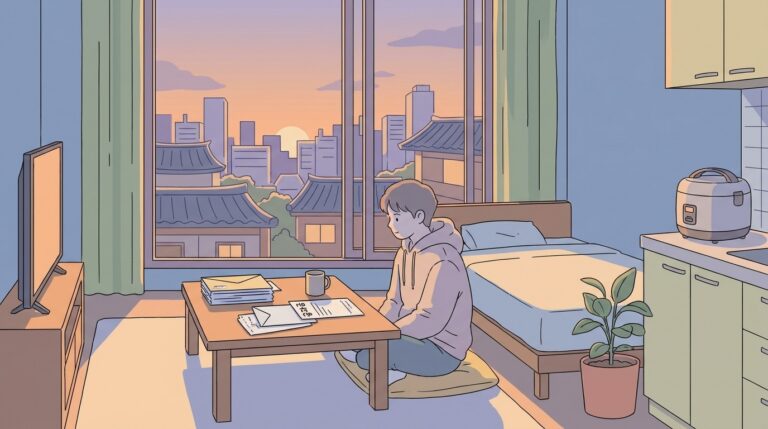
Suddenly, your KakaoPay buzzes with notifications: 월세 (wolse, monthly rent), 관리비 (gwallibi, building maintenance fee), city gas, water, electricity, and that eye-watering grocery bill where two humble apples cost nearly 10,000 KRW. That is the exact moment every solo dweller in Korea whispers to themselves: “Wait… is breathing always this expensive?”
Many of our intermediate learners share this exact pain point: “I know how to say ‘비싸요’ (It’s expensive), but how do I express the heavy, adult reality of carrying all these financial burdens alone without sounding like a robotic textbook?”
Carrying all your living costs solo is a universal rite of passage, but in Korean culture, discussing it comes with a unique mix of dark humor, deep empathy, and shared adulthood camaraderie. Today’s guide is crafted directly from real conversations of expats and local 20-somethings navigating solo life (jachwi) in South Korea. By the end of this guide, you will be able to talk about your rent, bills, and budget with genuine nuance, emotional depth, and native flair.
Phase 2: Deep Dive into 3 Key Expressions
1. 감당하다 (Gamdanghada)
- Pronunciation: [gam-dang-ha-da] (Think of the word “GUM”, followed by a sharp “DANG”, and “HA-DA”)
- Meaning: Literal: “To bear / to handle” | Actual Nuance: To shoulder a weighty responsibility or financial burden through endurance and grit.
- K-Culture Moment: In youth dramas like Itaewon Class, when a young character takes on a massive business loan or family debt, an elder will ask with furrowed brows: “혼자 감당할 수 있겠어?” (Honja gamdanghal su itgesseo? / Can you truly shoulder that alone?)
- Editor’s Insight: You don’t use 감당하다 for trivial chores like washing dishes. It carries gravity. Pairing it with 오롯이 (orosi, entirely/purely) emphasizes that there is zero safety net—it is all on your shoulders.
- Situation Spectrum:
- Casual: ⚠️ (A bit heavy for light banter, but used when venting sincerely)
- Semi-formal: ✅ (Perfect for heart-to-heart conversations with colleagues or friends)
- Formal: ✅ (Ideal for interviews, essays, and news broadcasts)
- 🤔 Think About It: In many English-speaking cultures, total independence is celebrated as an unalloyed victory. Why does Korean culture often frame complete financial self-reliance with a hint of bittersweet solitude?
2. 만만치 않다 (Manmanchi anta)
- Pronunciation: [man-man-chi an-ta] (Sounds rhythmically like “MAHN-mahn-chee ahn-tah”)
- Meaning: Literal: “Not to be negligible / not easy” | Actual Nuance: “It’s no joke,” “It definitely shouldn’t be underestimated.”
- K-Culture Moment: On the hit reality show I Live Alone (나 혼자 산다), when celebrities open their winter heating bills or buy groceries at a local market, they shake their heads and mutter: “아, 생활비 만만치 않네…” (Ah, saenghwalbi manmanchi anne… / Wow, living expenses are no joke…)
- Editor’s Insight: Korean communication often favors understated elegance over aggressive complaining. Instead of shouting “너무 힘들어요!” (It’s too hard!), saying “만만치 않아요” sounds mature, composed, and instantly relatable.
- Situation Spectrum:
- Casual: ✅
- Semi-formal: ✅
- Formal: ✅
- 🤔 Think About It: Why does using a double-negative understatement (“not easy”) feel more socially polite in Korean than a direct assertion (“extremely difficult”)?
3. 오롯이 (Orosi)
- Pronunciation: [o-ro-si] (Flows smoothly like “OH-ROH-SEE”)
- Meaning: Literal: “Wholly / entirely / in its entirety” | Actual Nuance: Bearing or experiencing something completely on one’s own without any dilution, assistance, or compromise.
- K-Culture Moment: Frequently spotted in introspective Korean essay bestsellers and soothing YouTube life vlogs: “오롯이 나에게 집중하는 시간” (Orosi na-ege jipjunghaneun sigan / Time spent entirely focusing on myself) or “오롯이 혼자 짊어지는 삶의 무게” (The weight of life shouldered entirely alone).
- Editor’s Insight: While 혼자 (honja) simply means “alone,” 오롯이 혼자 adds a poetic, reflective texture that signals intermediate-to-advanced mastery.
- Situation Spectrum:
- Casual: ⚠️ (Can sound slightly literary or poetic in everyday slang)
- Semi-formal: ✅
- Formal: ✅
- 🤔 Think About It: How does the term 오롯이 bridge the gap between traditional Korean collectivism and modern youth individualism?
Phase 3: Textbook Korean vs. Real Korean
Situation 1: Talking about how money disappears non-stop
- 📖 교과서 한국어 (Textbook Korean):
- 생활비가 너무 많이 들어서 힘듭니다. (Saenghwalbiga neomu mani deureoseo himdeumnida. / Living expenses cost too much, so it is difficult.)
- 🗣️ 진짜 한국어 (Real Native Korean):
- 진짜 숨만 쉬어도 돈이 훅훅 나가요. (Jinjja summan swieodo doni hukhuk nagayo. / Seriously, money flies out the door even if I just breathe.)
- 💡 왜 다를까? (Why the difference?):
- Textbook Korean sounds like an official economic report. Real Koreans use the dramatic hyperbole “숨만 쉬어도” (even if I just breathe) combined with the vivid onomatopoeia “훅훅” (the whooshing sound of wind) to turn financial stress into shared laughter.
Situation 2: Explaining that your bank account is empty at the end of the month
- 📖 교과서 한국어 (Textbook Korean):
- 이번 달은 개인 예산이 모두 소진되었습니다. (Ibeon dareun gaein yesani modu sojindoeeotseumnida. / This month, my personal budget has been completely exhausted.)
- 🗣️ 진짜 한국어 (Real Native Korean):
- 월급 들어오자마자 스쳐 지나가서 완전 텅장 됐어요. (Wolgeup deureo-ojamaja seuchyeo jinagaseo wanjeon teongjang dwaesseoyo. / My paycheck grazed my account for a second and vanished; I’m left with a totally empty ‘ghost’ account.)
- 💡 왜 다를까? (Why the difference?):
- 텅장 (teongjang) is an essential modern blend of 텅 빈 (empty) and 통장 (bankbook). Saying your salary 스쳐 지나가다 (merely grazed and passed by) is the ultimate millennial and Gen-Z humor trope in Korea.
Phase 4: K-Culture Deep Dive & Non-Verbal Manners
4-1. 눈치 (Nunchi) & Body Language: The Art of the “Adult Sigh”
When discussing living costs in Korea, balance is everything. If you complain too aggressively, you risk dampening the mood; if you act like money is nothing, you risk sounding out of touch.
- The Forehead Touch & Gentle Sigh: When a Korean friend mentions their heating bill, the classic response is a slow nod, a soft “하아…” (Haaa…), and gently rubbing the back of your neck or touching your temple. This physicalizes shared struggle without melodrama.
- The Mutual Validation Nod: Never answer someone’s financial vent with unsolicited financial advice right away (e.g., “You should just stop buying lattes!”). Instead, match their frequency by saying: “맞아요, 혼자 살면 진짜 그렇죠.” (Majayo, honja salmyeon jinjja geureotjyo. / Exactly, living alone is really like that.)
4-2. Cultural Codes: The “Jachwi” (자취) Paradox
In Korea, 자취 (jachwi, independent living away from family) was historically viewed as temporary—something you only did for university or until marriage. Today, solo households (1인 가구) make up over 34% of the country!
Yet, the infrastructure still catches newcomers off guard. Delivery apps (Baedal-ui Minjok) often have minimum order thresholds of 15,000–20,000 KRW plus delivery fees, making eating alone surprisingly expensive. Meanwhile, the dreaded 관리비 (gwallibi) can fluctuate wildly depending on whether heating is central or individual. Sharing your jachwi struggles is not considered taboo; it is one of the fastest ways to build deep, emotional solidarity (정, jeong) with Korean peers.
Phase 5: Real-Life Roleplay Scenario
Setting: A casual pojangmacha tent near Hapjeong Station on a crisp Thursday evening. You are sharing warm fish cake soup and a drink with your Korean co-worker, Minji.
- Minji: 요즘 얼굴이 좀 피곤해 보여요. 자취 시작하고 잠은 잘 자요?
(Yojeum eolguri jom pigonhae boyeoyo. Jachwi sijakhago jameun jal jayeo?)
“You look a bit exhausted these days. Have you been sleeping well since moving into your own place?” - You:
🎭 한숨을 가볍게 내쉬며 (Gently sighing)
혼자 사니까 자유롭긴 한데, 생각보다 신경 쓸 게 너무 많아요.
(Honja sanikka jayuropgin hande, saenggakboda singyeong sseul ge neomu manayo.)
“Living alone gives me total freedom, but there are way more things to worry about than I imagined.” - Minji: 아, 뭔지 알죠. 청소랑 빨래도 끝이 없잖아요.
(Ah, mwonji aljyo. Cheongsorang ppallae-do kkeuchi eopjanayo.)
“Oh, I know that feeling all too well. The cleaning and laundry just never end, right?” - You:
🎭 영수증 알림을 떠올리며 씁쓸하게 웃음 (Smiling wryly while recalling bill notifications)
그것도 그렇지만, 월세와 관리비, 공과금까지 오롯이 혼자 감당해야 해서 경제적인 부담이 만만치 않아요.
(Geugeotdo geureochiman, wolse-wa gwallibi, gong-gwageum-kkaji orosi honja gamdanghaeya haeseo gyeongjejeogin budami manmanchi anayo.)
“That too, but shouldering rent, maintenance fees, and utilities entirely on my own brings a serious financial burden that’s no joke.” - Minji:
🎭 격하게 고개를 끄덕이며 (Nodding vigorously in agreement)
진짜 격하게 공감해요! 저도 지난달 난방비 나온 거 보고 기절할 뻔했어요.
(Jinjja gyeokhage gonggamhaeyo! Jeodo jinandal nanbangbi naon geo bogo gijeolhal ppeonhaesseoyo.)
“I feel that so deeply! I almost fainted when I saw my gas heating bill last month too.” - You: 맞아요. 배달음식 몇 번 시켜 먹으면 식비도 금방 훅 나가더라고요.
(Majayo. Baedareumsik myeot beon sikyeo meogeumyeon sikbido geumbang huk nagadeoragoyo.)
“Exactly. If I order delivery food just a few times, grocery and food spending shoots up in an instant.” - Minji: 맞아요, 숨만 쉬어도 돈이죠! 우리 이번 주말에 망원시장 가서 같이 장볼래요? 혼자 사는 사람끼리 소분해요!
(Majayo, summan swieodo donijyo! Uri ibeon jumare Mangwon Sijang gaseo gachi jangbollaeyo? Honja saneun saramkkiri sobunhaeyo!)
“Right? Just breathing costs money! Want to hit Mangwon Market together this weekend? We can split bulk groceries between solo dwellers!” - You:
🎭 눈이 번쩍 뜨이며 (Eyes lighting up with gratitude)
와, 정말요? 선배의 자취 꿀팁 전수받으러 꼭 갈게요!
(Wa, jeongmalyo? Seonbae-ui jachwi kkultip jeonsubadeureo kkok galgeyo!)
“Wow, really? I will definitely be there to learn your veteran solo-life survival secrets!”
🔀 Interactive Choice Point
How would you reply if Minji asks: “이번 달 월세 내고 생활비 좀 남았어요?” (Did you have any living expense budget left after paying this month’s rent?)
- Option A: “선배, 저 돈 없으니까 이번 술값 좀 대신 내주시면 안 돼요?”
- Feedback [Bad 🚫]: Asking a colleague or senior friend to pay because you lack money crosses personal boundaries (선 넘는 행동) and puts heavy social pressure on them.
- Option B: “월세 내고 나니까 완전 텅장이라서, 당분간은 허리띠 바짝 졸라매야 해요!”
- Feedback [Best ⭐]: Natural, self-aware, and uses colorful idiomatic slang (텅장, 허리띠를 졸라매다 = tighten one’s belt). It keeps the tone friendly and relatable without burdening the other person.
- Option C: “한국은 왜 이렇게 월세랑 관리비가 비싸요? 이해가 안 가요.”
- Feedback [Risk ⚠️]: Sounds like aggressive cultural complaining rather than personal bonding. Frame expenses as a shared challenge rather than an accusation.
Phase 6: 10-Second Emotion Shadowing Drill
Read these sentences aloud, paying close attention to the pause slashes (/) and emotional cues:
[😮💨 한숨 쉬며 현실 자각 - Sighing with realistic weariness]
월세와 관리비까지 / 오롯이 혼자 감당하려니까 / 부담이 만만치 않아요.
(Wolse-wa gwallibi-kkaji / orosi honja gamdangharyeonikka / budami manmanchi anayo.)-
[💸 억울하면서도 웃프게 - A bit aggrieved yet self-deprecatingly humorous]
진짜 숨만 쉬어도 / 돈이 훅훅 나가서 / 이번 달은 완전 텅장이에요.
(Jinjja summan swieodo / doni hukhuk nagaseo / ibeon dareun wanjeon teongjang-ieyo.) -
[🤝 공감대를 형성하며 따뜻하게 - Warmly seeking mutual understanding]
혼자 사는 자유는 좋은데 / 모든 생활비를 혼자 감당하는 건 / 참 벅차네요.
(Honja saneun jayuneun joeunde / modeun saenghwalbireul honja gamdanghaneun geon / cham beokchaneyo.)
Phase 7: K-Culture Mini Dictionary
- 자취 (Jachwi)
- Meaning: Living independently away from family (literally “cooking for oneself”).
- Usage: Refers exclusively to unmarried young adults, university students, or working professionals renting a studio or one-room on their own.
- 텅장 (Teongjang)
- Meaning: An empty bank account (Portmanteau of 텅 빈 [empty] + 통장 [bankbook]).
- Usage: Essential internet and casual conversation slang used right after rent, utility bills, or credit card bills clear.
- 관리비 (Gwallibi)
- Meaning: Building maintenance fees.
- Usage: In Korean rental contracts, rent (월세) and 관리비 are separate. Always ask what it covers (elevator maintenance, cleaning, internet, water, or building security).
- 엔빵 / N빵 (N-ppang)
- Meaning: Splitting the bill evenly (dividing by ‘N’ people).
- Usage: Casual slang used among friends or colleagues at cafes and casual dinners (“우리 이거 N빵 하자!” = Let’s split this bill evenly!).
Phase 8: Survival Kit for Travelers & Expats
TOP 3 Survival Phrases for Rental & Bills
- 관리비에 수도세랑 인터넷 포함인가요?
- Pronunciation: Gwallibie sudosyerang inteonet pohamingayo?
- Meaning: “Are the water bill and internet included in the maintenance fee?”
- Pro Tip: Crucial when signing a contract at a local real estate agency (부동산).
- 공과금 고지서는 어디로 나오나요?
- Pronunciation: Gong-gwageum gojiseoneun eodiro naonayo?
- Meaning: “Where do the utility bill notices get delivered?”
- Pro Tip: Ask whether bills arrive in your physical mailbox, by text message, or via KakaoTalk notification.
- 영수증은 버려주세요.
- Pronunciation: Yeongsujeungeun beoryeojuseyo.
- Meaning: “Please throw away the receipt.”
- Pro Tip: The standard native phrase at marts and convenience stores when you don’t need a paper slip.
Editor’s Expat Note
To keep utility bills from shocking you in winter, set your floor heating (ondol) to 외출 (oechul, “away” mode) rather than turning it off completely; turning it back on from ice-cold consumes double the gas!
For seamless apartment living, use 네이버 지도 앱 다운로드 to locate local discount marts (식자재마트) where fresh produce is nearly half the price of large department supermarkets. For automated bill tracking and split payments with roommates, check out 토스(Toss) 금융 앱 서비스.
Phase 9: “한 발 더 깊이” (One Step Deeper)
In traditional Korean culture, the home was rarely viewed as an individual playground; it was the nexus of family life, communal warmth, and shared tables (식구, literally “mouths that eat together”). The rapid surge of the 1인 가구 (single-person household) represents one of the most drastic sociological shifts in modern Korea.
Young Koreans cherish the unprecedented autonomy that solo living grants—peace, privacy, and personal style. Yet, the heavy weight of shouldering every won alone often sparks a renewed craving for community. This is why traditions like sharing market runs, sending homemade side dishes (반찬 나눔), and venting over drinks remain so central to Korean life. Expressing financial vulnerability is not seen as weakness—it is an invitation to connect.
💬 Your Turn: What was the most surprising bill or expense you encountered when you first started living on your own? Share your story in the comments below!
Phase 10: FAQ & Common Mistakes
Q: What is the exact difference between 관리비 and 공과금?
A: 관리비 (gwallibi) is the maintenance fee paid to the building management for shared amenities (hallway lights, elevator, trash sorting, security). 공과금 (gong-gwageum) refers to public utility charges based directly on your personal consumption: electricity (전기세), water (수도세), and city gas (도시가스).
Q: Can I negotiate the monthly rent (월세) in Korea?
A: Yes, but usually indirectly through your real estate agent (공인중개사). In Korea, raising the security deposit (보증금, bojeunggeum) is the standard lever: for every 10,000,000 KRW increase in deposit, landlords often reduce monthly rent by 30,000 to 50,000 KRW.
Q: Is it considered rude to complain about living costs to elders or bosses?
A: To close colleagues and friends, it is completely normal bonding banter. However, with higher-level bosses or conservative elders, frame it with gratitude and responsibility (e.g., “자취를 해보니 부모님의 노고를 다시금 깨닫고 있습니다” – “Living alone has made me truly appreciate the hard work of my parents”) rather than pure complaining.
🚨 흔한 실수 (Common Mistakes) Warning Board
- ❌ Mistake 1: Saying “모든 돈을 내요” to mean “I pay all the expenses.”
- 👉 Correct Action: Use “모든 생활비를 혼자 감당해요” (Modeun saenghwalbireul honja gamdanghaeyo). It accurately conveys the weight of ongoing adult upkeep rather than a one-time payment.
- ❌ Mistake 2: Using “만만해요” when you mean to say life is hard.
- 👉 Correct Action: Remember that 만만하다 means “easy / negligible.” You must negate it: “만만치 않아요” (Manmanchi anayo) to mean “It’s no easy task!”
- ❌ Mistake 3: Confusing 전세 (jeonse) with 월세 (wolse).
- 👉 Correct Action: 월세 is monthly rent with a smaller deposit; 전세 is the unique Korean lease system where you deposit a massive lump sum (often 60–80% of property value) with zero monthly rent.
Phase 11: Action Mission & Participation
- 🥉 Bronze Mission (Solo Practice): Stand in front of your bathroom mirror or record a voice memo using the sentence: “월세에 공과금까지 감당하려니까 부담이 만만치 않아요.”
- 🥈 Silver Mission (Social Share): Take a photo of your desk, grocery haul, or cozy room corner. Post it on your Instagram Story or Threads with the caption: “오늘도 자취생은 숨만 쉬어도 돈이 훅훅… 💸 #매일한글 #자취생활”
- 🥇 Gold Mission (Real Interaction): Next time you talk to a Korean friend or your language exchange partner, ask them: “자취해 보셨어요? 생활비 감당하기 만만치 않죠?” Watch their eyes light up with instant empathy!
- 🎮 K-Culture Mission: Watch an episode of MBC’s reality show 나 혼자 산다 (I Live Alone). Spot at least one moment where a guest talks about 관리비, 식비, or 배달음식!
Phase 12: Interactive Quiz Challenge
Test your mastery of Korean solo-living expressions below! Click each dropdown to check your answer.
Quiz 1. Situation Judgment: Which response is the most natural when a friend sighs about high heating bills?
- A) “돈을 더 많이 버시면 되잖아요!” (Just earn more money!)
- B) “맞아요, 겨울철 난방비 진짜 만만치 않죠.” (I know, winter heating bills are truly no joke.)
- C) “저는 난방 안 켜요. 전혀 안 추워요.” (I don’t turn on heating. I’m not cold at all.)
Correct Answer: B
Explanation: Option B validates their hardship using the essential idiomatic expression 만만치 않다. Options A and C dismiss the speaker’s feelings.
Quiz 2. Fill-in-the-Blank: Complete the popular Korean slang expression.
“월급이 들어오자마자 공과금으로 다 빠져나가서 통장이 완전히 ( ) 됐어요!”
* Hint: A blend of ‘empty’ and ‘bank account’.
Correct Answer: 텅장 (Teongjang)
Explanation: 텅장 comes from combining 텅 빈 (completely hollow/empty) and 통장 (bankbook).
Quiz 3. True or False: Cultural Understanding
Statement: In Korea, 관리비 (maintenance fee) always covers your personal electricity and gas heating usage.
Correct Answer: False (X)
Explanation: Most standard rental contracts separate 관리비 (general building maintenance and sometimes water) from 공과금 (gas and electricity, which depend strictly on individual meter readings). Always confirm what is included before signing!
🎬 Watch Our Daily Videos! (Daily Hangul Official Instagram)
Review the expressions you learned in this article with our fun daily short videos! Check out native pronunciation and real-life nuances in action.
- Instagram @dailyhangul_en







