

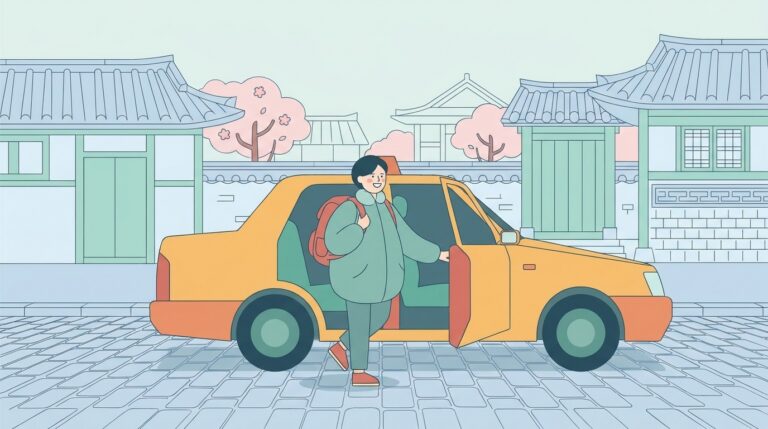
Master the Korean Taxi Exit: How to Say ‘I Will Get Off Here’ Like a Native
Phase 1: Empathy (Story Intro)
안녕하세요! It’s your Daily Hangul editor here. Picture this: after an unforgettable evening wandering through the glowing neon alleys of Hongdae, your feet are completely exhausted. Relieved, you step into a cozy Seoul taxi. The ride is wonderfully smooth, mellow K-pop hums softly on the radio, and the meter gently ticks. Suddenly, your hotel entrance flashes right past the window! Your heart skips a beat. You need the driver to stop immediately, but your mind freezes in panic. What if you shout rudely? What if you stumble over complex words? We have helped thousands of beginner travelers navigate this exact heart-thumping situation. With just two simple, friendly phrases, you will step out of any Korean taxi smoothly, gracefully, and completely stress-free!
Phase 2: Core Expressions Deep Dive
1. 여기서 내릴게요 (Yeogiseo naerilgeyo)
- Pronunciation: [yeo-gi-seo nae-ril-ge-yo] (Sounds like: yaw-gee-saw + nay-reel-gay-yo)
- Meaning: Literal: “From here, I will descend.” | Real Nuance: “I will get off right here, please!”
- K-Culture Moment: In modern romance K-dramas, the protagonist spots someone on the street corner and urgently tells the cab driver to pull over right at the sidewalk.
- Editor’s Insight: The ending -게요 (-geyo) expresses your gentle intention. It sounds much softer and more cooperative than commanding someone to halt the vehicle.
- Situation Spectrum: Casual ⚠️ | Semi-formal ✅ | Formal ✅
- 🤔 Think About It: In English, we often say “Can you let me out?” Why do you think Korean focuses on your own action of “stepping down” rather than directing the driver’s actions?
2. 감사합니다 (Gamsahamnida)
- Pronunciation: [gam-sa-ham-ni-da] (Sounds like: gahm-sah-hahm-nee-dah)
- Meaning: Literal: “Gratitude is done.” | Real Nuance: “Thank you very much!”
- K-Culture Moment: The heartwarming scene when a traveler leaves a taxi on a rainy night, exchanging a brief bow of gratitude with the smiling elderly driver.
- Editor’s Insight: This is the golden master key across all of South Korea. Combining 여기서 내릴게요 with 감사합니다 marks you instantly as a considerate, well-mannered guest.
- Situation Spectrum: Casual 🚫 | Semi-formal ✅ | Formal ✅
- 🤔 Think About It: Why is formal politeness so naturally woven into daily micro-interactions in Korean society?
3. 저기서 세워 주세요 (Jeogiseo sewo juseyo)
- Pronunciation: [jeo-gi-seo se-wo ju-se-yo] (Sounds like: jaw-gee-saw + say-woh joo-say-yo)
- Meaning: Literal: “Please make it stand over there.” | Real Nuance: “Please pull over right over there.”
- K-Culture Moment: When an office worker points toward the subway exit and asks the taxi driver to stop safely by the crosswalk.
- Editor’s Insight: Use this when your stop is still 20 to 30 meters ahead. It gives the driver enough warning to signal and merge into the curb lane.
- Situation Spectrum: Casual ⚠️ | Semi-formal ✅ | Formal ✅
- 🤔 Think About It: Notice the polite helping verb -주세요 (-juseyo), which softens a request into a plea for kind assistance.
Phase 3: Textbook Korean vs. Real Korean
Situation 1: Telling the driver you want to get off
- 📖 교과서 한국어 (Textbook Korean): 저를 여기서 하차시켜 주십시오 (Jeoreul yeogiseo hachasikyeo jusipsio – Please disembark me here).
- 🗣️ 진짜 한국어 (Real Korean): 여기서 내릴게요! (Yeogiseo naerilgeyo! – I’ll get off here!)
- 💡 왜 다를까? (Why is it different?): 하차 (disembarkation) is formal public transit jargon used in automated subway announcements. Real humans use the natural daily verb 내리다 (to get off).
Situation 2: Asking the driver to pull over
- 📖 교과서 한국어 (Textbook Korean): 즉시 정지하십시오 (Jeuksi jeongjihasipsio – Halt immediately).
- 🗣️ 진짜 한국어 (Real Korean): 저기 앞에서 세워 주세요 (Jeogi ap-eseo sewo juseyo – Please pull over just up ahead).
- 💡 왜 다를까? (Why is it different?): Saying 정지 sounds like a military checkpoint order! Specifying 저기 앞 (just up ahead) gives the driver safety buffer and makes you sound calm.
Phase 4: K-Culture Deep Dive & Non-verbal Manners
4-1. 눈치 (Nunchi) & Gestures
- Keep Your Seatbelt Clicked: Do not unbuckle your seatbelt while the taxi is still slowing down. Drivers in Korea value road safety rules and will worry if you unbuckle early.
- The Two-Handed Handover: When tapping or handing over your credit card or T-money transit card, support your right wrist or forearm with your left hand. This subtle gesture shows immense respect.
- The Courteous Departure Nod: As you say 감사합니다 (Gamsahamnida), give a gentle 15-degree head nod before exiting.
4-2. Culture Code: The Curb & Delivery Scooters
In Korea, taxi passenger doors are manual—not automatic like in Japan. You must push the door open yourself. However, always exercise Nunchi (situational awareness) and look over your shoulder! Seoul has thousands of fast-moving delivery scooters (배달 오토바이) darting alongside curb lanes. Checking before swinging the door open protects both you and the driver.
Phase 5: Real-Life Roleplay Scenario
Setting: A silver Seoul taxi cruising down Gangnam Boulevard. You (Leo) spot your friend waiting outside a brightly lit cafe.
Characters: Leo (A1 Beginner) & Mr. Kim (택시 기사님 – Kind Taxi Driver)
- Driver Kim: 거의 다 왔습니다. 어디쯤 내려 드릴까요? (Geoui da wasseumnida. Eodijjeum naeryeo deurilkkayo?) [🎭 Glances politely into the rearview mirror] (We are almost there. Where should I drop you off?)
- Leo: 아, 네! 저기 카페 보여요. (A, ne! Jeogi kape boyeoyo.) [🎭 Points gently forward toward the storefront] (Ah, yes! I see the cafe over there.)
- Leo: 여기서 내릴게요! (Yeogiseo naerilgeyo!) [🎭 Sits upright and speaks clearly with a warm tone] (I will get off here!)
- Driver Kim: 네, 우측 깜빡이 켜고 세워 드릴게요. (Ne, ucheuk kkamppagi kyeogo sewo deurilgeyo.) [🎭 Flashes right turn signal and eases toward the sidewalk] (Sure, I will turn on the blinker and pull over to the right.)
- Leo: 카드로 결제할게요. (Kadeuro gyeoljehalgeyo.) [🎭 Holds out the card with both hands] (I will pay with a card.)
- Driver Kim: 삑! 결제되었습니다. 영수증 드릴까요? (Bbik! Gyeoljedoeeosseumnida. Yeongsujeung deurilkkayo?) [🎭 Hands back the card with both hands] (Beep! Payment complete. Would you like a receipt?)
- Leo: 영수증은 괜찮아요. 감사합니다! (Yeongsujeungeun gwaenchanayo. Gamsahamnida!) [🎭 Receives the card with a light bow] (Receipt is okay. Thank you!)
- Driver Kim: 네, 안녕히 가세요! 문 조심하시고요. (Ne, annyeonghi gaseyo! Mun josimhasigoyo.) [🎭 Waves goodbye with a warm smile] (Goodbye! Please watch the door as you exit.)
🔀 Interactive Decision Point
Your taxi is traveling in the center lane of a four-lane boulevard, and your destination is directly to your right. What should you say?
- Option A: Shout “여기서 당장 스톱! (Stop right here right now!)” and unbuckle immediately.
- Option B: Say clearly, “저기 앞에서 세워 주세요 (Jeogi ap-eseo sewo juseyo)” while pointing ahead.
- Option C: Say nothing and try to crack open the door while paused at a red light.
Feedback:
* Best Choice (Option B): Excellent! This gives the driver the required time and distance to check blind spots and slide smoothly into the curbside lane.
* Bad Choice (Option A): Sudden shouting induces driver stress and creates a dangerous traffic hazard in fast-moving lanes.
* Dangerous Risk (Option C): Extremely illegal and life-threatening! Seoul streets are packed with traffic. Never exit in the middle of active traffic lanes.
Phase 6: 10-Second Emotional Shadowing Drill
Practice these natural rhythm pauses (/) and emotional cues out loud:
[😊 Cheerful & Clear]여기서 / 내릴게요! (Yeogiseo / naerilgeyo! – I will get off here!)[🚕 Calm & Helpful]저기 / 편의점 앞에서 / 세워 주세요! (Jeogi / pyeon-ui-jeom ap-eseo / sewo juseyo! – Please pull over in front of that convenience store!)[🙏 Heartfelt & Courteous]감사합니다! / 좋은 하루 보내세요! (Gamsahamnida! / Joeun haru bonaeseyo! – Thank you! Have a wonderful day!)
Phase 7: K-Culture Mini Dictionary
- 기사님 (Gisa-nim) | Driver / Sir | The respectful, essential honorific title used to address taxi, bus, or chauffeur drivers across Korea.
- 영수증 (Yeongsujeung) | Receipt | Always request this! A taxi receipt includes the driver’s plate number and phone line, ensuring lost belongings are easily recovered.
- 카드 결제 (Kadeu gyeolje) | Card payment | Modern Korean taxis almost exclusively prefer credit cards, debit cards, or T-money transit cards over physical cash.
- 세워 주다 (Sewo juda) | To stop / pull over (a vehicle) | The essential compound verb used whenever you want any driver to safely bring the car to a halt.
Phase 8: Traveler’s Survival Kit
Survival Expressions TOP 3
- 카드 돼요? (Kadeu dwaeyo?) – Can I pay by card?
- Pro Tip: All licensed Korean taxis accept cards, but asking this when boarding puts any beginner at ease.
- 영수증 주세요 (Yeongsujeung juseyo) – Please give me a receipt.
- Pro Tip: Keep your receipt in your pocket until you verify you haven’t left your phone or umbrella behind.
- 트렁크 열어 주세요 (Teureongkeu yeoreo juseyo) – Please open the trunk.
- Pro Tip: Say this upon arrival if you have heavy airport luggage in the back.
Editor’s Travel Note
Before stepping foot into South Korea, download the official Kakao T taxi hail app on your smartphone. It allows you to select your exact destination on a digital map, view estimated fares, and hail official taxis without worrying about language barriers. Furthermore, save your destination address in Korean text on your notes app for quick reference!
Phase 9: Step Deeper (Reflection)
In Korean grammar, sentence endings reflect human connection. When you say -게요 (-geyo) in 여기서 내릴게요, you are sharing your personal decision rather than issuing a direct demand. This linguistic softness mirrors Korea’s communal philosophy of 배려 (Baeryeo)—the art of considerate accommodation. By framing your departure as your own step rather than an order to the driver, you build instant mutual respect in a shared, confined space.
💬 Your Turn: Have you ever ridden in a taxi abroad where you felt too shy or nervous to speak? Which of these expressions feels easiest for you to try? Share your thoughts below!
Phase 10: FAQ & Common Mistakes
Q: Do I need to tip the taxi driver in Korea?
A: No, tipping is not practiced in South Korea! Tipping can even cause confusion or awkwardness. Simply pay the exact meter amount shown on the terminal screen.
Q: What should I say if the taxi driver misses my street corner?
A: Stay calm and say: 조금 더 가서 세워 주세요 (Jogeum deo gaseo sewo juseyo – Please go a little further and pull over). Korean drivers will quickly find the next safe opening.
Q: Can I pay with my T-money public transport card?
A: Yes! Almost every metered taxi in Seoul, Busan, and major cities has a T-money terminal right on the center console beside the driver.
🚨 Common Mistakes Alert (Top 3)
- Shouting “Stop!” in English: Drivers might be startled or assume something went wrong with the vehicle. Correct Action: Say 여기서 내릴게요 (Yeogiseo naerilgeyo) in a steady, conversational voice.
- Forgetting Your Belongings: In a hurry to leave, phones slip out onto back seats unnoticed. Correct Action: Request 영수증 주세요 (Yeongsujeung juseyo) so you possess the driver’s contact info.
- Opening the Door Blindly: Swinging the door open without checking the side mirror can clip passing motorcycles. Correct Action: Check your blind spot, unlatch slowly, and step out onto the sidewalk.
Phase 11: Action Missions
- Bronze Level: Stand in front of your mirror and repeat 여기서 내릴게요, 감사합니다! 5 times aloud with a smile.
- Silver Level: Record yourself saying 저기 앞에서 세워 주세요 (Jeogi ap-eseo sewo juseyo) on your voice memo app and listen to your rhythm.
- Gold Level: On your next trip to Korea (or with a Korean study partner), complete a full ride and exit using only Korean!
- 🎮 K-Culture Mission: Watch any modern K-drama episode (such as Business Proposal or Itaewon Class) and spot the exact moment a character asks a taxi to stop.
Phase 12: Interactive Quiz Challenge
1. Situational Judgment:
You are sitting in the taxi and see your subway station entrance 15 meters ahead. Which sentence is the most polite and natural?
* A) 여기서 당장 서라 (Yeogiseo dangjang seora)
* B) 저기 앞에서 세워 주세요 (Jeogi ap-eseo sewo juseyo)
* C) 운전 그만하세요 (Unjeon geumanhaseyo)
2. Fill in the Blank:
Complete the natural exit expression:
* 여기서 ______게요! (I’ll get off here!)
3. True or False:
In Korea, it is standard etiquette to leave a 15% cash tip when leaving a taxi.
* [True / False]
👉 Click here to reveal answers and explanations!
- Answer: B (저기 앞에서 세워 주세요 gives safe stopping room and uses the polite request form -주세요).
- Answer: 내릴 (The full verb is 내리다, which combines with -ㄹ게요 to become 내릴게요).
- Answer: False (Tipping is not customary in South Korea. Simply paying the metered fare with a polite 감사합니다 is the gold standard!).
🎬 Watch Our Daily Videos! (Daily Hangul Official Instagram)
Review the expressions you learned in this article with our fun daily short videos! Check out native pronunciation and real-life nuances in action.
- Instagram @dailyhangul_en







