Phase 1: Empathy (Story-Driven Opening)
안녕하세요! 매일한글 에디터입니다.
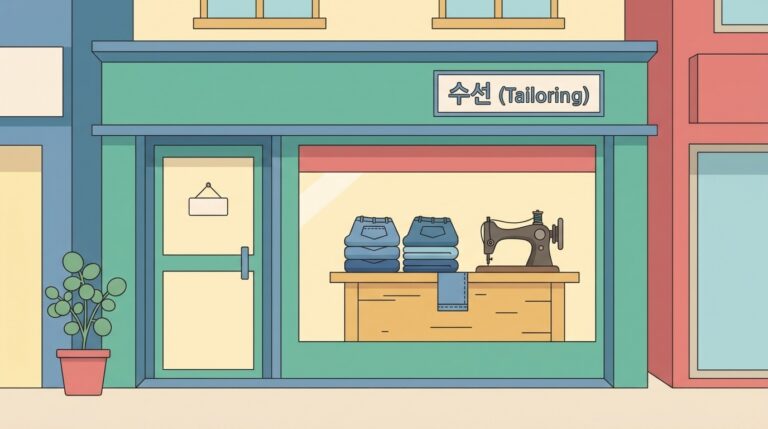
Imagine this: You are exploring the trendy alleys of Seongsu-dong or Hongdae, and you find the absolute holy grail of vintage washed denim. The fade is immaculate, the drape is effortless, but there is just one tiny catch—the legs are about two inches too long. In Seoul, the immediate fix is heading straight into a cozy neighborhood alteration shop (suseonjip, 수선집) or laundry shop (setakso, 세탁소). But suddenly, panic sets in. If the tailor simply cuts off the bottom hem with large scissors and sews a generic straight hem, that gorgeous factory-distressed edge will vanish forever! You will end up with high-end designer jeans that look like school uniform slacks.
Every expat and traveler in Korea has faced this exact crossroads. You stand in front of the tailor (sajangnim, 사장님), miming sewing motions, pointing frantically at the hemline, praying they understand what “keeping the original hem” means. You do not need complex fashion degree vocabulary to get this right. Today, based on real feedback from dozens of our Daily Hangul learners who survived their first alteration visits in Seoul, we are going to unlock the single magic phrase that will protect your favorite pants: 원래 밑단 모양을 그대로 살려서 수선해 주실 수 있나요? (Wonlae mitdan moyang-eul geudaero sallyeoseo suseonhae jusil su innayo? / Could you hem them while keeping the original bottom hem?). By the end of this guide, you will walk into any Korean alteration shop like a seasoned local.
Phase 2: 3 Key Expressions Deep Dive
1. 원래 밑단 살려주세요 (Wonlae mitdan sallyeojuseyo)
- Pronunciation: [Won-leh meet-dan sal-lyeo-joo-seh-yo] (Think: “Won-lay meet-dahn, then say ‘sally’ with ‘uh-joo-say-yo'”)
- Meaning: Literally “Please revive the original bottom hem,” naturally meaning “Please hem it while keeping the original edge.”
- K-Culture Moment: You will hear this exact phrase whenever characters in modern K-Dramas visit tailor shops after a shopping spree in Dongdaemun. It is the gold standard phrase used by stylish Koreans to protect denim distress details.
- Editor’s Insight: The verb 살리다 (sallida) literally means “to save” or “to bring to life.” In Korean fashion slang, whenever you keep a garment’s authentic detail (like factory distressing or raw edges), you “save” it. Tailors love this word because it instantly tells them you care about garment craftsmanship.
- Situation Spectrum: Casual: ⚠️ | Semi-formal: ✅ | Formal: ✅
- 🤔 Think About It: In English, we say “keep the hem” or “reattach the hem.” Why do you think Korean uses the word “save” or “bring to life” (살리다) when talking about fashion details?
2. 기장 좀 줄여주세요 (Gijang jom juryeojuseyo)
- Pronunciation: [Gee-jang jom joo-ryeo-joo-seh-yo] (Sounds like: “Gee-jahng” + “chom” + “jew-ryuh-joo-say-yo”)
- Meaning: Literally “Please reduce the length a bit,” used as “Please shorten the hem length.”
- K-Culture Moment: In makeover reality shows, stylists consistently use 기장 (gijang) instead of the generic word 길이 (giri) to specify garment silhouette adjustments.
- Editor’s Insight: While 길이 (giri) means general physical length, 기장 (gijang) is the dedicated industry term for garment vertical length. Adding 좀 (jom – a bit) softens your request and makes you sound remarkably polite and natural.
- Situation Spectrum: Casual: ⚠️ | Semi-formal: ✅ | Formal: ✅
- 🤔 Think About It: How does softening a direct command with small words like “a bit” (좀) change how the tailor treats your clothes?
3. 언제까지 돼요? (Eonjekkaji dwaeyo?)
- Pronunciation: [Eon-jeh-kkah-jee dway-yo] (Think: “Un-jay-kkah-jee” + “dway-yo”)
- Meaning: “When will it be ready?”
- K-Culture Moment: The iconic fast-paced Korean ppallippalli (빨리빨리 – quick, quick) culture! In Korea, alterations often take just a few hours or one single day.
- Editor’s Insight: Instead of asking “When will you finish working on it?”, Koreans ask “Until when does it become possible?” (언제까지 돼요?). It focuses on the result rather than pressuring the craftsman’s personal schedule.
- Situation Spectrum: Casual: ⚠️ | Semi-formal: ✅ | Formal: ✅
- 🤔 Think About It: Notice how Korean phrasing emphasizes the state of the object rather than the person doing the work. How does this reflect respect for the craftsman?
Phase 3: Textbook Korean vs. Real Korean
Situation 1: Asking to preserve the distressed hem
- 📖 Textbook Korean: 원래의 밑단 디자인을 보존하면서 바지 길이를 단축해 주시겠습니까? (Wonlae-ui mitdan dijain-eul bojonhamyeonseo baji giri-reul danchukae jusigesseumnikka? / Would you be willing to shorten the trouser length while preserving the original bottom design?)
- 🗣️ Real Korean: 밑단 살려서 기장 수선해 주세요. (Mitdan sallyeoseo gijang suseonhae juseyo. / Please hem the length while saving the bottom hem.)
- 💡 Why the difference? Textbook Korean sounds like an official legal contract between corporate entities. Real locals use the snappy industry idiom “밑단 살리기” (saving the hem) which instantly clicks with alteration masters.
Situation 2: Asking the alteration fee
- 📖 Textbook Korean: 이 의류 수선 작업의 총비용은 얼마입니까? (I uiryu suseon jageop-ui chongbi-yong-eun eolma-imnikka? / How much is the total expense for this garment repair operation?)
- 🗣️ Real Korean: 수선비 얼마예요? (Suseonbi eolmayeyo? / How much is the alteration fee?)
- 💡 Why the difference? Koreans combine words efficiently into everyday compound nouns. Attaching -비 (fee) directly to 수선 (alteration) creates 수선비 (suseonbi), saving breath and sounding authentic.
Phase 4: K-Culture Deep Dive & Non-verbal Manners
4-1. Nunchi (눈치) & Body Language at the Tailor
When you step into an authentic Korean suseonjip, space is often tiny. You will see a small dressing curtain or a raised wooden platform. Here is how to show effortless respect:
1. Fold, Don’t Guess: Never just say “cut 3 centimeters.” Put on the pants and fold the hem upward outward to show your desired break over your shoes. If you are holding the jeans in your hands, present them with both hands holding the waistband toward the master.
2. Point to the Stitch Line: Gently tap the washed edge and say “여기 밑단이요” (Yeogi mitdaniyo / This bottom hem right here). This visual cue reinforces that you value the distress marks.
3. The Eye-Contact Bow: When hand-delivering garments, give a slight 15-degree nod. Neighborhood tailors are proud artisans who often have 30 to 40 years of experience behind that single sewing machine.
4-2. Cultural Code: The Magic of Neighborhood “Suseonjip”
In Korea, dry cleaners (setakso) and alteration booths (suseonjip) are community anchors. Unlike Western department store services that can take two weeks and cost half the price of the jeans, a Korean neighborhood artisan can perform an invisible “hem transplant” (밑단 살리기) in under 30 minutes for around 5,000 to 10,000 KRW. It is a cornerstone of Korea’s vibrant fashion culture—buying clothes off the rack and immediately customizing them for a tailored fit.
Phase 5: Real-World Roleplay Scenario
Setting: Master Kim’s Alterations (명품수선), a cozy shop tucked in a quiet alley near Hongdae. Master Kim sits behind a classic heavy-duty industrial sewing machine, spectacles perched on his nose.
- Master Kim: 어서 오세요! 뭐 고치러 오셨어요? (Eoseo oseyo! Mwo gochireo osyeosseoyo?)
English: Welcome! What did you come to fix today?
🎭 Leaning back slightly from the sewing table, looking over his glasses with a warm smile. -
Learner: 안녕하세요! 이 청바지 기장 좀 줄이고 싶어요. (Annyeonghaseyo! I cheongbaji gijang jom jurigo sipeoyo.)
English: Hello! I would like to shorten the length of these jeans a bit.
🎭 Handing over the folded denim gently with both hands. -
Master Kim: 얼마나 줄일까요? 입어보고 맞출래요? (Eolmana jurilkkayo? Ibeobogo matchullaeyo?)
English: How much should we shorten? Want to try them on and measure?
🎭 Pointing his thumb toward the small curtain fitting room. -
Learner: 네! 제가 미리 접어왔어요. 이만큼이요. (Ne! Jega miri jeobeowasseoyo. Imankeumiyo.)
English: Yes! I folded them beforehand. About this much.
🎭 Showing the pre-folded cuff on the right pant leg. -
Master Kim: 오케이, 3센티 정도네. 그냥 잘라내고 박으면 되죠? (Okei, sam-senti jeongdone. Geunyang jallanaego bageumyeon doejo?)
English: Okay, about 3 centimeters. Should I just cut it and stitch it across?
🎭 Grabbing tailoring chalk and reaching for the scissors. -
Learner: 아, 사장님! 원래 밑단 모양을 그대로 살려서 수선해 주실 수 있나요? (A, sajangnim! Wonlae mitdan moyang-eul geudaero sallyeoseo suseonhae jusil su innayo?)
English: Ah, Boss! Could you hem them while keeping the original bottom hem as it is?
🎭 Pointing to the vintage washed stitching at the edge with an earnest expression. -
Master Kim: 아하, 워싱 밑단 살리기? 당연히 되지! 예쁜 바지인데 살려야지. (Aha, wosing mitdan salligi? Dang-yeonhi doeji! Yeppeun baji-inde sallyeoyaji.)
English: Aha, saving the washed hem? Of course! It is a nice pair of jeans; we definitely must save it.
🎭 Nodding approvingly at your fashion sense while measuring with a tape. -
Learner: 감사해요! 언제까지 돼요? 그리고 얼마예요? (Gamsahaeyo! Eonjekkaji dwaeyo? Geurigo eolmayeyo?)
English: Thank you! When will it be ready? And how much is it?
🎭 Asking pleasantly with a bright smile.
🔀 Interactive Decision Point
Master Kim smiles and says: “한 시간 뒤에 와요! 8,000원이에요.” (Come back in an hour! That is 8,000 KRW.) How do you reply?
- Option A: “네, 사장님! 한 시간 뒤에 찾으러 올게요. 카드 돼요?” (Ne, sajangnim! Han sigan dwie chajeureo olgeyo. Kadeu dwaeyo?)
Feedback: Best! You confirm the pickup time clearly and politely ask if credit cards are accepted (some small shops prefer cash or bank transfer). - Option B: “너무 비싸요. 깍아주세요.” (Neomu bissayo. Kkak-ajuseyo.)
Feedback: Bad! Preserving the hem takes twice as much precision work as a normal cut. Haggling 8,000 KRW (about $6 USD) for artisan labor comes off as very rude. - Option C: “안녕히 계세요.” (Annyeonghi gyeseyo.) and leaving immediately without confirming payment method or pick-up slip.
Feedback: Risk! Many small alteration booths are cash-preferred or require your phone number on a yellow ticket. Leaving without confirming might lead to confusion later.
Phase 6: 10-Second Emotion Shadowing Drill
Practice these lines out loud with the pause marks (/) and emotional cues!
[🥺 조심스럽고 간절하게 - Polite & hopeful]
저기 사장님, / 원래 밑단 / 그대로 살려주실 수 있나요?
(Jeogi sajangnim, / wonlae mitdan / geudaero sallyeojusil su innayo?)
English: Excuse me, boss, / could you preserve / the original hem as it is?-
[😊 명확하고 자신 있게 - Clear & confident]
청바지 기장 수선 / 맡기려고 하는데요.
(Cheongbaji gijang suseon / matgiryeogo haneundeyo.)
English: I am here / to drop off jeans for hemming. -
[😄 밝고 공손하게 - Bright & grateful]
오늘 저녁까지 / 찾을 수 있을까요? / 감사해요!
(Oneul jeonyeok-kkaji / chajeul su isseulkkayo? / Gamsahaeyo!)
English: By this evening / could I pick it up? / Thank you!
Phase 7: K-Culture Mini Dictionary
-
밑단 살리기 (Mitdan Salligi) | Original Hem Preservation
Literally “bottom-edge resurrecting.” The specialized tailoring technique of cutting the garment above the distressed hem, cutting off excess length, and stitching the original cuff back on seamlessly. -
기장 (Gijang) | Garment Vertical Length
Used specifically for clothing measurements (e.g., 바지 기장 – pant length, 코트 기장 – coat length). Distinct from horizontal widths or generic distances. -
수선집 (Suseonjip) | Alteration / Repair Shop
Small workshops dedicated to clothing repairs, zipper fixes, and size adjustments. Look for signs saying 수선 (Suseon) or 옷수선 (Ot-suseon). -
드라이 (Deurai) | Dry Cleaning
Everyday Korean shorthand for 드라이클리닝 (dry cleaning). You can say: “이 코트 드라이 맡길게요” (I would like to drop off this coat for dry cleaning).
Phase 8: Traveler’s Survival Kit
Top 3 Survival Phrases
- 바지 단 좀 올려주세요. (Baji dan jom ollyeojuseyo.)
English: Please take up the hem on these pants.
Pro Tip: Use this if you forgot the word 기장 (gijang). 단 (dan) refers to the cuff fold. - 오늘 찾을 수 있나요? (Oneul chajeul su innayo?)
English: Can I pick this up today?
Pro Tip: Perfect when you are traveling and checking out of your hotel tomorrow morning. - 계좌이체 가능한가요? (Gyejwa-iche ganeunghangayo?)
English: Is bank transfer possible?
Pro Tip: Many indie alteration masters do not have card terminals. If you do not have cash, mobile banking transfer is universally welcomed.
Editor’s Travel Note
- Finding Local Masters: Skip hotel laundry services that charge high fees. Instead, search “수선집” on Naver Map App download to find highly-rated neighborhood shops right inside residential apartment complexes (Sang-ga, 상가).
- Payment Manners: Keep 10,000 KRW cash in your wallet. Alteration masters appreciate small bills for quick 5,000–8,000 KRW jobs.
Phase 9: A Step Deeper (Reflective Prompt)
In the Korean language, the verb 살리다 (sallida) literally means to rescue, revive, or save a life. Using this word for a pair of pants—밑단 살리기—reveals something fascinating about Korean society’s attitude toward material objects. Clothing is not just disposable fabric; the craftsmanship, the intentional distressing, and the character of the garment deserve to be “rescued” and preserved. By asking the tailor to “save” the hem, you are participating in a communal appreciation of craft.
💬 Your Turn: Does your native language have an everyday idiom where an inanimate object (like clothes, food, or cars) is spoken of as if it were alive? Share your language’s quirky phrases in the comments below!
Phase 10: FAQ & Avoiding Misunderstandings
Q: Can I drop off dry cleaning at an alteration shop (수선집), or do I need to find a laundry shop (세탁소)?
A: Most neighborhood laundry shops (세탁소) also offer basic alterations! However, specialized alteration shops (수선집) usually focus exclusively on cutting and sewing. If you need dry cleaning, search for 세탁 (setak). If you need complex hemming, a dedicated 수선 (suseon) shop is faster and more precise.
Q: What should I bring when getting pants altered in Korea?
A: Always bring the shoes you intend to wear with those pants! Sneaker soles, loafers, and boots hang differently. Putting on your shoes in the fitting corner allows the tailor to pin the break with pinpoint accuracy.
Q: How much does it cost to keep the original hem compared to regular hemming?
A: Standard straight-cut hemming typically costs around 3,000 to 5,000 KRW. Keeping the original hem (밑단 살리기) requires delicate micro-stitching and usually costs between 6,000 and 10,000 KRW. It is still remarkably affordable!
🚨 Common Mistakes Alert
- Mistake 1: Saying “그냥 잘라주세요” (Just cut it).
Why it hurts: Tailors will take you literally and snip off the hem with scissors, throwing the washed edge in the scrap bin.
Correct Action: Always specify: “밑단 살려주세요” (Mitdan sallyeojuseyo). - Mistake 2: Measuring with your fingers instead of trying them on.
Why it hurts: Fabric stretches and sits differently when seated versus standing.
Correct Action: Step into their fitting corner and fold the hem while standing straight. - Mistake 3: Forgetting to take the claim ticket.
Why it hurts: Small neighborhood shops rely on numbered slips or your last four phone digits.
Correct Action: Make sure you agree on your name or phone digits before stepping out.
Phase 11: Action Mission & Engagement
- 🥉 Bronze Level: Stand in front of your mirror with a pair of pants. Point to the hem and say three times: “원래 밑단 살려주세요!” (Wonlae mitdan sallyeojuseyo!)
- 🥈 Silver Level: Snap a photo of your favorite pair of jeans, post it on your Instagram Story or Threads, and write: “바지 기장 수선하고 싶어요 #DailyHangul”.
- 🥇 Gold Level: Visit a local Korean suseonjip or practice roleplaying with a Korean speaker on HelloTalk using the phrase: “원래 밑단 모양을 그대로 살려서 수선해 주실 수 있나요?”
🎮 K-Culture Mission: Next time you watch a modern K-Drama (like Crash Landing on You or Hospital Playlist), spot how neighborhood elders greet each other in local shops. Notice how often they use the friendly title 사장님 (Sajangnim – boss/owner) to address shopkeepers!
Phase 12: Interactive Quiz Challenge
1. Situation Judgment: You bought designer distressed denim. You want to hem the pants without losing the distressed finish. What do you say to the tailor?
(A) 그냥 가위로 잘라주세요. (Geunyang gawiro jallajuseyo.)
(B) 원래 밑단 살려서 수선해 주세요. (Wonlae mitdan sallyeoseo suseonhae juseyo.)
(C) 드라이클리닝만 해 주세요. (Deuraikeullining-man hae juseyo.)
2. Fill in the Blank: “바지 [_____] 좀 줄이고 싶어요.” (I want to shorten the pant [length].)
Hint: The dedicated fashion word for garment length starting with ‘ㄱ’.
3. True or False: In Korea, asking “밑단 살려주세요” means you want the tailor to sew colorful flower patches onto the hem.
👉 Click to reveal answers and explanations!
- Answer: (B)
Explanation: “원래 밑단 살려서 수선해 주세요” specifically instructs the tailor to preserve the original hem. Option (A) asks them to just cut it with scissors, and (C) only asks for dry cleaning! -
Answer: 기장 (Gijang)
Explanation: While 길이 (giri) means length in general, 기장 (gijang) is the exact term tailors use for garment length. -
Answer: False
Explanation: “살리다” (sallida) metaphorically means to “save” or keep the original factory design of the hem, not adding patches!
🎬 Watch Our Daily Videos! (Daily Hangul Official Instagram)
Review the expressions you learned in this article with our fun daily short videos! Check out native pronunciation and real-life nuances in action.
- Instagram @dailyhangul_en