

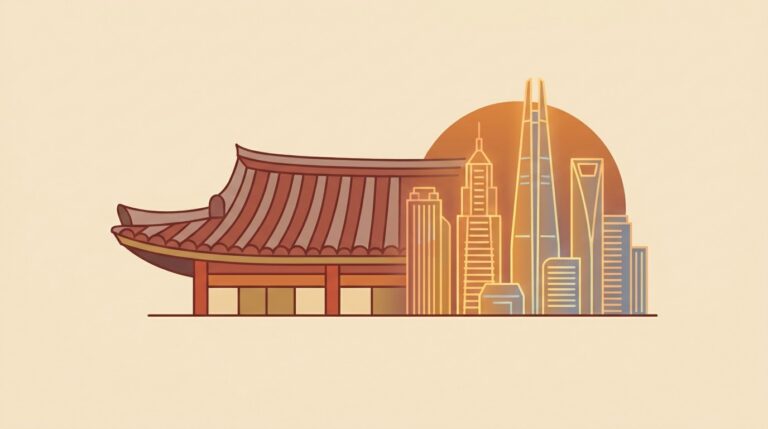
Phase 1: Empathy (Immersive Storytelling Opening)
안녕하세요! 매일한글 에디터입니다. (Annyeonghaseyo! It’s your Daily Hangul editor.)
Picture this: You are walking down the vibrant alleys of Seongsu-dong in Seoul. Five years ago, this neighborhood was a humble labyrinth of leather shoe workshops and dusty auto-repair garages. Today, you are standing in front of an avant-garde, glass-fronted AI concept lab nestled right inside a preserved 1970s red-brick warehouse. Beside you, a stylish barista serves artisanal single-origin pour-over coffee using a robotic arm, while an elderly craftsman next door quietly polishes handcrafted boots. You want to express this breathtaking, almost dizzying clash of epochs to your Korean business partner or friend. But your mind freezes. You end up saying: “동네가 많이 바뀌었네요” (Dongnega mani bakkwieotneyo / “The neighborhood changed a lot”). It feels flat, doesn’t it?
If you have ever felt that your intermediate vocabulary collapses when trying to describe profound societal shifts, generational leaps, or the melancholic transience of time, you are not alone. Many advanced learners at the C1 threshold hit this exact wall. In Korea—a country that catapulted from agrarian ruins to a digital powerhouse within a single human lifetime—people do not merely say “things changed.” They reach into ancient four-character idioms (사자성어, Sajeoseongeo) to capture the philosophical soul of transformation. By mastering the idioms of epochal change, you transition from someone who merely translates words to a culturally attuned thinker who understands Korea’s collective memory. Let’s unlock three high-level idioms that will transform how you articulate time, innovation, and timeless values.
Phase 2: In-Depth Breakdown of 3 Core Idioms
1. 상전벽해 (桑田碧海)
- Pronunciation: Sang-jeon-byeok-hae (Pronunciation tip: Think of “Sahng-jeon” flowing effortlessly into a crisp “byuk-heh”)
- Meaning: Mulberry fields turn into the blue sea (Literal) vs. Radical, earth-shattering transformation of a landscape, status, or era (Nuance).
- K-Culture Moment: Seen frequently in historical-corporate dramas like Reborn Rich (재벌집 막내아들) when characters gaze over empty reed fields in Bundang or Gangnam that later explode into multi-billion-dollar metropolis districts.
- Editor’s Insight: Mulberry trees (상전, sangjeon) were once the bedrock of traditional Korean sericulture (silk production). This idiom does not mean a slight cosmetic update; it signifies an overhaul so total that the land itself has become an ocean. Use it when describing Korea’s dizzying technological leap or a start-up that conquered the market overnight.
- Situation Spectrum: Casual (⚠️ sounds a bit dramatic/literary unless used playfully) | Semi-formal (✅) | Formal & Business (✅)
- 🤔 Think About It: Does your native culture frame drastic progress as a conquest of nature, or as an inevitable cosmic cycle like the tide replacing a field?
2. 온고지신 (溫故知新)
- Pronunciation: On-go-ji-sin (Pronunciation tip: Pronounce “Own-go-jee-sheen” with equal weight on every syllable)
- Meaning: Warming up the old to understand the new (Literal) vs. Deriving modern innovation and wisdom by anchoring yourself in timeless heritage (Nuance).
- K-Culture Moment: The design philosophy celebrated by K-pop icons like BTS and NewJeans when performing in contemporary Hanbok against the backdrop of Geunjeongjeon Hall in Gyeongbokgung Palace.
- Editor’s Insight: In an era of AI disruption, Koreans deeply admire those who adapt without losing their root values (본질, bonjil). 온고지신 is the intellectual sweet spot: it rejects both stubborn traditionalism and hollow trend-chasing. It is the ultimate praise for sustainable innovation.
- Situation Spectrum: Casual (⚠️) | Semi-formal (✅) | Formal & Business (✅)
- 🤔 Think About It: When your company adopts disruptive technology, do you discard previous traditions, or do you seek the foundational wisdom hidden within them?
3. 격세지감 (隔世之感)
- Pronunciation: Gyeok-se-ji-gam (Pronunciation tip: Quick “Gyuk-seh” with a soft pause before “jee-gahm”)
- Meaning: The feeling of being separated by a whole generation or world (Literal) vs. A poignant, nostalgic shock at how unrecognizably fast time has advanced (Nuance).
- K-Culture Moment: Heartwarming variety shows like You Quiz on the Block (유 퀴즈 온 더 블럭) where senior citizens encounter smartphone kiosks, or veteran actors look back at black-and-white television reels.
- Editor’s Insight: Unlike 상전벽해, which focuses on the objective magnitude of change, 격세지감 is an emotional state (감, 感). It conveys personal awe and gentle nostalgia. Use it when you return to a place after a decade, or when reminiscing with older colleagues.
- Situation Spectrum: Casual (⚠️) | Semi-formal (✅) | Formal & Business (✅)
- 🤔 Think About It: When was the last time you experienced a sudden wave of chronological whiplash? What artifact of the past triggered it?
Phase 3: Textbook Korean vs. Real Native Korean
Scenario 1: Remarking on a neighborhood’s rapid high-tech evolution
- 📖 교과서 한국어 (Textbook): 이 지역은 최근 몇 년 동안 경제적으로 매우 크게 발전했습니다. (I jiyeogeun choegeun myeot nyeon dongan gyeongjejeogeuro maeu keuge baljeonhaesseumnida. / This area has economically developed very significantly over recent years.)
- 🗣️ 진짜 한국어 (Real Native C1): 여기가 예전엔 허허벌판이었는데, 이렇게 첨단 밸리로 바뀌다니 완전 상전벽해네요. (Yeogiga yejeonen heoheobeolpanieonneunde, ireoke cheomdan baelliro bakkwidani wanjeon sangjeonbyeokhaeneyo. / This place used to be a barren wasteland, but seeing it turn into a high-tech valley like this feels like a total transformation into a new world.)
- 💡 왜 다를까? (Why the difference?): Educated native speakers avoid dry statistical adverbs like 매우 크게 (very greatly). Instead, they contrast sensory markers of the past (허허벌판, barren emptiness) with vibrant idioms (상전벽해).
Scenario 2: Feeling overwhelmed by digital ordering kiosks
- 📖 교과서 한국어 (Textbook): 새로운 기술이 너무 빨리 생겨나서 적응하기가 참 어렵습니다. (Saeroun gisuri neomu ppalli saenggyeonaseo jeogeunghagiga cham eoryeopseumnida. / New technologies emerge so fast that adapting is truly difficult.)
- 🗣️ 진짜 한국어 (Real Native C1): 이제는 동네 식당까지 키오스크로 주문하는 걸 보니 정말 격세지감이 느껴지네요. (Ijeneun dongne sikdangkkaji kiosukeuro jumunhaneun geol boni jeongmal gyeoksejigami neukkyeojineyo. / Seeing even neighborhood mom-and-pop diners switch to touch-screen kiosks really makes me feel the transience of generational change.)
- 💡 왜 다를까? (Why the difference?): Rather than complaining abstractly about difficulty, native speakers express a thoughtful emotion (격세지감이 느껴지다, to feel the generational leap) anchored to concrete everyday shifts.
Phase 4: K-Culture Deep Dive & Non-Verbal Manners
4-1. 눈치 (Nunchi) & Mindful Demeanor
When invoking ancient four-character idioms in Korean society, your physical delivery matters just as much as your grammar:
* Avoid the “Lecture Tone”: Sajeoseongeo carries intellectual weight. If spoken with rapid gestures or a raised chin, you risk sounding pedantic (잘난 척하는 사람).
* The Reflective Nod: Lower your voice slightly into a warm, grounded register. Tilt your head forward in a slow, thoughtful nod (고개 끄덕임), allowing a deliberate micro-pause before dropping the idiom. This projects philosophical maturity and contemplative empathy.
4-2. The Cultural Dialectic: “빨리빨리” (Hurry-Hurry) vs. “뉴트로” (Newtro)
Korea is famous for its hyper-speed 빨리빨리 (ppalli-ppalli) culture. The country adopted 5G, automated logistics, and lightning deliveries faster than almost anywhere else. Yet, precisely because physical landscapes vanish so quickly, contemporary Koreans cultivate a passionate reverence for 뉴트로 (Newtro = New + Retro).
Consider Euljiro—often nicknamed “Hip-jiro.” Young startup founders do not bulldoze old metal lathe shops; they build speakeasies and design studios behind faded acrylic signboards. This cultural dynamic embodies the principle of holding steadfast to core historical textures while displaying agile adaptation to modern trends. Using idioms like 온고지신 during a design review or networking meeting shows that you understand the dual soul of modern Korea.
Phase 5: Real-Life Roleplay Scenario
Setting: A rooftop cafe in Seongsu-dong overlooking refurbished brick factories and high-rise software hubs.
Characters:
* Alex (알렉스): Global Strategy Director (You, C1 Advanced Learner).
* Min-woo (민우): Co-founder of a Korean AI-driven heritage platform.
- 민우: 알렉스 님, 저희 성수동 사옥 테라스 전경 어떠세요? 10년 전만 해도 이 주변이 온통 구두 공장이랑 철공소였거든요.
(Alex-nim, jeohi Seongsu-dong sa-ok teraseu jeongyeong eotteoseyo? Simnyeon jeonman haedo i jubyeoni ontong gudu gongjang-irang cheolgongsoyeotgeodeunyo.)
“Alex, how do you like the view from our Seongsu office terrace? Just ten years ago, this entire area was packed with shoe factories and ironworks.”
🎭 Min-woo leans against the railing, holding an iced americano, looking out over the skyline. -
Alex (알렉스): 와, 정말 놀랍네요. 낡은 붉은 벽돌 건물들 사이로 현대식 사옥들이 들어선 걸 보니, 그야말로 상전벽해라는 말이 딱 어울립니다.
(Wa, jeongmal nollamneyo. Nalkeun bulgeun byeokdol geonmuldeul sairo hyeondaesik sa-okdeuri deoreoseon geol boni, geuyamallo sangjeonbyeokhaeraneun mari ttak eoullimnida.)
“Wow, it is truly astonishing. Seeing ultra-modern corporate headquarters rise among aged red-brick warehouses, the idiom ‘mulberry fields turning into oceans’ fits perfectly.”
🎭 Alex gazes out thoughtfully, letting out a genuine, admiring smile. -
민우: 하하, 맞아요! 변화 속도가 너무 빠르다 보니 가끔은 현기증이 날 정도예요. 하지만 무작정 부수고 새로 짓는 것만이 답은 아니더라고요.
(Haha, majayo! Byeonhwa sokdoga neomu ppareuda boni gakkeumeun hyeongijeungi nal jeongdoyeyo. Hajiman mujakjeong busugo saero jinneun geonmani dabeun anideoragoyo.)
“Haha, exactly! The pace of change is so relentless that it sometimes makes your head spin. But we realized tearing everything down to rebuild isn’t the sole answer.” -
Alex (알렉스): 깊이 공감합니다. 과거 장인들의 손때 묻은 유산을 지키면서 그 위에 혁신을 더하는 것이야말로 진정한 온고지신의 태도가 아닐까요?
(Gipi gonggamhamnida. Gwageo jang-indeurui sonttae mudeun yusaneul jikimyeonseo geu wie hyeoksineul deohaneun geosiyamallo jinjeonghan ongojisirui taedoga anilkkayo?)
“I resonate deeply with that. Safeguarding the time-honored craft of yesterday’s artisans while building modern innovation on top of it—isn’t that the quintessential spirit of ‘learning from the old to innovate the new’?”
🎭 Alex speaks in a measured, warm tone, maintaining steady, respectful eye contact. -
민우: 오, 알렉스 님 사자성어 구사력이 정말 수준급이시네요! 저희 할아버지 세대께서 스마트폰으로 전통주를 주문하시는 모습을 뵐 때면 문득 격세지감이 들곤 했는데, 본질은 결국 통하는 것 같습니다.
(O, Alex-nim sajeoseong-eo gusaryeogi jeongmal sujunggeubisineyyo! Jeohi harabeoji sedegkkeseo seumateu-poneuro jeontongjureul jumunhasineun moseubeul boel ttaemyeon mundeuk gyeoksejigami deulgon haenneunde, bonjireun gyeolguk tonghaneun geot gatseumnida.)
“Oh Alex, your mastery of four-character idioms is truly exceptional! When I see my grandfather’s generation ordering traditional artisanal liquor on a smartphone app, I often feel an immense generational gap, yet our fundamental human connection remains intact.” -
Alex (알렉스): 맞습니다. 기술이 아무리 상상을 초월해 발전해도, 사람을 향한 본질적인 가치는 결코 흔들려서는 안 되니까요.
(Matseumnida. Gisuri amuri sangsangeul chowolhae baljeonhaedo, sarameul hyanghan bonjiljeogin gachineun gyeolko heundeullyeoseoneun an doenikkayo.)
“Quite right. No matter how technology leaps beyond our wildest imagination, our core values centered on humanity must never waver.” -
민우: 역시 통찰력이 남다르시네요. 이번 프로젝트도 전통의 가치와 최첨단 알고리즘을 융합하는 방향으로 구체화해 보시죠.
(Yeoksi tongchalryeogi namdareusineyo. Ibeon peurojekteudo jeontong-ui gachiwa choecheomdan algo-rijeumeul yunghaphaneun banghyang-euro guchehwahae bosijo.)
“I knew your insight was extraordinary. Let’s shape this upcoming venture by fusing the values of our heritage with state-of-the-art algorithms.” -
Alex (알렉스): 좋습니다, 대표님. 유연한 혁신과 확고한 정체성으로 멋진 결과물을 만들어 봅시다!
(Jotseumnida, daepyonim. Yuyeonhan hyeoksingwa hwakkwohan jeongcheseong-euro meotjin gyeolgwamureul mandeureo bopsida!)
“Sounds excellent, CEO Min-woo. Let’s create something extraordinary with agile innovation anchored in firm identity!”
🎭 Alex firmly nods and raises a coffee cup in a professional toast.
🔀 Interactive Decision Point
Min-woo asks: “변화무쌍한 AI 시대에, 우리 브랜드가 잃지 말아야 할 가장 중요한 본질은 무엇일까요?” (In an era of relentless AI disruption, what is the single most vital core value our brand must never lose?)
- Option A: “기술이 최고죠. 트렌드에 뒤처지면 끝장나니까 무조건 최신 유행만 쫓아가야 합니다.” (Gisuri choegojo. Teurende-e dwicheojimyeon kkeutjangnanikka mujogeon choesin yuhaengman jjochagaya hamnida.)
- Option B: “시대가 상전벽해로 변할수록 고객과의 신뢰라는 본질을 지키며, 온고지신의 정신으로 기술을 유연하게 접목해야 합니다.” (Sidaega sangjeonbyeokhaero byeonhalsurok gogaekgwaui sinroeraneun bonjireul jikimyeo, ongojisirui jeongsineuro gisureul yuyeonhage jeobmokhaya hamnida.)
- Option C: “옛날 방식만 고수합시다. 조상님들의 가르침 외에는 어떤 혁신도 필요 없습니다.” (Yennal bangsingman gosuhapsida. Josangnimdeurui gareuchim oe-eneun eotteon hyeoksindo piryo eopseumnida.)
Feedback on Your Choice:
- Option A (Risk / Inappropriate): Overly reactive. Dismissing foundational brand identity to chase ephemeral fads makes you appear shortsighted and unsteady in an executive Korean setting.
- Option B (Best Choice): Impeccable C1 delivery! You eloquently weave both 상전벽해 and 온고지신 into strategic business discourse, showing both vision and grounding.
- Option C (Bad / Counterproductive): Rigid fundamentalism. Rejecting innovation contradicts the agility expected in modern Korean corporate environments.
Phase 6: 10-Second Emotion Shadowing Drill
Practice reading these sentences aloud. Emphasize breathing at each slash (/) and embody the bracketed emotional milestone.
[🤔 감탄하며 깊은 여운을 담아 / With philosophical wonder and gravitas]
“허허벌판이었던 이곳이 / 이렇게 화려하게 바뀌다니 / 그야말로 상전벽해네요.”
(Heoheobeolpanieotdeon igosi / ireoke hwaryeohage bakkwidani / geuyamallo sangjeonbyeokhaeneyo.)
(“This barren plain… / turning into such brilliance… / it is truly mulberry fields becoming oceans.”)-
[✨ 당당하고 지혜롭게 / Confident, balanced, and visionary]
“옛것의 본질을 잃지 않으면서 / 새로운 혁신을 품는 / 온고지신의 자세가 필요합니다.”
(Yetgeosui bonjireul ilji aneumyeonseo / saeroun hyeoksineul pumneun / ongojisirui jasega piryohamnida.)
(“Without losing the essence of our heritage / embracing fresh innovation / the spirit of Ongojisin is essential.”) -
[🥺 아련한 그리움과 경이로움을 섞어서 / With nostalgic poignancy and gentle awe]
“골목길 어귀에서 / 옛 추억을 떠올리다 보면 / 문득 격세지감이 밀려옵니다.”
(Golmokgil eogwieseo / yet chueogeul tteoollida bomyeon / mundeuk gyeoksejigami millyeoomnida.)
(“At the corner of this old alley / reminiscing about past memories / a deep sense of generational transience washes over me.”)
Phase 7: K-Culture Mini Dictionary
-
상전벽해 (桑田碧海 / Sang-jeon-byeok-hae)
Translation: Mulberry fields turning into azure seas.
Real-World Usage: Applied to rapid urban redevelopments (e.g., Pangyo Techno Valley), economic turnarounds, and sudden paradigm shifts in high-tech industries. -
온고지신 (溫故知新 / On-go-ji-sin)
Translation: Exploring the past to create modern innovation.
Real-World Usage: Widely referenced in creative branding, culinary fusion (craft Makgeolli breweries, Newtro desserts), and architectural renovations honoring historical motifs. -
격세지감 (隔世之感 / Gyeok-se-ji-gam)
Translation: The sentiment of witnessing an entire epoch elapse.
Real-World Usage: Used in reflective dialogue when contrasting childhood technologies (floppy disks, landlines) with modern hyper-connectivity (smart homes, generative AI). -
압축성장 (壓縮成長 / Ap-chuk-seong-jang)
Translation: Compressed economic and societal growth.
Real-World Usage: A foundational socio-historical term explaining how South Korea traversed centuries of industrial and democratic development in just four decades, shaping the modern Korean psyche.
Phase 8: Survival Kit for Travelers
Top 3 Survival Expressions
-
“예전 모습이 전혀 기억나지 않을 만큼 완전히 바뀌었네요!”
(Yejeon moseubi jeonhyeo gieognaji aneul mankeum wanjeonhi bakkwieotneyo!)
Pro Tip: Use this when revisiting an area like Hongdae, Gangnam, or Busan’s Marine City with a Korean friend. It immediately invites nostalgic storytelling. -
“전통과 현대가 조화롭게 어우러져 있어서 참 인상 깊어요.”
(Jeontonggwa hyeondaega johwaropge eoureojyeo isseoseo cham insang gipeoyo.)
Pro Tip: The premier phrase to use when touring Bukchon Hanok Village, DDP (Dongdaemun Design Plaza), or modern museums. -
“기술이 발달해서 편리하면서도, 한편으론 옛 정취가 그립기도 해요.”
(Gisuri baldalhaeseo pyeonrihamyeonseodo, hanpyeoneuron yet jeongchwiga geuripgido haeyo.)
Pro Tip: Perfect conversational bridge when drinking tea with older artisans or locals in traditional markets like Gwangjang Market.
Editor’s Travel Note
- App Navigation: While Google Maps works for basic footpaths, Seoul’s landscape shifts every few months. Save yourself from walking into demolished or relocated venues by doing a Naver Map app download to access real-time store openings, street views, and transit updates.
- Transit & Taxis: Taxis in Seoul rarely take cash now. Use the Kakao T mobility app guide to hail cabs seamlessly and pay via integrated cards.
- Historical Walking Route: To tangibly witness 상전벽해, take the subway from Jongno 3-ga (preserving 600-year-old jewelry alleys) straight across the Han River to Teheran-ro in Gangnam. The sheer contrast between these two stations will grant you an unforgettable, visceral encounter with 격세지감.
Phase 9: “One Step Deeper” (Reflective Cultural Essay)
Language is an emotional archive. In many Western cultures, history is conceptualized linearly—a timeline marching relentlessly forward where the new naturally supplants the old. In Korea, however, historical time is experienced almost seismically. Because the country underwent profound “compressed modernization” (압축성장) within living memory, generations who once studied by kerosene lamps now consult AI agents on high-speed rail.
When a native speaker sighs and utters 격세지감 or reflects upon 온고지신, they are not merely reciting classical literature. They are reconciling the intense cognitive tension between what was lost and what was gained. Surviving in a relentless society requires agile adaptability, yet enduring within it requires an immovable core.
💬 Your Turn: What is one part of your hometown or life that has undergone a true 상전벽해? When did you last experience 격세지감? Share your story in Korean or English in the comments below!
Phase 10: FAQ & Common Mistakes
Q: Can I use Sajeoseongeo (four-character idioms) in casual texting with younger Korean friends?
A: Yes, but context and delivery are critical. Dropping 상전벽해 casually in a KakaoTalk chat can sound intentionally theatrical or mock-serious—which can be hilarious if you are joking about a messy room suddenly becoming spotless! However, for sincere casual conversation, native speakers often pair it with lighthearted endings: e.g., “우리 방 완전 상전벽해 수준인데? ㅋㅋ” (Uri bang wanjeon sangjeonbyeokhae sujuninde? kk / “Our room is practically on the level of an epochal metamorphosis, lol”).
Q: What is the subtle emotional difference between 상전벽해 and 격세지감?
A: 상전벽해 is landscape- and state-focused. It spotlights the objective magnitude of change—how unrecognizably a physical place, industry, or environment has shifted. 격세지감, on the other hand, is an inner psychological sentiment. It highlights the subjective, poignant feeling of standing between two different temporal dimensions.
Q: Are these idioms considered formal Hanja expressions that require specific honorific particles?
A: While they originate from Sino-Korean roots (Hanja), they function flexibly in syntax. You can attach verbalizers like ~이다 (to be), ~를 느끼다 (to feel), or use them adjectivally: 상전벽해와 같은 변화 (a change akin to mulberry fields becoming seas).
🚨 흔한 실수 (Common Mistakes) Board
| Foreign Learner’s Mistake | Why It Sounds Awkward | Correct Action (Pro Polish) |
|---|---|---|
| ❌ “날씨가 상전벽해로 추워졌어요.” | 상전벽해 describes epochal, structural transformations, not routine weather fluctuations. | ✅ “날씨가 하루아침에 표변했네요 / 갑자기 쌀쌀해졌네요.” (Use weather-appropriate change descriptors). |
| ❌ Over-pronouncing Hanja characters with robotic pauses: “상. 전. 벽. 해.” | Makes you sound like you are reciting an antique dictionary rather than expressing natural thought. | ✅ Connect the syllables smoothly with natural cadence: Sangjeonbyeok-hae. |
| ❌ Using 격세지감 for short spans: “어제 보고 오늘 보니 격세지감이다.” | 격세지감 requires the passage of a significant span of time (years, decades, technological eras). | ✅ Reserve it for long lapses: “10년 만에 모교를 찾아오니 격세지감이 드네요.” |
Phase 11: Action Missions
- 🥉 Bronze Mission (Solo Practice): Stand before a mirror. Shadow the three sentences from Phase 6, paying sharp attention to vocal depth and reflective head tilts until the pronunciation feels silky smooth.
- 🥈 Silver Mission (Social Engagement): Find an old photo of your hometown or a vintage shot of Seoul from the 1980s. Post it on Instagram or Threads with the caption: “그야말로 상전벽해네요! #매일한글 #사자성어”.
- 🥇 Gold Mission (Real-World Execution): In your next Korean 1-on-1 tutoring session, work meeting, or language exchange, describe an industry shift or urban renewal project using 온고지신 or 격세지감 to anchor your argument.
- 🎮 K-Culture Mission: Watch an episode of a time-travel or generational K-drama (like Reborn Rich, Signal, or Reply 1988). Note down the visual moments where the characters confront the shock of chronological change.
Phase 12: Interactive Quiz Challenge
1. Situational Judgment
You are presenting a business proposal to a Korean venture capital board. You want to argue that your fintech product respects traditional banking trust while leveraging bleeding-edge blockchain security. Which idiom provides the highest strategic polish?
* (A) 상전벽해 (Sangjeonbyeokhae)
* (B) 온고지신 (Ongojisin)
* (C) 격세지감 (Gyeoksejigam)
2. Fill-in-the-Blank
“어릴 적 뛰어놀던 시골 마을에 고층 빌딩과 복합 쇼핑몰이 들어선 모습을 바라보니 정말 [ ]가 느껴진다.”
* (Hint: Choose the idiom that expresses personal emotional nostalgia toward elapsed generations.)
3. True or False Cultural Check
True or False: Calling an overnight change in a friend’s new hairstyle 상전벽해 is considered standard, serious business Korean.
👉 Click to reveal answers & in-depth explanations!
- Answer: (B) 온고지신 (Ongojisin)
Explanation: 온고지신 directly encapsulates honoring classic wisdom (traditional financial trust) while developing innovative mechanisms (blockchain). Using this in business pitches proves strategic, mature sophistication. -
Answer: 격세지감 (Gyeoksejigam)
Explanation: When witnessing a childhood home become high-rise urban complexes, the psychological awe and emotional resonance of passing time is characterized as feeling 격세지감 (격세지감이 느껴지다). -
Answer: False
Explanation: Using 상전벽해 for a haircut can only work as exaggerated, tongue-in-cheek sarcasm among intimate friends (반말 humor). In formal settings, applying it to petty cosmetic changes sounds incorrect and ungrounded.
🎬 Watch Our Daily Videos! (Daily Hangul Official Instagram)
Review the expressions you learned in this article with our fun daily short videos! Check out native pronunciation and real-life nuances in action.
- Instagram @dailyhangul_en






