

Phase 1: Empathy (Story-Driven Opening)
안녕하세요! 매일한글 에디터입니다. (Hello! I am your Daily Hangul editor.)
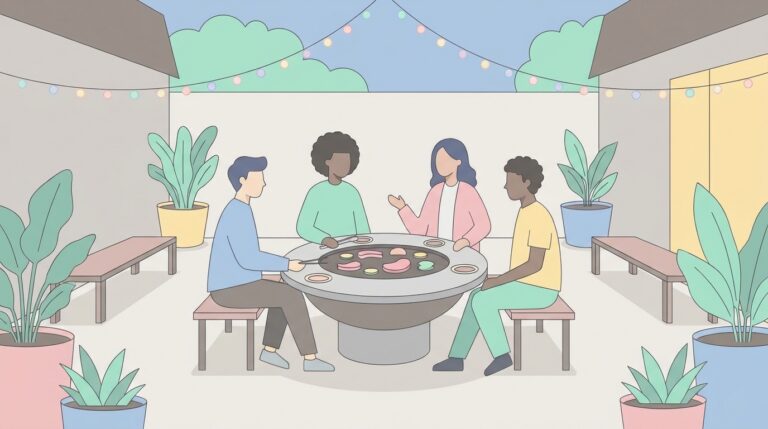
Picture this: the sun has just dipped below the horizon on Jeju Island. The courtyard of your cozy guesthouse is strung with warm fairy lights, and the intoxicating aroma of sizzling pork belly fills the cool evening air. Picnic tables are loaded with kimchi, lettuce wraps, and cold bottles of soju and beer. Dozens of travelers are laughing, talking, and pouring drinks for one another.
You walk outside with your plate, heart pounding. You want so badly to join the circle, make new Korean travel buddies, and practice the Korean you have spent months learning. But suddenly, your mind blanks out. What if I sound too formal like a textbook? What if I accidentally offend someone?
You are not alone! Over 80% of our A2 learners told us they stayed quiet at guesthouse barbecue parties simply because they lacked quick, casual icebreakers. Today, we will fix that once and for all. Drawing from real guest experiences across Korea’s guesthouses, this guide gives you the exact phrases, cultural nuances, and non-verbal secrets to step into that party with confidence and make friends before the first batch of barbecue is even cooked.
Phase 2: Top 3 Core Expressions In-Depth
1. 여기 자리 있어요? (Yeogi jari isseoyo?)
- Pronunciation: [Yeo-gi ja-ri i-sseo-yo?] (Sounds like: “Yaw-gee jah-ree ee-ssuh-yo?”)
- Meaning: Literal: “Is there a seat here?” | Real Nuance: “Excuse me, is this seat taken? / Mind if I sit here?”
- K-Culture Moment: Seen in almost every youth travel drama when a solo backpacker approaches a packed table at a beachside hostel.
- Editor’s Insight: At Korean guesthouses, tables fill up fast. Asking this with a warm smile is polite, friendly, and non-intrusive. It immediately signals that you are open to socializing.
- Situation Spectrum: Casual ✅ | Semi-formal ✅ | Formal ⚠️
- 🤔 Think About It: In English, we usually ask about the absence of someone (“Is anyone sitting here?”), but Korean asks about the presence of space (“Is there a seat?”). How does focusing on the seat rather than the person make this question feel softer?
2. 혼자 여행 오셨어요? (Honja yeohaeng osyeosseoyo?)
- Pronunciation: [Hon-ja yeo-haeng o-syeo-sseo-yo?] (Sounds like: “Hone-jah yaw-hang oh-syuh-ssuh-yo?”)
- Meaning: Literal: “Did you come traveling alone?” | Real Nuance: “Are you traveling solo too?”
- K-Culture Moment: The magic question at communal guesthouse dinners in Gangneung or Jeju where solo travelers bond instantly over shared adventures.
- Editor’s Insight: The honorific infix -시- (si) shows respect to someone you just met, while the topic invites an instant shared bond. If both of you are solo travelers, you have an immediate connection.
- Situation Spectrum: Casual ✅ | Semi-formal ✅ | Formal ⚠️
- 🤔 Think About It: Why is asking about travel companionship so natural in Korean hostels, whereas in some cultures asking if someone is alone might feel slightly personal?
3. 다 같이 짠해요! (Da gachi jjanhaeyo!)
- Pronunciation: [Da ga-chi jjan-hae-yo!] (Sounds like: “Dah gah-chee jjahn-heh-yo!”)
- Meaning: Literal: “Let’s clink together!” | Real Nuance: “Let’s all make a toast! Cheers, everyone!”
- K-Culture Moment: When a fresh platter of hot grilled meat arrives at the table and everyone raises their soju or cider glasses simultaneously.
- Editor’s Insight: 짠 (Jjan) is an onomatopoeia mimicking the sound of glasses clinking. Saying 다 같이 짠해요! brings instant collective energy and brings everyone into the conversation.
- Situation Spectrum: Casual ✅ | Semi-formal ✅ | Formal 🚫
- 🤔 Think About It: Toasting in Korea is not just a formality; it is a ritual of unity that re-establishes table harmony throughout the entire meal.
Phase 3: Textbook Korean vs. Real Korean
Situation 1: Asking Someone’s Name
- 📖 교과서 한국어 (Textbook): 당신의 이름은 무엇입니까? (Dangsin-ui ireum-eun mueos-imnikka?)
- 🗣️ 진짜 한국어 (Real-Life): 이름이 어떻게 되세요? (Ireumi eotteoke doeseyo?) or 혹시 성함이 어떻게 되세요? (Hoksi seonghami eotteoke doeseyo?)
- 💡 왜 다를까? (Why the difference?): The word 당신 (dangsin) can sound aggressive or like a translated movie script in modern Korean conversation. Natural Korean drops pronouns and uses humble indirect phrasing.
Situation 2: Proposing a Toast
- 📖 교과서 한국어 (Textbook): 우리 건배합시다. (Uri geonbaehapsida.)
- 🗣️ 진짜 한국어 (Real-Life): 우리 짠해요! (Uri jjanhaeyo!) or simply 짠! (Jjan!)
- 💡 왜 다를까? (Why the difference?): 건배합시다 (Geonbaehapsida) sounds like a formal corporate dinner from the 1980s. Modern guesthouse parties thrive on lively, playful sounds like 짠 (Jjan).
Phase 4: K-Culture Deep Dive & Non-Verbal Manners
4-1. 눈치 (Nunchi) & Gestures at the BBQ Table
- Two Hands When Receiving and Pouring: Even at a casual guesthouse party with peers your age, use both hands (or place your left hand lightly under your right forearm) when pouring or receiving a drink. It demonstrates consideration without being stiff.
- The Clink Level: When toasting (짠!), gently lower the rim of your cup slightly below the rim of the other person’s cup if they are older or if you just met. It is an effortless way to impress your new friends with your cultural awareness.
- Nunchi with the Grill: Korean barbecue is collaborative. If you notice the lettuce basket is empty or someone needs water, offering to grab it shows high 눈치 (nunchi – social situational awareness).
4-2. Culture Code: Guesthouse BBQ Party Culture (게하 바비큐 파티)
In Korea’s premier travel spots like Jeju, Gangneung, and Yangyang, guesthouses are famous for their evening gatherings (often called 게하 파티). Travelers pay a small fee to share unlimited barbecue, side dishes, and drinks. It is an accepted social incubator designed for solo travelers to form day-trip groups for the following morning.
Phase 5: Real-Life Roleplay Scenario
Setting: A lively outdoor wooden table at a Jeju guesthouse barbecue party. The coals are glowing, and upbeat K-indie music plays in the background.
Characters: You (a curious traveler) and Minho (민호, a friendly Korean solo traveler handling the barbecue tongs).
- You: 저기요, 혹시 여기 자리 있어요? (Jeogiyo, hoksi yeogi jari isseoyo?)
🎭 [Smiling politely and gesturing toward the empty plastic stool]
(Excuse me, is this seat taken?) -
Minho: 네, 비어 있어요! 편하게 앉으세요. (Ne, bieo isseoyo! Pyeonhage anjeuseyo.)
🎭 [Shifting his bag and pulling the chair out for you warmly]
(No, it’s open! Please have a comfortable seat.) -
You: 감사합니다! 혼자 여행 오셨어요? (Gamsahamnida! Honja yeohaeng osyeosseoyo?)
🎭 [Setting down your water bottle and sitting down]
(Thank you! Are you traveling solo too?) -
Minho: 네, 서울에서 어제 왔어요. 그쪽도 혼자 오셨어요? (Ne, seoureseo eoje wasseoyo. Geujjokdo honja osyeosseoyo?)
🎭 [Flipping a golden-brown pork belly strip on the grill]
(Yes, I arrived from Seoul yesterday. Did you come solo as well?) -
You: 네, 맞아요. 삼겹살 냄새가 정말 좋아요! (Ne, majayo. Samgyeopsal naemsaega jeongmal joayo!)
🎭 [Looking at the grill with enthusiastic appreciation]
(Yes, that’s right. The pork belly smells so delicious!) -
Minho: 이거 다 익었어요. 먼저 한 점 드셔 보세요! (Igeo da igeosseoyo. Meonjeo han jeom deusyeo boseyo!)
🎭 [Placing a freshly grilled slice of meat directly onto your plate]
(This piece is ready. Please try a piece first!) -
You: 와, 정말 감사해요! 우리 다 같이 짠해요! (Wa, jeongmal gamsahaeyo! Uri da gachi jjanhaeyo!)
🎭 [Raising your cup with both hands and looking around the table]
(Wow, thank you so much! Let’s all toast together!) -
Minho: 좋아요, 다 같이 짠! 제주도 온 걸 환영해요! (Joayo, da gachi jjan! Jejudo on geol hwanyeonghaeyo!)
🎭 [Clinking glasses cheerily with a wide smile]
(Sounds great, cheers everyone! Welcome to Jeju!)
🔀 Interactive Decision Point
Minho picks up the soju bottle to pour you a drink. What do you do?
- Option A: Hold up your cup with both hands, smile, and say: “감사합니다!” (Gamsahamnida!)
- Option B: Wave your hand dismissively and say: “아니요, 내가 할게요.” (Aniyo, naega halgeyo. – “No, I’ll do it myself.”)
- Option C: Put your glass on the table, lean back, and say: “더 많이 줘!” (Deo mani jwo! – “Give me more!”)
Feedback:
* Option A (Best!): Perfect score! Holding your glass with both hands while someone pours shows great table etiquette and friendliness.
* Option B (Risk): In Korea, pouring your own drink while someone is offering breaks the communal bonding ritual. If you don’t drink alcohol, simply accept water or soda instead!
* Option C (Bad!): Using informal language (반말) like 더 많이 줘 on your first encounter can sound impolite and demanding.
Phase 6: 10-Second Emotional Shadowing Drill
Practice reading these out loud, observing the rhythmic pauses (/) and feeling the emotion tag before speaking!
[😊 조심스럽고 친근하게 - Polite & Friendly]
저기요, / 혹시 여기 / 자리 있어요?
(Jeogiyo, / hoksi yeogi / jari isseoyo?)-
[🤝 반갑고 호기심 가득하게 - Curious & Warm]
혼자 / 여행 / 오셨어요?
(Honja / yeohaeng / osyeosseoyo?) -
[🎉 활기차고 신나게 - Energetic & Celebratory]
고기 진짜 맛있어요! / 우리 다 같이 / 짠해요!
(Gogi jinjja masisseoyo! / Uri da gachi / jjanhaeyo!)
Phase 7: K-Culture Mini Dictionary
- 게하 (Ge-ha) (Noun): Short for 게스트하우스 (Guesthouse). Young travelers frequently say: “오늘 게하 분위기 진짜 좋다!” (“The vibe at this guesthouse is amazing today!”)
- 펜션 (Pensyeon) (Noun): A Korean-style vacation home or villa equipped with kitchen and barbecue amenities, popular for group getaways.
- 소맥 (Somaek) (Noun): A popular cocktail blend of 소주 (Soju) and 맥주 (Maekju / Beer), famous for breaking the ice at barbecue parties.
- 불멍 (Bulmeong) (Noun): The state of zoning out peacefully while staring into a campfire or charcoal grill (“fire daydreaming”).
Phase 8: Traveler’s Survival Kit
Survival Expressions TOP 3
- 쌈장 좀 더 주실 수 있나요? (Ssamjang jom deo jusil su innayo?)
Meaning: Could we have some more ssamjang (seasoned soybean paste)?
Pro Tip: Essential when the communal dipping sauce bowl runs dry. - 이거 어떻게 구워요? (Igeo eotteoke guwoyo?)
Meaning: How do I grill this?
Pro Tip: Great conversation starter if you are hesitant around Korean charcoal grills. - 사진 한 장 찍어 드릴까요? (Sajin han jang jjigeo deurilkkayo?)
Meaning: Shall I take a photo for you?
Pro Tip: Offering to take a photo of fellow travelers makes you an instant favorite friend.
Editor’s Travel Note
- Navigation Guide: Korean addresses in countryside pension areas can be tricky on international map apps. Be sure to complete your 네이버 지도 앱 다운로드 (Naver Map app download) before heading out for accurate bus and walking routes.
- Payment Tip: Guesthouse barbecue participation fees (typically 15,000 to 25,000 KRW) often prefer bank transfer or local debit cards at check-in, though cash is readily accepted.
Phase 9: “One Step Deeper” (Cultural Reflection)
In Western party cultures, small talk often revolves around individual career paths or witty personal anecdotes. In Korea, especially around a guesthouse barbecue table, connection is forged through shared physical experience—sharing freshly grilled meat wraps, topping up each other’s glasses, and marveling at the stars. This reflects the spirit of 정 (Jeong): an affectionate communal bond formed by simply being and eating together. You do not need complex grammar to be loved at a Korean table; your willingness to share food and say 짠! speaks louder than words.
💬 Your Turn: Have you ever attended a barbecue party during your travels? What is your favorite way to break the ice with locals? Share your story in the comments below!
Phase 10: FAQ & Common Mistakes
Q: Can I attend the guesthouse barbecue party if I do not drink alcohol?
A: Absolutely! Many travelers drink cider (사이다 – lemon-lime soda) or water. Just participate in the toast with your soft drink using two hands; the spirit of camaraderie is what matters most.
Q: Is it okay to use informal language (반말) if other guests are the same age as me?
A: Not right away. Even if you find out you are the same age, it is polite to maintain 존댓말 (polite style) until someone suggests: “말 편하게 해도 돼요?” (“Shall we speak comfortably?”).
Q: What should I do when someone grills meat for me?
A: Always express immediate appreciation! Say “잘 먹겠습니다!” (Jal meokgetseumnida – I will eat well) and make sure to offer them side dishes or sauces in return.
🚨 Common Mistakes Alert
- Mistake: Calling a fellow guest “너 (Neo)” because you heard it in a K-drama.
Correct Action: Never use 너 with strangers. Address them by their name with -씨 (-ssi) or simply say 그쪽 (geujjok) politely. - Mistake: Clinking glasses with one limp hand while leaning back.
Correct Action: Support your pouring or holding wrist with your other hand to display warmth and respect. - Mistake: Eating without waiting for the group toast.
Correct Action: Wait until everyone has a drink in hand to do the inaugural 짠! together.
Phase 11: Action Mission & Engagement
- 🥉 Bronze Level: Stand in front of your mirror and practice saying “여기 자리 있어요?” with a bright, welcoming smile 5 times.
- 🥈 Silver Level: Record a short voice note saying “우리 다 같이 짠해요!” and post it to your study Instagram story or language exchange app.
- 🥇 Gold Level: During your next trip or visit to a Korean barbecue restaurant, use “쌈장 좀 더 주실 수 있나요?” directly with the staff!
🎮 K-Culture Mission: Watch any episode of a travel variety show (like Youth Over Flowers or Camping Club) and count how many times the cast says “짠!” around the campfire!
Phase 12: Interactive Quiz Challenge
1. Situation Challenge: You see an empty seat next to another solo traveler at a guesthouse barbecue. What do you say?
* a) 저기 앉아라! (Jeogi anjara!)
* b) 여기 자리 있어요? (Yeogi jari isseoyo?)
* c) 밥 먹었니? (Bap meogeonni?)
2. Fill-in-the-Blank: Complete the friendly toast expression:
우리 다 같이 _____ 해요! (Uri da gachi _____ haeyo!)
3. Cultural True or False: When clinking glasses with someone newly met at a party, it is respectful to raise your glass as high above theirs as possible. (True / False)
👉 Click here for Answers & Explanations
- Correct Answer: b) 여기 자리 있어요? (Yeogi jari isseoyo?)
Explanation: This is the polite, natural way to ask if you can join the table. Choice (a) is a command and choice (c) is informal. -
Correct Answer: 짠 (Jjan)
Explanation: 우리 다 같이 짠해요! means “Let’s all toast together!” -
Correct Answer: False
Explanation: To show humility and respect, gently keep your cup level with or slightly lower than the other person’s rim when clinking.
🎬 Watch Our Daily Videos! (Daily Hangul Official Instagram)
Review the expressions you learned in this article with our fun daily short videos! Check out native pronunciation and real-life nuances in action.
- Instagram @dailyhangul_en






