Phase 1: Empathy (Story-Driven Opening)
안녕하세요! 매일한글 에디터입니다. (Hello! This is your Daily Hangul editor.)
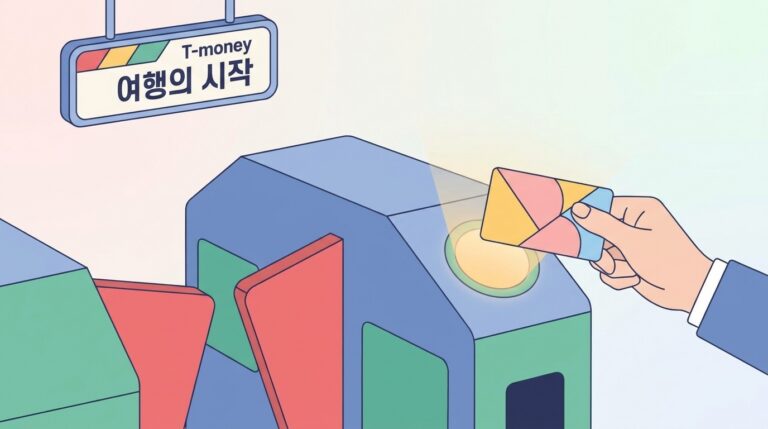
Picture this: You just touched down at Incheon Airport, hopped on the swift AREX express train, and arrived at the vibrant streets of Hongdae. Your heart is racing with excitement. You step in front of the sleek subway turnstile, pull out your stylish leather wallet, and proudly press the entire wallet onto the sensor. But instead of a satisfying ding and an opening barrier, a loud beep pierces the air. A crisp automated voice rings out across the station: “카드를 한 장만 대 주세요 (Kadeureul han jangman dae juseyo).”
The turnstile screen turns bright red with an alert icon. Behind you, a swift wave of morning commuters in trench coats immediately begins bunching up. Your cheeks flush red, panic sets in, and you frantically wonder: Did my card run out of money? Did I break the machine? What does that sentence even mean?!
Take a deep breath—you are completely fine! Every single Korean person has experienced this exact moment. Based on real feedback from hundreds of our beginner students, subway gate confusion is the #1 embarrassment trigger for travelers in Korea. Today, we are breaking down the exact Korean phrases and local hacks you need so you can breeze through Seoul’s subway gates like a seasoned local.
Phase 2: Top 3 Essential Expressions Deep Dive
1. 카드를 한 장만 대 주세요 (Kadeureul han jangman dae juseyo)
- Pronunciation: [Kah-deu-reul han-jang-man dae-joo-seh-yo] (Sounds like: Car-do-rail han-jang-man day-joo-say-yo)
- Meaning: Literal: “Please place only one card.” / Real Nuance: “Multiple cards detected! Tap just one transit card against the reader.”
- K-Culture Moment: Seen in relatable K-drama commute scenes (like in My Liberation Notes), where exhausted office workers fumble at the gate during Seoul’s high-speed rush hour.
- Editor’s Insight: ‘한 장’ (han jang) uses the flat-object counter ‘장’ (jang), and ‘대다’ (daeda) means to touch or hold an object against a surface. The machine isn’t scolding you—it’s simply asking you to separate your transit card from your other RFID credit cards!
- Situation Spectrum: Casual ⚠️ | Semi-formal ✅ | Formal ✅
- 🤔 Think About It: In English, we say “tap one card”, but Korean specifically highlights the counter ‘장’ (flat sheet/card). How does your native language count cards?
2. 찍어 주세요 (Jjigeo juseyo)
- Pronunciation: [Jji-geo joo-seh-yo] (Sounds like: Jjee-guh joo-say-yo with a crisp, double-j pop)
- Meaning: Literal: “Please stamp/print.” / Real Nuance: “Please tap your card on the reader.”
- K-Culture Moment: When a kind elderly passenger or a station attendant sees you hesitating and points to the glowing pad saying, “여기 찍어 주세요!” (Tap it right here!).
- Editor’s Insight: The root verb ‘찍다’ (jjikda) originally referred to stamping an ink seal onto official paper. In 21st-century digital Korea, it is the universal everyday word for tapping any contactless card or scanning a barcode.
- Situation Spectrum: Casual ✅ | Semi-formal ✅ | Formal ⚠️
- 🤔 Think About It: Notice the satisfying onomatopoeic feeling of ‘찍’ (jjik). It mimics the physical contact of the card hitting the reader!
3. 충전해 주세요 (Chungjeonhae juseyo)
- Pronunciation: [Choong-jeon-hae joo-seh-yo] (Sounds like: Choong-jun-hay joo-say-yo)
- Meaning: Literal: “Please recharge.” / Real Nuance: “Please reload / top up my transit card.”
- K-Culture Moment: Stepping into a cozy convenience store (GS25 or CU), sliding your cute character T-Money card and a 10,000 KRW bill toward the clerk, and saying this phrase with a warm smile.
- Editor’s Insight: ‘충전’ (chungjeon) is a versatile powerhouse word. You use it for transit cards, your smartphone battery, and even when taking a weekend rest to recharge your own energy (재충전 – jaechungjeon)!
- Situation Spectrum: Casual ⚠️ | Semi-formal ✅ | Formal ✅
- 🤔 Think About It: Adding ‘해 주세요’ (hae juseyo) turns virtually any Sino-Korean noun into a polite, natural request without complex verb conjugations.
Phase 3: Textbook Korean vs. Real Korean
Situation 1: What the machine says vs. What actual Koreans say
- 📖 교과서 한국어 (Textbook): 교통카드를 단말기에 접촉하십시오. (Gyotongkadeureul danmalgie jeopchokhasipsio. – Please make contact with the transit card to the terminal.)
- 🗣️ 진짜 한국어 (Real-life): 카드 찍어 주세요. (Kadeu jjigeo juseyo. – Please tap the card.)
- 💡 왜 다를까? (Why the difference?): Official signs and automated announcements use hyper-formal Sino-Korean vocabulary (접촉 – jeopchok). Everyday Koreans prefer the snappy, action-driven native verb 찍다 (jjikda).
Situation 2: Warning a friend holding multiple cards
- 📖 교과서 한국어 (Textbook): 복수의 카드를 태그하지 마십시오. (Boksuui kadeureul taegeuhaji masipsio. – Do not tag multiple cards.)
- 🗣️ 진짜 한국어 (Real-life): 카드 한 장만요! (Kadeu han jangmanyo! – Just one card!)
- 💡 왜 다를까? (Why the difference?): In the rapid rhythm of Seoul’s subway rush, long sentences are discarded. Attaching ‘요’ (yo) to the noun phrase ‘한 장만’ (only one card) makes it instantaneously fast yet politely respectful.
Phase 4: K-Culture Deep Dive & Non-Verbal Manners
4-1. 눈치 (Nunchi) & Turnstile Etiquette
In Korea, Nunchi (the art of sensing social flow and room awareness) is on full display at subway gates. If your card fails to register on the first attempt:
1. Step sideways immediately: Never stay rooted directly in the gate slot while digging through your backpack. Take half a step back to let the person behind you breeze through.
2. The Two-Handed Apologetic Nod: If you accidentally cause someone to stop abruptly, offer a slight 15-degree head bow and a quiet “죄송합니다” (Joesonghamnida – I’m sorry).
3. Pre-tap Preparation: Experienced Seoulites already hold their individual card between their index finger and thumb three steps before reaching the gate.
4-2. Cultural Code: The ‘Ppalli-Ppalli’ (Fast-Fast) Rhythm
South Korea’s public transit system is globally renowned for hyper-efficiency. Automated gates process up to 40 passengers per minute! Commuters plan their boarding location right down to the specific train car number to exit directly in front of their transfer stairs. Understanding the announcement “카드를 한 장만 대 주세요” is your ticket into this synchronized urban dance.
Phase 5: Real-World Roleplay Scenario
Setting: Morning rush hour at Hongik University Station (Line 2). Alex (a solo traveler) gets stuck at the turnstile. Mr. Kim, a helpful station assistant wearing an orange vest, steps in.
- Gate Machine: 카드를 한 장만 대 주세요! (Kadeureul han jangman dae juseyo!)
“Please tap only one card!”
🎭 (기계음이 울리며 빨간 불이 켜진다 / Machine chimes loudly as the red light blinks) - Alex: 어? 왜 안 되지? (Eo? Wae an doeji?)
“Huh? Why isn’t it working?”
🎭 (지갑을 단말기에 계속 문지른다 / Frantically rubs entire wallet against the sensor pad) - Mr. Kim: 저기요, 도와드릴까요? (Jeogiyo, dowadeurilkkayo?)
“Excuse me, may I help you?”
🎭 (미소를 지으며 알렉스에게 다가온다 / Walks over with a reassuring smile) - Alex: 네, 카드가 안 돼요. (Ne, kadeuga an dwaeyo.)
“Yes, my card isn’t working.”
🎭 (지갑을 보여주며 억울한 표정을 짓는다 / Shows wallet with a puzzled expression) - Mr. Kim: 지갑에 카드가 많아서 그래요. (Jigabe kadeuga manaseo geuraeyo.)
“It’s because there are multiple cards inside your wallet.”
🎭 (지갑 속 신용카드들을 가리킨다 / Points gently to the layers of cards in the wallet) - Mr. Kim: 티머니 카드만 꺼내서 찍어 주세요. (T-meoni kadeuman kkeonaeseo jjigeo juseyo.)
“Please take out just your T-Money card and tap it.”
🎭 (카드를 찍는 손동작을 흉내 낸다 / Demonstrates a tapping gesture with his hand) - Alex: 아! 티머니 카드만요? 알겠습니다! (A! T-meoni kadeumanyo? Algesseumnida!)
“Ah! Just the T-Money card? Understood!”
🎭 (카드를 단독으로 꺼내 단말기에 갖다 댄다 / Pulls out the single card and taps it alone) - Gate Machine: 삐빅! (Ppibik!)
“Beep!”
🎭 (초록색 화살표가 켜지며 개찰구가 열린다 / Green arrow illuminates as the gate opens wide)
🔀 Interactive Choice Point: What would you do next?
- Choice A: Hand your entire wallet to the commuter behind you and say “해 주세요” (Hae juseyo).
- Feedback (Bad): Very awkward! Personal boundaries are important; strangers will be startled if handed personal items.
- Choice B: Walk through the gate, turn to Mr. Kim, bow lightly, and say “감사합니다! 좋은 하루 되세요!” (Gamsahamnida! Joeun haru doeseyo!).
- Feedback (Best!): Perfect! Polite, warm, and shows high conversational fluency.
- Choice C: Duck underneath the barrier before it closes and run toward the platform.
- Feedback (Risk): Never do this! An alarm will sound across the station, and station security will stop you for fare evasion.
Phase 6: 10-Second Emotion Shadowing Drill
Repeat these lines out loud with the marked intonation breaks (/) and emotional tone:
[😮 당황하지만 침착하게 / Panicked but trying to stay calm]
카드를 / 한 장만 / 대 주세요!
(Kadeureul / han jangman / dae juseyo!)-
[💡 깨달음을 얻고 명쾌하게 / Sudden realization and bright clarity]
아! / 티머니 카드만 / 찍으면 돼요?
(A! / T-meoni kadeuman / jjigeumyeon dwaeyo?) -
[😊 안도하며 따뜻하고 정중하게 / Relieved, warm, and polite]
감사합니다! / 좋은 하루 / 되세요!
(Gamsahamnida! / Joeun haru / doeseyo!)
Phase 7: K-Culture Mini Dictionary
- 티머니 (T-meoni) | T-Money Card | Korea’s premier rechargeable transit smart card used for subways, city buses, taxis, and convenience stores nationwide.
- 개찰구 (Gaechalgu) | Turnstile / Ticket Gate | The physical barrier gates inside train and subway stations where you tap your transit card.
- 환승 (Hwanseung) | Transit Transfer | Korea’s world-famous integrated transit discount system. Transferring between subway and bus within 30 minutes is free or discounted!
- 잔액 부족 (Janaek bujok) | Insufficient Balance | The screen notification that appears when your card has less than the minimum transit fare (typically below 1,400 KRW).
Phase 8: Traveler’s Survival Kit
Top 3 Survival Phrases
- 1. 어디서 충전해요? (Eodiseo chungjeonhaeyo?)
Pronunciation: [Eo-di-seo choong-jeon-hae-yo?]
Meaning: Where do I recharge?
Pro Tip: Use this when looking for the cash recharge machine or asking a convenience store counter. - 2. 잔액 확인해 주세요. (Janaek hwaginhae juseyo.)
Pronunciation: [Jan-aek hwa-gin-hae joo-seh-yo]
Meaning: Please check my balance.
Pro Tip: Hand your card to any convenience store cashier to check remaining funds before embarking on a long journey. - 3. 얼마 남았어요? (Eolma namasseoyo?)
Pronunciation: [Eol-ma na-mas-seo-yo?]
Meaning: How much is left?
Pro Tip: Casual, natural question to check remaining money on your card.
Editor’s Travel Note
- Essential Transit Apps: Before your trip, download the Naver Map navigation app and the KakaoMetro subway route planner for real-time door-to-door subway timetables.
- Cash is King for Recharging: Subway station automated reload machines only accept physical Korean Won (paper bills)! Foreign credit cards and digital wallets like Apple Pay do not work on these machines. Always keep a crisp 10,000 KRW bill in your pocket for emergency transit reloads.
Phase 9: “One Step Deeper” (Cultural Reflection)
Have you noticed how Korean turnstiles address you? In many countries, machines show cold technical error codes like “Card Collision: Error 42”. But in Korea, the machine speaks with polite honorific request grammar: “대 주세요” (-juseyo: Please hold against).
This reflects Korea’s collectivist public philosophy. Automated announcements are programmed to emulate the gentle tone of a helpful elder or public guide rather than a punitive barrier. In Korean society, public transit is viewed as a shared communal space (공공장소 – gonggongjangso), where rules are mutual courtesies designed to keep everyone moving forward together smoothly.
💬 Your Turn: Have you ever had a hilarious or panic-inducing turnstile moment while traveling abroad? Share your story in the comments below!
Phase 10: FAQ & Avoiding Misunderstandings
Q: Why did the gate beep red even though I charged my T-Money card with 30,000 KRW?
A: 99% of the time, your card has plenty of money, but your wallet holds other RFID cards—such as a contactless credit card or your hotel room keycard. The sensor detects competing radio frequencies and safely pauses. Simply slide your T-Money card out and tap it alone.
Q: Can I use one T-Money card for both me and my travel partner at the subway turnstile?
A: No. Unlike Seoul city buses (where you can ask the bus driver “두 명이요” – two people), subway turnstiles require each passenger to tap their own individual card to track transit distance and transfer discounts.
Q: What should I do if the barrier gate closes on me and traps me inside?
A: Look right beside the gate for a large gate labeled “비상구” (Emergency Exit) or find the round yellow Help Bell (도움벨 – doumbel). Press the button, and say: “도와주세요! 카드가 안 돼요” (Dowajuseyo! Kadeuga an dwaeyo – Help me! My card isn’t working). The gate will open remotely!
🚨 Common Mistakes Alert
- Tapping your entire backpack or purse: Sensors cannot penetrate thick leather bags containing multiple cards. Keep your card in a phone pocket or lanyard.
- Tapping and pulling back too fast: Hold the card firmly against the sensor for 0.5 seconds until you hear the distinct ding! sound.
- Forgetting to tap when getting off the bus: If you transfer to a bus, always tap upon getting off (하차태그 – hacha taegeu), or you will incur a maximum fare penalty on your next trip!
Phase 11: Action Mission & Engagement
- 🥉 Bronze Level: Practice saying “카드를 한 장만 대 주세요” out loud 3 times in front of your mirror.
- 🥈 Silver Level: Snap a picture of your favorite Korean transit card design (Kakao Friends, Line Friends, or K-pop photo cards) and share it on Instagram with #DailyHangul!
- 🥇 Gold Level: On your next trip to Korea, go to a convenience store and reload your card entirely in Korean using: “티머니 만 원 충전해 주세요” (T-meoni man won chungjeonhae juseyo).
- 🎮 K-Culture Mission: Watch any modern commute K-drama (such as My Mister or Extraordinary Attorney Woo) and listen carefully for the subway chime and transit card beeps during station scenes!
Phase 12: Interactive Quiz Challenge
Question 1 (Situational Judgment)
You tap your wallet on the subway reader. It rings “삐빅!” and says “카드를 한 장만 대 주세요.” What is the correct next step?
1. Force the gate open and run.
2. Tap your entire wallet harder against the glass.
3. Take out only your T-Money card and tap it by itself.
👉 Click to reveal Answer & Explanation
Correct Answer: 3
The machine is detecting multiple RFID signals. Taking your single T-Money card out and tapping it alone resolves the collision immediately!
Question 2 (Fill-in-the-Blank)
Complete the natural Korean phrase for topping up your transit card at a convenience store:
“티머니 [ ]해 주세요.” (Please reload my T-Money card.)
👉 Click to reveal Answer & Explanation
Correct Answer: 충전 (Chungjeon)
충전 means reload/recharge. The full phrase is: “티머니 충전해 주세요 (T-meoni chungjeonhae juseyo).”
Question 3 (True or False Cultural Check)
True or False: You can reload a standard physical T-Money card at automated Seoul Metro station machines using foreign Visa or Mastercard credit cards.
👉 Click to reveal Answer & Explanation
Correct Answer: False!
Automated subway station machines in Seoul strictly accept cash (Korean Won bills). Always carry physical Won cash or visit specialized traveler kiosks like WOWPASS!
🎬 Watch Our Daily Videos! (Daily Hangul Official Instagram)
Review the expressions you learned in this article with our fun daily short videos! Check out native pronunciation and real-life nuances in action.
- Instagram @dailyhangul_en