

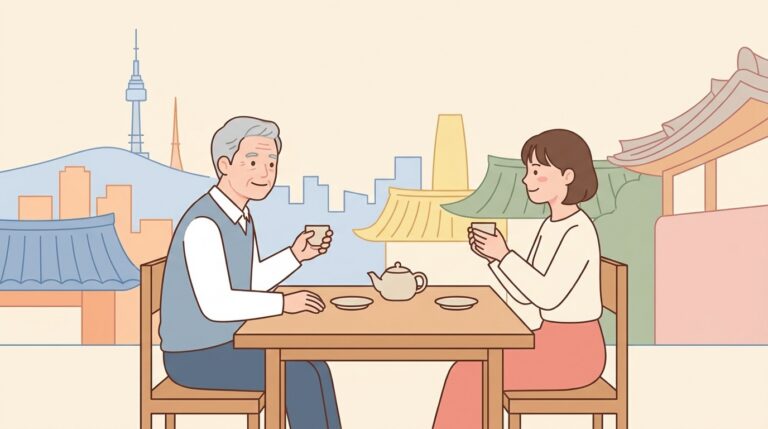
Phase 1: Empathy (Story-Driven Opening)
안녕하세요! 매일한글 에디터입니다. Have you ever felt the air instantly freeze at a Korean dinner table when work ethic or career loyalty comes up? You might witness an executive manager lamenting the lack of grit while a twenty-something junior colleague quietly checks their phone, emotionally shutting down. Foreign professionals and advanced learners constantly tell me, ‘Korean generational conflicts feel like two entirely distinct planets colliding in a single conference room.’ But here is the secret: Korean worldviews are evolutionary survival artifacts. When you learn to articulate why each generation reacts as it does, tense friction transforms into profound empathy. Based on real learner experiences, this C1 cultural navigation guide gives you the nuanced Korean tools to bridge generational divides with grace.
Phase 2: Core Expressions Deep Dive
1. 시대적 배경을 감안하다 (Sidaejeok baegyeongeul gamanhada)
- Pronunciation: [Si-dae-jeok bae-gyeong-eul ga-man-ha-da] (Pronounce ‘gaman’ smoothly like the English word ‘garment’ without the ‘rt’, flowing with a soft breath)
- Meaning: Literal: “To take the historical context into consideration” vs. Actual Nuance: Acknowledging that someone’s rigid habits are products of historical turmoil rather than personal malice.
- K-Culture Moment: Frequently heard in analytical documentaries or reflective family dramas like Reply 1988 when children finally realize why their parents hoard scraps or fear debt.
- Editor’s Insight: ‘감안하다’ (gamanhada) is an advanced Sino-Korean verb essential for constructive debates. It shows intellectual maturity by decoupling behavior from character flaws.
- Situation Spectrum: Casual ⚠️ / Semi-formal ✅ / Formal ✅
- 🤔 Think About It: In your home country, do people rationalize older generations’ behaviors through historical trauma, or is it purely viewed as individual stubbornness?
2. 그 시절을 살아낸 사람들의 생존 방식 (Geu sijeoreul sara-naen saramdeurui saengjon bangsik)
- Pronunciation: [Geu si-jeo-reul sa-ra-naen sa-ram-deu-rui saeng-jon bang-sik] (Flow smoothly from ‘sara-naen’ into ‘sa-ram’, evoking resilience)
- Meaning: Literal: “The survival method of those who lived through that era” vs. Actual Nuance: A respectful nod to the collective trauma and resilience behind older Koreans’ aggressive work ethic.
- K-Culture Moment: Mirrored in historical blockbuster movies like Ode to My Father (국제시장), explaining the sacrifice of the industrialization generation.
- Editor’s Insight: The verb compound ‘살아내다’ (surviving/enduring life against the odds) carries far more emotional weight than the simple verb ‘살다’ (to live).
- Situation Spectrum: Casual ⚠️ / Semi-formal ✅ / Formal ✅
- 🤔 Think About It: Why does Korean place such strong linguistic honor on collective endurance compared to individual happiness?
3. 다름을 틀림으로 보지 않다 (Dareumeul teullimeuro boji anta)
- Pronunciation: [Da-reu-meul teul-li-meu-ro bo-ji an-ta] (Crisp ‘t’ sound on ‘teullim’, rhyming with clean precision)
- Meaning: Literal: “To not view difference as wrongness” vs. Actual Nuance: Moving beyond binary moral judgments in cultural and generational disputes.
- K-Culture Moment: Often cited in modern public lectures (세바시, Change the World 15 Min) discussing the MZ generation versus baby boomers.
- Editor’s Insight: Koreans often slip into saying “틀려요” (it’s wrong) when they mean “달라요” (it’s different). Using this phrase corrects that bias diplomatically.
- Situation Spectrum: Casual ✅ / Semi-formal ✅ / Formal ✅
- 🤔 Think About It: How does your native language differentiate ideological disagreement from moral incorrectness?
Phase 3: Textbook Korean vs. Real Korean
- Situation 1: Explaining an older boss’s obsessive overtime culture
- 📖 Textbook Korean: 세대 차이를 극복하기 위해 노력해야 합니다. (Sede chai-reul geukbok-hagi wihae noryeok-haeya hamnida. / We must strive to overcome generational differences.)
- 🗣️ 진짜 한국어: 그땐 밤낮없이 일하지 않으면 살아남을 수 없던 시절이었잖아요. (Geuttaen bamnat-eopsi ilhaji aneumyeon saranameul su eopdeon sijeorieotjanhayo. / In those days, you literally couldn’t survive unless you worked day and night.)
- 💡 왜 다를까?: Textbook Korean leans on abstract, bureaucratic slogans. Real advanced speakers humanize the struggle by referencing the socioeconomic reality of rapid industrialization (압축성장).
- Situation 2: Defending a junior colleague’s work-life boundary
- 📖 Textbook Korean: 젊은 세대의 의견을 존중해 주십시오. (Jeolmeun sede-ui uigyeoneul jonjung-hae jusipsio. / Please respect the opinions of the younger generation.)
- 🗣️ 진짜 한국어: 요즘 친구들 입장에서는 저성장 시대의 자연스러운 생존 전략일 수 있어요. (Yojeum chingudeul ipjang-eseoneun jeoseongjang sidae-ui jayeonseureoun saengjon jeollyagil su isseoyo. / From the juniors’ perspective, it is a natural survival strategy in an era of low economic growth.)
- 💡 왜 다를까?: Rather than making it an emotional plea for respect, native professionals frame youth attitudes within structural economic realities (저성장, stagnant growth).
Phase 4: K-Culture Deep Dive & Non-Verbal Manners
4-1. 눈치 (Nunchi) & Non-Verbal Gestures
When discussing generational friction in Korea, vocal inflection and posture determine whether you sound like an empathetic mediator or an arrogant critic. When an elder recounts past hardships, maintain soft eye contact and execute slow, deliberate nods (경청의 고개 끄덕임). Avoid crossing your arms; keep your hands loosely clasped in front of your lap. When balancing the argument for younger peers, soften your voice with a gentle tilt of the head and use inclusive markers like “저 역시 이해하지만…” (While I understand that as well…).
4-2. Cultural Code Analysis: The Ghost of the 1997 IMF Crisis
To understand Korean generational discourse, you must understand the Asian Financial Crisis of 1997 (IMF 사태). Before 1997, lifelong employment was an unwritten covenant. When overnight bankruptcies swept the nation, parents learned that loyalty doesn’t guarantee security. Consequently, their children (today’s youth) grew up watching their parents burn out, leading to modern self-preservation trends like ‘각자도생’ (individual survivalism) and radical work-life balance (워라밸). Recognizing these economic milestones transforms generational critique into historical empathy.
Phase 5: Real-World Roleplay Scenario
- Setting: A quiet pub in Jongno after a long cross-department meeting. Deputy Director Park (50s) sighs heavily while nursing a draft beer, complaining about the rookie team member Min-ji (20s) leaving right at 6:00 PM despite looming deadlines.
-
Dialogue:
- 박 부장: 솔직히 민지 씨 보면 주인의식이 좀 아쉬워. 우리 땐 회사 일이 내 일이었는데 말이야. (Soljikhi Minji ssi bomyeon juinuigigi jom aswiwo. Uri ttaen hoesa iri nae irieonneunde mariya.) 🎭 한숨을 내쉬며 맥주잔을 만지작거린다 (Sighs and fiddles with his beer glass)
- You: 부장님께서 밤낮으로 헌신하시며 회사를 키우신 시절을 생각하면 서운하실 만해요. (Bujangnimkkeseo bamnajeuro heonsin-hasimyeo hoesareul kiusin sijeoreul saenggakhayeon seounhasil manhaeyo.) 🎭 고개를 끄덕이며 공감하는 눈빛을 보낸다 (Nods with an empathetic gaze)
- 박 부장: 그렇지? 내가 꼰대라서 그러는 게 아니라, 책임감의 문제라는 거지. (Geureotji? Naega kkondaeraseo geureoneun ge anira, chaegimgamui munjeraneun geoji.) 🎭 억울함을 토로하듯 잔을 내려놓는다 (Sets down the glass as if venting frustration)
- You: 맞습니다. 다만 민지 씨 세대는 평생직장 개념이 사라진 시대를 살아왔잖아요. (Matseumnida. Daman Minji ssi sedaneun pyeongsaengjikjang gaenyeomi sarajin sidaereul sarawatjanhayo.) 🎭 차분하고 차분한 어조로 운을 뗀다 (Speaks calmly in a measured tone)
- 박 부장: 평생직장이 없다라… 하긴 요즘 애들 취업난 보면 참 팍팍하긴 하더라. (Pyeongsaengjikjangi eopdara… hagin yojeum aedeul chwieomnan bomyeon cham pakpakhagin hadeora.) 🎭 시선을 돌려 생각에 잠긴다 (Looks away, lost in thought)
- You: 네, 각 세대가 맞닥뜨린 생존 환경이 다르다 보니 가치관의 우선순위도 달라진 것 같아요. (Ne, gak sedega matdaktteurin saengjon hwangyeongi dareuda boni gachigwanui useonsunwido dallajin geot gatayo.) 🎭 미소를 띠며 완충하는 제스처를 취한다 (Smiles gently with a buffering hand gesture)
- 박 부장: 듣고 보니 그렇네. 다름을 틀림으로 단정 지을 일은 아니었어. (Deutgo boni geureonne. Dareumeul teullimeuro danjeong jieul ireun anieosseo.) 🎭 표정이 풀리며 안주를 집는다 (His expression softens as he picks up food)
- You: 세대 간의 시각차를 이렇게 나눠주시니 저도 많이 배웁니다, 부장님. (Sedae ganui sigakchareul ireoke nanwojusini jeodo mani baeumnida, bujangnim.) 🎭 공손하게 양손으로 술잔을 들어 올린다 (Politely raises the glass with both hands)
- 🔀 Interactive Decision Point:
- How would you respond if Director Park snapped: “요즘 젊은 친구들은 왜 이렇게 개인주의적인가요?” (Why are young people these days so individualistic?)
- Choice A (Best): “사회가 급변하며 각자도생할 수밖에 없던 성장 배경을 감안하면, 그들에겐 자연스러운 방어기제일 수도 있어요.” (Nuanced, sociologically grounded, preserves elder’s face while validating youth)
- Choice B (Bad): “요즘은 개인주의가 글로벌 스탠더드인데 부장님이 너무 옛날 방식만 고집하시는 겁니다.” (Blunt, confrontational, triggers defensiveness)
- Choice C (Risk): “그러게요, 역시 우리 세대랑은 정말 안 맞네요.” (Passive, fuels division, lacks diplomatic integrity)
Phase 6: 10-Second Emotional Shadowing Drill
Practice these natural pacing pauses (/) and adopt the indicated emotional state:
[🥺 깊이 공감하며 / With deep empathetic validation]
부장님 시절에는 / 회사의 성장이 곧 / 개인의 성공이었기에 / 모든 걸 바치셨던 거잖아요.
(Bujangnim sijeoreneun / hoesaui seongjang-i got / gaeinui seonggong-ieotgie / modeun geol bachisyeotdeon geojanhayo.)-
[🤝 차분하고 통찰력 있게 / With calm and balanced insight]
각 세대가 통과해 온 / 역사적 환경이 다르니 / 생존 방식의 차이를 인정할 때 / 진짜 소통이 시작된다고 봐요.
(Gak sedega tonggwahae on / yeoksajeok hwangyeong-i dareuni / saengjon bangsik-ui chaireul injeonghal ttae / jinjja sotong-i sijakdoendago bwayo.)
Phase 7: K-Culture Mini Dictionary
- 압축성장 (Apchuk-seongjang) | Compressed Economic Growth
Usage: Refers to South Korea’s transformation from war ruins to an industrial giant in merely three decades. Used in discussions to explain why older Koreans prioritize speed, output, and loyalty over emotional well-being. - 각자도생 (Gakjado-saeng) | Each Person Fends for Themselves
Usage: A four-character idiom (사자성어) reflecting modern youth skepticism toward societal security nets. Explains why younger workers prioritize savings, personal boundaries, and freelance side-hustles over company loyalty. - 꼰대 (Kkondae) | Condescending Elder / Out-of-Touch Figure
Usage: Originally slang for strict teachers or fathers, now describing anyone who imposes unsolicited life lessons based purely on seniority. Advanced learners use this cautiously to critique authoritarian attitudes without attacking individuals. - 세대 포용 (Sedae Poyong) | Generational Inclusivity
Usage: A frequent catchphrase in Korean business ethics and HR forums referring to creating harmonious workplaces that integrate Baby Boomers, Gen X, and Gen MZ.
Phase 8: Survival Kit for Travelers & Expats
-
Top 3 Survival Lines for Delicate Social Situations:
- 말씀 듣고 보니 그 시절엔 그럴 수밖에 없었겠네요. (Malsseum deutgo boni geu sijeoren geureol subakke eopseotgenneyo. / Hearing your story, it makes sense that you had no choice back then.) → Pro Tip: Use this to defuse a senior coworker’s monologue about past hardships.
- 세대마다 짊어진 짐의 무게가 서로 다른 것 같습니다. (Sedaemada jilmeojin jimui mugega seoro dareun geot gatseumnida. / Each generation carries a different weight of burdens.) → Pro Tip: Elegant mediation phrase during boardroom debates.
- 저도 다른 시각에서 배울 수 있어 뜻깊습니다. (Jeodo dareun sigageseo baeul su isseo tteutgipseumnida. / I appreciate learning from a different perspective.) → Pro Tip: Polite conversational exit when generational arguments peak.
- Editor’s Travel & Life Note:
Navigating Seoul’s subway lines during rush hour offers a masterclass in intergenerational dynamics. Watch how younger commuters clear seats near the designated elderly cars (노약자석). When meeting older Koreans at local markets or traditional restaurants, always present and receive receipts or payment cards with both hands. If you need to navigate these cultural hubs with real-time transit awareness, ensure you utilize the 네이버 지도 앱 다운로드 to coordinate public transportation and explore historical districts like Euljiro where retro factories and trendy modern cafes co-exist seamlessly.
Phase 9: “One Step Deeper” (Cultural Reflection)
South Korea’s modern history is a tempestuous timeline: Japanese colonization, the Korean War, rapid industrialization, authoritarian rule, democratization, the IMF collapse, and rapid digital domination—all crammed into a single century. Consequently, grandparents, parents, and grandchildren in Korea did not merely grow up in different eras; they practically lived in entirely different countries. The tension we observe today is not intrinsic malice; it is the friction of competing survival strategies. When we recognize that another generation’s rigidity or detachment is their psychological armor forged by historical trials, the impulse to blame dissolves into empathetic understanding.
💬 Your Turn: Have you experienced a generational clash in Korea or with Korean friends? Which historical context helped you decipher their point of view? Drop your thoughts in the comments below!
Phase 10: FAQ & Common Mistakes
Q: Can calling someone a ‘꼰대’ (kkondae) ever be playful or acceptable in formal settings?
A: In formal or semi-formal business settings, calling anyone a ‘꼰대’—even humorously—is extremely dangerous. It carries a sharp sting of disrespect. Reserve playful uses strictly for close friends of the same age when self-deprecating (e.g., “나 벌써 꼰대 됐나 봐”). In professional environments, replace it with neutral academic terms like ‘기성세대의 시각’ (the older generation’s viewpoint).
Q: Why do older Koreans ask very personal questions like marital status or salary?
A: In post-war Korea, communal survival (우리 culture) required knowing everyone’s circumstances to offer mutual aid and maintain social cohesion. What westernized or younger minds interpret as an invasion of privacy, older generations often subconsciously view as warm communal affection (정, Jeong). Reframe it as clumsy concern rather than nosiness.
Q: How do I express disagreement with a senior Korean colleague without sounding insubordinate?
A: Employ the ‘쿠션어’ (cushion language) technique. Always start with validation: “말씀해주신 취지에 깊이 공감합니다” (I deeply empathize with your intention), followed by an environmental pivot: “다만 현업 데이터와 최근 시장 흐름을 감안했을 때, 이러한 대안도 고려해 볼 수 있을 것 같습니다” (However, considering frontline data and recent trends, we might also consider this alternative).
- 🚨 Common Mistakes Board:
- ❌ Mistake 1: Saying “부장님 생각이 틀렸어요” (Director, your thought is wrong).
→ ✅ Correct Action: Say “부장님 말씀도 맞지만, 이런 측면도 함께 감안하면 어떨까요?” (You make a fair point, but what if we also take this aspect into account?). - ❌ Mistake 2: Assuming silence from younger Koreans means agreement.
→ ✅ Correct Action: Korean juniors often remain silent to avoid direct conflict. Follow up privately with “혹시 실무자 입장에서 우려되는 점이 있나요?” (Are there any concerns from your operational perspective?). - ❌ Mistake 3: Equating 586-generation (democracy activists) mindsets with older war-generation mindsets.
→ ✅ Correct Action: Korean middle-aged generations are deeply proud of political democratization, while elderly citizens pride themselves on economic survival. Tailor your respect accordingly.
- ❌ Mistake 1: Saying “부장님 생각이 틀렸어요” (Director, your thought is wrong).
Phase 11: Action Missions
- Bronze Mission (Self Practice): Read the Phase 6 Shadowing Drills aloud 5 times, paying attention to the pitch decline when uttering empathetic buffer phrases like “감안하면”.
- Silver Mission (Social Media Sharing): Write a 2-sentence reflection on social media or in your language journal using the phrase
다름을 틀림으로 보지 않다to describe an intercultural or intergenerational experience. - Gold Mission (Real-World Execution): In your next Korean interaction involving a workplace or social debate, incorporate
시대적 배경을 감안하다or생존 방식to mediate between opposing viewpoints. - 🎮 K-Culture Mission: Watch an episode of the drama Misaeng (미생) or the movie Default (국가부도의 날). Note how managerial figures and younger newcomers justify their professional decisions based on their survival environments.
Phase 12: Interactive Quiz Challenge
- Situational Judgment: You are facilitating a meeting where a senior director criticizes a new hire for declining an after-work drinking session (회식). Which response demonstrates C1-level cultural empathy?
- A) “회식 강요는 법적으로 직장 내 괴롭힘에 해당합니다.”
- B) “부장님께서 팀 단합을 중시하시는 마음도 충분히 이해되지만, 요즘 세대는 사생활 분리를 통해 업무 효율을 높이는 방식을 선호하기도 하더라고요.”
- C) “신입사원이 예의가 없네요. 제가 대신 사과드립니다.”
- Fill in the Blank: “서로 살아온 환경이 다르다는 점을 인정하고, 다름을 (________)으로 보지 않는 태도가 중요해요.”
- Word Bank: 틀림 / 모순 / 정답 / 과장
- True / False: In modern Korean sociological discourse, younger generations prioritizing personal boundaries is generally analyzed as an irrational fad rather than an economic adaptation to low-growth eras. (True / False)
정답과 해설 보기 (Click for Answer & Explanation)
- 정답: B
해설: B validates the senior’s underlying desire for team cohesion while offering a structural, professional explanation for the junior’s boundaries without assigning moral blame. Choice A is too aggressive for smooth mediation, and Choice C unnecessarily sacrifices the junior colleague. -
정답: 틀림 (Wrongness)
해설: The proverb-like idiom is ‘다름을 틀림으로 보지 않다’ (not viewing difference as wrongness), a cornerstone of modern Korean empathy debates. -
정답: False
해설: C1-level sociolinguistic analyses emphasize that youth attitudes (워라밸, 각자도생) are structural adaptations to low growth (저성장) and job insecurity, not merely fickle trends.
🎬 Watch Our Daily Videos! (Daily Hangul Official Instagram)
Review the expressions you learned in this article with our fun daily short videos! Check out native pronunciation and real-life nuances in action.
- Instagram @dailyhangul_en







