

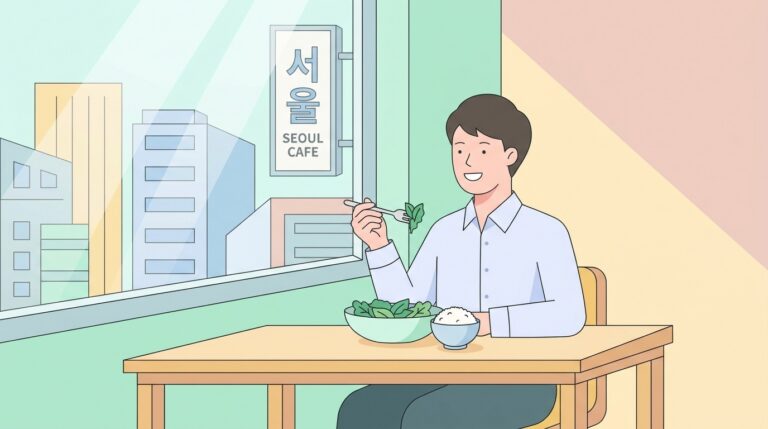
Phase 1: 공감 (Story-Driven Opening)
안녕하세요! (Annyeonghaseyo!) Welcome back to Daily Hangul. I’m your resident cultural navigator and Korean study bestie.
Picture this classic K-Drama workplace scene: It is 1:45 PM in a sunlit Gangnam office. You and your team just returned from a satisfying team lunch of spicy Dolsot Bibimbap (돌솥 비빔밥) or steaming Jjambbong (짬뽕). You sit back down at your dual-monitor desk, open your spreadsheets, and suddenly… bam! It hits you. Your eyelids feel like lead weights, your focus completely evaporates, and you find yourself doing the dreaded “chicken nod” (꾸벅꾸벅 졸다 – kkubuk-kkubuk jolda) right in front of your manager.
For decades, Koreans simply called this heavy drowsiness 식곤증 (sikgonjeung, post-meal sleepiness) and accepted it as an inevitable tax on enjoying a warm, hearty carb-heavy lunch. But walk into any Seoul cafe or office pantry today, and you won’t hear people just complaining about being tired. Instead, you’ll hear: “아, 방금 밥 먹고 혈당 스파이크 제대로 왔어!” (Oh, I just got a massive blood sugar spike from lunch!).
In hyper-trend-conscious South Korea, health and wellness slang has exploded. Understanding how modern Koreans speak about wellness trends—from 혈당 스파이크 (blood sugar spikes) to 할매니얼 (retro grandma treats) and 제로슈거 (zero sugar everything)—is not just about vocabulary; it gives you an instant backstage pass to contemporary Seoul work and dining culture. Based on real feedback from intermediate learners who wanted to sound like actual Seoulites rather than 1990s grammar textbooks, this guide will transform how you talk about food, fatigue, and dining out in Korean!
Phase 2: 핵심 표현 3선 심층 분석 (3 Core Expressions)
1. 혈당 스파이크 (Hyeoldang seupaikeu)
- Pronunciation: [Hyeol-dang seu-pa-i-keu] (Sounds like: “Hyul” as in pure-huel + “dahng” like a brass bell gong + “spike” pronounced with crisp Korean loanword vowels)
- Meaning: Literal: “Blood sugar spike” | Real Nuance: The trendy, half-scientific, half-dramatic reason modern Koreans attribute to an intense afternoon energy crash after eating heavy carbohydrates or sweets.
- K-Culture Moment: You will see this phrase everywhere on Korean YouTube lifestyle vlogs (Vlog/브이로그) where creators wear continuous glucose monitors (CGM) while eating spicy Tteokbokki, screaming playfully as their graph shoots straight up.
- Editor’s Insight: While it is a medical term, Koreans use it colloquially much like English speakers use “sugar crash” or “carb coma,” but framed with a self-aware, modern wellness twist.
- Situation Spectrum: Casual: ✅ | Semi-formal: ✅ | Formal: ⚠️
- 🤔 Think About It: In your home country, do people talk about biological metrics like glucose in casual daily conversation, or is wellness usually discussed in broader terms like “sleepy” or “stuffed”? What does this say about Korea’s rapid adoption of medical-wellness trends?
2. 식곤증 (Sikgonjeung)
- Pronunciation: [Sik-gon-jeung] (Sounds like: “Seek” with a sharp cut + “gon” rhyming with cone + “jung” like jungle)
- Meaning: Literal: “Food drowsiness symptom” | Real Nuance: The classic, universal post-lunch food coma.
- K-Culture Moment: Seen in nearly every Korean corporate webtoon or drama (like Misaeng). An entire department silently sips ice-cold Americanos (아아 – Aa) simultaneously at 2:05 PM to fight off sikgonjeung.
- Editor’s Insight: Sikgonjeung is the traditional cultural term, while hyeoldang seupaikeu is the modern explanation for why it happens. Pairing them together—“식곤증인 줄 알았는데 혈당 스파이크였어요” (I thought it was just a food coma, but it turned out to be a blood sugar spike)—is peak B1-level fluency!
- Situation Spectrum: Casual: ✅ | Semi-formal: ✅ | Formal: ✅
- 🤔 Think About It: Notice how Korean uses Sino-Korean roots (食 meal, 困 tiredness, 症 symptom) to turn an everyday physical feeling into an established state of being. Does your language treat afternoon sleepiness as a temporary mood or a bodily condition?
3. 거꾸로 식사법 (Geokkuro siksabeop)
- Pronunciation: [Geok-kku-ro sik-sa-beop] (Sounds like: “Guk” as in gum + hard doubled “koo” + “ro” followed by “seek-sah-bup”)
- Meaning: Literal: “Reverse/inverted eating method” | Real Nuance: Eating vegetables and fiber first, then protein and fats, and finishing with rice or carbs last to prevent glucose surges.
- K-Culture Moment: In trendy salad spots in Seongsu-dong or Yeouido, you will see office workers methodically munching down their side salads completely before touching a single grain of rice or noodle.
- Editor’s Insight: 거꾸로 (geokkuro) means “backwards” or “upside down.” Koreans love systematic hacks, and this phrase has become shorthand for being disciplined and conscious about your metabolic health.
- Situation Spectrum: Casual: ✅ | Semi-formal: ✅ | Formal: ✅
- 🤔 Think About It: Traditional Korean dining serves rice, soup, and side dishes simultaneously (한상차림). How does modern diet science like “eating backwards” clash or blend with customary communal eating?
Phase 3: 교과서 한국어 vs 진짜 한국어 (Textbook vs. Real Korean)
Situation 1: Explaining why you are crashing after lunch
- 📖 교과서 한국어 (Textbook Korean):
- 점심 식사 후에 너무 피곤하고 졸립니다.
- (Jeomsim siksa hue neomu pigonhago jollimnida.)
- “After lunch, I am very tired and sleepy.”
- 🗣️ 진짜 한국어 (Real Native Korean):
- 밥 먹자마자 식곤증 제대로 와서 기절할 뻔했어요.
- (Bap meokjamaja sikgonjeung jedaero waseoseo gijeolhal ppeonhaesseoyo.)
- “Right after eating, my food coma hit so hard I almost passed out.”
- 💡 왜 다를까? (Why is it different?): Textbook Korean overuses basic adjectives like 피곤하다 (to be tired). Real Koreans use dynamic physical idioms like 식곤증이 오다 (a food coma comes) paired with adverbs like 제대로 (properly/intensely) and dramatic exaggeration like 기절할 뻔하다 (almost faint/pass out).
Situation 2: Explaining a switch in diet routine
- 📖 교과서 한국어 (Textbook Korean):
- 저는 건강을 위해서 채소를 먼저 먹고 밥을 나중에 먹습니다.
- (Jeoneun geon-gang-eul wihaeseo chaesoreul meonjeo meokgo babeul najung-e meokseumnida.)
- “For my health, I eat vegetables first and eat rice later.”
- 🗣️ 진짜 한국어 (Real Native Korean):
- 혈당 스파이크 막으려고 거꾸로 식사법 시작했어요.
- (Hyeoldang seupaikeu mageuryeogo geokkuro siksabeop sijakhaesseoyo.)
- “I started eating in reverse order to prevent blood sugar spikes.”
- 💡 왜 다를까? (Why is it different?): Native speakers use buzzwords (혈당 스파이크, 거꾸로 식사법) combined with the intention particle -으려고 (in order to), making the sentence concise, professional, and culturally up to date.
Phase 4: K-Culture 딥다이브 & 비언어적 매너 (Deep Dive & Nunchi)
4-1. 눈치 (Nunchi) & Office Lunch Body Language
In Korean working culture, lunchtime is social bonding, but the 30 minutes right after lunch is a battle of survival. When you start dozing off in front of your computer screen or in a post-lunch team meeting:
1. The Subtle Head Tilt: Never slump forward on your desk unless it’s designated break time. If your head drops, quickly rub the back of your neck (목덜미를 주무르다), squint at your monitor as if reading tiny text, and softly whisper: “아, 식곤증 장난 아니네…” (Ah, this food coma is no joke…).
2. The Ice Cup Rescue Gesture: Walking into a meeting holding a mega-sized plastic cup of Iced Americano (메가커피 or 빽다방) and noisily stirring the ice with your straw is the universal Korean gesture signaling: “I am suffering, but I am fighting for my life to stay alert.”
3. Eye Contact & Nunchi: If your team lead (팀장님) catches you yawning, don’t pretend you weren’t. Lightly tap your chest, smile sheepishly, and say you got hit by a carb crash. Blaming a physiological biological reaction like 혈당 스파이크 feels much more forgivable than appearing lazy!
4-2. Cultural Code: The Rise of “Healthy Pleasure” (헬시 플레저)
Korea recently experienced a wild cultural whiplash. In 2023, the country was swept by the sugary craze of 탕후루 (Tanghulu – sugar-glazed candied fruit skewers). Almost overnight, a fierce counter-reaction emerged. Young Koreans (MZ generation) adopted the buzzword “Healthy Pleasure” (헬시 플레저)—the philosophy that staying healthy should be delicious and sustainable, not miserable.
This gave rise to three major culinary phenomenons you will notice on any street in Seoul:
1. 제로 (Zero) Everything: Supermarkets have entire aisles dedicated to 제로슈거 (Zero Sugar) sodas, zero-alcohol beers, and zero-calorie jellies.
2. 할매니얼 (Halmaenial): A portmanteau of 할머니 (Grandmother) and 밀레니얼 (Millennial). Young people are obsessed with traditional, less-processed desserts favored by grandparents: 약과 (yakgwa honey cookies), 흑임자 (black sesame lattes), and 인절미 (injeolmi soybean rice cakes).
3. Dining Sequence Consciousness: The idea that carbs must be earned. Ordering a salad before entering a Korean BBQ joint is no longer seen as bizarre—it’s respected as smart self-management.
Phase 5: 실전 롤플레이 시나리오 (Real-Life Roleplay)
Setting: A popular office district lunch restaurant in Gwanghwamun. You are dining with your Korean colleague, Minji (민지), who has ordered a hearty stew and a bowl of white rice.
- 민지 (Minji): 자, 맛있게 먹자! 근데 왜 밥은 안 먹고 채소 반찬부터 다 먹어?
(Ja, mas-itge meokja! Geunde wae babeun an meokgo chaeso banchanbuteo da meok?)
🎭 Tearing open her paper chopsticks and looking at your bowl with genuine curiosity.
“Alright, let’s dig in! But why aren’t you touching your rice and finishing all the vegetable side dishes first?” -
You: 저 요즘 식습관 바꿨거든요. 혈당 스파이크 막으려고요.
(Jeo yojeum sikseupgwan bakkweotgeodeunyo. Hyeoldang seupaikeu mageuryeogoyo.)
🎭 Smiling proudly while picking up a piece of seasoned spinach (시금치무침).
“I changed my eating habits recently. To prevent blood sugar spikes.” -
민지 (Minji): 혈당 스파이크? 아, 그 유튜브에서 유행하는 거꾸로 식사법?
(Hyeoldang seupaikeu? A, geu yutyubeueseo yuhaenghaneun geokkuro siksabeop?)
🎭 Her eyes light up with sudden recognition, nodding quickly.
“Blood sugar spike? Ah, that reverse eating method trending on YouTube?” -
You: 네, 맞아요! 전에는 점심 먹고 나면 식곤증 때문에 기절할 것 같았거든요.
(Ne, majayo! Jeon-eneun jeomsim meokgo namyeon sikgonjeung ttaemune gijeolhal geot gat-atgeodeunyo.)
🎭 Shaking your head dramatically, recalling the afternoon exhaustion.
“Yes, exactly! Before this, after lunch, I felt like I was literally going to pass out from the food coma.” -
민지 (Minji): 맞아, 탄수화물 먼저 먹으면 2시쯤에 진짜 눈이 저절로 감기잖아.
(Maja, tansuhwamul meonjeo meog-eumyeon dusi-jjeume jinjja nun-i jeojeollo gamgijanha.)
🎭 Sighing in deep office-worker solidarity and rubbing her forehead.
“Totally. If you eat carbs first, by 2 PM your eyes literally close on their own.” -
You: 그래서 채소랑 단백질 먼저 먹고, 밥은 맨 마지막에 먹어요.
(Geuraeseo chaesorang danbaekjil meonjeo meokgo, babeun maen majimage meogeoyo.)
🎭 Pointing neatly to your plate with chopsticks.
“So I eat fiber and protein first, and save the rice for the very end.” -
민지 (Minji): 대단하다! 효과 좀 있어? 오후에 덜 졸려?
(Daedanhada! Hyogwa jom isseo? Ohue deol jollyeo?)
🎭 Leaning in, looking genuinely intrigued.
“Impressive! Does it actually work? Are you less sleepy in the afternoon?” -
You: 확실히 머리가 덜 무겁고 오후 업무할 때 집중이 잘 돼요!
(Hwaksilhi meoriga deol mugeopgo ohu eommuhal ttae jipjung-i jal dwaeyo!)
🎭 Giving a bright, confident thumbs-up.
“Definitely! My head feels way lighter and I can focus so much better during afternoon work!”
🔀 인터랙티브 분기점 (Choose Your Response)
Minji finishes her stew and looks over at the dessert menu on the wall showing iced sugary milk tea and brown sugar syrup bingsu: “우리 후식으로 달달한 밀크티 마시러 갈래?” (Shall we go grab sweet milk tea for dessert?)
- Option A: “밀크티 마시면 바로 혈당 스파이크 와서 쓰러져요. 저 제로 음료나 차 마실래요!”
(Milkeuti masimyeon baro hyeoldang seupaikeu waseo sseureojyeoyo. Jeo jero eumnyona cha masillaeyo!)- Outcome: [BEST] Witty, hyper-natural, and suggests a healthy alternative using modern slang (제로 음료). Minji will laugh and agree to check out a zero-sugar cafe or tea spot.
- Option B: “설탕은 몸에 매우 해로우니까 당신도 먹지 마세요.”
(Seoltang-eun mome maeu haerounikka dangsindo meokji maseyo.)- Outcome: [BAD] Far too blunt, lecturing, and uses the unnatural pronoun 당신 (dangsin), which can sound aggressive or confrontational between colleagues.
- Option C: “안 돼요. 저는 지금 다이어트 중이니까 아무것도 안 마셔요.”
(An dwaeyo. Jeoneun jigeum daieoteu jung-inikka amugeotdo an masyeoyo.)- Outcome: [RISK] Grammatically correct, but shuts down the social vibe instantly (분위기를 깨다). In Korean work culture, the post-lunch cafe run is an important social ritual. Even if you don’t drink sugar, holding an iced water or herbal tea keeps you part of the team conversation.
Phase 6: 10초 감정 섀도잉 드릴 (Shadowing Drill)
Practice reading these sentences aloud, pausing precisely at the slashes (/) and channeling the emotional tone guide in brackets.
[😫 극도로 피곤하고 나른하게 - Utterly drained & sluggish]
점심에 라면 먹었더니 / 식곤증이 제대로 와서 / 눈을 못 뜨겠어요.
(Jeomsime ramyeon meogeotdeoni / sikgonjeungi jedaero waseo / nuneul mot tteugesseoyo.)
“I ate instant ramen for lunch, / and the food coma hit so hard / I can barely keep my eyes open.”-
[💡 번뜩이는 깨달음과 자신감 - Sudden realization & confidence]
식곤증인 줄 알았는데, / 알고 보니까 / 혈당 스파이크 때문이었어요!
(Sikgonjeung-in jul aranneunde, / algo bonikka / hyeoldang seupaikeu ttaemunieosseoyo!)
“I thought it was just regular post-lunch sleepiness, / but when I looked into it, / it was actually because of a blood sugar spike!” -
[😎 꿀팁을 전수하는 뿌듯함 - Proudly sharing a life hack]
식사 순서만 바꿔도 / 오후에 / 훨씬 덜 졸려요.
(Siksa sunseoman bakkwodo / ohue / hwolssin deol jollyeoyo.)
“Just by changing your eating order, / in the afternoon, / you feel so much less drowsy.”
Phase 7: K-Culture 미니 사전 (Mini Dictionary)
-
할매니얼 (Halmaenial)
- Translation: Grandma-Millennial Taste
- Real-life Usage: A blend of 할머니 (grandma) and 밀레니얼 (millennial). Used when young people passionately crave old-fashioned Korean treats like roasted grain powder (미숫가루), mugwort rice cakes (쑥떡), or sesame cookies. You can say: “저 완전 할매니얼 입맛이에요!” (I have totally grandma-millennial tastebuds!).
- 제로슈거 (Jerosyugeo)
- Translation: Zero Sugar
- Real-life Usage: Ubiquitous on restaurant menus and convenience store shelves. In Korea, asking “혹시 제로 탄산 있어요?” (Do you happen to have zero-sugar soda?) is standard protocol at almost every BBQ and fried chicken restaurant.
- 혈당 스파이크 (Hyeoldang Seupaikeu)
- Translation: Blood Sugar Spike
- Real-life Usage: The conversational go-to scapegoat for mental fog, sudden irritability, or post-meal sluggishness. Often heard in expressions like “혈당 스파이크 터졌다” (My blood sugar spike just exploded/hit).
- 오마카세 (Omakase)
- Translation: Chef’s Choice Dining (Korean cultural evolution)
- Real-life Usage: Originally high-end Japanese sushi dining, Koreans now humorously attach “-omakase” to almost anything where a curator chooses the sequence: 한우 오마카세 (Korean beef course), 디저트 오마카세 (dessert tasting course), or even 이모카세 (a course meal chosen on the fly by an older female restaurant auntie/이모!).
Phase 8: 여행자를 위한 생존 키트 (Traveler’s Survival Kit)
Survival Expressions TOP 3
- 혹시 제로 음료 있나요?
- Pronunciation: Hoksi jero eumnyo innayo?
- Pro Tip: Use this at convenience stores or small eateries when you want Diet Coke, Zero Sprite, or unsweetened bottled barley tea.
- 밥은 조금만 주셔도 돼요.
- Pronunciation: Babeun jogeumman jusyeodo dwaeyo.
- Pro Tip: Korean restaurants give massive portions of steamed rice (공깃밥). Saying this politely shows both food-waste consciousness and prevents that heavy afternoon crash.
- 샐러드 먼저 주실 수 있나요?
- Pronunciation: Saelleodeu meonjeo jusil su innayo?
- Pro Tip: At fusion or Western-style restaurants, request your appetizer salad to arrive before the pasta or main carb course so you can practice your 거꾸로 식사법!
Editor’s Travel Note: Staying Healthy on the Move
- Finding Healthy Bites: Download the 네이버 지도 앱 (Naver Map App) and search keywords like
포케(Poke bowl),샐러드(Salad cafe), or키토 김밥(Keto Kimbap wrapped with fluffy egg strips instead of white rice). Seoul is teeming with healthy options once you know the exact search terms. - Convenience Store Hack: If you feel an afternoon dip coming on at 3 PM, skip the sugary canned coffee. Head into any GS25 or CU and grab a chilled 삶은 달걀 (boiled egg twin-pack) and an unsweetened 보리차 (roasted barley tea) to stabilize your energy until dinner.
Phase 9: “한 발 더 깊이” (Deep Cultural Insight)
In South Korea’s high-octane, ultra-fast “Ppal-li Ppal-li” (빨리빨리 – Hurry, Hurry) society, self-discipline is viewed as a form of respect for both oneself and one’s team. When Koreans adopt a health trend, they don’t do it quietly or passively; they systematize it, turn it into social currency, and create shared linguistic inside jokes around it. A decade ago, surviving office fatigue meant chugging an energy drink; today, it means swapping white rice for salad and bonding with your supervisor over avoiding 혈당 스파이크. Health is no longer just private medicine—it is a communal lifestyle dialogue.
💬 Your Turn: Have you ever experienced a sudden “blood sugar spike” after enjoying your favorite carb-heavy meal? How would you explain your post-meal food coma to a Korean friend using today’s expressions? Leave your Korean sentence in the comments below!
Phase 10: FAQ & 오해 방지 (FAQ & Common Mistakes)
Q: Can I use “혈당 스파이크” in a formal business meeting?
A: While it is an accurate medical loanword, during formal executive briefings it is better to use formal phrasing like 식사 후 급격한 혈당 상승 (rapid blood sugar rise after meals). However, in semi-formal team meetings and casual water-cooler chats with colleagues, 혈당 스파이크 is 100% acceptable and very relatable!
Q: What is the difference between “졸려요” and “식곤증”?
A: 졸려요 (jollyeoyo) is simply the verb meaning “I am sleepy” (from lack of sleep, boredom, or late hours). 식곤증 (sikgonjeung) is a specific noun referring strictly to post-meal food coma drowsiness. Instead of just saying 졸려요, saying 식곤증이 와서 졸려요 (I’m sleepy because the food coma hit) sounds far more articulate and native.
Q: Is “할매니얼” considered rude to elderly grandmothers?
A: Not at all! 할매니얼 (Halmaenial) is an affectionate, trendy marketing term celebrating the wisdom and comforting flavors of traditional Korean snacks. It is never used as an insult toward people; it refers strictly to aesthetic and culinary tastebuds.
🚨 흔한 실수 (Common Mistakes) 경고판
- Mistake: Saying 식곤증을 받았어요 (I received a food coma).
- Correct Action: In Korean, symptoms “come” (오다). Always say 식곤증이 왔어요 (The food coma arrived) or 식곤증을 겪고 있어요 (I am experiencing a food coma).
- Mistake: Translating “carb crash” literally as 탄수화물 부서짐.
- Correct Action: Use 혈당 스파이크 (blood sugar spike) or 식곤증 (food coma).
- Mistake: Calling zero-sugar beverages 노슈거 (No sugar).
- Correct Action: In Korea, the standard term is always 제로슈거 (Zero sugar) or simply 제로 (Zero), as in 제로 콜라 (Zero Coke).
Phase 11: 액션 미션 & 참여 유도 (Action Missions)
- 🥉 Bronze Mission (Solo Practice):
Stand in front of the mirror, shake your head groggily, and practice saying Phase 6 sentence #2 three times with natural intonation: “식곤증인 줄 알았는데 혈당 스파이크 때문이었어요!” - 🥈 Silver Mission (Social Share):
Take a picture of your next meal or zero-sugar drink. Post it on your Instagram Story or Korean study log with the caption: “오늘 점심은 거꾸로 식사법 도전! 혈당 스파이크 안녕~” (Trying the reverse eating method for lunch today! Bye bye blood sugar spike~). - 🥇 Gold Mission (Real Interaction):
The next time you visit a Korean restaurant or speak with your Korean tutor/friend, ask: “혹시 점심 드시고 식곤증 심한 편이세요?” (Do you tend to get bad post-lunch food comas?) and listen to their tips! - 🎮 K-Culture Mission:
Search the tag#거꾸로식사법or#혈당스파이크on Instagram or YouTube Shorts. Watch one Korean short-form creator explain what order they eat their food in, and spot the words 채소 (vegetables), 단백질 (protein), and 탄수화물 (carbohydrates)!
Phase 12: 인터랙티브 퀴즈 챌린지 (Interactive Quiz)
1. 상황 판단 퀴즈 (Context Quiz)
After a big team lunch with your Korean coworkers, you notice everyone yawning quietly. You want to suggest taking a brisk 10-minute walk to help prevent energy crashes. What is the most natural, friendly B1-level sentence?
* A) 우리 피곤하니까 일 그만합시다. (We are tired, so let’s stop working.)
* B) 식곤증도 깰 겸 혈당 스파이크 막으러 잠깐 산책할까요? (Shall we take a brief walk to shake off the food coma and prevent blood sugar spikes?)
* C) 탄수화물이 너무 많아서 배가 아파요. (My stomach hurts because there were too many carbs.)
👉 정답 및 해설 보기 (Click to Reveal Answer)
정답: B
해설: Option B elegantly combines the intermediate grammar structure -(으)ㄹ 겸 (while also doing X / to kill two birds with one stone) with our key buzzwords 식곤증 and 혈당 스파이크. Option A sounds unprofessional, and Option C is an awkward complaint rather than a social invitation.
2. 빈칸 채우기 (Fill-in-the-Blank)
Complete the sentence below using the correct term for “eating vegetables and protein first, and carbs last”:
“점심에 졸리지 않으려고 채소부터 먼저 먹는 ( ____________ )을 실천하고 있어요.”
👉 정답 및 해설 보기 (Click to Reveal Answer)
정답: 거꾸로 식사법 (Geokkuro siksabeop)
해설: 거꾸로 means upside down or in reverse. 거꾸로 식사법 refers specifically to reversing the conventional dining sequence to maintain stable metabolic energy.
3. True / False 문화 퀴즈 (Cultural T/F)
In modern Korea, the term 할매니얼 (Halmaenial) refers to elderly grandmothers who have learned to use modern digital technology like smartphones and AI.
* True or False?
👉 정답 및 해설 보기 (Click to Reveal Answer)
정답: False
해설: 할매니얼 is a portmanteau of 할머니 (grandma) and 밀레니얼 (millennial). It actually describes young people who love traditional, nostalgic tastes and retro heritage snacks like 약과 (honey pastry), 흑임자 (black sesame), and 인절미 (rice cake)!
🎬 Watch Our Daily Videos! (Daily Hangul Official Instagram)
Review the expressions you learned in this article with our fun daily short videos! Check out native pronunciation and real-life nuances in action.
- Instagram @dailyhangul_en







