

Phase 1: 공감 (Story-Immersed Opening)
안녕하세요! 매일한글 에디터입니다. (Hello! I’m your Daily Hangul editor.)
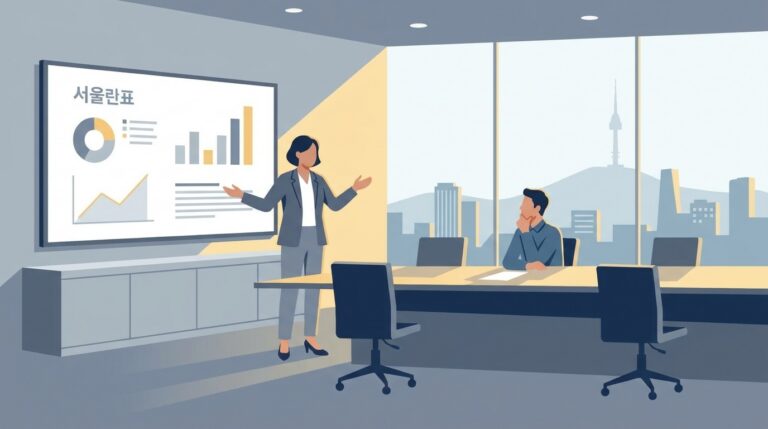
Picture this: You are standing in a sleek, glass-walled conference room on the 21st floor of a Gangnam high-rise. You just spent forty-five minutes passionately presenting your quarterly business review (QBR). Your slides were crisp, your charts immaculate. You take a breath, click to the final slide, and smile warmly. “Thank you.” You think the hard part is over.
Then, Managing Director Kim (김 상무님)—a veteran executive whose steely gaze could slice through titanium—unfolds his arms, taps his fountain pen onto the mahogany desk, and leans forward.
“Well, Alex-ssi, your numbers look decent. But Competitor A is launching their next-generation platform next month at half our subscription fee. How exactly does this strategy defend our market share against that shockwave?”
The air freezes. Your colleagues suddenly develop an intense fascination with their notepads. If you’ve watched K-dramas like Misaeng (Incomplete Life) or Agency, you know this exact second: the dreaded executive cross-examination. In Korean corporate culture, this isn’t personal—executives use Q&A to test your composure, agility, and whether you genuinely own your strategy.
Mastering this high-stakes exchange transforms you from an outsider who merely memorizes slides into a trusted strategist who commands boardroom respect. In this guide, built directly on feedback from international professionals thriving in Korean conglomerates, you will learn the exact verbal shields and strategic pivots needed to handle sharp executive inquiries with poise and elegance.
Phase 2: 핵심 표현 3선 심층 분석 (Top 3 Core Expressions)
1. 지적해주신 부분에 대해 전적으로 공감하며, 다음과 같이 대응하고자 합니다.
- Pronunciation: Jijeokhaejusin bubune daehae jeonjeogeuro gonggamhamyeo, daeumgwa gachi daeeunghagoja hamnida. (Sound analogy: Think of jee-jeok-hae-joo-shin flowing smoothly like ‘geez-oak-hey-jew-shin’, followed by a rhythmic cadence.)
- Meaning: “I fully agree with the point you pointed out, and we plan to respond as follows.”
- Nuance: Direct translation might feel overly submissive, but in corporate Korean, acknowledging an executive’s criticism first (공감 / Empathy/Validation) defuses tension before you deliver your counterstrike.
- K-Culture Moment: Seen in executive boardroom dramas whenever an ambitious team lead validates a board member’s harsh critique before unveiling their trump card.
- Editor’s Insight: The word 지적 (jijeok) literally means ‘pointing out an error.’ By treating their sharp attack as a valuable observation, you preserve their 체면 (chaemyeon / social face) while taking back narrative control.
- Situation Spectrum: Casual 🚫 | Semi-formal ⚠️ | Formal ✅
- 🤔 Think About It: In many Western boardrooms, you might immediately defend your data with “Actually, our data indicates otherwise.” Why does Korean business communication prioritize acknowledging the questioner’s perspective before stating your defense?
2. 경쟁사의 시장 진입에 대응하여 차별화된 프로모션을 준비 중입니다.
- Pronunciation: Gyeongjaengsaui sijang jin-ibe daeeunghayeo chabyeolhwadoen peuromosyeoneul junbi jung-imnida. (Sound analogy: Gyeong-jaeng-sa-ui rolls like ‘young-jang-sa-wee’ with a soft initial ‘g’.)
- Meaning: “In response to our competitor’s market entry, we are currently preparing differentiated promotional strategies.”
- Nuance: It signals proactivity. You are not scrambling; you foresaw the competitor’s launch and already set countermeasures into motion.
- K-Culture Moment: The classic line delivered by top marketing leads in corporate series right before pulling up a hidden contingency slide.
- Editor’s Insight: The phrase 차별화된 (chabyeolhwadoen / differentiated) is a magic corporate buzzword in Korea. It reassures stakeholders that you aren’t engaging in a reckless price war, but competing on unique value.
- Situation Spectrum: Casual 🚫 | Semi-formal ⚠️ | Formal ✅
- 🤔 Think About It: How does shifting from a passive response to proactive differentiation change the psychological power balance in a high-stakes discussion?
3. 세부 데이터는 확인 후 금일 퇴근 전까지 보강하여 보고드리겠습니다.
- Pronunciation: Sebu de-iteoneun hwagin hu geum-il toegeun jeonkkaji boganghayeo bogodeurigessumnida. (Sound analogy: Geum-il toe-geun rhymes neatly, sounding like ‘gum-eel toy-goon’.)
- Meaning: “After verifying the detailed data, I will supplement the analysis and report back before the end of the day today.”
- Nuance: Never say “I don’t know” in front of Korean executives. This formula admits you lack the exact figure right now, sets a firm deadline (금일 퇴근 전 / before COB today), and commits to follow-up.
- K-Culture Moment: The quintessential survival line of competent project managers facing impromptu financial queries from senior management.
- Editor’s Insight: 금일 (geum-il) is Sino-Korean business parlance for “today.” Paired with 퇴근 전까지 (before leaving work), it demonstrates exceptional work ethic and reliability.
- Situation Spectrum: Casual 🚫 | Semi-formal ⚠️ | Formal ✅
- 🤔 Think About It: Why is giving a specific time commitment infinitely better than simply saying “I will look into it later” in high-context business environments?
Phase 3: 교과서 한국어 vs 진짜 한국어 (Textbook vs Real Native Korean)
Situation 1: When you need to admit an unpredicted factor without looking unprepared
- 📖 교과서 한국어 (Textbook): 그 점은 미처 생각하지 못했습니다. (Geu jeomeun micheo saenggakhaji mothaessumnida. – “I couldn’t think of that point in advance.”)
- 🗣️ 진짜 한국어 (Real Native): 해당 변수 역시 면밀히 모니터링 중이며, 즉각 플랜 B를 가동할 예정입니다. (Haedang byeonsu yeoksi myeonmilhi monitoring jung-imyeo, jeukgak peullaen bireul gadonghal yejeong-imnida. – “We are also monitoring that variable closely and plan to activate Plan B immediately.”)
- 💡 왜 다를까? (Why the difference?): Saying you “didn’t think of it” undermines your credibility instantly. Real corporate pros frame surprises as monitored variables with ready contingency plans.
Situation 2: When an executive expresses strong anxiety over competitor aggression
- 📖 교과서 한국어 (Textbook): 걱정하지 마십시오. 괜찮습니다. (Geokjeonghaji masipsio. Gwaenchansumnida. – “Do not worry. It is okay.”)
- 🗣️ 진짜 한국어 (Real Native): 우려하시는 리스크를 최소화할 수 있도록 다각도의 방어책을 마련해 두었습니다. (Uryeohasineun riseukeureul choesohwahal su itdorok dagakdoui bangeochaegeul maryeonhae dueossumnida. – “We have prepared multifaceted safeguards to minimize the risks you are concerned about.”)
- 💡 왜 다를까? (Why the difference?): Telling a Korean director “don’t worry” can sound dismissive or arrogant. Acknowledging their 우려 (worry/concern) and presenting calculated 방어책 (safeguards) conveys mature professionalism.
Phase 4: K-Culture 딥다이브 & 비언어적 매너 (Deep Dive & Non-Verbal Cues)
4-1. 눈치 (Nunchi) & Boardroom Body Language
Handling Q&A in Korea is 50% language and 50% physical poise:
1. The Respectful Tilt & Pen Note: When an executive asks a critical question, do not stare blankly. Nod slightly twice, pick up your pen, and jot down their keywords on your notepad. This non-verbal cue signals: “Your insight is so valuable that I am recording it.”
2. Eye Contact Calibration: Avoid unwavering, aggressive eye contact, which can be interpreted as defiance (눈을 부라리다). Instead, maintain a soft, focused gaze toward the bridge of the executive’s nose, periodically glancing at the wider executive committee to share the answer with the room.
3. Post-Answer Posture: End your rebuttal with an open, slight upper-body inclination and state: 이상입니다 (That is all), keeping your hands clasped comfortably at waist height.
4-2. Cultural Code Analysis: The Boardroom Hierarchy (서열과 체면)
In Korean office dynamics, tough questions during quarterly presentations are rarely designed to humiliate you; they are tests of 위기관리능력 (crisis management capability). Senior executives need to see that you do not crumble when market conditions turn volatile. By combining deferential speech forms (하십시오체) with firm strategic substance, you validate the executive’s seniority while earning their backing.
Phase 5: 실전 롤플레이 시나리오 (Real-World Roleplay Scenario)
Setting: Boardroom A at a tech enterprise in Pangyo Techno Valley. Managing Director Kim (김 상무), known for ruthless financial scrutiny, locks eyes with Alex (알렉스), the marketing project lead.
- 김 상무: 수고했어요. 그런데 이번 분기 플랜을 보면 경쟁사의 신제품 출시에 대한 실질적인 방어 전략이 전혀 보이지 않는데, 어떻게 돌파할 생각입니까?
(Sugohaesseoyo. Geureonde ibeon bungi peullaeneul bomyeon gyeongjaengsaui sinjepum chulsie daehan siljiljeogin bangeo jeollyagi jeonhyeo boiji anneunde, eotteoke dolpahwal saenggagimnikka?)
“Good work. However, looking at this quarter’s plan, I don’t see any substantive counter-strategy against our competitor’s new launch. How do you plan to break through?”
🎭 (He removes his glasses and tosses his laser pointer onto the table.) -
알렉스: 상무님, 지적해주신 부분에 대해 전적으로 공감합니다.
(Sangmunim, jijeokhaejusin bubune daehae jeonjeogeuro gonggamhamnida.)
“Managing Director Kim, I completely understand and agree with the point you noted.”
🎭 (Alex nods calmly, writes a quick keyword on his tablet, and looks up with composure.) -
김 상무: 그래요? 알면서도 슬라이드에 안 넣은 겁니까?
(Geuraeyo? Almyeonseodo seullaideue an neoeun geomnikka?)
“Is that so? You knew about it and still left it out of the presentation?”
🎭 (Raises an eyebrow, testing Alex’s stress threshold.) -
알렉스: 아닙니다. 경쟁사의 진입에 대응하여 기존 고객 이탈을 막기 위한 락인(Lock-in) 프로모션을 비공개로 시뮬레이션 중이었습니다.
(Animnida. Gyeongjaengsaui jin-ibe daeeunghayeo gijon gogaek itareul makgi wihan rang-in peuromosyeoneul bigonggaero simyulleisyeon jung-ieossumnida.)
“Not at all. In response to their entry, we have been privately running simulations on a customer lock-in promotion to prevent churn.”
🎭 (Gestures smoothly with an open palm toward the projection screen.) -
김 상무: 그 프로모션이 우리 영업이익률에 미칠 구체적인 수치는 뽑아봤어요?
(Geu peuromosyeoni uri yeong-eob-iingnyure michil guchejeogin suchineun ppobabwasseoyo?)
“Have you extracted specific figures on how that promotion will impact our operating margin?”
🎭 (Crosses arms and leans back into his leather chair.) -
알렉스: 네, 1차 마진율 방어선은 확보했으나, 세부 데이터는 확인 후 금일 퇴근 전까지 보강하여 별도 보고드리겠습니다.
(Ne, ilcha majinyul bangeoseoneun hwakbohaesseuna, sebu de-iteoneun hwagin hu geum-il toegeun jeonkkaji boganghayeo byeoldo bogodeurigessumnida.)
“Yes, we secured our first-line margin threshold, but I will double-check the granular data and submit a reinforced supplementary report before the end of the day.”
🎭 (Speaks with steady pitch, maintaining relaxed shoulders.) -
김 상무: 좋습니다. 그럼 오늘 5시까지 정리해서 메일로 올려주세요. 다음 안건 넘어갑시다.
(Joessumnida. Geureom oneul daseotsikkaji jeongnihaeseo meillo ollyeojuseyo. Daeum angeon neomeogapsida.)
“Good. Then organize it and send it to me via email by 5 PM. Let’s move to the next agenda item.”
🎭 (Picks up his pen again and nods with a slight, satisfied smirk.) -
알렉스: 경청해 주셔서 대단히 감사합니다. 즉시 준비하겠습니다.
(Gyeongcheonghae jusyeoseo daedanhi gamsahamnida. Jeuksi junbihagessumnida.)
“Thank you very much for your time and attentive listening. I will prepare it immediately.”
🎭 (Gives a crisp 15-degree bow before stepping aside.)
🔀 인터랙티브 분기점 (Interactive Decision Point)
When the executive asked if you deliberately omitted the counter-strategy from the slide deck, how should you answer?
- Option A: “죄송합니다. 시간이 부족해서 슬라이드에 미처 못 넣었습니다.” (I apologize. We ran out of time so we couldn’t include it in the slides.)
- Option B: “경쟁사의 진입에 대응하여 락인(Lock-in) 전략을 비공개로 시뮬레이션 중이었습니다.” (We were privately running simulations on our customer lock-in defense.)
- Option C: “상무님, 그 제품은 우리 타깃과 달라서 굳이 대응할 필요가 없다고 봅니다.” (Managing Director, that product targets a different audience so we don’t need to respond.)
Feedback:
* Option A (Bad): Saying you ran out of time (시간 부족) is the ultimate red flag in Korean corporate culture; it frames your team as disorganized and uncommitted.
* Option B (Best!): Professional masterstroke! It highlights proactive preparation and reassures leadership that critical strategy is already under calculation.
* Option C (High Risk): Dismissing the executive’s concern outright without robust data sounds defensive and disrespects the executive’s judgment.
🎬 Watch Our Daily Videos! (Daily Hangul Official Instagram)
Review the expressions you learned in this article with our fun daily short videos! Check out native pronunciation and real-life nuances in action.
- Instagram @dailyhangul_en
Frequently Asked Questions (FAQ)
Q: What does "지적해주신 부분에 대해 전적으로 공감하며, 다음과 같이 대응하고자 합니다." mean in Korean and how do you pronounce it?
A: In Korean, "지적해주신 부분에 대해 전적으로 공감하며, 다음과 같이 대응하고자 합니다." is pronounced [Jijeokhaejusin bubune daehae jeonjeogeuro gonggamhamyeo, daeumgwa gachi daeeunghagoja hamnida. (Sound analogy: Think of jee-jeok-hae-joo-shin flowing smoothly like 'geez-oak-hey-jew-shin', followed by a rhythmic cadence.] and means: "I fully agree with the point you pointed out, and we plan to respond as follows."
Q: What does "경쟁사의 시장 진입에 대응하여 차별화된 프로모션을 준비 중입니다." mean in Korean and how do you pronounce it?
A: In Korean, "경쟁사의 시장 진입에 대응하여 차별화된 프로모션을 준비 중입니다." is pronounced [Gyeongjaengsaui sijang jin-ibe daeeunghayeo chabyeolhwadoen peuromosyeoneul junbi jung-imnida. (Sound analogy: Gyeong-jaeng-sa-ui rolls like 'young-jang-sa-wee' with a soft initial 'g'.] and means: "In response to our competitor's market entry, we are currently preparing differentiated promotional strategies."
Q: What does "세부 데이터는 확인 후 금일 퇴근 전까지 보강하여 보고드리겠습니다." mean in Korean and how do you pronounce it?
A: In Korean, "세부 데이터는 확인 후 금일 퇴근 전까지 보강하여 보고드리겠습니다." is pronounced [Sebu de-iteoneun hwagin hu geum-il toegeun jeonkkaji boganghayeo bogodeurigessumnida. (Sound analogy: Geum-il toe-geun rhymes neatly, sounding like 'gum-eel toy-goon'.] and means: "After verifying the detailed data, I will supplement the analysis and report back before the end of the day today."







