

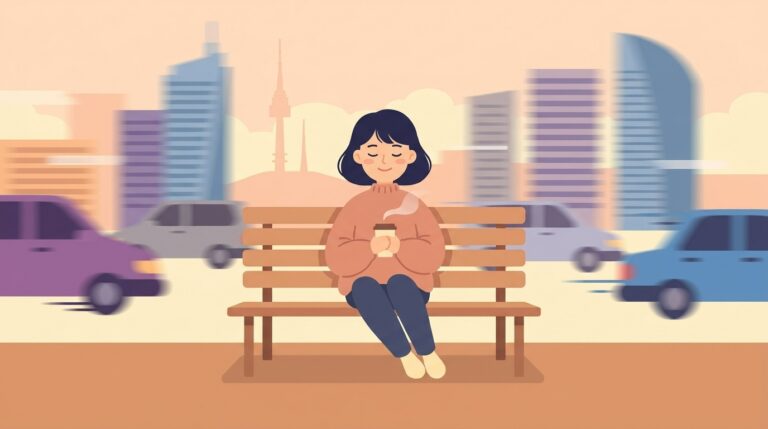
Finding Your Own Pace in Fast-Paced Korea: Overcoming the Anxiety of Rushing
Phase 1: Empathy (Story-Immersive Opening)
안녕하세요! 매일한글 에디터입니다. (Hello! I’m your Daily Hangul editor.)
Picture this: You step off the subway at Gangnam Station at 8:45 AM. Around you, a sea of commuters moves like a synchronized high-speed train. People stride up escalators two steps at a time, iced Americanos clutched like fuel tanks, phones lighting up with work notifications. In Korea, everything arrives fast—your Coupang package lands at your door before dawn, your latte is ready in forty seconds, and Wi-Fi downloads high-definition films in the blink of an eye.
It is undeniably exhilarating, but then comes the quiet aftershock. You sit on a park bench or scroll through your feed, and a sudden wave of panic hits: “Am I moving too slow? Look at how ahead everyone else is.” In Korea, this feeling is so common that even locals frequently battle jogeupam (조급함, the anxiety of urgency) and social comparison. Many of our intermediate learners tell us: “I know how to order food fast, but how do I express that I feel overwhelmed by the pace, or tell a Korean friend to slow down without sounding lazy?” Today, we will decode the emotional vocabulary you need to navigate Korea’s warp-speed rhythm with grace, empathy, and your peace of mind intact.
Phase 2: Core Expressions Deep Dive
1. 마음이 조급해요 (Mae-um-i jo-geup-hae-yo)
- Pronunciation: [Mae-um-i jo-geup-hae-yo] (Think: ‘My-oom-ee’ followed by ‘Joe-goop-hae-yo’)
- Meaning: “My mind feels rushed / I feel anxious and impatient.”
- K-Culture Moment: Seen frequently in coming-of-age K-dramas like Twenty-Five Twenty-One when an athlete or student watches their peers succeed and confesses late at night that they feel desperate and rushed inside.
- Editor’s Insight: 조급하다 (jogeup-hada) combines 조 (hasty) and 급 (urgent). It doesn’t mean your physical body is in a hurry; it describes that uncomfortable flutter in your chest when you feel the clock ticking against your life goals.
- Situation Spectrum: Casual: ⚠️ (Use 마음이 조급해 with friends) | Semi-formal: ✅ (마음이 조급해요) | Formal: ✅ (마음이 조급해집니다)
- 🤔 Think About It: In English, we often say “I feel stressed” or “I’m rushing.” Why does Korean specifically locate this feeling inside the 마음 (mind/heart)?
2. 남들과 비교하게 돼요 (Nam-deul-gwa bi-gyo-ha-ge dwae-yo)
- Pronunciation: [Nam-deul-gwa bi-gyo-ha-ge dwae-yo] (Rhymes with ‘Nom-deul-gwa bee-gyo-ha-gay dway-yo’)
- Meaning: “I end up comparing myself to others.”
- K-Culture Moment: A character in Misaeng (Incomplete Life) sitting on the office rooftop after seeing a colleague secure a major contract, reflecting on their own self-worth.
- Editor’s Insight: Notice the grammatical ending -게 돼요 (-ge dwaeyo). It expresses involuntary action—you didn’t set out with the malicious intent to compare yourself; society’s pressure simply makes you fall into that habit passively.
- Situation Spectrum: Casual: ⚠️ (남들과 비교하게 돼) | Semi-formal: ✅ (남들과 비교하게 돼요) | Formal: ✅ (남들과 비교하게 됩니다)
- 🤔 Think About It: Does your native tongue have a subtle way to say “I didn’t mean to compare, but it happened automatically”?
3. 천천히 가도 괜찮아요 (Cheon-cheon-hi ga-do gwaen-chan-a-yo)
- Pronunciation: [Cheon-cheon-hi ga-do gwaen-chan-ah-yo] (Think of a gentle train rhythm: ‘Chon-chon-hee gah-doh gwen-chan-ah-yo’)
- Meaning: “It’s okay to go slowly / It’s fine to take your time.”
- K-Culture Moment: A warm mentor figure or indie song lyric in Hospital Playlist whispering comfort to someone experiencing burnout.
- Editor’s Insight: While Korean is famous for the energetic 빨리빨리 (ppalli-ppalli; hurry, hurry), 천천히 (cheoncheonhi) is its ultimate healing antidote. Using -도 괜찮아요 (-do gwaenchanayo) offers unconditional acceptance of the other person’s pace.
- Situation Spectrum: Casual: ⚠️ (천천히 가도 괜찮아) | Semi-formal: ✅ (천천히 가도 괜찮아요) | Formal: ✅ (천천히 가셔도 괜찮습니다)
- 🤔 Think About It: How often do you tell yourself that taking the slow path is not failure, but intentional pacing?
Phase 3: Textbook Korean vs. Real Korean
Situation 1: Talking about feeling left behind
- 📖 Textbook Korean: 저는 뒤처지는 것을 두려워합니다. (Jeoneun dwicheojineun geoseul duryeowohamnida. / I fear falling behind.)
- 🗣️ Real Korean: 나만 뒤처지는 것 같아서 불안해. (Naman dwicheojineun geot gat-aseo buranhae. / I feel anxious like I’m the only one falling behind.)
- 💡 Why the difference? Textbook phrasing sounds like an excerpt from a psychology thesis. In casual conversation, Koreans rely heavily on ~것 같아 (it feels like / it seems like) to soften personal emotional confessions.
Situation 2: Comforting a frantic friend
- 📖 Textbook Korean: 서두르지 마십시오. (Seodureuji masipsio. / Do not hurry.)
- 🗣️ Real Korean: 너무 조급해하지 마, 숨 좀 돌려. (Neomu jogeuphae-haji ma, sum jom dollyeo. / Don’t rush yourself, catch your breath.)
- 💡 Why the difference? 서두르지 마십시오 is a strict warning you might hear on a subway platform. To comfort a peer, Koreans use the sensory idiom 숨을 돌리다 (to turn one’s breath around / catch one’s breath).
Phase 4: K-Culture Deep Dive & Non-Verbal Manners
4-1. Nunchi & Physical Body Language
When Koreans feel overwhelmed by the societal pace, they rarely yell or stage a dramatic scene. Instead, you will notice a subtle 한숨 (hansum, a deep reflective sigh) accompanied by looking down and massaging the back of their neck. If a colleague or friend does this while checking their schedule, pressing them with “Why are you quiet?” breaks good Nunchi (tactful intuition).
Instead, match their posture, lower your vocal pitch, and gently offer a warm drink with both hands while saying: “잠깐 쉬었다 해요” (Jamkkan swieotta haeyo / Let’s pause and rest a moment).
4-2. The Cultural Counter-Current: The Rise of ‘Yeoyu’ and ‘Chon-cance’
While Korea built its economic miracle on relentless speed, contemporary K-culture is witnessing a profound counter-movement. Hit shows like Summer Strike (아무것도 하고 싶지 않아) and Our Blues reflect a national craving for 여유 (yeoyu)—mental breathing room. You will now find urbanites trading packed weekend clubs for 촌캉스 (chon-cance, rural countryside staycations) and forest retreats, proving that resisting the urge to compare has become the ultimate modern Korean luxury.
Phase 5: Real-Life Roleplay Scenario
Setting: A quiet rooftop cafe overlooking the bustling streets of Euljiro, Seoul. The sun is setting.
Character: Minji (민지), your Korean coworker and close friend who has been staying overtime every night, stressed about everyone else’s promotion portfolios.
- Turn 1 (Minji): 다른 팀 동료들은 벌써 포트폴리오를 다 끝냈대요. 저만 너무 늦은 것 같아요. (Dareun tim dongnyodeureun beolsseo poteupollioreul da kkeunnaetdaeyo. Jeoman neomu neujeun geot gat-ayo.)
🎭 Looking at her open laptop with tired, self-doubting eyes.
“They say colleagues on the other team have already finished their portfolios. I feel like I’m the only one who’s late.” -
Turn 2 (You): 민지 씨, 오늘 하루 종일 모니터만 봤잖아요. 마음이 많이 조급해요? (Minji ssi, oneul haru jong-il moniteoman bwatjanayo. Maeum-i mani jogeuphaeyo?)
🎭 Gently pushing a warm cup of herbal tea toward her.
“Minji, you’ve been staring at the monitor all day today. Are you feeling very rushed in your mind?” -
Turn 3 (Minji): 네, 맞아요. 남들이 앞서가는 걸 보면 저도 모르게 남들과 비교하게 돼요. (Ne, majayo. Namdeuri apseoganeun geol bomyeon jeodo moreuge namdeulgwa bigyohage dwaeyo.)
🎭 Letting out a quiet sigh and rubbing her temples.
“Yes, exactly. When I see others getting ahead, I end up comparing myself without even realizing it.” -
Turn 4 (You): 그 마음 이해해요. 하지만 민지 씨는 민지 씨만의 속도가 있잖아요. (Geu maeum ihaehaeyo. Hajiman Minji ssineun Minji ssiman-ui sokdoga itjanayo.)
🎭 Giving a reassuring, firm nod.
“I understand that feeling. But Minji, you have your own pace.” -
Turn 5 (Minji): 그렇지만 다들 ‘빨리빨리’ 끝내는데 저만 제자리걸음인 것 같아서 불안해요. (Geureochiman dadeul ‘ppalli-ppalli’ kkeunnaeneunde jeoman jejari-georeumin geot gat-aseo buranhaeyo.)
🎭 Fidgeting with her pen, her shoulders stiff with tension.
“Still, everyone finishes everything so quickly, and I feel anxious like I’m running in place.” -
Turn 6 (You): 천천히 가도 괜찮아요. 방향이 맞으면 속도는 상관없어요. (Cheoncheonhi gado gwaenchanayo. Banghyang-i majeumyeon sokdoneun sang-gwan-eopseoyo.)
🎭 Smiling warmly and looking her straight in the eye.
“It is okay to go slowly. As long as the direction is right, the speed doesn’t matter.” -
Turn 7 (Minji): 휴… 그 말을 들으니 마음이 한결 편해지네요. 고마워요. (Hyu… geu mareul deureuni maeum-i hangyeol pyeonhaejineyo. Gomawoyo.)
🎭 Taking a deep breath and leaning back against her chair with a softer expression.
“Phew… hearing those words makes my heart feel so much more at ease. Thank you.” -
Turn 8 (You): 그럼 오늘은 노트북 닫고, 맛있는 거 먹으러 갈까요? (Geureom oneureun notebuk datgo, masinneun geo meogeurco galkkayo?)
🎭 Closing her laptop lid gently with a playful grin.
“Then how about we shut this laptop for today and go eat something delicious?”
🔀 Interactive Decision Point
How would you respond when a Korean friend says: “요즘 나만 뒤처지는 것 같아.” (I feel like only I am falling behind lately.)?
- Option A: “남들 신경 쓰지 말고 그냥 더 열심히 일해!” (Don’t mind others, just work harder!)
- Option B: “남들과 비교하지 말고, 천천히 네 페이스대로 가도 괜찮아.” (Don’t compare yourself to others, it’s totally okay to go at your own pace.)
- Option C: “한국에서는 빨리빨리 해야 성공해요.” (In Korea, you must do things quickly to succeed.)
Feedback:
* Option A (Risk): While meant to motivate, telling someone to “just work harder” (더 열심히 해) reinforces burnout culture and invalidates their vulnerability.
* Option B (Best!): Empathetic, culturally aware, and uses soothing phrasing (천천히 네 페이스대로). Perfect balance of warmth and encouragement.
* Option C (Bad): Preachy and reinforces societal stress. Never lecture someone on their own cultural pressure when they are expressing anxiety!
Phase 6: 10-Second Emotion Shadowing Drill
Practice reading these lines aloud with the emotional cues. Notice the slashes (/), which show natural breathing and pause points!
[🥺 불안하고 조급하게 - Anxious and rushed]
마음이 너무 조급해서 / 일이 손에 안 잡혀요.
(Mae-um-i neomu jo-geup-hae-seo / ir-i son-e an jap-hyeo-yo.)
My mind is so rushed / that I can’t concentrate on my work.-
[😔 자책하듯 솔직하게 - Honest and slightly self-deprecating]
SNS만 보면 / 나도 모르게 / 남들과 비교하게 돼요.
(SNS-man bo-myeon / na-do mo-reu-ge / nam-deul-gwa bi-gyo-ha-ge dwae-yo.)
Whenever I look at social media / without even realizing it / I end up comparing myself to others. -
[🌿 따뜻하고 단단하게 - Warm and comforting reassurance]
서두르지 마요. / 천천히 가도 / 충분히 잘하고 있어요.
(Seo-du-reu-ji ma-yo. / Cheon-cheon-hi ga-do / chung-bun-hi jal-ha-go iss-eo-yo.)
Don’t rush yourself. / Even if you go slowly / you are doing more than well enough.
Phase 7: K-Culture Mini Dictionary
- 여유 (Yeo-yu) | Translation: Leeway, composure, or mental breathing space.
Usage: Unlike the English word “relaxation,” 여유 refers to having extra room in your mind, schedule, or wallet. A native will often say, “마음의 여유가 없어요” (I have no emotional leeway). - 현타 (Hyeon-ta) | Translation: A sudden, harsh reality check (Short for 현실 타격 / Reality Strike).
Usage: Used when you snap out of a fantasy and realize the overwhelming gap between your dreams and daily grind. “야근 끝나고 지하철 탔는데 현타 왔어” (I had a sudden reality check on the subway after overtime). - 번아웃 (Beon-a-ut) | Translation: Burnout syndrome.
Usage: Widely adopted in Korean workplaces to describe emotional and physical exhaustion caused by overwork and hyper-competition. - 소확행 (So-hwak-haeng) | Translation: Small but certain happiness (소소하지만 확실한 행복).
Usage: A popular lifestyle buzzword representing a conscious rebellion against grand, distant ambitions—finding joy in a warm convenience-store pastry or a 15-minute riverside walk.
Phase 8: Traveler Survival Kit
Top 3 Survival Expressions
- 천천히 해주셔도 돼요. (Cheoncheonhi haejusyeodo dwaeyo.)
Pro Tip: Say this to store clerks or taxi drivers who look flustered. It immediately melts the tension. - 천천히 둘러볼게요. (Cheoncheonhi dulleobolgeyo.)
Pro Tip: Perfect when boutique shop staff follow you too closely. It politely signals: “I am browsing slowly without rushing.” - 숨 좀 돌리고 갈게요. (Sum jom dolligo galkkeyo.)
Pro Tip: Tell your Korean travel companion this when you need a 10-minute sit-down before moving to the next itinerary stop.
Editor’s Travel Note
When Seoul’s subway rush becomes overstimulating, escape the crowds by heading to slow zones like Seoul Forest (서울숲) or renting a bicycle via the Seoul Ttareungyi bike app. For seamless public transit navigation without feeling like you’re lost in a sprint, keep the Naver Map navigation application handy on your home screen so you can check quiet walking routes at your own leisure.
Phase 9: “One Step Deeper” (Reflective Essay)
Korea’s compressed economic growth transformed a war-torn peninsula into an ultra-modern powerhouse in less than two generations. The engine behind this miraculous leap was undeniably the 빨리빨리 (ppalli-ppalli) ethos—a relentless drive to build, adapt, and surpass faster than anyone else.
Yet, this shared engine created an unintended cultural side effect: a collective sensitivity to relative speed. When life is perceived as a single track with standardized milestones (university at 20, corporate job at 27, marriage in early 30s), anyone taking a scenic detour easily feels acute 조급함 (the panic of falling behind). Acknowledging this isn’t cultural cynicism; it is the first step toward genuine empathy. When you learn to say “천천히 가도 괜찮아요,” you are offering a rare gift in modern Korea—the permission to breathe.
💬 Your Turn: Have you ever felt rushed or anxious while trying to keep up with Korean culture, study goals, or daily life? Drop your experience in the comments below!
Phase 10: FAQ & Avoiding Misunderstandings
Q: Does telling someone “천천히 하세요” sound like I am criticizing their work speed?
A: Not at all! In fact, it is considered very considerate. Saying “천천히 하세요” (Please take your time) or “천천히 준비하셔도 돼요” (It’s okay to prepare slowly) shows you value their comfort over instant service.
Q: What is the exact difference between ‘조급하다’ (jogeup-hada) and ‘불안하다’ (buran-hada)?
A: 불안하다 is general anxiety or insecurity about an unknown outcome (like taking an exam). 조급하다 specifically involves time pressure—feeling frantic because you believe you have too little time or are trailing behind others.
Q: Can I use “천천히 가도 괜찮아” with my Korean boss or university professor?
A: Be careful! Because it gives permission (“It is okay to…”), junior speakers generally shouldn’t say it upward to superiors. To a boss or elder, replace it with: “무리하지 마시고 편하게 하십시오” (Please don’t overexert yourself and take it comfortably).
🚨 Common Mistakes (흔한 실수) Warning Board
- Mistake 1: Saying “느리게 일하세요” to mean “Take your time at work.”
Why it fails: 느리게 means sluggishly or inefficiently.
Correct Action: Say “천천히 하셔도 괜찮아요” (Take your time, it’s fine). - Mistake 2: Using 비교해요 without the reflexive nuance when talking about self-esteem.
Why it fails: Just saying “저는 비교해요” sounds incomplete.
Correct Action: Use “남들과 비교하게 돼요” (I end up comparing myself to others). - Mistake 3: Replying “빨리빨리 하지 마세요” to someone who is hurrying you.
Why it fails: It sounds blunt and confrontational.
Correct Action: Say “조금만 시간 여유를 주세요” (Please give me just a little bit of time leeway).
Phase 11: Action Missions & Engagement
- 🥉 Bronze Level: Stand in front of your mirror and practice the phrase: “마음이 조급할 땐, 심호흡을 해요” (When my mind feels rushed, I take a deep breath) 3 times with steady breathing.
- 🥈 Silver Level: Post a study journal entry or Instagram Story of your Korean study notebook with the caption: “천천히 가도 괜찮아요 🌿 (It’s okay to go slowly)” and tag
@DailyHangul. - 🥇 Gold Level: During your next language exchange or Korean conversation, whenever your partner apologizes for speaking slowly or looking up a word, immediately say: “괜찮아요, 천천히 말씀하세요!”
🎮 K-Culture Mission: Watch an episode of a slice-of-life K-drama (like Our Blues or My Liberation Notes) this week. Listen closely for the word 여유 (yeoyu) or 조급하다 (jogeup-hada) and write down the exact context!
Phase 12: Interactive Quiz Challenge
Test your cultural and linguistic intuition! Click the accordion toggles below to verify your answers.
1. Situational Judgment
Your Korean friend Jihoon looks exhausted and says: “동창들은 다 대기업 갔는데, 나만 아직 취준생이야… 마음이 너무 조급해.” (All my classmates went to major conglomerates, but only I am still a job-seeker… My mind is so anxious and rushed.) What is the most empathetic response?
* ① “그럼 스펙을 더 빨리 쌓아야지!”
* ② “남들과 비교하게 되는 마음 이해해. 그래도 천천히 너만의 길을 가면 돼.”
* ③ “한국 취업 시장은 원래 그래요.”
Click to view answer and explanation
Correct Answer: ②
Explanation: Option ② acknowledges his emotional pain (남들과 비교하게 되는 마음 이해해) and provides comfort regarding his personal pace (천천히 너만의 길을 가면 돼). Option ① adds pressure, while Option ③ offers cold, detached commentary.
2. Fill-in-the-Blank
Complete the sentence to mean: “I don’t have mental breathing room right now because work is so busy.”
“일이 너무 바빠서 요즘 마음의 [ ]가 없어요.”
Click to view answer and explanation
Correct Answer: 여유 (Yeoyu)
Full Sentence: 일이 너무 바빠서 요즘 마음의 여유가 없어요. (Ir-i neomu bappaseo yojeum maeum-ui yeoyuga eopseoyo.)
Explanation: 마음의 여유 is the classic Korean collocation for having mental or emotional breathing space.
3. True / False Cultural Check
“In Korean culture, the phrase ‘소확행’ (Sohwakhaeng) encourages people to work overtime to buy luxury designer goods quickly.” ( True / False )
Click to view answer and explanation
Correct Answer: False
Explanation: 소확행 stands for “Small but Certain Happiness.” It celebrates modest, everyday contentment (like a hot cup of tea or a quiet walk) rather than materialistic overachievement.
🎬 Watch Our Daily Videos! (Daily Hangul Official Instagram)
Review the expressions you learned in this article with our fun daily short videos! Check out native pronunciation and real-life nuances in action.
- Instagram @dailyhangul_en







