

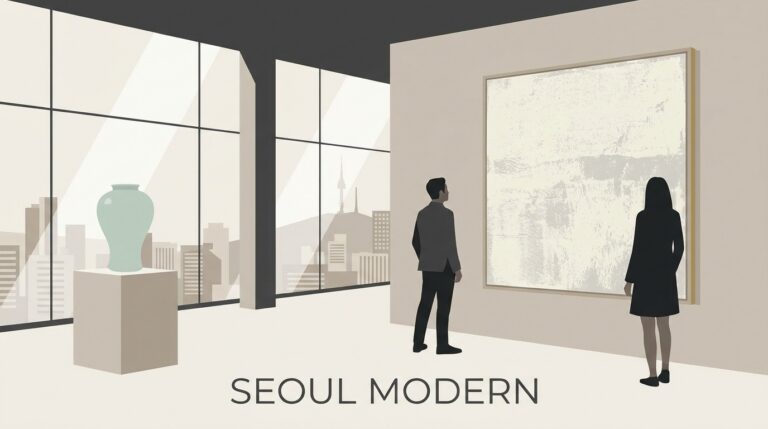
Decoding Seoul’s Art Auctions: The Secret Language of Connoisseurship and Provenance
Phase 1: Empathy (Story-Driven Opening)
안녕하세요! 매일한글 에디터입니다. (Hello! This is your Daily Hangul editor.)
Picture this: You are standing under the discreet, recessed spotlights of a VIP preview room in Seoul’s prestigious Pyeongchang-dong art district or an exclusive salon in Hannam-dong. Around you, bespoke-suited fund managers, seasoned gallerists, and veteran collectors murmur in hushed, measured tones. On the easel rests an exquisite 18th-century Joseon Dynasty blue-and-white porcelain water dropper alongside a sublime 1970s Dansaekhwa (monochrome) canvas. You overhear someone whisper: “안목도 탁월하지만, 소장 이력이 워낙 확실해서 이번 경매의 백미가 되겠네요.” You know you are at the apex of the art world, where millions of dollars ride on subtle visual nuances and archival evidence. Yet, when the discussion shifts to structural connoisseurship, scientific pigment analysis, and unbroken chain of custody, standard conversational Korean simply dissolves.
Navigating high-end Korean art auctions, blue-chip galleries, and art investment funds requires more than general fluency; it demands mastery of a specialized sociolect steeped in academic rigor, aesthetic philosophy, and legal precision. Whether you are advising an institutional fund, bidding at Seoul Auction or K-Auction, or discussing masterpieces with top curators, this guide bridges the gap. Developed directly from our curriculum for international art professionals and senior curators, this deep-dive unpacks the two indispensable pillars of art valuation in Korea: 진위 감정 (Authentication & Connoisseurship) and 소장 이력 (Provenance).
Phase 2: Core Expressions In-Depth
1. 진위 감정 (Jinwi gamjeong)
- Pronunciation: [Jin-wi gam-jeong] (Think: “Gene-we” + “Gahm-jung”, like the rhythm of ‘genuine judgement’)
- Meaning: Literal: “Authentic-false appraisal” | Actual Nuance: Comprehensive connoisseurship combined with scientific authentication to verify whether a work is genuine or forged.
- K-Culture Moment: Seen frequently in sophisticated dramas like Queen of Tears or Mine, where family chaebol art foundations inspect newly acquired heirlooms before board meetings.
- Editor’s Insight: In Korean art law and auction circles, 감정 (gamjeong) is split into two complementary domains: 안목 감정 (anmok gamjeong – stylistic appraisal by eye) and 과학적 감정 (gwahakjeok gamjeong – scientific spectroscopic/pigment testing). When you say ‘진위 감정’, you invoke this twin-track investigative discipline.
- Situation Spectrum: Casual: 🚫 | Semi-formal: ⚠️ | Formal: ✅
- 🤔 Think About It: In Western discourse, authentication often leans heavily on legal warranties and single catalogue raisonné entries. In Korean art history, why do you think collective expert panels (감정위원회) play such a decisive cultural role in certifying authenticity?
2. 소장 이력 (Sojang iryeok)
- Pronunciation: [So-jang i-ryeok] (Rhymes roughly with “So-jahng ee-ryuk”, like ‘historic track record’)
- Meaning: Literal: “Possession history” | Actual Nuance: Provenance; the unbroken, documented lineage of ownership from the artist’s studio down to the current seller.
- K-Culture Moment: In high-stakes antique appraisal shows like KBS’s legendary TV Show 진품명품 (TV Show Jinpum Myeongpum), when an appraiser gasps at an imperial seal indicating royal provenance.
- Editor’s Insight: While ‘이력’ generally means a person’s resume or background, when paired with ‘소장’ (keeping/holding), it becomes the gold standard for institutional trust. In Korea, a piece originating from an old scholarly family (종가/문중) or historic collections like Kansong represents elite heritage.
- Situation Spectrum: Casual: 🚫 | Semi-formal: ⚠️ | Formal: ✅
- 🤔 Think About It: How does the linguistic framing of ‘소장’ (treasuring and holding) differ from merely ‘owning’ (소유) property in transactional English?
3. 안목을 기르다 (Anmogeul gireuda)
- Pronunciation: [An-mo-geul gi-reu-da] (Pronounce ‘An-mok’ smoothly linking into ‘-eul’: An-mo-geul)
- Meaning: Literal: “To raise/cultivate one’s eye-measure” | Actual Nuance: To sharpen connoisseurship; to refine intuitive discernment and high-level critical taste.
- K-Culture Moment: Seasoned collectors in art documentaries often tell aspiring younger buyers: “수억 원을 쓰기 전에 먼저 안목을 길러야 실패하지 않습니다.”
- Editor’s Insight: Anmok (안목) is one of the most culturally revered concepts in Korea. It is not merely knowledge; it is an embodied aesthetic wisdom cultivated through years of handling masterpieces, feeling brushweights, and observing crackle patterns.
- Situation Spectrum: Casual: ✅ | Semi-formal: ✅ | Formal: ✅
- 🤔 Think About It: Can aesthetic taste be quantified, or does Korean culture view ‘안목’ as an intangible virtue akin to moral character?
Phase 3: Textbook Korean vs. Real Korean
Context 1: Confirming that an artwork’s background is fully verified and documented
- 📖 교과서 한국어 (Textbook Korean):
이 그림은 역사가 확실하고 진짜가 맞습니다.
(I geurimeun yeoksaga hwaksilhago jinjjaga matseumnida.)
“This painting has a clear history and is definitely real.” - 🗣️ 진짜 한국어 (Authentic Korean):
출처와 소장 이력이 빈틈없이 입증된 진작(眞作)입니다.
(Chulcheowa sojang iryeogi binteumeopsi ipjeungdoen jinjagimnida.)
“It is an authenticated original work whose provenance and acquisition chain have been impeccably verified.” - 💡 왜 다를까? (Why the difference?):
In C2-level professional dialogues, generic words like ‘역사’ (history) and ‘진짜’ (real thing) are replaced by specialized terms like ‘소장 이력’ (provenance) and ‘진작’ (original/authentic work, contrasting with ‘위작’ – forgery). This establishes institutional authority.
Context 2: Assessing if an art fund piece has strong market viability
- 📖 교과서 한국어 (Textbook Korean):
이 작품은 가격이 많이 오를 것 같습니다.
(I jakpumeun gagyeogi mani oreul geot gatseumnida.)
“I think the price of this artwork will rise a lot.” - 🗣️ 진짜 한국어 (Authentic Korean):
감식안이 뒷받침된 수작이라 중장기적 밸류에이션 상승 여력이 충분합니다.
(Gamsigani dwitbatchimdoen sujagira jungjanggijeok baellyueisyeon sangseung yeoryeogi chungbunhamnida.)
“As a masterwork backed by discerning connoisseurship, it possesses substantial mid-to-long-term valuation upside.” - 💡 왜 다를까? (Why the difference?):
Art investment funds (아트펀드) and private bankers combine classical connoisseurship terms (감식안, 수작) with financial vocabulary (밸류에이션, 상승 여력) to convey calculated analytical confidence.
Phase 4: K-Culture Deep Dive & Non-Verbal Manners
4-1. Nunchi & Silent Etiquette in Korean Auction Salons
- The White-Glove Protocol (백장갑 매너): Even if an auction specialist invites you to examine an artifact close up, never touch an unglazed celadon or an oil canvas with bare hands. Always slip on the provided white cotton gloves (백장갑). Touching directly signals a lack of basic curatorial courtesy.
- Gaze & Posture: Do not lean directly over an open scroll. Avoid breathing heavily near delicate silk or Hanji (traditional Korean paper). Tilt your body slightly at a 45-degree angle, leaning in with contemplative silence, keeping hands clasped in front of your waist (공수 자세).
- The Subdued Tone: In VIP viewing rooms (프리뷰 룸), speaking loudly or explicitly naming exorbitant figures (e.g., “이거 50억 원 넘겠네!”) breaches decorum. Instead, use nuanced understatements: “호가가 상당할 것으로 예상되네요.” (The hammer price estimate seems quite formidable).
4-2. The Cultural Pillar: The Legacy of Gansong and Private Museums
Korea’s sensitivity toward provenance is deeply rooted in 20th-century history. During the Japanese colonial period and the Korean War, countless national treasures were scattered, looted, or forged. Figures like Jeon Hyeong-pil (Gansong) spent immense familial fortunes tracking down and verifying historical relics to protect national heritage. Consequently, in Korean auctions, establishing provenance (소장 이력) is not just a commercial safeguard; it is perceived as an act of restoring cultural genealogy. When an art fund or auction house announces that an artifact was preserved through an unbroken domestic lineage, its cultural and financial valuation skyrockets.
Phase 5: Real-World Roleplay Scenario
Setting: A secluded private viewing salon inside a leading auction house in Pyeongchang-dong, Seoul.
Characters:
* 강 수석 (Chief Specialist Kang): A veteran connoisseur with 25 years of appraisal experience.
* You (Client / Fund Advisory Board Member): Evaluating a rare Joseon-era landscape painting for a corporate art collection.
— dialogue start —
강 수석: 🎭 양손에 흰 면장갑을 착용하고 부드러운 제스처로 족자를 가리키며
이번 경매의 메인 로트인 18세기 겸재 정선 화풍의 산수화입니다. 도록으로 보시던 것보다 필선(筆線)의 기운이 훨씬 생생하지 않으십니까?
(Ibeon gyeongmaeui mein roteuin sibpal-segi Gyeomjae Jeong Seon hwapungui sansuhwaimnida. Dorogeuro bosideon geotboda pilsenui giuni hwolssin saengsaenghaji aneusimnikka?)
“This is the main lot of our auction, an 18th-century landscape in the style of Gyeomjae Jeong Seon. Isn’t the vitality of the brushstrokes much more vivid than what you saw in the catalog?”
You: 🎭 한 걸음 다가가 돋보기를 들여다보며 신중하게
네, 준법(皴法)의 농담 처리가 매우 과감하네요. 그런데 이 작품의 진위 감정서와 과학 감정 데이터는 이미 패널 검증을 통과한 상태인가요?
(Ne, junbeobui nongdam cheoriga maeu gwagamhaneyo. Geureonde i jakpumui jinwi gamjeongseowa gwahak gamjeong deiteoneun imi paeneol geomjeungeul tonggwahan sangtae-ingayo?)
“Yes, the gradation of the shading brushstrokes is quite bold. By the way, have the authentication certificate and scientific analysis data for this piece already cleared panel verification?”
강 수석: 🎭 정중하게 서류 파일을 열어 분광 분석표와 X선 투과 사진을 펼쳐 보이며
물론입니다. 안료 성분 분석과 지질(紙質) 탄소연대측정 결과, 18세기 중엽의 데이터와 완벽히 일치합니다. 감정위원회 전원 일치로 진작 판정을 받았습니다.
(Mollonimnida. Allyo seongbun bunseokgwa jijil tanso-yeondae-cheukjeong gyeolgwa, sibpal-segi jung-yeobui deiteowa wanbyeokhi ilchihamnida. Gamjeong-wiwonhoe jeonwon ilchiro jinjak panjeongeul badatseumnida.)
“Certainly. The pigment analysis and paper carbon dating align completely with mid-18th-century reference data. It was verified as authentic by a unanimous committee decision.”
You: 🎭 고개를 끄덕이며 문서의 소장란을 세밀하게 검토하며
과학적 분석은 명쾌하군요. 그렇다면 소장 이력(Provenance) 쪽은 어떻습니까? 근대 이후 소장 경위가 명확히 아카이빙되어 있나요?
(Gwahakjeok bunseogeun myeongkwaehagunyo. Geureotamyeon sojang iryeok jjogeun eotteoseumnikka? Geundae ihu sojang gyeongwiga myeonghwakhi akai-bingdoe-eo innayo?)
“The scientific analysis is clear. What about the provenance? Is the chain of custody since the modern era clearly archived?”
강 수석: 🎭 안도의 미소를 지으며 낙관 옆 묵서(墨書)를 가리킨다
바로 그 점이 이 작품의 진가입니다. 일제강점기 당시 경성미술구락부 경매 기록과 해방 후 간송 가문과 교류하던 원로 컬렉터의 소장 인장이 온전히 남아 있습니다.
(Baro geu jeomi i jakpumui jingaimnida. Iljegangjeomgi dangsi Gyeongseong Misul Gurakbu gyeongmae girokgwa haebang hu Gansong gamungwa gyoryuhadeon wonro keolrekteoui sojang injangi onjeonhi nama itseumnida.)
“That is precisely where the true value lies. The Keijo Art Club auction records from the colonial period and the collector seal of a senior connoisseur connected with the Gansong circle remain intact.”
You: 🎭 차분하지만 결단력 있는 어조로
단절 없는 소장 이력에 감식안의 방증까지 더해졌으니, 펀드 심의회에서도 리스크 없이 승인될 수 있겠군요.
(Danjeol eomneun sojang iryeoge gamsiganui bangjeongkkaji deohaejyeosseuni, peondeu simuihoeedoseo riseukeu eopsi seung-indoel su itgetgunyo.)
“With an unbroken provenance complemented by corroborating connoisseurship, this should be approved by our fund review board without risk.”
강 수석: 🎭 정중하게 목례하며
탁월한 안목이십니다. 프리뷰 기간 동안 프라이빗 뷰잉 룸에 단독 보관해 두겠습니다.
(Tagwolhan anmogisimnida. Peuribyu gigan dongan peuribit byuing rume dandok bogwanhae dugetseumnida.)
“Your discernment is truly exceptional. We will keep it privately secured in this salon throughout the preview period.”
You: 🎭 감사를 표하며
배려 감사합니다, 강 수석님. 최종 리포트 서류 일체를 오늘 중으로 송부해 주십시오.
(Baeryeo gamsahamnida, Gang suseongnim. Choejong ripoteu seoryu ilchereul oneul jung-euro songbuhae jusipsio.)
“Thank you for your consideration, Chief Specialist Kang. Please transmit the complete final report dossier by the end of today.”
— dialogue end —
🔀 Interactive Decision Point
Suppose you notice a 20-year gap in the documentation between 1945 and 1965 in the provenance file. How do you respond?
- Option A: “이 정도 공백은 옛날 그림이니 어쩔 수 없죠. 그냥 진행합시다.” (A gap like this is inevitable for old paintings. Let’s just proceed.)
Feedback: [Bad] In high-value Korean art fund management, brushing aside a mid-century gap exposes the buyer to massive legal disputes regarding wartime confiscation or unrecorded family inheritance disputes. - Option B: “해당 시기의 소장 경위를 입증할 전시 도록이나 문중 서한 등 보조 자료가 보강되지 않으면, 심의 통과가 어렵습니다.” (Unless supplementary evidence such as exhibition catalogs or clan letters verifying custody during that period is provided, board approval will be difficult.)
Feedback: [Best] Sophisticated, prudent, and uncompromising. Perfectly maintains your professional standing and protects the fund. - Option C: “이거 가짜 아니에요? 당장 전수 재감정 신청하세요!” (Isn’t this a fake? Request an immediate total re-appraisal!)
Feedback: [Risk] Overly abrasive. A gap in provenance does not automatically equate to forgery (위작). Accusing an auction house of fraud without evidence severs elite institutional connections.
Phase 6: 10-Second Emotional Shadowing Drill
Read each sentence aloud, strictly honoring the pauses (/) and capturing the designated emotional posture.
[🧐 극도로 신중하고 분석적으로 / Highly analytical]
“단순한 구전(口傳)이 아니라, / 문헌과 도록으로 검증된 / 소장 이력이어야 합니다.”
(Dansunhan gujeoni anira, / munheongwa dorogeuro geomjeungdoen / sojang iryeogieoya hamnida.)
“It must not be mere word of mouth; / it must be a provenance verified / through literature and catalogs.”-
[✨ 확신에 차서 감탄하며 / Imbued with intellectual conviction]
“필선의 골격과 안료의 퇴색 상태를 보니, / 안목 감정과 과학 감정이 / 완벽히 일치하네요!”
(Pilsenui golgyeokgwa allyoui toesaek sangtaereul boni, / anmok gamjeonggwa gwahak gamjeongi / wanbyeokhi ilchihaneyo!)
“Observing the armature of the brushwork and the pigment degradation, / the connoisseurship and scientific analysis / align flawlessly!” -
[🤝 정중하지만 흔들림 없이 / Polite yet firm business posture]
“진위 여부에 대한 감정서 원본과 / 낙찰 보증 조항을 / 계약서에 명시해 주십시오.”
(Jinwi yeobue daehan gamjeongseo wonbongwa / nakchal bojeung johangeul / gyeyakseoe myeongsihae jusipsio.)
“Please specify the original certificate of authenticity / and the hammer guarantee clause / in the contract.”
Phase 7: K-Culture Mini Dictionary
-
낙찰 (Nakchal)
Translation: Successful bid / Fall of the hammer.
Context: When the highest bidder wins a lot. The opposite is 유찰 (Yuchal – unsold lot passed over due to failing to meet the reserve price). At dinner, you might say: “그 달항아리는 치열한 경합 끝에 최고가로 낙찰되었습니다.” -
도록 (Dorok)
Translation: Exhibition catalog or Catalogue Raisonné.
Context: Not just a souvenir book, but a vital legal instrument. If a work is listed in an old, authoritative 도록 from a national museum exhibition, it confers instant provenance credibility. -
위작 (Wijak)
Translation: Forgery or counterfeit artwork.
Context: The primary risk factor in art valuation. Contrast with 진작 (Jinjak – genuine work) and 모작 (Mojak – study copy done after a master). -
미감 (Migam)
Translation: Aesthetic sensibility or sense of beauty.
Context: Used in intellectual art critique to describe an era’s or an artist’s signature visual soul (e.g., “조선 백자 특유의 절제된 미감” – The understated aesthetic sensibility unique to Joseon white porcelain).
Phase 8: Traveler & Professional’s Survival Kit
Top 3 Field Expressions
- “프라이빗 뷰잉 예약을 확인하고 싶습니다.”
(Peuraibit byuing yeyageul hwaginhago sipseumnida.)
Pro Tip: Use this at prestigious auction houses like Seoul Auction in Pyeongchang-dong or K-Auction in Sinsa-dong when viewing blue-chip lots away from the public crowd. - “컨디션 리포트와 감정서 사본을 미리 열람할 수 있을까요?”
(Keondisyeon ripoteuwa gamjeongseo sanyoneul miri yeollamhal su isseulkkayo?)
Pro Tip: Requesting condition reports and certificate copies before the auction signals that you are an institutional or educated buyer, commanding immediate respect. - “추정가 범위와 최저 낙찰 기준선이 어떻게 됩니까?”
(Chujeong-ga beom-wiwa choejeo nakchal gijunseoni eotteoke doemnikka?)
Pro Tip: A discreet way to ask about the pre-sale estimate (추정가) and the confidential reserve price (최저 낙찰가/유보가).
Editor’s Travel Note: Navigating the Seoul Art Corridor
To experience connoisseurship firsthand, spend your day in the Samcheong-dong to Pyeongchang-dong axis. Start at the National Museum of Modern and Contemporary Art (MMCA Seoul), walk up through the traditional galleries of Insadong for antique calligraphy, and then take a taxi north into the winding hills of Pyeongchang-dong where major auction headquarters and private foundations reside.
* Essential App: Download 네이버 지도 (Naver Map) to locate private galleries hidden deep within residential hills, as foreign maps often mislabel private gallery salon addresses. When visiting high-end previews, smart-casual attire (blazers, dress shoes) is recommended.
Phase 9: Going One Step Deeper
In Western art commerce, provenance often functions like a vehicle’s Carfax report—a linear documentation of legal chain-of-title. In Korea, however, 소장 이력 carries an ethical and spiritual dimension. Due to turbulent modern history—foreign occupations, civil war, and abrupt modernization—the preservation of an unbroken lineage of an artwork is seen as a heroic triumph of cultural stewardship. To own a piece that survived these historical fractures implies that the collector is not merely a proprietor (소유자), but a temporary custodian (수탁자) of Korean civilization’s collective memory. When you master these terms, you aren’t just transacting art; you are stepping into a profound historical dialogue.
💬 Your Turn: Have you ever seen an artwork whose value completely changed after learning its backstory or previous owner? What do you think matters more in your culture: the physical condition of an object or who once held it? Share your thoughts below!
Phase 10: FAQ & Avoiding Misconceptions
Q: Can an individual collector obtain a ‘진위 감정서’ (Certificate of Authenticity) directly from an artist’s descendants?
A: While families often provide certificates of provenance, the auction market distinguishes between family claims and institutional panels. In Korea, recognized bodies like the Korea Art Appraisal Association (한국미술품감정연구센터) or auction house appraisal boards must corroborate the findings to eliminate conflicts of interest.
Q: What is the exact difference between ‘소장 이력’ (Sojang iryeok) and ‘출처’ (Chulcheo)?
A: ‘출처’ simply means “source” or “origin” (e.g., acquired from a gallery in Paris). ‘소장 이력’ is a comprehensive, chronological record tracking every hand, collection, exhibition, and auction through which the artwork passed.
Q: Is scientific appraisal (과학 감정) considered more definitive than eye connoisseurship (안목 감정) in Korea?
A: Neither takes unilateral precedence. Scientific methods (FTIR spectroscopy, X-ray fluorescence, pigment spectrometry) prove date and composition, but they cannot evaluate stylistic genius, rhythm of line, or artistic intent. Top Korean institutions insist on a 50/50 synthesis of both.
🚨 Common Mistakes Warning Board
- Mistake: Using “가짜” (gajja) in professional settings.
Correct Action: Always use “위작” (wijak – forgery) or “비진품” (bijinpum – non-genuine work). - Mistake: Confusing “감정” (gamjeong – appraisal/authentication) with “평가” (pyeongga – price evaluation).
Correct Action: Say “진위 감정” when determining whether it is real; say “가치 평가” (value appraisal) or “시세 산정” when discussing price. - Mistake: Asking “이거 주인이 누구였어요?” (Who was the owner of this?) casually.
Correct Action: Inquire formally: “이전 소장처나 소장 이력에 대해 확인 가능한 아카이브가 있습니까?” (Is there verifiable archival documentation regarding previous owners or provenance?).
Phase 11: Action Missions
- Bronze Mission (Solo Practice): Stand before a mirror with white gloves (or an imaginary pair). Practice reciting: “이 작품은 안목 감정과 과학 감정을 모두 거친 진작입니다.” with a calm, discerning tone three times.
- Silver Mission (Community Interaction): Visit an online preview catalogue on the official website of Seoul Auction or K-Auction. Find an antique or modern painting lot, screenshot the provenance section, and identify the terms 소장 (Collection), 전시 (Exhibition), and 출품 (Entered into auction).
- Gold Mission (Real-World Application): The next time you visit a contemporary art gallery in Seoul, ask the docent or gallery assistant: “이 작가의 초기작과 비교했을 때, 화풍의 변화와 미감의 차이를 어떻게 보시나요?” (Compared to this artist’s early works, how do you perceive the stylistic evolution and shifts in aesthetic sensibility?)
🎮 K-Culture Mission: Watch an episode of an elite Korean drama featuring a gallery director (such as Mine or Queen of Tears). Listen carefully for how the characters refer to artworks—can you spot words like 감정, 진작, or 경매?
Phase 12: Interactive Quiz Challenge
1. Situational Judgment:
You are negotiating a private treaty sale with a Korean art fund manager. The manager is uncertain about an unverified seal on a 19th-century scroll. Which statement demonstrates peak C2-level professional competence?
* A) “인장이 좀 이상하긴 한데, 그림이 예쁘니까 그냥 넘어가시죠.”
* B) “해당 인영(印影)을 관련 서화 도록의 공인된 인보(印譜)와 대조하여 감식안적 검증을 거치겠습니다.”
* C) “어차피 과학 감정만 통과하면 인장 따위는 신경 쓸 필요 없습니다.”
2. Fill-in-the-Blank:
미술품의 가치를 온전히 입증하기 위해서는 전문가의 날카로운 ( )과 명확한 ( )이 상호 보완되어야 합니다.
(Hint: The two pillars discussed in this guide!)
3. True or False:
In Korean art auctions, if an artwork undergoes carbon-dating and passes pigment analysis, stylistic connoisseurship (안목 감정) by veteran scholars is no longer required. (T/F)
Click to reveal answers & explanations!
1. Answer: B
Explanation: B uses exquisite professional terminology: comparing the seal imprint (인영) against authenticated seal registries (인보) through connoisseurship verification (감식안적 검증). Options A and C are unprofessional and dismissive of art historical methodology.
2. Answer: 안목 (or 감식안) / 소장 이력
Explanation: Connoisseurship (안목 / 감식안) and Provenance (소장 이력) are the twin pillars of art valuation.
3. Answer: False
Explanation: Scientific authentication proves physical material age, but stylistic connoisseurship (안목 감정) remains indispensable to evaluate aesthetic coherence, brushstroke authority, and artist intentionality.
🎬 Watch Our Daily Videos! (Daily Hangul Official Instagram)
Review the expressions you learned in this article with our fun daily short videos! Check out native pronunciation and real-life nuances in action.
- Instagram @dailyhangul_en






