

Phase 1: Empathy & Cultural Context
안녕하세요! 매일한글 에디터입니다. (Hello! This is your Daily Hangul editor.)
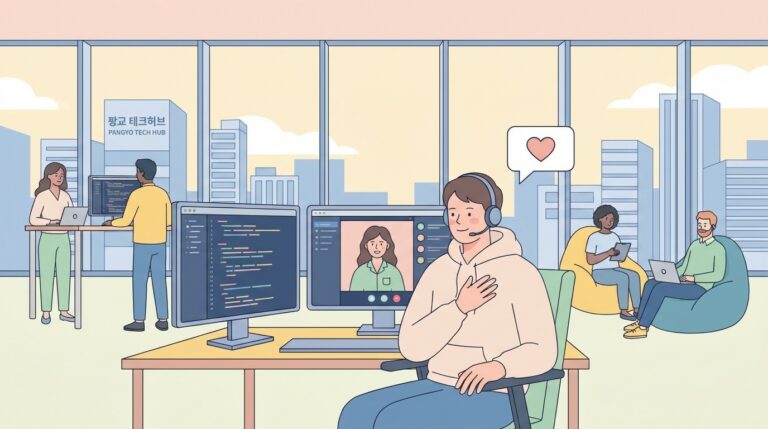
Imagine this scene straight out of a Pangyo Techno Valley office drama like Start-Up: You are an ambitious Product Manager or Software Engineer at a fast-growing Seoul tech unicorn. You usually spend your days arguing over sprint burndown charts, refining Jira tickets, and polishing code. But today is the dreaded yet transformative 전 직원 CS 데이 (All-Hands CS Half-Day).
Once a month, the entire team puts on customer support headsets for four intense hours. Suddenly, you aren’t looking at abstract bug reports; an elderly customer in Busan is frantically calling because the latest app update locked her out of ordering fresh groceries for Chuseok. You hear the tremble in her voice, and your heart sinks. In Korean business culture, bridging the distance between cold data and warm human emotion is everything. Mastering intermediate (B2) workplace Korean means learning how to absorb raw, frustrated user feedback with deep empathy and then translating that exact sentiment into technical backlog priorities. Based on real feedback from foreign professionals working in Korean tech firms, this guide will help you navigate both customer calls and internal stakeholder debates like a true Pangyo insider.
Phase 2: Top 3 Core Expressions In-Depth
1. 피부로 와닿다 (Piburo wadatda)
- Pronunciation: [Pi-bu-ro wa-dat-da] (Think of pea-boo-row wah-daht-dah, where ‘wa-dat’ feels like a quick splash against your skin)
- Meaning: Literally “to touch/strike against the skin”; used idiomatically as “to hit home palpably” or “to feel something firsthand.”
- K-Culture Moment: In tech documentaries and startup dramas like Search: WWW, developers often remark after reviewing raw user complaints: “데이터로 볼 때랑 달리 피부로 확 와닿네요” (Unlike looking at raw data, this really hits home).
- Editor’s Insight: English speakers often say “it really opened my eyes” or “it sank in.” In Korean, emotional resonance is tactile—it touches the skin (피부). Use this when customer friction moves from an abstract chart to genuine visceral realization.
- Situation Spectrum: Casual: ⚠️ | Semi-formal: ✅ | Formal: ✅
- 🤔 Think About It: Why does Korean emphasize sensory physical metaphors (skin, gut, bone) when expressing deep cognitive shifts compared to English’s visual metaphors (“I see”)?
2. 개선 백로그에 반영하다 (Gaeseon baeklogeu-e banyeonghada)
- Pronunciation: [Gae-seon baek-lo-geu-e ban-yeong-ha-da] (Blend gay-seon back-log-oo-eh bahn-young-hah-dah)
- Meaning: Literally “to reflect into the improvement backlog”; practically means “to translate customer feedback into actionable product tickets.”
- K-Culture Moment: During post-CS retro meetings, the PM stands in front of the whiteboard declaring: “오늘 접수된 VOC 중에서 결제 오류 건은 바로 개선 백로그에 반영하겠습니다” (We will immediately prioritize the payment failure VOC from today into our improvement backlog).
- Editor’s Insight: The verb 반영하다 (to reflect) is the golden key in Korean corporate communications. You don’t just ‘add’ (추가하다) or ‘record’ (기록하다) feedback; you reflect it, honoring the source’s voice.
- Situation Spectrum: Casual: 🚫 | Semi-formal: ✅ | Formal: ✅
- 🤔 Think About It: How does the word ‘반영’ (reflection) highlight the Korean cultural priority of demonstrating that other people’s opinions were actively mirrored in decisions?
3. 많이 불편하셨을 텐데 (Mani bulpyeonhasyeosseul tende)
- Pronunciation: [Mah-nee bool-pyeon-ha-syeos-seul ten-deh] (Soft, gentle pacing; soften the ending like a sigh of shared concern)
- Meaning: Literally “It must have been so inconvenient for you”; nuance is an essential cushion phrase (쿠션어) validating customer frustration before proposing solutions.
- K-Culture Moment: When a furious caller rants about a broken delivery notification, a veteran Korean CS lead doesn’t argue facts. She starts with: “고객님, 서비스 이용에 많이 불편하셨을 텐데 신속히 도와드리겠습니다” (Customer, you must have been so frustrated; let me resolve this swiftly).
- Editor’s Insight: This uses the grammar
-을 텐데(guessing a condition with empathetic anticipation). Saying this immediately lowers emotional friction (갑을관계 tension) and validates the caller’s dignity. - Situation Spectrum: Casual: ⚠️ (drop honorifics) | Semi-formal: ✅ | Formal: ✅
- 🤔 Think About It: In Western customer service, companies often say “We apologize for the inconvenience.” Why does Korean focus first on the user’s emotional state (불편하셨을 텐데) rather than just corporate liability?
Phase 3: Textbook Korean vs. Real-World Korean
Situation A: Acknowledging a customer complaint over the phone
- 📖 교과서 한국어 (Textbook): 고객님의 불만 사항을 접수하여 기록하도록 하겠습니다. (Gogaengnim-ui bulman sahang-eul jeopsuhayeo girok-hadorok hagesseumnida. – I will receive and record your dissatisfaction items.)
- 🗣️ 진짜 한국어 (Real-World): 많이 답답하셨을 텐데, 말씀해 주신 내용 바로 개발팀과 공유해서 확인해 드릴게요. (Mani dabdabhasyeosseul tende, malsseumhae jusin naeyong baro gaebaltimgwa gong-yuhaeseo hwaginhae deurilgeyo. – You must have felt so stifled! I’ll share what you said with our engineering squad right away to check on it.)
- 💡 왜 다를까? (Why is it different?): Textbook phrases sound like bureaucratic robotic detachment. Real tech CS relies on 쿠션어 (cushion words) and collaborative action verbs like 공유하다 (share) to show dynamic responsiveness.
Situation B: Reporting customer feedback in an internal sprint retro
- 📖 교과서 한국어 (Textbook): 사용자들의 요구 사항을 문서로 작성하여 다음 개발 일정에 넣겠습니다. (Sayongjadeul-ui yogu sahang-eul munseoro jakseonghayeo daeum gaebal iljeong-e neokgetseumnida. – I will draft user requests into a document and put them into the next development schedule.)
- 🗣️ 진짜 한국어 (Real-World): 현장에서 터져 나온 VOC들을 우선순위별로 티켓화해서 다음 스프린트 백로그에 바로 녹여내겠습니다. (Hyeonjang-eseo teojyeo naon VOC-deureul useonsunwibyeollo tiket-hwahaeseo daeum seupeurinteu baeklogeu-e baro nogyeonaegetseumnida. – I will ticket the raw VOC emerging from the front lines by priority and melt them straight into our next sprint backlog.)
- 💡 왜 다를까? (Why is it different?): Pangyo startups love vivid culinary/crafting metaphors like 녹여내다 (to melt/infuse into) and hybrid loanwords like 티켓화 (ticketing) to communicate agile speed.
Phase 4: K-Culture Deep Dive & Non-Verbal Manners
4-1. 눈치 (Nunchi) & Phone Call Manners
Even over voice calls where nobody sees you, Korean professional etiquette requires physical non-verbal adjustment:
* The Headset Bow: When a customer vents on the line, Korean team members habitually nod rhythmically and even slightly bow their torso while uttering soft affirming filler words like “아, 네… 그러셨군요” (Ah, yes… I see that was the case). Believe it or not, physical bowing changes your vocal cord resonance and projects audible humility.
* Lowering Pitch at Sentence Endings: Avoid rising intonation at the end of sentences during troubleshooting; rising tones can sound defensive or questioning. Land your verbs gently with a clean downward contour: “확인해 드리겠습니다↘.”
4-2. Culture Code: Pangyo Startup “고객 집착” (Customer Obsession)
In Korea’s hyper-competitive tech landscape (dominated by giants like Coupang, Toss, and Woowa Brothers), customer responsiveness is a matter of corporate survival. Korean tech culture has institutionalized 전 직원 CS 데이 (All-Hands CS Day) to prevent product silos. While engineers in Silicon Valley might see CS as an operational cost center, Korean startups view it as raw field reconnaissance (현장 감각). Experiencing the raw temperature of customer pain (고객의 온도) prevents developers from writing code for imaginary personas.
Phase 5: Real-World Roleplay Scenario
Setting: It’s 2:30 PM during Pangyo fintech startup ‘PayMoa’s CS Day. Min-ho (a backend developer taking customer calls for the first time) is speaking with Ms. Park, a 45-year-old boutique owner whose payment settlement failed.
- 박 대표 (Ms. Park): 여보세요? 어제부터 정산 금액이 계속 안 들어오는데, 장사 접으라는 거예요 뭐예요? (Yeoboseyo? Eojebuteo jeongsan geumaek-i gyesok an deureo-oneunde, jangsa jeob-euraneun geoyeyo mwoyeyo? – Hello? My settlement money hasn’t arrived since yesterday. Are you telling me to shut down my business or what?)
- 민호 (Min-ho): 🎭 [Swallowing hard, sitting upright, softening voice] 대표님, 정산 문제로 영업에 큰 차질을 빚으셨을 텐데 정말 죄송합니다. (Daepyonim, jeongsan munjero yeong-eob-e keun chajireul bijeusyeosseul tende jeongmal joesonghamnida. – Boss, your business operations must have experienced major disruptions due to this settlement issue; I am genuinely sorry.)
- 박 대표 (Ms. Park): 주말 앞두고 직원들 알바비 줘야 하는데 앱 오류라고만 뜨면 어떡하냐고요! (Jumal apdugo jigwondeul albabi jwoya haneunde aep oryuragoman tteumyeon eotteok-hanyagoyo! – I have to pay my part-timers before the weekend, so what am I supposed to do if the app just keeps showing ‘system error’?)
- 민호 (Min-ho): 🎭 [Typing rapidly to locate the transaction log on his monitor] 네, 대표님. 답답하신 심정 충분히 이해합니다. 사업자 등록번호 말씀해 주시면 제가 로그 바로 추적해 보겠습니다. (Ne, daepyonim. Dabdabhasin simjeong chungbunhi ihaehamnida. Sa-eopja deungnok-beonho malsseumhae jusimyeon jega rogeu baro chujeokhae bogetseumnida. – Yes, Boss. I fully understand how suffocating this is. If you give me your business registration number, I will trace the system log right now.)
- 박 대표 (Ms. Park): 120-81-… 이거 오늘 안에 해결 안 되면 금융감독원에 민원 넣을 겁니다! (120-81-… Igeo oneul an-e haegyeol an doemyeon geumyung-gamdogwon-e min-won neoeul geomnida! – 120-81-… If this isn’t resolved today, I will file a formal complaint with the Financial Supervisory Service!)
- 민호 (Min-ho): 🎭 [Checking database query] 확인 감사합니다. 결제 게이트웨이 연동 지연으로 일시 락이 걸린 상태입니다. 30분 내로 수동 정산 처리해 드리고 문자 남겨드리겠습니다. (Hwagin gamsahamnida. Gyeolje geiteuwei yeondong jiyeon-euro ilsi rag-i geollin sangtae-imnida. Samsipbun naero sudong jeongsan cheorihae deurigo munja namgyeodeurigetseumnida. – Thank you for confirming. A temporary system lock occurred due to a payment gateway sync delay. I will manually process your payout within 30 minutes and text you confirmation.)
- 박 대표 (Ms. Park): 🎭 [Tone deflating slightly from anger to relief] 하… 30분 내로 확실히 되는 거죠? (Ha… Samsipbun naero hwaksilhi doeneun geojyo? – Whew… It will definitely be done within 30 minutes, right?)
- 민호 (Min-ho): 🎭 [Speaking with reassuring firmness] 네! 제가 직접 끝까지 팔로업하겠습니다. 다시 한번 놀라게 해 드려 송구합니다. (Ne! Jega jikjeop kkeutkkaji pallo-eophagesseumnida. Dasi hanbeon nollage hae deuryeo song-guhamnida. – Yes! I will personally follow up until the very end. Once again, I am deeply regretful for shocking you.)
🔀 Interactive Decision Point
After hanging up, Min-ho needs to log this into the internal team Slack channel before their evening backlog grooming. How should he frame it?
- Option A: “오늘 정산 오류 CS 건 해결했습니다. 서버 게이트웨이 파라미터 버그였는데 패치 완료요.” (Closed the settlement CS case today. It was a server gateway parameter bug; patch done.)
- Option B: “오늘 CS 데이에서 정산 지연 VOC를 직접 받아보니 소상공인 피해 온도가 피부로 와닿네요. 관련 에러 핸들링 로직을 이번 스프린트 최우선 개선 백로그로 올려야 합니다.” (Taking settlement delay VOC firsthand during CS Day made the severity of merchant impact hit home palpably. We must raise the related error handling logic to the top improvement backlog this sprint.)
- Option C: “고객이 금융감독원에 신고한다고 소리 질러서 어쩔 수 없이 수동 정산했습니다. 사용자들 너무 예민하네요.” (The customer yelled that they would report us to the authorities, so I had no choice but to do manual payout. Users are too sensitive.)
Feedback:
* Option A (Risk): Technocentric and dismissive. While technically accurate, it fails to capture customer pain points or advocate for systemic architectural prevention in the backlog.
* Option B (Best!): Outstanding B2 tech professional Korean! It uses professional empathy idioms (피부로 와닿다), captures business context (소상공인 피해 온도), and drives actionable product iteration (개선 백로그로 올리다).
* Option C (Bad): Highly unprofessional. Blaming user emotion creates team bias and violates tech customer-obsession standards.
Phase 6: 10-Second Emotion Shadowing Drill
Practice reading these sentences aloud, matching the vocal cadence and emotional cues indicated:
[🎧 차분하고 진중하게 - Calm and composed]
고객님, / 서비스 이용에 많이 불편하셨을 텐데 / 신속하게 확인해 드리겠습니다.
(Gogaengnim, / seobiseu iyong-e mani bulpyeonhasyeosseul tende / sinsokhage hwaginhae deurilgeyo.)-
[💡 뼈저리게 실감하며 - With deep firsthand realization]
직접 전화를 받아보니까 / 사용자들이 겪는 병목 현상이 / 정말 피부로 확 와닿네요.
(Jikjeop jeonhwareul badabonikka / sayongjadeuri gyeongneun byeongmok hyeonsang-i / jeongmal piburo hwak wadatneyo.) -
[🚀 결단력 있고 든든하게 - Resolute and assertive]
이번 스프린트에서는 / 이 이슈를 최우선 순위로 / 개선 백로그에 반영하시죠!
(Ibeon seupeurinteu-eseoneun / i issyureul choe-useon sunwiro / gaeseon baeklogeu-e banyeonghasijo!)
Phase 7: K-Culture Mini Dictionary
- 고객의 소리 (VOC – Gogaek-ui Sori): Literally “Voice of Customer.” In Korean corporate tech, this refers not just to complaints, but to raw gold user intelligence used for UX pivots.
- 쿠션어 (Cushion Words – Kusyeoneo): Softening introductory phrases (such as “번거로우시겠지만…” or “불편하셨을 텐데…”) used in high-context Korean communication to absorb shock before delivering neutral or bad news.
- 쳐내다 (Cheonaeda): Colloquial office slang meaning to rapidly clear out, triage, or hack away a mountain of backlog tickets or incoming support calls (e.g., “오늘 밀린 티켓 50개 다 쳐냈어요”).
- 백로그 우선순위 (Backlog Priority – Baeklogeu Useonsunwi): The ranking of product backlog features based on ROI and customer impact, a staple discussion topic in Korean agile sprint planning.
Phase 8: Traveler and Expat Survival Kit
If you ever need to call customer support in Korea for your SIM card, banking app, or accommodation booking, keep these three phrases handy:
- 1. 연결이 자꾸 끊기는데 확인 부탁드립니다. (Yeongyeor-i jakku kkeunkkineunde hwagin butakdeurimnida.) – My connection keeps dropping; please check on this. [Pro Tip: Use this when apps like Kakao or your mobile carrier misbehave].
- 2. 상담원 연결 부탁드립니다. (Sangdamwon yeongyeol butakdeurimnida.) – Please connect me to an agent. [Pro Tip: Hit ‘0’ or say this when stuck in infinite automated ARS voice menus].
- 3. 한국어가 서툴러서 그런데 천천히 말씀해 주시겠어요? (Hangug-eoga seotulleoseo geureonde cheoncheonhi malsseumhae jusigesseoyo?) – My Korean is a bit clumsy; could you please speak slowly? [Pro Tip: Korean CS agents are exceptionally polite; stating this prompts them to simplify vocabulary immediately].
-
Editor’s Note: When experiencing issues with delivery or navigation in Korea, avoid calling standard numbers if you don’t speak fluent Korean. Instead, use the 1:1 in-app text chat feature in the 네이버 지도 앱 고객센터 where auto-translate tools can assist you effortlessly.
Phase 9: A Step Deeper (Reflection)
In Korean corporate history, customer interactions were historically governed by rigid corporate hierarchies or high-stress call center outsourcing. However, the modern Korean tech wave has fundamentally redefined this dynamic through “All-Hands CS Days.” When software developers step down from their two-monitor workstations to bear the brunt of user frustration, the traditional Korean concept of 역지사지 (易地思之 – putting yourself in someone else’s shoes) shifts from a moral proverb into an agile engineering principle. Code is no longer just logic; it is human relationships codified in software.
💬 Your Turn: Has your company or school ever made you work on the front lines to interact with real users? How did experiencing that user pain change the way you worked? Share your thoughts below!
Phase 10: FAQ & Avoiding Misunderstandings
Q: Why do Korean CS agents address callers as ‘고객님’ instead of using their names?
A: In Korean culture, addressing someone directly by their personal name (e.g., ‘수잔 씨’ or ‘존 님’) in an external service encounter can feel uncomfortably intimate or blunt. 고객님 (Honored Customer) or specific occupational titles like 대표님 (CEO/Boss) convey the highest tier of professional deference without crossing interpersonal boundaries.
Q: Is the word ‘백로그’ universally understood in Korean companies?
A: Yes, in tech startups, agile teams, and modern IT enterprises in Pangyo and Gangnam, English tech loanwords like 백로그 (backlog), 스프린트 (sprint), 스펙 (spec), and 티켓 (ticket) are standard industry vernacular.
Q: What is the risk of saying “죄송합니다” too early in a technical dispute?
A: While empathy is vital, repeatedly apologizing without offering concrete steps can be interpreted as admitting legal or operational fault prematurely in commercial disputes. That is why savvy professionals use cushion phrases like 많이 불편하셨을 텐데 (You must have experienced inconvenience) to validate emotions without prematurely accepting liability before debugging.
🚨 Common Mistakes Alert
- Saying ‘당신’ to address an upset customer: Never call a customer ‘당신’. In spoken Korean, ‘당신’ during an argument implies a hostile confrontation (“Hey you!”). Always use 고객님.
- Using cold negative verbs like ‘안 됩니다’: Saying flatly “그건 안 됩니다” (That is impossible) inflames tempers. Instead, use soft cushioning: “현재 시스템상 지원이 어려운 점 양해 부탁드립니다” (Please kindly understand that current system parameters make support difficult).
- Translating ‘I will try’ as ‘노력하겠습니다’: In product backlog management, telling team members ‘노력해 볼게요’ sounds non-committal and weak. Use concrete technical phrasing: “백로그에 등록해서 다음 배포 때 검토하겠습니다” (I will register it to the backlog and inspect it during the next release).
Phase 11: Action Missions
- 🥉 Bronze Mission (Solo Shadowing): Stand up with a headset, record your voice saying: “많이 불편하셨을 텐데 신속히 개선 백로그에 반영하겠습니다”, and verify that your ending tone falls gently downward.
- 🥈 Silver Mission (Community Drill): Write a mock Slack post in our comment section tagging a coworker about an app bug using the phrase 피부로 와닿다.
- 🥇 Gold Mission (Real-World Integration): Next time you file a support inquiry on a Korean platform (like Coupang, Karrot Market, or Naver), write your complaint using a proper cushion phrase (불편을 겪고 있습니다) and observe how warmly the agent replies!
- 🎮 K-Culture Mission: Watch Episode 5 of the K-Drama Start-Up and spot how the characters debate user testing feedback. Count how many times they use customer-centric empathy verbs!
Phase 12: Interactive Quiz Challenge
Test your mastery of Korean tech VOC and backlog culture!
1. Situational Judgment: You are a developer who just listened to a user crying because a booking bug ruined their anniversary. What is the most culturally empathetic and professional sentence to say to your PM?
* A) 고객이 감정적이라 무시하는 게 좋겠어요.
* B) 사용자 고통이 피부로 와닿아서, 이 버그 수정건은 백로그 최상단에 올려야 합니다.
* C) 데이터베이스 쿼리 문제니까 서버팀에 넘기겠습니다.
2. Fill-in-the-Blank: Complete this essential CS cushion phrase:
“서비스 이용에 많이 ________ 텐데, 빠르게 처리해 드리겠습니다.”
* A) 행복하셨을
* B) 불편하셨을
* C) 시끄러우셨을
3. True or False: In Korean tech startups, ‘All-Hands CS Day’ is viewed purely as a disciplinary punishment for junior developers when servers crash.
* True / False
👉 Click here for Answers & Explanations!
- Answer: B | Feedback: Option B perfectly pairs the tactile idiom 피부로 와닿다 with decisive agile prioritization (백로그 최상단). Option A is unethically dismissive; Option C lacks empathy.
- Answer: B (불편하셨을) | Feedback: The standard cushion formula is “많이 불편하셨을 텐데” (You must have experienced much inconvenience).
- Answer: False | Feedback: It is an intentional cultural practice across modern Korean IT giants designed to bridge the empathy gap between product builders and end users!
🎬 Watch Our Daily Videos! (Daily Hangul Official Instagram)
Review the expressions you learned in this article with our fun daily short videos! Check out native pronunciation and real-life nuances in action.
- Instagram @dailyhangul_en







