

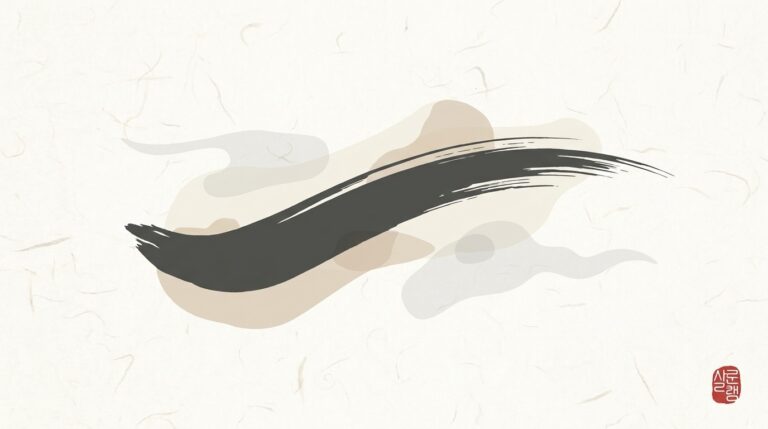
Beyond Pretty: How to Talk About Korean Art Like a True Connoisseur
Phase 1: Empathy & Storytelling Opening
안녕하세요! 매일한글 에디터입니다. (Annyeonghaseyo! It’s your Daily Hangul editor.)
Picture this: You are standing in the quiet, sun-dappled pavilion of the Kansong Art Museum or weaving through an exclusive vernissage in Samcheong-dong. Everyone around you—from velvet-blazered gallery directors to discerning collectors—is gazing intently at a monumental Joseon ink wash painting. You want to contribute something profound to the conversation. You desperately want to move past elementary praise like “이 그림 정말 예뻐요” (This painting is really pretty) or “색깔이 멋져요” (The colors are cool). But when you search for words to articulate the sweeping tension, the living cosmic energy coursing through the brushstroke, and the breathtaking emptiness surrounding the ink, your tongue freezes.
Critiquing East Asian traditional aesthetics requires more than vocabulary; it demands an aesthetic worldview. In this Masterclass guide for C2 learners, we unpack the foundational canon of East Asian painting and calligraphy criticism: Southern Qi critic Xie He’s (사혁) Gu Huapin Lu (<고화품록>) and its supreme principle, 기운생동(氣韻生動)—”Spirit Resonance and Life Motion.” Grounded in real feedback from our advanced learners navigating Seoul’s high-art circles, this lesson will elevate your discourse from casual gallery visitor to an articulate, culturally attuned connoisseur.
Phase 2: Key Expressions In-Depth
1. 기운생동 (Gi-un-saeng-dong)
- Pronunciation: [Gi-un-saeng-dong] (Think: ‘gee-oon-seng-dong’, where the ‘gi’ hums from your diaphragm and ‘dong’ resonates like a struck bell.)
- Meaning: Literal: “Energy and resonance vibrating with life.” Nuance: The atmospheric vitality and metaphysical cosmic breath (qi) pulsing through a work of art, making the subject feel organically alive rather than merely copied.
- K-Culture Moment: In the historical art drama Painter of the Wind or contemporary cultural documentaries, master critics lean back and whisper this phrase when a brushstroke seems to breathe on the hanji (mulberry paper).
- Editor’s Insight: Xie He placed this as the very first of his “Six Canons of Painting” (화육법). If an artwork lacks Giun Saengdong, technical precision is utterly irrelevant. Use this when a piece radiates an undeniable, living aura.
- Situation Spectrum: Casual 🚫 / Semi-formal ⚠️ / Formal ✅
- 🤔 Think About It: Western classical art long prioritized photographic realism (mimesis). Why does traditional Korean art prioritize the artist’s transferred inner energy over anatomical accuracy?
2. 일필휘지 (Il-pil-hwi-ji)
- Pronunciation: [Il-pil-hwi-ji] (Think: ‘eel-peel-hwee-jee’, sweeping effortlessly off the tongue in a single breath.)
- Meaning: Literal: “Writing or painting down with a single stroke of the brush without interruption.” Nuance: Supreme mastery, absolute presence of mind, and the irrevocable decisiveness where no corrections (or Ctrl+Z) are possible.
- K-Culture Moment: Modern Korean ink masters or calligraphers featured on cultural programs executing an entire dragon or poetic couplet in one continuous, breathless sweep.
- Editor’s Insight: It does not just mean “fast.” It implies that the artist cultivated their mind for decades so that their physical hand executes pure intention instantaneously without hesitation.
- Situation Spectrum: Casual ⚠️ / Semi-formal ✅ / Formal ✅
- 🤔 Think About It: In an age of infinite digital editing, what psychological value does the irreversibility of Ilpilhwiji hold for modern observers?
3. 여백의 미 (Yeo-bae-gui mi)
- Pronunciation: [Yeo-baeg-ui mi] (Think: ‘yuh-beck-ee mee’, smooth and meditative.)
- Meaning: Literal: “The beauty of empty space.” Nuance: Deliberate voids that are not bare absences, but pregnant silences full of infinite potentiality and room for the viewer’s imagination to wander.
- K-Culture Moment: Architects in Seongsu-dong designing ultra-minimalist gallery cafes, or K-pop visual directors discussing the negative space in music video cinematography.
- Editor’s Insight: Emptiness in East Asian metaphysics is never “nothingness” (무); it is pregnant with invisible flow, mist, sky, and time. Leaving space blank is the highest form of trust between artist and viewer.
- Situation Spectrum: Casual ✅ / Semi-formal ✅ / Formal ✅
- 🤔 Think About It: How does “leaving space” manifest in Korean social etiquette, such as leaving pauses in speech to allow the listener to process without verbal pressure?
Phase 3: Textbook Korean vs. Real Korean
Situation 1: Praising the Dynamic Movement of Ink Strokes
- 📖 교과서 한국어 (Textbook Korean):
이 그림은 매우 역동적이고 힘이 넘칩니다.
(I geurimeun maeu yeokdongjeog-igo him-i neomchimnida.)
“This painting is very dynamic and full of power.” - 🗣️ 진짜 한국어 (Real Korean):
붓끝에서 기운생동하는 에너지가 그대로 전해지네요.
(Butkkeuteseo giunsaengdonghaneun eneojiga geudaero jeonhaejineyo.)
“You can literally feel the vibrant spirit resonance pulsating right from the tip of the brush.” - 💡 왜 다를까? (Why the difference?): Advanced native art critics avoid bland abstract adjectives like “역동적이다” (dynamic). Instead, they anchor the experience in the physicality of the brush (붓끝) and classical aesthetic vitality (기운생동).
Situation 2: Commenting on an Unpainted, Minimalist Composition
- 📖 교과서 한국어 (Textbook Korean):
배경이 많이 비어 있어서 단순해 보입니다.
(Baegyeong-i mani bieo isseoseo dansunhae boimnida.)
“The background is very empty, so it looks simple.” - 🗣️ 진짜 한국어 (Real Korean):
과감하게 여백을 살려둬서 오히려 깊은 여운이 남아요.
(Gwagamhage yeobaegeul sallyeodwoseo ohiryeo gipeun yeo-un-i nam-ayo.)
“By boldly honoring the empty space, it leaves a lingering resonance that cuts far deeper.” - 💡 왜 다를까? (Why the difference?): Saying an art piece looks “empty” or “simple” sounds amateurish or dismissive. Highlighting that the artist “살려두다” (breathed life into / honored) the space acknowledges intentionality.
Phase 4: K-Culture Deep Dive & Non-Verbal Manners
4-1. 눈치 (Nunchi) & Curatorial Body Language
When standing before Korean monochrome art (Dansaekhwa) or classic ink landscape (Sansuhwa):
* The Two-Step Distance Shift: Never stand statically glued to one spot. Take two slow paces back to capture the compositional void (여백), then lean slightly forward with your hands clasped behind your lower back to inspect the ink gradation (농담). This posture conveys discernment.
* The Low-Register Vocal Nod: When agreeing with a curator’s critique, refrain from high-pitched cheerful exclamations like “와 대박!”. Instead, nod slowly with eyes lowered, offering a restrained low-pitched “과연 그렇군요” (Indeed, it is so) or “기운이 남다르네요” (The energy is truly extraordinary).
4-2. Cultural Code: The Metaphysics of Modern K-Cinematography
Notice how modern Korean masters of cinema—such as Bong Joon-ho (Parasite) or Park Chan-wook (Decision to Leave)—frame their shots. The framing frequently leaves massive swathes of the screen uncluttered: a foggy sea, an empty corridor, or an unmoving silhouette. This is the direct cinematic reincarnation of 여백의 미. Western framing often seeks to populate the frame with information; Korean cinematic framing invites the audience to fill the stillness with psychological tension and unspoken nunchi.
Phase 5: Real-Life Roleplay Scenario
- Setting: An exclusive invitation-only evening reception at a boutique contemporary gallery nestled behind Changdeokgung Palace.
- NPC: Director Min (민 관장), an austere, legendary gallerist renowned for testing whether foreign collectors genuinely understand the soul of Korean art or are merely chasing trends.
Dialogue:
1. 민 관장: 이번 기획전의 메인 작품입니다. 사혁이 말한 ‘기운생동’의 본질을 현대적으로 재해석했다고들 하죠.
(Ibeon gihoekjeon-ui mein jakpumimnida. Sahyeog-i malhan ‘giunsaengdong’-ui bonjireul hyeondaejeog-euro jaehaeseokhaetdago-deul hajyo.)
“This is the centerpiece of our exhibition. Many claim it reinterprets the essence of Xie He’s ‘Spirit Resonance’ in a contemporary voice.”
🎭 [두 손을 깍지 끼고 안경 너머로 당신의 반응을 시험하듯 응시함]
- You: 화면 전체를 압도하는 필력에서 붓을 멈추지 않고 내달린 일필휘지의 기개가 느껴집니다.
(Hwamyeon jeonchereul apdohaneun pillyeogeseo buseul meomchuji anko naedallin ilpilhwiji-ui gigaega neukkyeojimnida.)
“From the brush vitality dominating the canvas, one can distinctly feel the spirited boldness of uninterrupted strokes.”
🎭 [차분하게 그림의 중심선을 응시하며 고개를 천천히 끄덕임] -
민 관장: 호오, 필력을 보실 줄 아는군요. 하지만 어떤 이들은 먹이 지나치게 거칠다고 평하기도 합니다.
(Hoo, pillyeogeul bosil jul aneungunyo. Hajiman eotteon ideureun meog-i jinachige geochildago pyeonghagido hamnida.)
“Oh? You know how to read brush force. Yet, some critics argue the ink is excessively rough.”
🎭 [미소를 지우고 흥미롭다는 듯 눈썹을 살짝 치켜올림] -
You: 거칠다기보다는, 인위적인 기교를 배제하고 기운이 살아 숨 쉬도록 내버려 둔 셈이죠.
(Geochildagibodaneun, in-wijog-in gigyoreul baejehago giun-i sara sum swidorok naebeoryeo dun sem-ijyo.)
“Rather than rough, it seems the artist rejected artificial technicality, allowing the cosmic energy to breathe naturally.”
🎭 [미간을 살짝 좁히며 그림의 먹선이 번진 자리를 지긋이 가리킴] -
민 관장: 정확합니다. 바로 그 무기교의 기교죠. 그렇다면 오른쪽 상단의 텅 빈 공간은 어떻게 다가오십니까?
(Jeonghwakhamnida. Baro geu mugigyo-ui gigyojyo. Geureotdamyeon oreunjjok sangdan-ui teong bin gonggan-eun eotteoke daga-osimnikka?)
“Spot on. The art of artlessness. What, then, do you make of that cavernous void in the upper right?”
🎭 [기대감을 품고 와인잔을 든 채 조용히 귀를 기울임] -
You: 단순한 빈 공간이 아니라, 먹의 에너지가 확장되는 여백의 미로 작동하고 있네요.
(Dansunhan bin gonggan-i anira, meog-ui eneojiga hwakjangdoeneun yeobaeg-ui miro jakdonghago itneyo.)
“It isn’t a mere empty space; it acts as the aesthetic of negative space through which the ink’s energy expands.”
🎭 [반 걸음 물러나 공간 전체의 균형을 시선으로 훑음] -
민 관장: 탁월한 안목이십니다. 먹의 묵직함과 여백의 긴장감이 절묘하게 상응하고 있지요.
(Takwolhan anmog-isimnida. Meog-ui mukjikham-gwa yeobaeg-ui ginjanggam-i jeolmyohage sang-eunghago itjiyo.)
“An exceptional aesthetic eye. The gravity of the dark ink and the tension of the void complement each other exquisitely.”
🎭 [만족스러운 표정으로 가볍게 목례를 건넴] -
You: 동양 예술철학이 추구하는 생명력이 현대 캔버스 위에 고스란히 살아 숨 쉬는 것 같습니다.
(Dongyang yesulcheolhag-i chuguhaneun saengmyeongnyeog-i hyeondae kaembeoseu wie goseuranhi sara sum swineun geot gatseumnida.)
“It feels as though the organic vitality sought by East Asian philosophy is breathing untamed on a contemporary canvas.”
🎭 [Director Min raises his glass slightly to you in mutual connoisseurship]
🔀 Interactive Choice Point:
Director Min now asks: “그렇다면 이 먹선의 농담(gradation) 처리는 어떻게 보십니까?” (How do you view this gradation of ink?)
* Option A: “색깔이 진했다가 연해지는 게 아주 세련되어 보여요!” (The colors shifting from dark to light look super chic!)
Feedback: Bad. This reduces philosophical ink gradation (농담) to trendy decorative aesthetics. You break the spell of intellectual camaraderie.
* Option B: “먹의 농담 변화를 통해 보이지 않는 바람과 생명의 율동을 표현해냈군요.” (Through the shifting density of ink, the artist has evoked the unseen wind and organic rhythm of life.)
Feedback: Best. Flawless C2 philosophical discernment! You directly tied Xie He’s principles to sensory perception. Director Min invites you to his private tea salon.
* Option C: “농담이 좋긴 한데 서양 유화에 비하면 명암 표현이 덜 정교합니다.” (The gradation is fine, but compared to Western oil paintings, the chiaroscuro is less sophisticated.)
Feedback: Risk. Dangerously misses the metaphysical premise of Eastern ink philosophy by evaluating it through a Western mimetic lens. Prepare for a polite, chilly nod.
Phase 6: 10-Second Emotional Shadowing Drill
Master the subtle cadences and philosophical weight of a high-level critic. Follow the breath pauses (/) and embody the emotion:
[🧐 깊은 사색과 절제된 감탄]
단순히 대상을 묘사한 것이 아니라, / 화면 위로 기운생동하는 생명력을 / 일필휘지로 뿜어냈군요.
(Dansunhi daesang-eul myosahan geos-i anira, / hwamyeon wiro giunsaengdonghaneun saengmyeongnyeog-eul / ilpilhwijiro ppum-eonaetgunyo.)
“It does not merely depict an object; / it releases an organic, spirit-resonating vitality across the surface / in one single, unhesitating brushstroke.”-
[🤫 고요하고 무게감 있는 어조]
비어 있는 여백에서 / 오히려 더 짙은 / 사색의 여운이 전해집니다.
(Bieo inneun yeobaegeseo / ohiryeo deo jiteun / sasaeg-ui yeo-un-i jeonhaejimnida.)
“From this uncluttered, negative space, / an even deeper, / lingering contemplation resonates.”
Phase 7: K-Culture Mini Dictionary
- 묵향 (Muk-hyang): Literal: “The scent of traditional black ink.” Practical usage: Represents scholarly dignity, refined artistic heritage, and old-soul cultivation. Saying someone gives off “묵향이 느껴지는 사람” means they are deeply cultured, calm, and grounded.
- 필력 (Pil-lyeok): Literal: “Brush force / stroke energy.” Practical usage: Beyond painting, Koreans frequently use this to praise master novelists, screenwriters, or investigative essayists whose writing grips you: “작가의 필력이 대단하다” (The writer’s penmanship and storytelling power are monumental).
- 농담 (Nong-dam): Literal: “Density and dilution (of ink).” Note: Homophone with “농담” (joke). Practical usage: Refers to tonal variations in ink wash (수묵화). Highbrow usage also applies metaphorically to balancing intensity and lightness in interpersonal relationships.
- 여운 (Yeo-un): Literal: “Lingering resonance / after-sound.” Practical usage: The haunting afterglow left behind by an exquisite film ending, a breathtaking song, or an encounter with a profound thinker: “그 영화는 여운이 참 길게 가네” (That movie leaves such a long, haunting resonance).
Phase 8: Survival Kit for Travelers & Connoisseurs
Top 3 Connoisseur Survival Expressions:
- 1. 전통 수묵화의 정취가 오롯이 묻어나네요.
(Jeontong sumukhwa-ui jeongchwiga orosi mudeonaneyo.)
Pro Tip: Use this when praising modern artwork that retains classical ink wash sensibilities. “오롯이” (wholly, purely) is a breathtakingly poetic C2 adverb. - 2. 여백 덕분에 작품의 숨통이 트이는 느낌입니다.
(Yeobaek deokbune jakpum-ui sumtong-i teuineun neukkim-imnida.)
Pro Tip: Literally, “Thanks to the negative space, the artwork feels like it can breathe.” A brilliant critique of cramped vs. spacious compositions. - 3. 먹선의 농담 조절에서 내공이 엿보여요.
(Meokseon-ui nongdam jojeoreseo naegong-i yeotboyeoyo.)
Pro Tip: “내공” (inner cultivation/depth). Saying an artist’s inner cultivation shines through their ink gradation marks you as an authentic insider.
Editor’s Cultural Field Guide:
- Gallery Pilgrimage: Avoid crowded tourist spots when you want to encounter true 기운생동. Head to the Kansong Art Museum (간송미술관) in Seongbuk-dong during their special spring/autumn exhibitions, or explore the quiet galleries flanking the stone walls of Samcheong-dong.
- Navigation Tip: Search for galleries using the Naver Map app download for iOS and Android instead of international map apps, which often misplace smaller independent hanok galleries in Bukchon.
Phase 9: Step Deeper (한 발 더 깊이)
In Western Renaissance traditions, painting was historically treated as an open window through which an artist mathematically captures the physical world using linear perspective and chiaroscuro. East Asian painting philosophy, anchored by Xie He’s Giun Saengdong, treats the silk or hanji not as a mirror of reality, but as a battlefield of living cosmic forces. The brush does not depict the wind; the brushstroke is the wind moving through the artist’s cultivated mind. Emptiness (여백) is not a void waiting to be filled with consumer goods or visual noise; it is the silent cosmic womb from which all forms emerge.
💬 Your Turn: When you examine your own daily routine or creative pursuits, where could you deliberately introduce “여백의 미” (the beauty of empty space)? Have you ever felt Giun Saengdong while experiencing K-art or K-performance? Share your thoughts below in Korean!
Phase 10: FAQ & Common Mistakes
Q: Can ‘기운생동’ be used outside of traditional paintings?
A: Absolutely! In contemporary South Korea, sophisticated cultural commentators frequently apply 기운생동 to dynamic theatrical performances, the fluid, organic choreography of high-concept modern dance, master calligraphy, and even charismatic stage presence in contemporary media.
Q: What is the difference between ‘여백’ (negative space) and ‘빈칸’ (blank space)?
A: A huge difference! 빈칸 refers to a mechanical blank space or missing slot that needs to be filled (like a blank line on a test). 여백 is an intentional, philosophical aesthetic space deliberately left unfilled to allow contemplation and breathing room.
Q: How do I praise someone’s calligraphy without sounding repetitive?
A: Instead of “글씨를 잘 쓰시네요” (You write letters well), say: “획 하나하나에 깃든 필력과 기운이 범상치 않습니다” (The brush force and energy imbued in each stroke are truly out of the ordinary).
🚨 Common Mistakes Alert:
- Mistake 1: Saying “이 그림은 여백이 너무 많아서 게을러 보여요” (This painting has too much empty space, so it looks lazy).
Correct Action: In East Asian aesthetics, unpainted space represents restraint and refinement. Phrase it as: “여백의 절제가 돋보입니다” (The restraint of the empty space stands out remarkably). - Mistake 2: Confusing “농담” (ink tone gradation) with “농담” (telling a joke).
Correct Action: Always clarify context. Say “먹의 농담” (the light-and-shade tonal gradation of ink) to prevent anyone from thinking you are talking about humor. - Mistake 3: Calling traditional Korean paintings “동양화” in an outdated manner.
Correct Action: Contemporary Korean art institutions prefer the term 한국화 (Korean Painting) or 수묵화 (Ink Wash Painting) over the colonial-era umbrella term “동양화 (Oriental Painting)”.
Phase 11: Action Missions
- 🥉 Bronze Mission (Solo Mastery): Stand in front of your mirror or open your phone’s voice memo app. Record yourself reciting the Phase 6 Shadowing Drill until the words “기운생동하는 생명력” roll off your tongue without a single stumble.
- 🥈 Silver Mission (Social Sharing): Post a photo of an ink painting, a minimalist room, or a serene landscape on Instagram or Threads. Caption it using: “과감한 여백의 미에서 깊은 여운이 느껴지는 순간.” (A moment where deep resonance is felt from the daring beauty of negative space.)
- 🥇 Gold Mission (Real-World Execution): Visit an art gallery or museum. When speaking to a gallery docent or fellow art lover, weave in at least one key expression: either 기운생동, 여백의 미, or 일필휘지.
- 🎮 K-Culture Mission: Watch an episode of a period K-drama or an interview with an ink artist. Spot the exact moment they mention “먹향” (scent of ink) or “필력” (brush power), and note the non-verbal reverence that accompanies the phrase!
Phase 12: Interactive Quiz Challenge
1. Situational Judgment: You are admiring a sweeping scroll of an orchid drawn in pure black ink at MMCA Seoul. Which comment showcases authentic C2 connoisseurship?
* A) “검은색 잉크만 써서 그런지 조금 밋밋하고 심심하네요.”
* B) “난초 잎의 유려한 선에서 일필휘지의 거침없는 기개가 전해집니다.”
* C) “배경을 안 칠해서 미완성 작품처럼 느껴져요.”
2. Fill-in-the-Blank: Choose the correct term for the sentence below:
동양 회화의 최고 이상은 남제 사혁이 말했듯, 화면 속 대상이 살아서 꿈틀거리는 듯한 (________)의 경지를 구현하는 데 있다.
* (A) 일필휘지
* (B) 기운생동
* (C) 묵향보존
3. True or False: In traditional Korean art theory, 여백 (negative space) is considered an unfinished section of the canvas that the artist simply didn’t have time to complete.
* True
* False
🔍 Click here to reveal the answers and explanations!
- Answer: B
Explanation: Option B accurately identifies the flowing brush line (유려한 선) and praises the unhesitating, spirited stroke (일필휘지의 거침없는 기개). Options A and C reveal a fundamental misunderstanding of ink aesthetics. -
Answer: B (기운생동)
Explanation: Xie He’s premier canon (고화품록 제1원리) that describes bringing the cosmic essence and living pulse to life on the canvas is 기운생동 (氣韻生動). -
Answer: False
Explanation: 여백 is never an unfinished deficit; it is a consciously constructed compositional and philosophical choice embodying boundless potentiality, breath, and resonance.
🎬 Watch Our Daily Videos! (Daily Hangul Official Instagram)
Review the expressions you learned in this article with our fun daily short videos! Check out native pronunciation and real-life nuances in action.
- Instagram @dailyhangul_en







