

Phase 1: Empathy (Story-Immersive Opening)
안녕하세요! (Hello!) I am your Daily Hangul editor, your personal cultural navigator through the vibrant (and sometimes overwhelming!) streets and stations of South Korea.
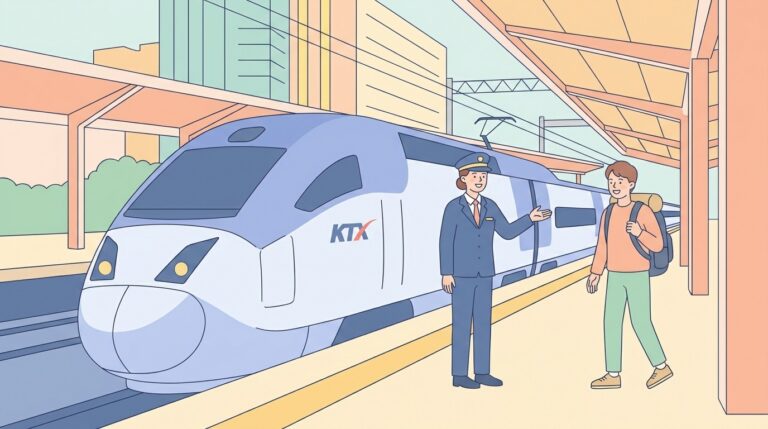
Picture this: You are standing in the middle of Seoul Station. You just grabbed a hot cup of coffee, snapped a selfie with the bustling train board, and checked your watch. Panic hits you like a dramatic K-drama freeze-frame. Your KTX to Busan left two minutes ago. The automated glass doors have closed, your 59,800 won ticket feels like it vanished into thin air, and your heart sinks. What do you do now? Do you buy a brand-new ticket? Will they yell at you? Don’t panic! Missing a train in South Korea is not the end of your trip. With just three simple, friendly Korean phrases, you can walk straight up to the customer window (매표소 – maepyoso) and secure a seat on the very next departure without breaking a sweat.
Phase 2: Core Expressions Deep Dive
Here are the top three survival phrases you need when train schedules go sideways.
1. 기차를 놓쳤어요 (Gichareul notchyeosseoyo)
- Pronunciation: [Gi-cha-reul no-chyeo-sseo-yo] (Sounds like “Gee-cha-reul note-chyo-so-yo”)
- Meaning: Literal: “I missed the train.” | Actual Nuance: “Oh no, I accidentally let my train slip away!”
- K-Culture Moment: The classic romance drama scene where the protagonist sprints across the concourse panting while the red tail-lights disappear into the tunnel.
- Editor’s Insight: The verb 놓치다 (notchida) means “to miss” or “to let slip from one’s grip.” Saying it with the polite past tense (-았/었어요) signals an honest accident rather than negligence.
- Situation Spectrum: Casual: ⚠️ | Semi-formal: ✅ | Formal: ✅
- 🤔 Think About It: In English, we say “I missed the train,” making “the train” the target. In Korean, adding the object particle ‘를’ (reul) highlights what slipped away from your schedule. How does your language express missing a ride?
2. 다음 기차로 바꿀 수 있나요? (Daeum gicharo bakkul su innayo?)
- Pronunciation: [Dae-um gi-cha-ro ba-kkul su in-na-yo] (Sounds like “Die-oom gee-cha-ro bah-kool soo een-nah-yo”)
- Meaning: Literal: “Can I change to the next train?” | Actual Nuance: “Could you possibly swap my ticket for the next available train?”
- K-Culture Moment: Seen frequently at ticketing booths in variety travel shows when cast members run late due to eating spicy tteokbokki at station food stalls.
- Editor’s Insight: The ending -(으)ㄹ 수 있나요? is the gold standard for polite, gentle requests in Korean. The particle -로 (-ro) signifies “direction of change” (“into the next train”).
- Situation Spectrum: Casual: 🚫 | Semi-formal: ✅ | Formal: ✅
- 🤔 Think About It: Notice how soft ~있나요? sounds compared to a direct command. It gives the staff member space to check their screen without feeling pressured.
3. 수수료가 얼마예요? (Susuryoga eolmayeyo?)
- Pronunciation: [Su-su-ryo-ga eol-ma-ye-yo] (Sounds like “Soo-soo-ryo-gah ull-mah-yeh-yo”)
- Meaning: Literal: “How much is the fee?” | Actual Nuance: “What is the change/cancellation penalty?”
- K-Culture Moment: The relatable thrifty traveler moment where every won counts for tonight’s Korean barbecue feast.
- Editor’s Insight: If your train has already departed, Korail charges a tiered penalty depending on how many minutes have passed (usually 15% to 70%). Asking this immediately shows you understand the system.
- Situation Spectrum: Casual: ⚠️ | Semi-formal: ✅ | Formal: ✅
- 🤔 Think About It: Asking about money in Korea is direct, yet adding ~예요 keeps it clean, practical, and respectful.
Phase 3: Textbook Korean vs. Real Korean
Let’s compare robotic book phrases with what native speakers actually say at the counter.
- Situation 1: Explaining you were late
- 📖 교과서 한국어 (Textbook): 열차 탑승 시각에 늦었습니다. (Yeolcha tapseung sigage neujeossseumnida. / “I was late for the train boarding time.”)
- 🗣️ 진짜 한국어 (Real Korean): 방금 기차를 놓쳐 버렸어요! (Banggeum gichareul notchyeo beoryeosseoyo! / “I just missed my train!”)
- 💡 Why is it different? Koreans use -아/어 버리다 (-a/eo beorida) to express unexpected regret or sadness. “방금” (banggeum – just now) adds urgency.
- Situation 2: Asking for the quickest replacement
- 📖 교과서 한국어 (Textbook): 다음 운행 편의 좌석을 원합니다. (Daeum unhaeng pyeonui jwaseogeul wonhamnida. / “I desire a seat on the subsequent operation service.”)
- 🗣️ 진짜 한국어 (Real Korean): 제일 빠른 다음 차 있어요? (Jeil ppareun daeum cha isseoyo? / “Is there a next train that’s the fastest?”)
- 💡 Why is it different? Real travelers substitute “열차” (yeolcha) with the shorter “차” (cha) and use “제일 빠른” (fastest/earliest) to save precious minutes.
Phase 4: K-Culture Deep Dive & Non-Verbal Manners
4-1. Nunchi & Station Manners
When you miss a train, your body language sets the tone. Approach the counter with a slight head bow (목례 – mongnye). Do not wave frantically or lean over the glass counter. Keep your smartphone screen on with the KorailTalk electronic ticket visible, holding it with both hands (양손 – yangson) toward the counter staff. Showing two-handed politeness shows instant respect and activates their helpful side.
4-2. Cultural Code: The Korail “Grace Window”
Korea operates on “Ppalli-ppalli” (빨리빨리 – quick, efficient) culture, but Korail actually has a generous policy for missed trains! If your train departed less than 20 minutes ago, you can go to an offline station counter and receive a partial refund or change your ticket with a minimal penalty (as low as 15%). However, you cannot do this on the app once the train has started moving; it must be done in person at the 매표소 (maepyoso)!
Phase 5: Real-Life Roleplay Scenario
Setting: Seoul Station Counter 3. You are speaking with Station Attendant Min-ji (민지).
- You: 저기요, 죄송한데요. 방금 기차를 놓쳤어요. (Jeogiyo, joesonghandeyo. Banggeum gichareul notchyeosseoyo.)
🎭 Looking worried, holding up your phone with both hands showing your ticket. - Min-ji: 아, 그러세요? 표 한번 보여주시겠어요? (A, geureoseyo? Pyo hanbeon boyeojusigesseoyo?)
🎭 Tapping quickly on her keyboard and inspecting your screen. - You: 네, 여기 있어요. 부산 가는 KTX예요. (Ne, yeogi isseoyo. Busan ganeun KTXyeyo.)
🎭 Nodding slightly and handing your phone closer. - Min-ji: 출발한 지 10분 지났네요. 다음 기차로 변경해 드릴까요? (Chulbalhan ji sipbun jinanneyo. Daeum gicharo byeongyeonghae deurilkkayo?)
🎭 Looking up attentively from her monitor. - You: 네! 다음 기차로 바꿀 수 있나요? (Ne! Daeum gicharo bakkul su innayo?)
🎭 Eyes widening with relief, leaning in slightly. - Min-ji: 20분 뒤 열차가 있는데, 일반실은 매진이고 입석만 있어요. (Isipbun dwi yeolchaga inneunde, ilbansireun maejinigo ipseongman isseoyo.)
🎭 Pointing toward the digital display monitor. - You: 수수료가 얼마예요? 입석도 괜찮아요! (Susuryoga eolmayeyo? Ipseokdo gwaenchanayo!)
🎭 Smiling gratefully. - Min-ji: 취소 수수료 15% 제외하고 차액만 결제하시면 됩니다. (Chwiso susuryo sip-o-peosenteu jewehago cha-aekman gyeoljehasimyeon doemnida.)
🎭 Hands over the newly printed paper ticket with a pleasant smile.
🔀 Interactive Decision Point
What would you say next to wrap up this situation?
* Option A: “지금 바로 취소만 해 주세요!” (Just cancel it right now!)
* Feedback (Risk): You will get some money back, but during peak hours you might be stranded in Seoul for hours without a ride!
* Option B: “입석 표로 변경해 주세요.” (Please change it to the standing ticket.)
* Feedback (Best): Perfect! Standing tickets (입석) often allow you to sit on flip-down jump seats in the corridor between cars.
* Option C: “그냥 다음 기차 아무거나 타면 안 돼요?” (Can’t I just board any next train?)
* Feedback (Bad): Boarding without a modified ticket will lead to a 0.5x to 3x penalty surcharge from the conductor on board!
Phase 6: 10-Second Emotion Shadowing Drill
Practice these three lines aloud, paying attention to the emotion tags and slash-pause points /!
[🥺 Desperate & Apologetic]
죄송한데요, / 제가 방금 / 기차를 놓쳤어요.
(Jeosonghandeyo, / jega banggeum / gichareul notchyeosseoyo.)-
[🙏 Polite & Hopeful]
혹시 / 제일 빠른 다음 기차로 / 바꿀 수 있나요?
(Hoksi / jeil ppareun daeum gicharo / bakkul su innayo?) -
[😌 Relieved & Grateful]
네! / 수수료 내고 / 입석으로 갈게요. / 감사합니다!
(Ne! / susuryo naego / ipseogeuro galgeyo. / Gamsahamnida!)
Phase 7: K-Culture Mini Dictionary
- 입석 (Ipseok) – Standing Ticket: When standard seats are booked, this cheaper ticket lets you ride between train compartments. Pro tip: Look for the fold-down seats near the restrooms!
- 매표소 (Maepyoso) – Ticket Counter: The physical customer booth inside the terminal where human station staff handle changes, refunds, and special assistance.
- 환불 수수료 (Hwanbul susuryo) – Refund/Cancellation Fee: The statutory fee deducted when altering or canceling a train or bus ticket after scheduled departure.
- 반환 (Banhwan) – Return/Redemption: The official term written on Korail receipts indicating ticket return and credit re-issuance.
Phase 8: Traveler’s Survival Kit
Top 3 Station Survival Expressions
- 다음 차 몇 시에 있어요? (Daeum cha myeot sie isseoyo?)
What time is the next train?
Pro Tip: Use this when the destination stays the same but your schedule is completely flexible. - 좌석 있어요? (Jwaseok isseoyo?)
Are there seats available?
Pro Tip: Simple, 2-word phrase that gets you an immediate “yes/no” answer. - 영수증 주세요. (Yeongsujeung juseyo.)
Please give me a receipt.
Pro Tip: Useful for tracking unexpected change fees for travel insurance or personal budgeting.
Editor’s Travel Note
Make sure to check the KorailTalk app English reservation guide before departing. Keep in mind that once your train’s departure whistle blows, in-app cancellation locks up. Walk straight to the service counter (고객만족센터 or 매표소). Foreign credit cards work smoothly at all major station windows.
Phase 9: “One Step Deeper” (Cultural Reflection)
In many Western transport hubs, missing a train simply means buying a completely new full-price ticket. In Korea, the public transit framework values collective convenience and understanding (정 – Jeong). The railway allows post-departure ticket adjustments with modest penalty fees because Koreans believe honest mistakes shouldn’t ruin your journey. Politeness and showing respect to the counter staff usually results in them finding the fastest cancellation seat for you.
💬 Your Turn: Have you ever missed a train or bus in your home country or while traveling? How does the station staff handle it where you live? Share your story in the comments below!
Phase 10: FAQ & Common Mistakes
Q: Can I change my missed KTX ticket directly on the KorailTalk app?
A: No. The moment the train departs from its origin station, mobile app changes are restricted. You must speak directly to a station agent at the ticket counter (매표소).
Q: What is the penalty for missing a KTX train?
A: If you visit the counter within 20 minutes after departure, you only lose 15% of the ticket price. Between 20 to 60 minutes, the fee is 40%. After 60 minutes up to arrival time, the fee is 70%.
Q: Can I just hop on the next train and explain it to the conductor on board?
A: Absolutely not! Riding an unassigned train without re-ticketing at the counter counts as unauthorized boarding and can incur a surcharge of up to 50% or more.
🚨 Common Mistakes Alert
- Mistake: Freezing up and waiting in a 30-minute cafe line before asking.
Correct Action: Head immediately to the counter! Every minute that passes increases the refund penalty percentage. - Mistake: Throwing away or closing your digital ticket after missing the departure.
Correct Action: Keep the ticket screen open; the agent needs the booking number and car number to process your change. - Mistake: Asking in English without any Korean courtesy phrase.
Correct Action: Starting with “죄송한데요…” (Jeosonghandeyo… / Excuse me…) makes the agent significantly more eager to search for sold-out seats.
Phase 11: Action Missions
- 🥉 Bronze Mission (Solo Practice): Stand in front of your mirror and repeat “기차를 놓쳤어요! 다음 기차로 바꿀 수 있나요?” three times with your phone in both hands.
- 🥈 Silver Mission (Social Share): Save this phrase card on your Instagram story or travel notes and tag someone you want to travel to Busan with!
- 🥇 Gold Mission (Real-World Test): Next time you are at Seoul Station or Busan Station, find the 매표소 (Maepyoso) and spot where the queue for ticket change is located.
- 🎮 K-Culture Mission: Watch an episode of a travel show like 2 Days & 1 Night or a train scene in Crash Landing on You and listen for words like “기차” (gicha) and “표” (pyo)!
Phase 12: Interactive Quiz Challenge
Test your knowledge with these three quick questions!
- Scenario Question: You missed your train 5 minutes ago at Seoul Station. What is the very first thing you should do?
- A) Buy a brand-new ticket on your phone app at full price.
- B) Walk quickly to the 매표소 (ticket counter) with your current ticket open.
- C) Sneak onto the next train and hide in the restroom.
- Fill-in-the-Blank: Fill in the missing verb: “다음 기차로 ______ 수 있나요?” (Can I change it to the next train?)
- A) 먹을 (meogeul)
- B) 바꿀 (bakkul)
- C) 잘 (jal)
- True or False: If all standard seats on the next train are sold out, you cannot travel on that train.
- True / False
👉 Click to reveal answers & explanations!
- Answer: B – Going straight to the counter lets you change the ticket with only a minor 15% cancellation fee!
- Answer: B (바꿀) – 바꿀 comes from 바꾸다 (to change/swap). Combined with -ㄹ 수 있나요, it forms “Can I change?”
- Answer: False – You can request an 입석 (Ipseok – standing ticket) and ride safely to your destination!
🎬 Watch Our Daily Videos! (Daily Hangul Official Instagram)
Review the expressions you learned in this article with our fun daily short videos! Check out native pronunciation and real-life nuances in action.
- Instagram @dailyhangul_en







