

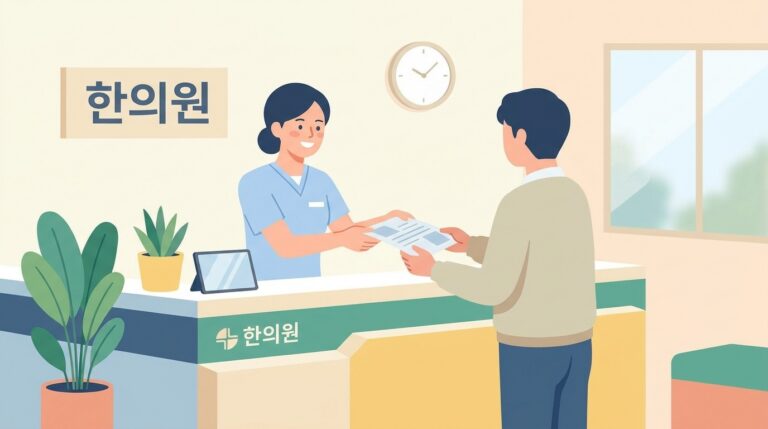
Master Korean Clinic Desks: How to Request Medical Bills for Insurance Like a Local
Phase 1: Empathy & Story
안녕하세요! 매일한글 에디터입니다. (Hello! It is your Daily Hangul editor.)
Imagine this familiar scene: You have just finished a doctor’s consultation at a clean, bustling clinic in Gangnam or Hongdae. Maybe you twisted your ankle exploring Bukchon Hanok Village, or caught a seasonal flu just like your favorite protagonist in a slice-of-life K-drama. You step up to the front desk (수납 접수처) ready to pay, but your heart starts racing. You need to file an insurance claim—either for your Korean private health insurance (실비보험) or your travel insurance back home.
You know that standard card receipt will not be enough; your insurance company specifically demands an itemized medical bill. The receptionist is swiftly typing across two widescreen monitors, patients are waiting behind you, and the infamous Korean “Palli-Palli” (quick, quick) rhythm is in full swing. What words should you say?
Do not stress! Over the past decade coaching foreign residents and exchange students in Seoul, this exact situation has caused more nervous sweat than ordering food at a barbecue restaurant. Today, we will break down the exact, polite expressions real Koreans use to get their paperwork organized in seconds without awkwardness.
Phase 2: Core Expressions Deep Dive
1. 진료비 세부내역서도 부탁드려요 (Jinlyobi sebu-naeyeokseo-do butakdeuryeoyo)
- Pronunciation: [Jin-ryo-bi seh-bu nae-yeok-seo-do boo-tak-deu-ryeo-yo] (Sounds like gene-yo-bee say-boo neck-saw-dough boo-tack-dew-ryuh-yo)
- Meaning: “Please also give me an itemized medical bill.” (Literal: Treatment fee detail statement too, please.)
- K-Culture Moment: Watch any modern medical drama like Hospital Playlist (슬기로운 의사생활) when patients wrap up outpatient care at the cashier desk.
- Editor’s Insight: Notice the little particle -도 (-do), meaning “also” or “as well.” Adding this shows you appreciate the main receipt they are already generating, making your additional request sound exceptionally thoughtful.
- Situation Spectrum: Casual 🚫 / Semi-formal ✅ / Formal ✅
- 🤔 Think About It: Why do Koreans prefer the humble phrasing “부탁드려요” (I request of you) rather than “주세요” (give me) at service counters?
2. 실손 보험 청구하려고 하는데요 (Silson boheom cheong-guharyeogo haneundeyo)
- Pronunciation: [Sheel-son bo-heom cheong-goo-ha-ryeo-go ha-neun-deh-yo] (Sounds like sheel-sone bow-hum chyoung-goo-ha-ryuh-go)
- Meaning: “I’m planning to file a private insurance claim…”
- K-Culture Moment: In Korea, almost 80% of citizens have private medical indemnity coverage, nicknamed “실비” (sil-bi). Announcing this upfront prompts desk staff to immediately bundle the exact documents you need.
- Editor’s Insight: The ending -는데요 (-neundeyo) gently softens the sentence. It leaves room for the receptionist to respond without making you sound demanding.
- Situation Spectrum: Casual 🚫 / Semi-formal ✅ / Formal ✅
- 🤔 Think About It: In English, we often say what we want first. In Korean, why do speakers explain the context or reason before making the actual request?
3. 건강보험 적용되나요? (Geongang-boheom jeok-yong doenayo?)
- Pronunciation: [Geon-gang bo-heom jeok-yong dway-nah-yo?] (Sounds like gun-gahng bow-hum juck-young dway-nah-yo)
- Meaning: “Is this covered by National Health Insurance?”
- K-Culture Moment: International students often check whether skin treatments or specific injections qualify for National Health Insurance (NHIS).
- Editor’s Insight: Korean medical items are strictly divided into 급여 (geub-yeo / covered) and 비급여 (bi-geub-yeo / non-covered). Asking this question prevents surprise expenses.
- Situation Spectrum: Casual 🚫 / Semi-formal ✅ / Formal ✅
- 🤔 Think About It: How does universal healthcare access shape the way Koreans casually visit neighborhood clinics for even minor symptoms?
Phase 3: Textbook Korean vs. Real-World Korean
Situation 1: Asking for documents for your insurance company
- 📖 교과서 한국어 (Textbook): 저는 사보험 회사에 제출할 세부적인 증명 서류를 요구합니다. (Jeoneun saboheom hoesae jechulhal sebujeogin jeungmyeong seoryureul yoguhamnida.)
- 🗣️ 진짜 한국어 (Real Korean): 실비 청구 서류 좀 떼어 주세요. (Silbi cheong-gu seoryu jom tte-eo juseyo.)
- 💡 왜 다를까? Textbook sentences use stiff words like “요구합니다” (I demand/request). Real locals use the shortened buzzword 실비 (sil-bi) and the colloquial administrative verb 떼다 (tte-da), which means to have an official document printed or issued.
Situation 2: Asking if you can pay with an international card
- 📖 교과서 한국어 (Textbook): 해외 신용 카드로 결제를 진행해도 무방합니까? (Hae-oe sinyong kadeuro gyeoljereul jinhaenghaedo mubanghamnikka?)
- 🗣️ 진짜 한국어 (Real Korean): 해외 카드도 결제돼요? (Hae-oe kadeudo gyeoljedwaeyo?)
- 💡 왜 다를까? Native speakers favor concise questions ending in friendly “-돼요?” over ceremonial grammar endings during everyday transactions.
Phase 4: K-Culture Deep Dive & Non-Verbal Manners
4-1. 눈치 (Nunchi) & Administrative Manners
When handing your Alien Registration Card (ARC), passport, or payment card to the receptionist, always hold it with both hands (or support your right wrist lightly with your left hand). In Korean clinical settings, receptionists work under intense time constraints. Keep your request precise. When your name is called over the speaker, stand up promptly, make polite eye contact, and offer a slight 15-degree head bow.
4-2. The “Silbi” Culture & Clinic Hierarchy
South Korea boasts one of the most efficient outpatient systems in the world. Neighborhood clinics (의원, such as 내과 or 이비인후과) rarely require appointments; you simply walk in. Because almost everyone uses supplemental 실손의료비보험 (Indemnity Medical Insurance), front desks can print standard reimbursement sets instantaneously. However, you must ask before or during payment, so they do not have to reopen closed billing files in their software.
Phase 5: Real-World Roleplay Scenario
- Location: Reception desk at Seoul Dasom Clinic (서울다솜의원).
- Characters: You (Learner) and Desk Nurse Min (Receptionist).
Nurse Min: 김민수 님, 수납 도와드릴게요. 처방전 나왔습니다. (Kim Minsu-nim, sunap dowadeurilgeyo. Cheobangjeon nawasseumnida.)
“Mr. Minsu Kim, I can help you with payment. Your prescription is ready.”
You: 🎭 [Holding payment card with both hands] 네, 감사합니다. 카드로 결제할게요. (Ne, gamsahamnida. Kadeuro gyeoljehalgeyo.)
“Yes, thank you. I’ll pay by card.”
Nurse Min: 네, 총 7,800원 결제되었습니다. (Ne, chong chil-cheon-pal-baek-won gyeoljedoeeosseumnida.)
“Yes, a total of 7,800 won has been processed.”
You: 저기요, 실손 보험 청구하려고 하는데요. (Jeogiyo, silson boheom cheong-guharyeogo haneundeyo.)
“Excuse me, I’m planning to submit a private insurance claim…”
Nurse Min: 아, 보험 청구 서류 필요하세요? (A, boheom cheong-gu seoryu piryohaseyo?)
“Ah, do you need paperwork for an insurance claim?”
You: 네, 진료비 세부내역서도 부탁드려요. (Ne, jinlyobi sebu-naeyeokseo-do butakdeuryeoyo.)
“Yes, please also give me an itemized medical bill.”
Nurse Min: 🎭 [Rapidly clicking mouse] 네, 영수증이랑 세부내역서 한 장씩 같이 뽑아 드릴게요. (Ne, yeongsujeung-irang sebu-naeyeokseo han jang-ssik gachi ppoba deurilgeyo.)
“Sure, I will print one copy of the receipt and itemized bill together.”
You: 🎭 [Bowing lightly with a warm smile] 네, 정말 감사합니다! (Ne, jeongmal gamsahamnida!)
“Yes, thank you very much!”
🔀 Interactive Branching Points
What would you say next if you need an additional document for work absence?
* Option A: “그냥 진단서 공짜로 한 장 써주세요.” (Just write me a diagnosis letter for free.)
Feedback (Risk): 🚫 Risky! An official diagnosis certificate (진단서) requires formal doctor verification and incurs an extra administrative fee (usually 10,000 to 20,000 KRW).
* Option B: “회사 제출용 진료확인서도 한 장 가능할까요?” (Could I also get a medical treatment confirmation slip for my company?)
Feedback (Best): ✅ Perfect! A 진료확인서 is inexpensive or free and verifies clinic attendance without extra hassle.
* Option C: “그럼 서류 필요 없어요.” (Then I don’t need documents.)
Feedback (Bad): ⚠️ Bad! You will lose the chance to reimburse your expenses.
Phase 6: 10-Second Emotion Shadowing Drill
Practice these lines aloud, matching the pause markers / and emotional tones:
[😊 차분하고 공손하게 / Calm and respectful]
저기요, / 실손 보험 청구하려고 / 하는데요.
(Jeogiyo, / silson boheom cheong-guharyeogo / haneundeyo.)-
[📋 명확하고 친절하게 / Clear and gentle]
진료비 영수증이랑 / 세부내역서도 / 함께 부탁드려요.
(Jinlyobi yeongsujeung-irang / sebu-naeyeokseo-do / hamkke butakdeuryeoyo.) -
[🙏 감사한 마음으로 / Sincerely appreciative]
네! / 빠르게 챙겨주셔서 / 정말 감사합니다.
(Ne! / Ppareuge chaeng-gyeojusyeoseo / jeongmal gamsahamnida.)
Phase 7: K-Culture Mini Dictionary
- 실비 (Silbi): Short for 실손의료비보험. The everyday household term Koreans use when discussing private insurance that covers out-of-pocket clinic and pharmacy costs.
- 진료비 세부내역서 (Jinlyobi sebu-naeyeokseo): Itemized medical bill listing every specific medication, test, and procedural charge alongside co-pay percentages.
- 수납 (Sunap): Payment and checkout. Look for this sign hanging above counters in hospitals to find where to settle your bill.
- 처방전 (Cheobangjeon): Doctor’s prescription slip. You must take this to any nearby pharmacy (약국) to receive your prescription medication.
Phase 8: Traveler’s Survival Kit
Top 3 Hospital Survival Phrases
- 진료비 영수증 주세요. (Jinlyobi yeongsujeung juseyo.) – Please give me the medical bill receipt.
- Pro Tip: The standard paper receipt shows both patient co-pay (본인부담금) and national insurance contribution (공단부담금).
- 약국은 어디에 있어요? (Yakguk-eun eodie itseoyo?) – Where is the pharmacy located?
- Pro Tip: Korean clinics do not dispense oral medicines inside; almost every clinic building has a pharmacy located on the first floor.
- 보험 서류 발급 비용이 드나요? (Boheom seoryu balgeup biyong-i deunayo?) – Does this insurance document cost an issuance fee?
- Pro Tip: Great for double-checking document fees before asking for doctor certifications.
Editor’s Travel Note
Always carry your physical Alien Registration Card (ARC) or passport. If you need to navigate to a nearby pharmacy or clinic immediately, use the 네이버 지도 앱 다운로드 link to find English-supported medical directories and real-time open hours.
Phase 9: Stepping Stones (Cultural Thought)
In many Western healthcare systems, requesting documentation feels like a bureaucratic marathon that takes weeks of phone tag. In South Korea, administrative speed is viewed as basic courtesy. Receptionists balance speed with polite deference, constantly using expressions like “도와드릴게요” (I will help you) rather than simple transaction phrasing. Understanding this blend of swift efficiency and mutual respect will make you feel confident rather than intimidated at any local clinic counter.
💬 Your Turn: Have you ever needed medical care while traveling in Korea? What part of the clinic procedure surprised you the most? Share your stories below!
Phase 10: FAQ & Common Pitfalls
Q: Does the itemized medical bill (진료비 세부내역서) cost money to issue?
A: At almost all neighborhood clinics and hospitals, the standard payment receipt (진료비 영수증) and the itemized breakdown (진료비 세부내역서) are issued completely free of charge upon request.
Q: What is the difference between a 진료확인서 and a 진단서?
A: A 진단서 (medical diagnosis certificate) is a formal legal document signed by a physician with specific disease codes and liability, usually costing 10,000 to 20,000 KRW. A 진료확인서 (confirmation of visit) simply confirms that you were examined on a specific date, often costing very little (1,000 to 3,000 KRW) or nothing.
Q: Can I request these documents days after my visit?
A: Yes, but you will need to revisit the clinic reception with your identification card. To save time and travel fees, always ask at the counter immediately when paying your initial bill.
🚨 Common Mistakes Alert
- Mistake 1: Ordering a costly 진단서 for basic insurance. Insurance adjusters usually only require the free 진료비 세부내역서 and standard receipt for claims under 100,000 KRW.
- Mistake 2: Handing documents or credit cards with one hand. Handing payment cards with only one hand can appear dismissive. Always use two hands.
- Mistake 3: Waiting until after the receipt is printed. Tell the desk staff you need insurance documents right before handing over your card so they can print everything in a single run.
Phase 11: Action Missions
- Bronze Level: Read the shadowing drills from Phase 6 aloud three times until your pronunciation of “진료비 세부내역서도 부탁드려요” flows without hesitation.
- Silver Level: Leave a comment below with your own sample sentence using the grammar structure “[Document Name] + 도 부탁드려요”.
- Gold Level: During your next clinic or pharmacy visit in Korea, successfully request your itemized bill or receipt entirely in Korean!
- 🎮 K-Culture Mission: Watch an episode of a modern K-drama featuring a hospital cashier scene and spot whether characters hand over payment with two hands.
Phase 12: Interactive Quiz Challenge
Test your clinic communication skills below!
- Situation Question: You are paying 9,000 KRW at an eye clinic. You need documents for your private insurance company. What should you say?
- A: “진단서 공짜로 빨리 주세요!”
- B: “실손 보험 청구용 세부내역서도 부탁드려요.”
- C: “보험 회사에 전화해 주세요.”
- Fill in the Blank:
“건강보험 [______]되나요?” (Is this covered by National Health Insurance?) -
True or False: An official diagnosis certificate (진단서) is always printed free of charge in Korea.
👉 Click here to reveal answers and explanations!
- Answer: B. Saying “실손 보험 청구용 세부내역서도 부탁드려요” politely and accurately secures the itemized receipt without unnecessary certificate fees.
- Answer: 적용 (jeok-yong). “적용되나요?” means “is it applied/covered?”
- Answer: False. Unlike the free itemized bill (세부내역서), an official diagnosis certificate (진단서) requires a fee established by medical regulations.
🎬 Watch Our Daily Videos! (Daily Hangul Official Instagram)
Review the expressions you learned in this article with our fun daily short videos! Check out native pronunciation and real-life nuances in action.
- Instagram @dailyhangul_en







