

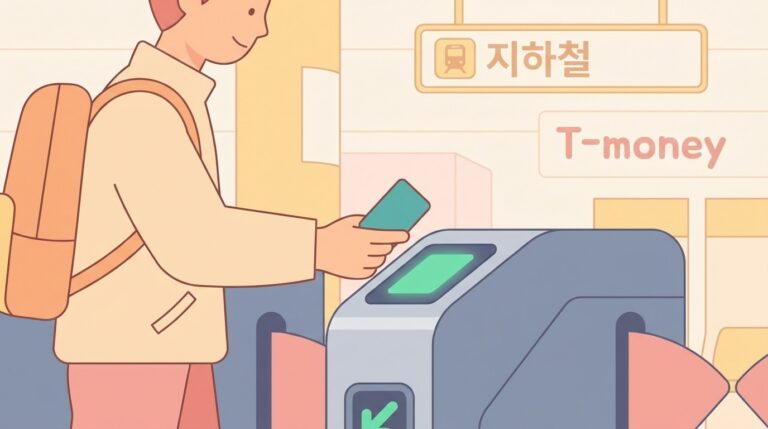
Don’t Freeze at the Seoul Subway Gate: Master the One Card Tap Like a Local
Phase 1: Empathy (Welcome to the Rush Hour Beat!)
안녕하세요! (Annyeonghaseyo!) It’s your Daily Hangul editor here, your trusted Seoul culture navigator! Picture this: You’ve landed at Incheon, grabbed your stylish BTS-edition T-Money card, loaded it with cash, and strutted into the bustling Hongdae subway station. The energy is vibrant, K-pop synths are floating from nearby shops, and you feel like the main character in your favorite K-drama.
You step confidently toward the turnstile, tap your whole wallet against the glowing sensor, and suddenly—BEEP-BEEP-BEEP!
A mechanical voice chimes out through the crowd: “카드를 한 장만 대 주세요” (Kadeureul han jangman dae juseyo – Please tap only one card).
The glass barriers stay locked. Behind you, an army of brisk Seoul commuters with iced Americanos comes to an abrupt halt. Your cheeks burn, your heart races, and you frantically smack your wallet against the pad again… only for the robotic voice to repeat the exact same sentence.
Take a deep breath! As someone who has coached hundreds of international travelers through this exact moment, let me tell you a secret: every single Korean has caused this turnstile traffic jam at least once. It is a rite of passage! By learning this short, practical unit, you won’t just unlock turnstiles smoothly—you’ll decode real subway audio announcements, communicate with station staff without fear, and navigate Korea’s world-class transit system with genuine local confidence.
Phase 2: Top 3 Core Expressions In-Depth
Here are the three survival phrases you need at any Korean subway gate.
1. 카드를 한 장만 대 주세요 (Kadeureul han jangman dae juseyo)
- Pronunciation: [Ka-deu-reul han jang-man dae ju-se-yo] (Sound tip: “Dae” sounds like the English word “Day” with a soft ‘d’, and “Jang” rhymes with “Song” but with a ‘j’.)
- Meaning: Literal: “Please touch only one sheet/piece of card.” / Practical nuance: “Please tap only one card against the sensor.”
- K-Culture Moment: You hear this automated voice broadcast whenever RFID sensors detect two transit-enabled cards (like your T-Money plus a credit card) at the same time in your purse or wallet.
- Editor’s Insight: The particle -만 (-man) means “only,” and 장 (jang) is the counter for flat objects like paper or plastic cards. Koreans love precision in shared spaces!
- Situation Spectrum: Casual 🚫 | Semi-formal ✅ | Formal ✅ (Standard automated polite announcement).
- 🤔 Think About It: In English, we say “tap your card,” but Korean says “대다 (daeda – to place in direct physical contact).” Notice how Korean verbs focus on contact and proximity!
2. 충전해 주세요 (Chungjeonhae juseyo)
- Pronunciation: [Chung-jeon-hae ju-se-yo] (Sound tip: “Chung” sounds like “chewing” without the ‘ew’ sound, “jeon” sounds like “John”.)
- Meaning: Literal: “Please recharge/refill.” / Practical nuance: “Please top up my transportation card.”
- K-Culture Moment: Seen in convenience store scenes in dramas like My Liberation Notes, where tired commuters recharge their cards alongside late-night banana milk.
- Editor’s Insight: This magic verb 충전 (chungjeon – charging/reloading) works for phone batteries, electric cars, and T-Money cards alike. Just hand your card and cash across the counter and say this phrase!
- Situation Spectrum: Casual ⚠️ | Semi-formal ✅ | Formal ✅
- 🤔 Think About It: Why do we ask to “recharge” rather than “add money”? Koreans conceptualize the transit card as an energy bank that powers your movement across the city.
3. 안 찍혀요 (An jikkyeoyo)
- Pronunciation: [An jik-kyeo-yo] (Sound tip: “Jik” sounds like a snappy “chick”, with a sharp stop at the end.)
- Meaning: Literal: “It doesn’t stamp / It isn’t being stamped.” / Practical nuance: “My card isn’t scanning / It won’t tap.”
- K-Culture Moment: When a commuter looks helplessly toward the station attendant window or asks a friend for help at the gate.
- Editor’s Insight: 찍다 (jjikda) originally means to stamp an ink seal or take a photograph. In modern slang and daily transit speech, it describes the crisp “beep” of tapping a card.
- Situation Spectrum: Casual ✅ | Semi-formal ✅ | Formal ⚠️
- 🤔 Think About It: Notice how beginner-friendly this is: put 안 (an – not) in front of the verb, and you instantly express that the technology isn’t cooperating!
Phase 3: Textbook Korean vs. Real Korean
| Context | 📖 Textbook Korean | 🗣️ Real Native Korean |
|---|---|---|
| 1. Card doesn’t scan at gate | 카드가 인식되지 않습니다. (Kadeuga insikdoeji anseumnida) “The card is not recognized.” |
어? 카드가 안 찍혀요! (Eo? Kadeuga an jikkyeoyo!) “Huh? My card isn’t scanning!” |
| 💡 Why it’s different: | The textbook version is what a computer manual says. Real humans use the intuitive sensory verb 찍히다 (to be stamped/tapped) with an authentic sound of surprise 어? (Eo? – Oh/Huh?). | |
| 2. Asking to reload at a counter | 교통카드를 충전하고 싶습니다. (Gyotongkadeureul chungjeonhago sipseumnida) “I wish to recharge my transportation card.” |
만 원 충전해 주세요. (Man won chungjeonhae juseyo) “Please reload 10,000 won.” |
| 💡 Why it’s different: | Real-life counters move fast. Stating the exact amount with -해 주세요 (hae juseyo – please do) is much more natural and polite than stating your inner desires. |
Phase 4: K-Culture Deep Dive & Non-Verbal Manners
4-1. Nunchi (눈치) & Turnstile Etiquette
In Korea, transit efficiency is a team sport. If your card beeps with an error, the golden rule of Nunchi (situational awareness) is the “One Step Sidestep.”
* Do not stand frozen in front of the scanner examining your wallet contents.
* Immediately take one step back and to the side, tilt your head slightly in a quick apologetic micro-bow (목례, mongnye), and let the brisk crowd flow through.
* Pull the single T-Money card cleanly out of your sleeve or pocket, tap it solo, and glide through.
4-2. The “Ppalli-Ppalli” (빨리빨리) Culture Code
Seoul’s transit system handles over 7 million riders daily. Korean society values collective smooth flow: when you pull out one single card instead of tapping a bulky purse that jams the RFID gate, you are participating in everyday Korean civic mindfulness (배려, baeryeo). You are showing your fellow passengers: “I respect your time as much as mine.”
Phase 5: Real-Life Roleplay Scenario
Setting: Gate 3 at Myeongdong Station during evening rush hour.
Characters: Alex (A1 level traveler visiting Korea for the first time) and Station Manager Min-woo (Kind, uniformed transit officer standing by the turnstile booth).
- Turn 1 (Alex): (flustered, stepping aside from the gate) 저기요, 도와주세요!
(Jeogiyo, dowajuseyo!)
“Excuse me, please help me!” - Turn 2 (Min-woo): (approaching with a warm smile) 네, 무슨 일이세요?
(Ne, museun iriseyo?)
“Yes, what seems to be the problem?” - Turn 3 (Alex): (pointing at the red gate sensor) 카드가 안 찍혀요.
(Kadeuga an jikkyeoyo.)
“My card isn’t scanning.” - Turn 4 (Min-woo): 혹시 지갑째 대셨어요?
(Hoksi jigapjjae daesyeosseoyo?)
“Did you tap the whole wallet by any chance?” - Turn 5 (Alex): 네, 지갑을 그냥 댔어요.
(Ne, jigabeul geunyang daesseoyo.)
“Yes, I just tapped my wallet.” - Turn 6 (Min-woo): (gesturing gently with two hands) 지갑에 카드가 많으면 안 돼요. 티머니 카드를 한 장만 대 주세요.
(Jigabe kadeuga maneumyeon an dwaeyo. Timeoni kadeureul han jangman dae juseyo.)
“If there are many cards in the wallet, it doesn’t work. Please tap only one T-money card.” - Turn 7 (Alex): (takes out the card and taps: *BEEP!)* 아! 소리 났어요! 정말 감사합니다!
(A! Sori nasseoyo! Jeongmal gamsahamnida!)
“Ah! It beeped! Thank you so much!” - Turn 8 (Min-woo): (nods with a reassuring thumbs up) 잘하셨어요! 즐거운 여행 되세요!
(Jalhasyeosseoyo! Jeulgeoun yeohaeng doeseyo!)
“Well done! Have a pleasant trip!”
🔀 Interactive Decision Point!
You hear: “삑! 카드를 한 장만 대 주세요!” What do you do?
- Option A: Press your entire backpack against the turnstile scanner harder.
- Feedback: [Bad] ❌ The scanner will trigger an alarm, and the gate will lock tighter.
- Option B: Slide under the turnstile bar while pretending not to notice.
- Feedback: [Risk] 🚨 Transit cameras will flag you for fare evasion (fines up to 30x the fare)!
- Option C: Step to the right, take out the T-Money card individually, and tap firmly.
- Feedback: [Best] ⭐ The sweet sound of “Pik!” welcomes you through, and Koreans behind you silently admire your smooth subway skills.
Phase 6: 10-Second Emotion Shadowing Drill
Read these out loud with rhythm and feeling! Pauses are marked with /.
[😅 Flustered & Polite]
저기요… / 카드가 / 안 찍혀요.
(Jeogiyo… / kadeuga / an jikkyeoyo.)
“Excuse me… my card isn’t scanning.”-
[🤖 Calm Automated Machine Voice]
카드를 / 한 장만 / 대 주세요.
(Kadeureul / han jangman / dae juseyo.)
“Please / tap only one / card.” -
[😊 Confident & Relieved]
만 원 / 충전해 주세요!
(Man won / chungjeonhae juseyo!)
“Ten thousand won / reload please!”
Phase 7: K-Culture Mini Dictionary
- 개찰구 (Gaechalgu) | Turnstile / Ticket Gate | The physical gate where you tap in and out. Look for the green arrow (O) and avoid the red cross (X).
- 티머니 (T-money) | T-Money Transit Card | The iconic rechargeable smart card used across all Korea for subways, buses, taxis, and even convenience stores.
- 환승 (Hwanseung) | Transit Transfer | Transferring between lines or from subway to bus within 30 minutes for a free or heavily discounted fare.
- 잔액 (Janaek) | Remaining Balance | The money left on your card. Displayed on the tiny digital screen right beneath the sensor when you tap.
Phase 8: Traveler’s Survival Kit
Top 3 Survival Phrases
- 교통카드 있어요? (Gyotongkadeu isseoyo?) – “Do you have transit cards?” (Ask at any convenience store cashier).
- 잔액이 부족합니다 (Janaegi bujokhamnida) – “Insufficient balance.” (The machine announcement when it’s time to reload!).
- 어디로 나가요? (Eodiro nagayo?) – “Which way do I exit?” (Handy when finding your station exit number).
Editor’s Travel Note 💡
- Cash is King for Reloads: While you can buy cute T-Money cards with a credit card at convenience stores, subway reloading machines inside the stations only accept Korean Won paper cash. Always keep a 10,000 won bill in your pocket!
- Transit Navigation: Download the Naver Map app transit guide or KakaoMap navigation service for real-time car-door boarding recommendations and English station alerts.
Phase 9: One Step Deeper (Reflection)
Korean subway announcements speak in high-respect honorifics (해요체 / 하십시오체) even though they are automated recordings. When the machine says “대 주세요 (dae juseyo),” it pairs the action of touching the card with the polite auxiliary verb -주세요 (please do for me/us). In Korean culture, public public address systems rarely order citizens around with harsh imperatives; rather, they gently invite travelers to cooperate for the community’s mutual ease.
💬 Your Turn: Does public transit in your home city talk to you? How do turnstile error messages sound back home? Tell me in the comments below!
Phase 10: FAQ & Common Mistakes
Q: Why does the turnstile keep saying “카드를 한 장만 대 주세요” even when my card is out?
A: If your T-Money card is touching a modern smartphone that has Apple Pay, Google Wallet, or an active NFC chip enabled, the gate reads two cards simultaneously! Hold the card by its edge or turn off NFC tap temporarily.
Q: What if I tapped at the wrong turnstile and entered going the wrong direction?
A: Don’t panic and never hop the barrier! Within 5 minutes, at most stations, you can tap out and tap back into the opposite direction on the same line for free once.
Q: Can my friend and I share one T-Money card at the subway turnstile?
A: No! On city buses, you can tell the driver “두 명이요 (Du myeong-iyo – Two people)”, but at subway turnstiles, every single passenger must tap their own card to enter and exit.
🚨 Common Mistakes Alert
- Mistake: Tapping your phone case with your hotel key card tucked behind it.
Correct Action: Keep your T-Money card isolated in a dedicated card sleeve or lanyard. - Mistake: Forgetting to tap when getting off the bus after a subway ride.
Correct Action: Always tap when exiting! Failing to tap out forfeits your transfer discount and charges a penalty fare on your next ride. - Mistake: Throwing away single-journey orange subway cards.
Correct Action: Feed them into the “Deposit Refund Machine (보증금 환급기)” right next to the gates to get your 500 KRW coin back!
Phase 11: Action Mission & Engagement
- 🥉 Bronze Mission: Stand in front of your mirror with a card. Practice saying “만 원 충전해 주세요” (Man won chungjeonhae juseyo) three times smoothly.
- 🥈 Silver Mission: Save a screenshot of this guide on your phone and spot the word 개찰구 (turnstile) on transit signage in your next K-drama.
- 🥇 Gold Mission: Successfully tap in and out of a Seoul subway line using a single card without triggering a single beep warning!
- 🎮 K-Culture Mission: Watch an episode of Extraordinary Attorney Woo or Business Proposal. Listen closely during transit commuting scenes for the real subway door chime and turnstile beeps!
Phase 12: Interactive Quiz Challenge
Test your rookie commuter reflexes!
1. Situation Judgment: You tap your wallet and hear: “삑! 카드를 한 장만 대 주세요.” What is the correct response?
* a) Push through the turnstile barrier immediately.
* b) Step aside, take out the transit card alone, and tap again.
* c) Shout “충전해 주세요!” at the gate.
2. Fill-in-the-Blank: Complete the sentence to ask the station clerk for a recharge:
“교통카드 _______ 주세요.” (Hint: Verb for recharge/refill)
3. True or False: Two friends can tap the exact same T-Money card one after another at the same subway turnstile. (True / False)
👉 Click here to reveal Answers & Explanations!
- Answer: b) Step aside and tap only the single transit card! Tapping a combined wallet confuses the scanner.
- Answer: 충전해 (Chungjeonhae). Full sentence: 교통카드 충전해 주세요 (Gyotongkadeu chungjeonhae juseyo – Please reload my transit card).
- Answer: False! Unlike buses where multi-passenger fares can be set manually by the driver, subway turnstiles require one card per individual rider.
You’re now ready to glide through Korean transit like a true Seoulite. Have a safe and exciting journey on the rails!
🎬 Watch Our Daily Videos! (Daily Hangul Official Instagram)
Review the expressions you learned in this article with our fun daily short videos! Check out native pronunciation and real-life nuances in action.
- Instagram @dailyhangul_en







