

Phase 1: 공감 (Story Immersion Opening)
안녕하세요! 매일한글 에디터입니다.
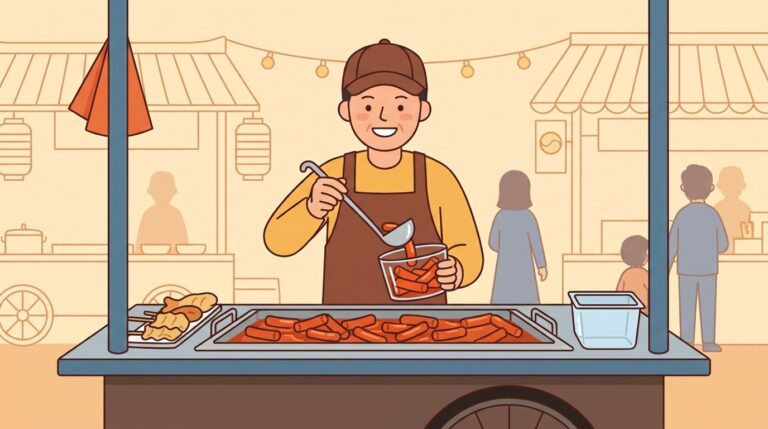
Imagine this: You are standing right in front of a bustling local bunsikzip (snack bar) in a cozy Seoul neighborhood. The tantalizing aroma of sweet and spicy tteokbokki sauce and sizzling fried dumplings fills the crisp evening air. Deep inside your tote bag, you have brought a clean, multi-use glass container from home. You are determined to practice zero-waste living and skip the single-use plastic bags that usually pile up after takeout.
Yet, as you reach the front of the line, your heart starts racing. You nervously clutch your glass container behind your back. “What if the owner thinks I’m being difficult? How do I even ask them to put hot street food into my own lunchbox without sounding awkward or impolite?”
If you have ever felt that hesitation, take a deep breath! You are participating in a beloved and trendy nationwide movement known as the 용기내 챌린지 (Yonggi-nae Chaellinji – ‘Courage Container Challenge’). In Korean, yonggi (용기) is a delightful double-meaning word that means both “bravery/courage” and “food container.”
Based on real experiences from our intermediate learners who successfully conquered their takeout anxiety, this guide provides the exact phrases, cultural etiquette, and nunchi hacks you need. By using these authentic B1-level expressions, you will not only protect the planet but also win over the neighborhood Imo-nim (auntie) so much that she might even slip an extra fried dumpling into your bowl!
Phase 2: 핵심 표현 3선 심층 분석 (Core Expressions)
1. 여기에 담아 주실 수 있나요? (Yeogie dama jusil su innayo?)
- Pronunciation: [Yeo-gie da-ma joo-shil soo in-na-yo?] (Sounds like: “Yaw-gee” + “dah-mah” + “jew-sheel” + “soo” + “een-nah-yo?”)
- Meaning: Literal: “Can you put it in here?” | Nuance: A polite, considerate way to ask a vendor to place food directly into your brought container instead of single-use packaging.
- K-Culture Moment: You often see eco-conscious characters in modern K-Dramas or YouTube daily vlogs pulling out stainless-steel containers at local markets while proudly saying this line to live sustainably.
- Editor’s Insight: Using “담다” (to put into/fill) rather than “넣다” (to insert) sounds far more natural when talking about scooping food into a wide bowl or box.
- Situation Spectrum:
- Casual: 🚫 여기에 담아줘 (Only with very close friends)
- Semi-formal: ✅ 여기에 담아 주실 수 있어요? (Friendly & standard)
- Formal: ✅ 여기에 담아 주실 수 있나요? / 담아 주시겠어요? (Very polite and respectful)
- 🤔 Think About It: In English, we often say “Can I get this to go in my own box?” In Korean, the verb focus is on the vendor doing the action for you (담아 주시다 – graciously scooping it into your container).
2. 국물 안 새게 뚜껑 잘 닫아 주세요 (Gungmul an saege dtukkeong jal dada juseyo)
- Pronunciation: [Goong-mool an sae-ge ddoo-kkeong jal da-da joo-se-yo] (Analogy: “Goong” like ‘boon’, “sae” like ‘set’ without the t, “ddoo-kkeong” like a double sharp ‘tuck-young’)
- Meaning: Literal: “Please close the lid well so soup doesn’t leak.” | Nuance: A practical reminder ensuring your airtight seal is locked before you walk home.
- K-Culture Moment: Seen frequently in Korean variety shows when cast members run takeout errands and walk back cautiously so the precious soup doesn’t spill on their shoes.
- Editor’s Insight: The pattern
~게means “so that / in a manner that.” “안 새게” (so it doesn’t leak) is the ultimate lifesaver phrase when buying saucy dishes like tteokbokki or kimchi-jjigae. - Situation Spectrum:
- Casual: ⚠️ 국물 안 새게 닫아줘 (Too blunt for vendors)
- Semi-formal: ✅ 국물 안 새게 뚜껑 잘 닫아 주세요
- Formal: ✅ 국물이 새지 않도록 뚜껑을 꼭 닫아 주시면 감사하겠습니다
- 🤔 Think About It: Why do Koreans prioritize gungmul (broth/sauce) so much? In Korean cuisine, sauce isn’t just an addition—it’s the essence of the dish meant for dipping fries, eggs, and fried fish cakes!
3. 일회용 수저는 안 주셔도 돼요 (Ilhoeyong sujeoneun an jusyeodo dwaeyo)
- Pronunciation: [Eel-hwe-yong soo-jeo-neun an joo-syeo-do dwae-yo] (Analogy: “Eel-hway-yong” + “sue-jaw-noon” + “ahn jew-sheo-doh dway-yo”)
- Meaning: Literal: “You don’t have to give me disposable cutlery.” | Nuance: A courteous refusal that saves plastic and tells the shop owner you are well-prepared at home.
- K-Culture Moment: This is the real-life spoken equivalent of unchecking the “Receive disposable spoon/chopsticks” toggle on Korean food delivery apps like Baemin (Baedal Minjok)!
- Editor’s Insight: The ending
~지 않아도 돼요or~안 ~셔도 돼요is the gold standard for saying “You don’t need to do [action] for me” without sounding demanding. - Situation Spectrum:
- Casual: 🚫 일회용 수저 안 줘도 돼 (Rude to elders)
- Semi-formal: ✅ 일회용 수저는 안 주셔도 돼요
- Formal: ✅ 일회용 수저는 주시지 않아도 괜찮습니다
- 🤔 Think About It: Sujeo (수저) combines spoon (숟가락) and chopsticks (젓가락). Declining both with one single compound word demonstrates how ingrained this dining pairing is in Korean culture.
Phase 3: 교과서 한국어 vs 진짜 한국어 (Textbook vs. Real-Life)
Situation 1: Handing over your container at the counter
- 📖 교과서 한국어: “이 용기에 음식을 포장해 주십시오.” (Please package food in this container.)
- 🗣️ 진짜 한국어: “사장님, 제 통에 좀 담아 주실 수 있어요?” (Boss, could you scoop it into my container?)
- 💡 왜 다를까? Textbook Korean uses robotic terms like “용기” (container) and “포장해 주십시오” (imperative formal). Real locals say 제 통 (my container/tub) and use soft, friendly question endings like ~실 수 있어요?.
Situation 2: Declining plastic utensils and plastic carry bags
- 📖 교과서 한국어: “일회용품을 거절하겠습니다.” (I shall reject single-use items.)
- 🗣️ 진짜 한국어: “수저랑 비닐은 빼주셔도 괜찮아요!” (It’s totally fine to leave out the utensils and plastic bag!)
- 💡 왜 다를까? Saying “I reject” (거절하겠습니다) sounds like an official political statement! Native speakers soften their refusal using the verb 빼다 (to leave out / subtract) with ~괜찮아요 (it’s okay).
Phase 4: K-Culture 딥다이브 & 비언어적 매너 (Deep Dive & Manners)
4-1. 눈치 (Nunchi) & Hand Gestures
- The Golden Timing: Hand over your clean container the very second you place the order! If you wait until the vendor reaches for a disposable plastic tub, you will disrupt their rapid cooking rhythm.
- Two-Handed Delivery (양손): Offer your container with both hands, lightly holding the base. Remove or unclamp the lid yourself beforehand so the chef can inspect the size and immediately ladle the food in.
- The Depth Check: If the shopkeeper looks at your container with hesitation, smile warmly and say: “여기에 다 들어가요!” (Everything fits in here!). Korean cooks love serving generous portions and worry your container is too small!
4-2. Cultural Code: The ‘Yonggi’ Movement & 덤 (Deom)
- The Yonggi-nae Challenge began as an eco-friendly grassroots campaign popularized by celebrities like actor Ryu Jun-yeol and international NGOs like Greenpeace Korea.
- In Korea’s small street-food culture, bringing your own container triggers an endearing traditional reaction known as 덤 (Deom)—the Korean art of giving extra food for free out of pure goodwill and affection (Jeong). When shop owners see a customer making an effort to reduce trash, their face often softens, and they toss in an extra fish cake or boiled egg as a reward for your eco-friendly courage!
Phase 5: 실전 롤플레이 시나리오 (Interactive Roleplay)
Setting: Outside a steaming neighborhood bunsik cart named “행복 떡볶이” (Happiness Tteokbokki). The red sauce is bubbling, and Imo-nim is deftly stirring it with a large wooden spatula.
Characters: Alex (Intermediate learner on a zero-waste mission) & Imo-nim (Warm-hearted, fast-moving snack bar owner).
- Alex:
🎭 두 손으로 유리 용기를 조심스럽게 꺼내며 (Carefully pulling out a glass container with both hands)
“사장님, 안녕하세요! 떡볶이 1인분 포장해 주세요.”
(Sajangnim, annyeohaseyo! Tteokbokki il-inbun pojanghae juseyo.)
“Hello, Boss! One portion of tteokbokki to go, please.” -
Imo-nim:
🎭 즉시 플라스틱 용기로 손을 뻗으며 (Immediately reaching for a disposable plastic bowl)
“네~ 1인분 금방 돼요! 순대도 줄까?”
(Ne~ il-inbun geumbang dwaeyo! Sundaedo julkka?)
“Sure~ One portion coming right up! Want some blood sausage too?” -
Alex:
🎭 미소를 지으며 자신의 용기 뚜껑을 열어 건넨다 (Smiling and handing over the container with the lid opened)
“순대는 괜찮아요! 저, 사장님… 혹시 이 통에 담아 주실 수 있나요?”
(Sundaeneun gwaenchannayo! Jeo, sajangnim… hoksi i tonge dama jusil su innayo?)
“I’m good on sundae! Uhm, boss… could you perhaps put it into this container?” -
Imo-nim:
🎭 눈을 동그랗게 뜨고 용기를 바라본다 (Eyes widening as she looks at the container)
“어머, 통을 직접 가져왔어? 학생, 환경 생각하는 거야? 대단하네!”
(Eomeo, tongeul jikjeop gajyeowasseo? Haksaeng, hwangyeong saenggakhaneun geoya? Daedanhane!)
“Oh my, you brought your own container? Student, are you thinking about the environment? Impressive!” -
Alex:
🎭 쑥스럽지만 뿌듯하게 웃으며 (Smiling shyly but proudly)
“네, 쓰레기 줄이려고 ‘용기내 챌린지’ 해봤어요!”
(Ne, sseuregi juriryeogo ‘yonggi-nae chaellinji’ haebwasseoyo!)
“Yes, I’m trying the ‘Courage Container Challenge’ to cut down on waste!” -
Imo-nim:
🎭 국자로 떡볶이를 듬뿍 퍼서 통에 담으며 (Generously scooping tteokbokki into the container with a ladle)
“착하기도 해라. 예쁘니까 내가 튀김 하나 덤으로 넣어 줄게! 국물 많이 줄까?”
(Chakhagido haera. Yeppeunikka naega twigim hana deomeuro neoeo julge! Gungmul mani julkka?)
“Look how sweet you are. Since you’re so lovely, I’ll toss in a fried treat for free! Want plenty of sauce?” -
Alex:
🎭 감사한 마음으로 고개를 숙이며 (Bowing head in gratitude)
“우와, 정말 감사합니다! 국물 안 새게 뚜껑 꼭 닫아 주세요.”
(Uwa, jeongmal gamsahamnida! Gungmul an saege dtukkeong kkok dada juseyo.)
“Wow, thank you so much! Please close the lid tight so the soup won’t leak.” -
Imo-nim:
🎭 뚜껑을 꽉 닫고 두 손으로 건네며 (Firmly snapping the lid shut and handing it back with two hands)
“자! 뚜껑 딱 소리 나게 닫았어. 수저 챙겨줘?”
(Ja! Dtukkeong ttak sori nage dadasseo. Sujeo chaenggyeojweo?)
“Here! I snapped it until it clicked. Should I pack utensils?”
🔀 인터랙티브 분기점 (What would you say next?)
- Option A: “빨리 주세요! 집에 가서 먹을래요.” (Give it to me quick! I want to eat at home.)
- 👉 Feedback (Bad): Too curt! It discards the friendly bond (Jeong) you just established with Imo-nim.
- Option B: “집에 수저 있어서 일회용 수저는 안 주셔도 괜찮아요! 안녕히 계세요!” (I have cutlery at home, so you don’t need to give me disposable ones! Goodbye!)
- 👉 Feedback (Best!): Perfect score! You complete the zero-waste mission respectfully while showing genuine Korean conversational etiquette.
- Option C: “비닐봉지에 한 번 더 싸주세요.” (Please wrap it once more inside a plastic bag.)
- 👉 Feedback (Risk): Defeats the entire purpose of bringing your own airtight container, generating unnecessary plastic wrap.
Phase 6: 10초 감정 섀도잉 드릴 (Shadowing Drill)
Read aloud with emotional intonation. Slashes (/) indicate a natural micro-pause.
[🥺 조심스럽고 공손하게 - Shy, polite, slightly cautious]
“저, 사장님… / 혹시 제 용기에 / 담아 주실 수 있나요?”
(Jeo, sajangnim… / hoksi je yonggie / dama jusil su innayo?)-
[😊 뿌듯하고 활기차게 - Proud, eco-friendly, upbeat]
“환경 보호하려고 / 집에서 직접 / 통 챙겨왔어요!”
(Hwangyeong bohoharyeogo / jibeseo jikjeop / tong chaenggyeowasseoyo!) -
[🙏 다정하고 확실하게 - Caring, practical, friendly]
“국물 안 새게 / 뚜껑 꼭 닫아 주시고요, / 수저는 안 주셔도 돼요!”
(Gungmul an saege / dtukkeong kkok dada jusigoyo, / sujeoneun an jusyeodo dwaeyo!)
Phase 7: K-Culture 미니 사전 (Mini Dictionary)
-
용기내 챌린지 (Yonggi-nae Chaellinji)
- Meaning: The Courage Container Challenge.
- Usage: A modern eco-movement in Korea where consumers bring multi-use lunchboxes or pots to restaurants and bakeries to reject single-use plastic.
- 다회용기 (Dahoeyonggi)
- Meaning: Reusable container / Multi-use dishware.
- Usage: Frequently contrasted with Ilhoeyonggi (일회용기 – single-use disposable packaging). You’ll see this word on university campuses and festival food stalls in Korea.
- 덤 (Deom)
- Meaning: Something extra given for free; a bonus treat.
- Usage: Deeply tied to market culture. Street vendors show their warmth by adding “덤” when you are polite, frequent their shop, or show considerate manners.
- 포장 (Pojang)
- Meaning: Takeout / Takeaway / Packaging.
- Usage: When asked “드시고 가세요?” (Eating here?), you answer: “포장해 주세요” (To go, please).
Phase 8: 여행자를 위한 생존 키트 (Traveler’s Survival Kit)
TOP 3 Survival Phrases
- 통에 포장할게요! (Tonge pojanghalgeyo!)
- Pronunciation: [Tong-e po-jang-hal-ge-yo]
- Pro Tip: Say this immediately upon stepping up to the food counter so they don’t tear off a plastic wrapper in advance.
- 비닐봉투는 필요 없어요 (Binilbongtuneun piryo eopseoyo)
- Pronunciation: [Bi-nil-bong-too-neun pi-ryo eop-seo-yo]
- Pro Tip: Useful at convenience stores and street stalls if you have your own canvas tote bag.
- 뚜껑 꽉 닫혔나요? (Dtukkeong kkwak dachyeonnayo?)
- Pronunciation: [Ddoo-kkeong kkwak da-chyeon-na-yo]
- Pro Tip: A quick check before sliding soup into your backpack.
Editor’s Travel Note
- Local Navigation Tip: In Seoul, zero-waste grocery stores and refill stations are common in eco-hubs like Mangwon-dong and Yeonnam-dong. Download the 네이버 지도 앱 다운로드 to search for keywords like “제로웨이스트” (Zero-Waste) or “용기내 매장” (Container-Friendly Stores).
- Material Matters: If ordering hot items like tteokbokki, odeng soup, or stews, bring heat-resistant glass (like Lock&Lock) or food-grade stainless steel. Avoid thin plastic containers that can warp under boiling street broth!
Phase 9: “한 발 더 깊이” (Reflective Question)
In many Western cultures, asking a restaurant to use your own container might occasionally trigger legal concerns regarding hygiene liability. In Korea, however, the cultural sentiment of 정 (Jeong – affectionate communal bonding) often overrides rigid formality in independent shops. When an elderly vendor sees a young customer or a foreign traveler bring a container to protect the environment, they view it not as a nuisance, but as an act of heartfelt maturity (착하다 – admirable and good). In Korean society, sharing small responsibilities creates an unspoken bond of community trust.
💬 Your Turn: Have you ever tried bringing your own container or cup to a restaurant in your home country? How did the staff react, and how do you think that compares to Korea’s Yonggi-nae culture? Leave a comment below!
Phase 10: FAQ & 오해 방지 (FAQ Schema)
Q: Will Korean street food vendors get annoyed if I ask them to use my container?
A: Not at all, provided you practice basic nunchi! If you tell them before they start cooking and hand over a clean, heat-resistant container, most small shop owners are actually proud of you and happy to help.
Q: What size container should I bring for 1 serving of street tteokbokki?
A: Bring an airtight container that holds at least 800ml to 1000ml. Korean street portions are notoriously generous, and you need extra headspace to prevent spicy red sauce from spilling onto the rim!
Q: Can I use the ‘Yonggi-nae’ method at major fast-food franchises in Korea?
A: For drinks and coffee, bringing your own tumbler is universally accepted (and usually gets you a 100~300 KRW discount!). For meals, however, large corporate franchise kitchens follow strict standardized hygiene protocols and may decline personal containers. It works best at local neighborhood eateries (bunsik, bakeries, side dish shops).
🚨 Common Mistakes Checklist
- ❌ Mistake 1: Waiting until the food is already wrapped in plastic before bringing out your container.
- 👉 Correct Action: Keep your container visible in hand and declare: “제 통에 담아 주세요!” right as you order.
- ❌ Mistake 2: Bringing flimsy disposable takeaway plastic tubs to refill.
- 👉 Correct Action: Use sturdy glass (Glasslock) or stainless steel. Boiling soup will deform cheap thin plastic!
- ❌ Mistake 3: Forgetting to decline disposable cutlery (sujeo).
- 👉 Correct Action: Say “수저는 빼주세요” (Please leave out the utensils) so they don’t automatically drop plastic wrapped sets into your hand.
Phase 11: 액션 미션 & 참여 유도 (Action Missions)
- 🥉 Bronze Mission (Solo Practice): Stand in front of your mirror with a lunchbox in hand and practice saying: “사장님, 여기에 담아 주실 수 있어요?” three times with a confident smile.
- 🥈 Silver Mission (Social Media): Take a photo of your reusable container ready to go and tag #매일한글 #용기내챌린지 on your Instagram or X (Twitter).
- 🥇 Gold Mission (Real-Life Action): Visit your nearest Korean restaurant or local Asian takeout joint, successfully order food in your own container, and say “일회용 수저는 안 주셔도 돼요!”.
🎮 K-Culture Mission: Search for #용기내챌린지 on Instagram or YouTube Shorts to observe how everyday Koreans pack pastries, fried chicken, and stews in their personal pots and pans!
Phase 12: 인터랙티브 퀴즈 챌린지 (Interactive Quiz)
Q1. (Situational Judgment)
You are ordering street food in your own container. When is the best time to present your container to the chef?
* A) After paying and waiting for 5 minutes.
* B) The very moment you place your order, before cooking begins.
* C) After the food is already wrapped in plastic foil.
Q2. (Fill-in-the-Blank)
Complete the polite sentence to decline disposable wooden chopsticks:
* “일회용 수저는 안 ________ 돼요.”
* (1) 받아도
* (2) 주셔도
* (3) 먹어도
Q3. (True or False Cultural Trivia)
In Korean, the phrase “용기내 챌린지” only refers to having mental bravery, and has no linguistic connection to lunchboxes or containers. (True / False)
👉 Click to reveal answers & explanations!
- Q1 Answer: B
- Explanation: Korean street food kitchens move at lightning speed! Handing it over instantly prevents single-use waste.
- Q2 Answer: (2) 주셔도
- Explanation: 안 주셔도 돼요 means “You do not have to give it to me.” (주시다 is the honorific form of ‘to give’).
- Q3 Answer: False
- Explanation: It is an ingenious pun! Yonggi (용기) means both “courage” (勇氣) and “container/dishware” (容器).
- Explanation: It is an ingenious pun! Yonggi (용기) means both “courage” (勇氣) and “container/dishware” (容器).
🎬 Watch Our Daily Videos! (Daily Hangul Official Instagram)
Review the expressions you learned in this article with our fun daily short videos! Check out native pronunciation and real-life nuances in action.
- Instagram @dailyhangul_en







