

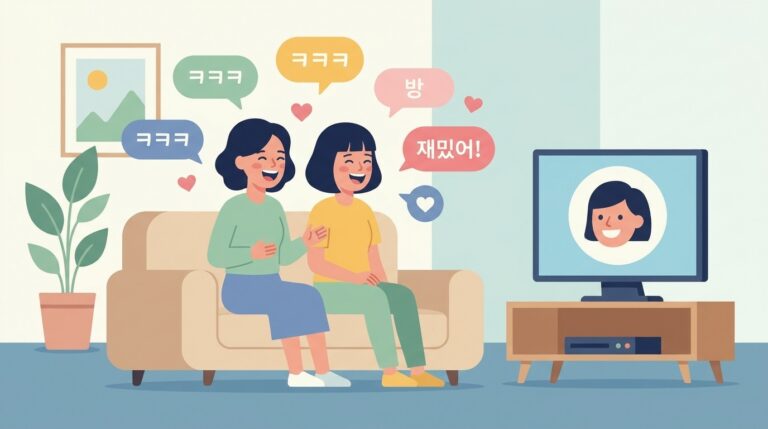
Phase 1: 공감 (Story-Immersive Opening)
안녕하세요! 매일한글 에디터입니다. (Hello! It is your Daily Hangul editor!)
Have you ever been curled up on your sofa watching an episode of Running Man or Earth Arcade, laughing your heart out, when suddenly a massive, neon-yellow subtitle flashes across the screen saying ‘배꼽 주의’ (Watch your bellybutton!) or ‘웃음 폭탄’ (Laughter bomb!)? You hit pause and blink. Wait, why are they warning me about my bellybutton? Did someone drop an actual explosive in the studio?
If you have felt puzzled by these chaotic, hyper-expressive Korean variety show captions, you are definitely not alone! One of our A2 learners, Sarah from London, once told me: “I thought ‘배꼽 주의’ was a bizarre warning about crop tops until my Korean friend explained people were just dying of laughter!”
Korean variety shows (예능 – ye-neung) do not just translate dialogue; they create a whole visual language to amplify comedy. Understanding these reaction phrases is your VIP pass to laughing right alongside Korean native speakers without missing the punchline. This guide is built directly from real student questions and authentic TV moments to help you master variety show humor naturally!
Phase 2: Core Expressions Breakdown
1. 배꼽 주의 (Baekkop ju-ui)
- Pronunciation: [Baek-kkop ju-ui] (Sounds like “beck-hope joo-ee” with a crisp ‘kk’ sound)
- Meaning: Literal: “Bellybutton caution!” | Real Nuance: “Warning: Extremely hilarious! You might laugh your bellybutton off!”
- K-Culture Moment: Seen flashing in bright bold red letters right before a member slips on a soapy mat or delivers an iconic comedic one-liner.
- Editor’s Insight: Koreans have a classic proverb: “배꼽이 빠지다” (One’s bellybutton falls off from laughing). Variety captions shortened this into a punchy safety hazard label: 배꼽 주의!
- Situation Spectrum: Casual: ✅ | Semi-formal: ⚠️ | Formal: 🚫
- 🤔 Think About It: In English, we say “I laughed my head off” or “burst a gut.” Why do you think Korean culture singles out the bellybutton (배꼽) as the center of big belly laughs?
2. 웃음 폭탄 (Useum poktan)
- Pronunciation: [U-seum pok-tan] (Sounds like “oo-seum poke-tahn” with a sharp aspirated ‘t’)
- Meaning: Literal: “Laughter bomb” | Real Nuance: “A massive comedic explosion / An unstoppable wave of laughter”
- K-Culture Moment: Subtitled when a normally serious actor or K-pop idol suddenly does a ridiculous dance, causing the entire studio crew to collapse in fits of giggles.
- Editor’s Insight: 폭탄 means bomb. When paired with 웃음 (laughter), it describes a punchline that detonates continuous laughter across the room.
- Situation Spectrum: Casual: ✅ | Semi-formal: ✅ | Formal: 🚫
- 🤔 Think About It: Why does Korean media love dramatic metaphors like bombs (폭탄) and fires (불) to describe everyday emotional reactions?
3. 빵 터지다 (Ppang teojida) / 빵 터졌어요 (Ppang teojyeosseoyo)
- Pronunciation: [Ppang teo-ji-da] (Pronounce ‘ppang’ like a popping balloon followed by ‘tuh-jee-dah’)
- Meaning: Literal: “To pop with a ‘bang'” | Real Nuance: “To crack up / To burst out laughing uncontrollably”
- K-Culture Moment: The host stays quiet for two seconds, then suddenly covers their face while wheezing with laughter.
- Editor’s Insight: 빵 is the onomatopoeia for a popping balloon or a gunshot. It describes laughter that breaks out so suddenly you cannot hold it back.
- Situation Spectrum: Casual: ✅ | Semi-formal: ⚠️ | Formal: 🚫
- 🤔 Think About It: Notice how Korean onomatopoeia turns physical body sensations into vivid sound words. Can you think of a popping sound word in your native language that describes laughter?
Phase 3: Textbook Korean vs. Real-World Korean
Situation 1: Telling your friend a show was insanely funny
- 📖 교과서 한국어 (Textbook Korean):
이 예능 프로그램은 정말 재미있습니다.
(I ye-neung peu-ro-geu-raem-eun jeong-mal jae-mi-it-seum-ni-da.)
“This entertainment program is very interesting.” - 🗣️ 진짜 한국어 (Real-World Korean):
이거 진짜 빵 터졌어요! 배꼽 빠지는 줄 알았어요!
(I-geo jin-jja ppang teo-jyeo-sseo-yo! Baek-kkop ppa-ji-neun jul a-ra-sseo-yo!)
“I totally cracked up at this! I thought my bellybutton was gonna fall off!” - 💡 왜 다를까? (Why the difference?):
Textbooks teach the polite adjective 재미있다 (to be fun), but real Koreans describe the physical impact of comedy using lively idioms like 빵 터지다.
Situation 2: Warning someone before showing them a ridiculous meme
- 📖 교과서 한국어 (Textbook Korean):
웃음을 조심하십시오.
(U-seum-eul jo-sim-ha-sip-si-o.)
“Please be careful with your laughter.” - 🗣️ 진짜 한국어 (Real-World Korean):
이 영상 볼 때 배꼽 주의하세요!
(I yeong-sang bol ttae baek-kkop ju-ui-ha-se-yo!)
“Bellybutton alert before you watch this video!” - 💡 왜 다를까? (Why the difference?):
Nobody warns someone with formal directives (조심하십시오) during comedy. Borrowing variety show caption style (배꼽 주의) adds playful drama between friends.
Phase 4: K-Culture Deep Dive & Non-Verbal Manners
4-1. Nunchi & Physical Comedy Reactions
In Korean culture, laughter is intensely collective. When Koreans experience an 웃음 폭탄 moment, watch their hands:
1. The Rhythmic Clap (박수치며 웃기): Koreans rarely laugh in complete silence. They frequently clap their hands repeatedly or slap their knees (물개박수 – seal clap) to signal: “I acknowledge this joke 100%!”
2. Covering the Mouth (입 가리기): Especially among women and younger people when laughing loudly in front of elders, placing a polite hand over the mouth balances pure joy with traditional decorum (예의).
3. Grabbing the Stomach: When someone doubles over, they physically press both palms onto their navel. If you do this with Korean friends, they will instantly recognize you are “holding your bellybutton in place”!
4-2. The Magic of Variety Show Captions (자막)
Unlike Western reality shows where subtitles merely transcribe spoken dialogue, Korean variety producers (PD) treat subtitles as an independent commentator. If a cast member stays silent, the caption might say “동공지진” (Pupil earthquake = panicking). When a scene escalates, huge sound effects and comic-book fonts frame the cast with “웃음 폭탄 투척!” (Laughter bomb launched!). Reading captions is half the fun of watching Korean TV.
Phase 5: Real-World Roleplay Scenario
Setting: You are chilling in a Hongdae living room with your Korean exchange friend, Minwoo (민우), watching an episode of Running Man on television.
- Turn 1 (Minwoo):
야, 이 장면 진짜 웃음 폭탄이야. 집중해서 봐봐!
(Ya, i jang-myeon jin-jja u-seum pok-tan-i-ya. Jip-jung-hae-seo bwa-bwa!)
“Hey, this scene is an absolute laughter bomb. Pay close attention!”
🎭 Minwoo points excitedly at the television screen with his popcorn bowl in lap. -
Turn 2 (You):
자막에 ‘배꼽 주의’라고 써 있어요! 왜 그래요?
(Ja-mak-e ‘baek-kkop ju-ui’-ra-go sseo i-sseo-yo! Wae geu-rae-yo?)
“The subtitle says ‘Watch your bellybutton!’ Why does it say that?”
🎭 Leaning closer to the screen, looking genuinely curious. -
Turn 3 (Minwoo):
배꼽 빠질 만큼 웃기다는 뜻이야! 조심해, 이제 나온다!
(Baek-kkop ppa-jil man-keum ut-gi-da-neun tteut-i-ya! Jo-sim-hae, i-je na-on-da!)
“It means it’s so funny your bellybutton might fall off! Careful, here it comes!”
🎭 Giggling anticipation, ready to burst. -
Turn 4 (Television Cast):
(The main host trips over a cardboard box and lands face-first into whip cream) -
Turn 5 (Minwoo):
아, 미치겠다! 으하하하! 빵 터졌다!
(A, mi-chi-get-da! Eu-ha-ha-ha! Ppang teo-jyeot-da!)
“Ah, I can’t take this! Bwahaha! I totally cracked up!”
🎭 Slapping both hands against the couch cushions, laughing till tears form. -
Turn 6 (You):
저도 진짜 빵 터졌어요! 배 아파요!
(Jeo-do jin-jja ppang teo-jyeo-sseo-yo! Bae a-pa-yo!)
“I cracked up so hard too! My stomach hurts!”
🎭 Clapping your hands together in shared laughter. -
Turn 7 (Minwoo):
너 리액션 진짜 한국인 다 됐다!
(Neo ri-aek-syeon jin-jja hang-guk-in da dwaet-da!)
“Your reaction is totally like a Korean now!”
🎭 Giving you an affectionate fist bump. -
Turn 8 (You):
다음 편도 배꼽 잡고 볼게요!
(Dae-um pyeon-do baek-kkop jap-go bol-ge-yo!)
“I’ll hold my bellybutton and watch the next episode too!”
🎭 Grabbing your waist playfully and smiling.
🔀 Interactive Decision Branch
What should you say if Minwoo shows you a comedy clip on his phone that is merely mildly amusing, but you want to be a supportive friend?
- Option A: “재미없어요. 배꼽 안 빠져요.” (It is not funny. My bellybutton is not falling off.)
- Option B: “우와, 진짜 웃음 폭탄이네요! 자막 완전 웃겨요!” (Wow, what a real laugh bomb! The subtitles are hilarious!)
- Option C: “조용히 하십시오.” (Please be quiet.)
Feedback:
* Option A (Risk): Honest, but a bit blunt! Friends tease each other like this only if they are super close childhood buddies.
* Option B (Best): Perfect match! It shows enthusiasm, utilizes the unit vocabulary, and keeps the friendly vibe flowing warmly.
* Option C (Bad): Far too rigid, cold, and grammatically ill-fitted for a relaxed entertainment moment.
Phase 6: 10-Second Emotional Shadowing Drill
Practice these lines out loud. Match the rhythm slashes (/) for natural breath pauses!
[😆 배꼽 잡고 박수치며 / Clapping joyfully while holding belly]
진짜 빵 터졌어요! / 배꼽 빠지는 줄 알았어요!
(Jin-jja ppang teo-jyeo-sseo-yo! / Baek-kkop ppa-ji-neun jul a-ra-sseo-yo!)
“I cracked up so hard! / I thought my bellybutton was gonna drop!”-
[🍿 기대감에 가득 차서 / Filled with bubbling anticipation]
이 영상 / 완전 웃음 폭탄이에요! / 꼭 보세요!
(I yeong-sang / wan-jeon u-seum pok-tan-i-e-yo! / Kkok bo-se-yo!)
“This clip / is a total laughter bomb! / You must watch it!” -
[🤣 눈물 닦으며 헐떡이듯 / Wiping tears of laughter while wheezing]
자막에 / 배꼽 주의 뜰 때부터 / 알아봤어요!
(Ja-mak-e / baek-kkop ju-ui tteul ttae-bu-teo / a-ra-bwa-sseo-yo!)
“From the moment / the ‘bellybutton alert’ appeared on the caption / I knew it!”
Phase 7: K-Culture Mini Dictionary
-
예능 (Ye-neung) | Korean Variety Shows
Short for ‘예능 프로그램’ (Entertainment Program). Encompasses game shows, reality TV, and comedy talk shows like Running Man, 2 Days & 1 Night, or Hangout with Yoo. -
자막 (Ja-mak) | Captions / On-screen Text
In Korean TV, 자막 does not just mean closed captions for the hearing-impaired. It refers to the dynamic graphic text overlays designed by show producers to deliver commentary. -
리액션 (Ri-aek-syeon) | Expressive Reaction
Adopted from English ‘reaction’, this noun is a critical skill in Korean entertainment and daily social gatherings. Having good 리액션 makes you a warm, beloved companion. -
꿀잼 (Kkul-jaem) | Honey-level Fun (Super Fun)
A delightful blend of 꿀 (honey) and 재미 (fun). When a variety episode is packed with 웃음 폭탄, viewers flood the comments calling it pure 꿀잼.
Phase 8: Traveler’s Survival Kit
Top 3 Survival Phrases for Variety Fans
- 이거 진짜 꿀잼이에요! (I-geo jin-jja kkul-jaem-i-e-yo!)
Pro Tip: Use this when chatting with barista staff at a K-pop-themed cafe about their screen displays. - 너무 웃겨서 배 아파요! (Neo-mu ut-gyeo-seo bae a-pa-yo!)
Pro Tip: Literally “I’m laughing so much my stomach hurts.” Universal praise for any funny friend or show host. - 한국 예능 자막 보는 거 좋아해요. (Hang-guk ye-neung ja-mak bo-neun geo jo-a-hae-yo.)
Pro Tip: Great icebreaker when meeting Korean language exchange partners.
Editor’s Travel Note: Streaming & Media on the Go
When traveling across Seoul, download and explore content through the TVING streaming official platform or browse viral short clips via the Naver TV trending video portal. Both showcase real-time trending variety snippets with original production subtitles. Remember that subway Wi-Fi in Korea is lightning fast, so watching funny clips with earphones on the Seoul Metro Line 2 is a beloved local pastime—just be careful not to trigger an unexpected 빵 터지다 moment out loud in a quiet train car!
Phase 9: A Step Deeper (한 발 더 깊이)
In Korean culture, humor is fundamentally communal. Individualistic societies often prize dry irony or witty sarcasm delivered with a poker face. In contrast, Korean entertainment thrives on 공감 (empathy) and shared bodily energy. When variety shows stamp 배꼽 주의 across the screen, the producers are inviting you into a collective circle of vulnerability: “Let’s put aside our daily work stress, laugh till our muscles ache, and celebrate being silly together.” Humor in Korea is not just intellectual entertainment; it is shared emotional healing (힐링).
💬 Your Turn: What is the most memorable scene from a Korean drama or variety show that made you 빵 터지다 (burst out laughing)? Share your favorite show in the comments below!
Phase 10: FAQ & Common Mistakes
Q: Can I say ‘배꼽 주의’ (Baekkop ju-ui) to my university professor or workplace boss?
A: No! 배꼽 주의 is strictly a pop-culture slang phrase. Using it in formal presentations or with senior executives will sound overly informal. Instead, say “매우 유쾌한 시간이었습니다” (It was a very delightful time).
Q: Is ‘웃음 폭탄’ (Useum poktan) a negative word because of the word ‘bomb’?
A: Not at all! In Korean entertainment slang, 폭탄 (bomb) is frequently used to emphasize magnitude, like 할인 폭탄 (huge discount bomb) or 감동 폭탄 (emotional bombshell). 웃음 폭탄 is always 100% positive and energetic.
Q: What is the grammatical difference between ‘빵 터지다’ and ‘웃기다’?
A: 웃기다 is an adjective/verb meaning “to be funny” (e.g., 이 영상 웃겨요 – This video is funny). 빵 터지다 describes your reaction—the sudden action of exploding into laughter (e.g., 나 빵 터졌어 – I cracked up!).
🚨 Common Mistakes Board
- ❌ Mistake 1: Translating “I laughed my head off” literally as “내 머리가 떨어졌어요” (My head fell off).
Correct Action: Use “배꼽 빠지게 웃었어요” (I laughed till my bellybutton fell off) or “진짜 빵 터졌어요”. - ❌ Mistake 2: Pronouncing 빵 (ppang) with a soft English ‘b’ or ‘p’.
Correct Action: Tense your lips tightly and pop the sound cleanly (ㅃ – double consonant), just like popping a soap bubble. - ❌ Mistake 3: Using 자막 (subtitles) when you actually mean spoken voice audio.
Correct Action: Remember that 자막 (ja-mak) specifically refers to text on the screen, while spoken dialogue is 대사 (dae-sa).
Phase 11: Action Mission & Engagement
- 🥉 Bronze Mission (Solo Practice): Stand in front of your mirror, say “배꼽 빠질 뻔했어요!” (I almost lost my bellybutton from laughing!) while doing the rhythmic double-hand clap.
- 🥈 Silver Mission (Social Media): Find a funny K-variety clip on YouTube or TikTok, and leave a Korean comment: “진짜 웃음 폭탄이네요! ㅋㅋㅋ”.
- 🥇 Gold Mission (Real Life): Next time your Korean tutor or language partner tells a joke, respond naturally with: “아, 완전 빵 터졌어요!”.
- 🎮 K-Culture Mission: Watch any 10-minute highlight clip of Running Man on YouTube with Korean captions enabled. Spot the character ‘폭탄’ or ‘주의’ in the graphic subtitles and screenshot it!
Phase 12: Interactive Quiz Challenge
Q1. Situational Judgment:
Your Korean friend sends you a video link captioned with “배꼽 주의!” What should you expect before pressing play?
(A) A cooking tutorial on belly pork
(B) A warning that the audio contains harsh swearing
(C) A ridiculously hilarious clip that might make you laugh until your stomach hurts
Click to view Answer & Explanation
Correct Answer: (C)
Explanation: ‘배꼽 주의’ is a playful warning that you will laugh so hard your bellybutton might fall off!
Q2. Fill in the Blank:
그 코미디언 때문에 완전 _____ 터졌어요! (I totally cracked up because of that comedian!)
(Hint: Sounds like a popping balloon / bread!)
Click to view Answer & Explanation
Correct Answer: 빵 (Ppang)
Explanation: ‘빵 터지다’ is the quintessential Korean informal expression for suddenly bursting out into laughter.
Q3. True or False Culture Check:
In Korean variety shows, subtitles (자막) are solely used to help people with hearing impairments and never contain sound effects, jokes, or colorful graphics. (True / False)
Click to view Answer & Explanation
Correct Answer: False
Explanation: Korean variety show captions are an art form of their own, loaded with visual humor, bold emojis, onomatopoeia, and editorial commentary!
🎬 Watch Our Daily Videos! (Daily Hangul Official Instagram)
Review the expressions you learned in this article with our fun daily short videos! Check out native pronunciation and real-life nuances in action.
- Instagram @dailyhangul_en






