

안녕하세요! 매일한글 에디터입니다.
Picture this: You have just wrapped up a bustling, high-energy day in Seoul. You navigated the crowded Line 2 subway during rush hour, squeezed past commuters at Gangnam Station, and finally opened the door to your cozy Korean officetel. You kick off your sneakers at the entryway, let out a deep sigh of relief, and your Korean roommate looks up with a warm smile and says, “손 먼저 씻고 편한 옷으로 갈아입어요!” (Wash your hands first and change into comfortable clothes!). In that single split second, your brain freezes. You know the word for hand (son), but what were those other verbs again?
If you have ever felt overwhelmed trying to describe your daily end-of-day decompression in Korean, you are not alone. As an A1 beginner, learning Korean often feels full of formal textbook sentences like “I return home at 7 PM.” But in real Korean homes, the evening routine is all about tactile comfort, cleanliness, and transitioning from the intense outside world to your warm personal sanctuary. Today, we are learning the exact everyday phrases you need to talk about washing your hands and slipping into your softest loungewear—naturally, easily, and without grammar stress!
Phase 2: Top 3 Core Expressions Deep Dive
1. 손 씻어요 (Son ssiseoyo)
- Pronunciation: [Son ssi-seo-yo] (Sounds like sown + she-saw-yo)
- Meaning: Literal: “I wash hands.” / Real Nuance: “I am washing my hands” or a gentle suggestion “Go wash your hands.”
- K-Culture Moment: Every time a K-drama character walks inside—whether it is a tired corporate worker in a slice-of-life drama or a cute child in a family series—the first instruction shouted from the living room is always “손 씻어!” (Son ssiseo!).
- Editor’s Insight: In Korean, when you do an obvious action to your own body parts, you rarely need to say “my” (je / nae). Saying just 손 씻어요 is 100% natural!
- Situation Spectrum:
- Casual (Close friends/kids): 손 씻어! (Son ssiseo!) ✅
- Semi-formal (Everyday polite/A1 standard): 손 씻어요. (Son ssiseoyo.) ✅
- Formal (Public announcements/workplaces): 손을 씻으십시오. (Soneul ssiseusipsio.) ⚠️
- 🤔 Think About It: In English, we often say “I’m going to freshen up,” which sounds vague. Why do you think Korean specifically specifies the exact action of washing hands (손 씻기) as the universal symbol of returning home?
2. 옷 갈아입어요 (Ot gara-ibeoyo)
- Pronunciation: [Ot ga-ra-i-beo-yo] (Sounds like oat + gah-rah-ee-buh-yo)
- Meaning: Literal: “Change and put on clothes.” / Real Nuance: “I am changing into different clothes.”
- K-Culture Moment: Think of those cozy reality shows like I Live Alone (나 혼자 산다) where K-pop idols head straight to their walk-in closet the second they enter their apartment, trading their stiff designer stage outfits for gigantic fleece sweatpants.
- Editor’s Insight: This verb is a combination of two words: 갈다 (galda, to replace/exchange) and 입다 (ipda, to wear/put on). Korean loves chaining verbs together to show fluid sequence!
- Situation Spectrum:
- Casual: 옷 갈아입어. (Ot gara-ibeo.) ✅
- Semi-formal: 옷 갈아입어요. (Ot gara-ibeoyo.) ✅
- Formal: 옷을 갈아입겠습니다. (Oseul gara-ipgetseumnida.) ⚠️
- 🤔 Think About It: How does your native language handle actions that happen in steps? In Korean, changing clothes is literally “swap-and-wear” (갈아입다).
3. 편한 옷 입어요 (Pyeonhan ot ibeoyo)
- Pronunciation: [Pyeon-han ot i-beo-yo] (Sounds like pyeon-hahn + oat + ee-buh-yo)
- Meaning: Literal: “I wear comfortable clothes.” / Real Nuance: “I’m slipping into loungewear/sweats.”
- K-Culture Moment: In Korean webtoons and dramas, the moment of ultimate freedom after an exhausting day is illustrated by unbuttoning a stiff collar and putting on an oversized T-shirt with cartoon characters.
- Editor’s Insight: 편하다 (pyeonhada) means “to be comfortable/convenient.” When modifying a noun like 옷 (clothes), it becomes 편한 (pyeonhan). It is your golden A1 adjective for everything cozy!
- Situation Spectrum:
- Casual: 편한 옷 입어. (Pyeonhan ot ibeo.) ✅
- Semi-formal: 편한 옷 입어요. (Pyeonhan ot ibeoyo.) ✅
- Formal: 편안한 복장으로 착용합니다. (Pyeon-an-han bok-jang-euro chag-yong-hamnida.) 🚫 (Too bureaucratic for home!)
- 🤔 Think About It: What counts as “comfortable clothes” in your culture versus Korea? In Korea, changing out of outside clothes (외출복) before sitting on the bed is practically a sacred law.
Phase 3: Textbook Korean vs. Real-Life Korean
Situation 1: Telling someone you are going to wash your hands right after coming home
- 📖 교과서 한국어 (Textbook Korean): 저는 지금 화장실에서 손을 깨끗하게 씻겠습니다. (Jeoneun jigeum hwajangsil-eseo soneul kkaekkeuthage ssitgetseumnida. – “I will cleanly wash my hands in the restroom right now.”)
- 🗣️ 진짜 한국어 (Real-Life Korean): 얼른 손 씻고 올게요! (Eolleun son ssitgo olgeyo! – “I’ll quickly wash my hands and be right back!”)
- 💡 왜 다를까? (Why is it different?): Real Koreans drop rigid particles like 저는 (as for me) and love adding lively adverbs like 얼른 (quickly/promptly) to show friendly, energetic flow.
Situation 2: Announcing that you are swapping into loungewear
- 📖 교과서 한국어 (Textbook Korean): 저는 편안한 실내복으로 교체하여 입습니다. (Jeoneun pyeon-an-han sillanebok-euro gyoche-hayeo ipseumnida. – “I substitute and wear comfortable indoor attire.”)
- 🗣️ 진짜 한국어 (Real-Life Korean): 편한 옷으로 갈아입을게요. (Pyeonhan oseuro gara-ibeulgeyo. – “I’m gonna change into something comfy.”)
- 💡 왜 다를까? (Why is it different?): Textbook Korean often borrows hyper-formal Hanja (Sino-Korean) nouns like 실내복 (indoor attire) or 교체 (replacement). Real humans just say 편한 옷 (comfy clothes) and use the everyday verb 갈아입다.
Phase 4: K-Culture Deep Dive & Non-verbal Manners
4-1. Nunchi & Physical Habits at Home
In Korea, the boundary between the “dirty outside world” and the “clean home sanctuary” is razor-sharp.
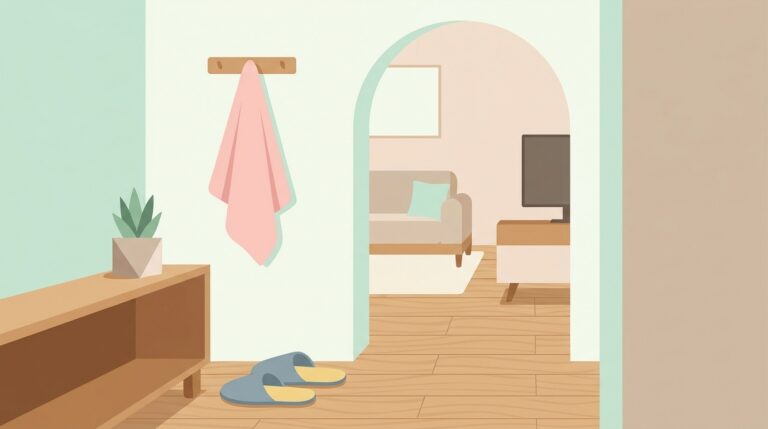
* The Footwear Rule: You step out of your street shoes at the sunken entrance area (현관, hyeongwan). Never let your bare feet or socks touch the entryway floor where shoes sit! Step directly up onto the raised wood or heated floor (ondol), or immediately slide into indoor slippers (실내화).
* The Bed Taboo: Never, ever flop onto your or your host’s bed wearing street clothes (외출복). Even if you are utterly exhausted, sitting on top of clean bedsheets in jeans worn on the subway will trigger major alarm bells for your Korean friends!
4-2. Cultural Code: The Sacred “Homewear” (홈웨어)
If you watch Korean variety shows, you will notice celebrities have a distinct wardrobe just for relaxing at home called 홈웨어 (homewear) or 이지웨어 (easywear). From matching plaid flannel sets in winter to breeze-inducing oversized cotton shirts (박스티) in summer, switching clothes the minute you step inside is not just about physical hygiene—it is a mental reset ritual that officially closes the workday.
Phase 5: Real-Life Roleplay Scenario
Setting: A warm, softly-lit shared apartment in Mapo-gu, Seoul. Rain is pattering outside.
Characters:
* Minji (민지): Your friendly Korean housemate who loves organizing and home cooking.
* You: A tired learner arriving back home after an intense day.
- Minji: 왔어요? 오늘 비 와서 힘들었죠? (Wasseoyo? Oneul bi waseo himdeureotjyo?)
🎭 Taking your wet umbrella and placing it in the stand with a warm smile
(You’re back? It was raining today, must have been tough, right?) - You: 네, 진짜 피곤해요! (Ne, jinjja pigonhaeyo!)
🎭 Kicking off your shoes and stepping up onto the wooden floor
(Yes, I am really tired!) - Minji: 얼른 손 씻고 편한 옷 입어요. (Eolleun son ssitgo pyeonhan ot ibeoyo.)
🎭 Pointing gently toward the bathroom door
(Go quickly wash your hands and put on comfy clothes.) - You: 네! 화장실에 비누 있어요? (Ne! Hwajangsire binu isseoyo?)
🎭 Heading toward the bathroom sink with rolled-up sleeves
(Yes! Is there soap in the bathroom?) - Minji: 응, 세면대에 핸드워시 있어요. 깨끗이 씻어요! (Eung, semyeondae-e haendeu-wosi isseoyo. Kkaekkeusi ssiseoyo!)
🎭 Handing you a clean, fluffy face towel
(Yeah, there’s hand wash on the sink. Wash thoroughly!) - You: 시원해요! 이제 옷 갈아입을게요. (Siwonhaeyo! Ije ot gara-ibeulgeyo.)
🎭 Drying your hands and feeling the stress melt away
(Feels so refreshing! Now I will change clothes.) - Minji: 그래요, 갈아입고 나와서 저녁 먹어요. (Geuraeyo, gara-ipgo nawaseo jeonyeok meogeoyo.)
🎭 Stirring a pot of bubbling kimchi stew in the kitchen
(Sounds good, change and come out so we can eat dinner.) - You: 좋아요! 5분만 기다려 주세요. (Joayo! Obunman gidaryeo juseyo.)
🎭 Smiling brightly and walking to your room to grab your oversized sweatpants
(Great! Please wait just five minutes.)
🔀 Interactive Decision Point
After washing your hands, you notice Minji looks exhausted from cooking. What do you say?
- Option A: “저도 요리 도울게요! 옷만 얼른 갈아입고 올게요!” (Jeodo yori doulgeyo! Otman eolleun gara-ipgo olgeyo! – I’ll help cook too! Let me just quickly change clothes and come back!)
- 👉 Feedback: [BEST] Super thoughtful, shows great nunchi, and perfectly practices our grammar in an empathetic way!
- Option B: “손 안 씻고 침대에 누울래요.” (Son an ssitgo chimdae-e nuullayo. – I will not wash my hands and lie down on the bed.)
- 👉 Feedback: [BAD] Oh no! Skipping hand washing AND going straight to bed in outside clothes is the ultimate Korean roommate horror story.
- Option C: “옷을 교체하십시오.” (Oseul gyochehasipsio. – Please substitute your clothing.)
- 👉 Feedback: [RISK] Grammatically robotic and awkwardly commanded toward your host. Stick to casual/polite standard language!
Phase 6: 10-Second Emotion Shadowing Drill
Read these aloud while matching the pitch and emotional cues!
[😮💨 Exhaling built-up tension]
집에 / 왔어요! / 드디어! (Jibe / wasseoyo! / Deudieo!)
(I’m home! Finally!)-
[🧼 Refreshingly clean & crisp]
손 깨끗이 / 씻었어요! (Son kkaekkeusi / ssiseosseoyo!)
(I washed my hands / squeaky clean!) -
[🥰 Super cozy and snuggled up]
편한 옷으로 / 갈아입으니까 / 너무 좋아요. (Pyeonhan oseuro / gara-ibeunikka / neomu joayo.)
(Changing into comfy clothes / feels so / wonderful.)
Phase 7: K-Culture Mini Dictionary
- 현관 (Hyeongwan) | Entryway / Foyer
The lowered area inside the front door where all shoes are left. In Korean architecture, this is the physical threshold separating the outside world from your sacred home space. - 실내화 (Sillaehwa) | Indoor Slippers
Soft slippers worn inside Korean homes, offices, and schools to keep feet warm and keep floors spotless. - 홈웨어 (Hom-we-eo) | Loungewear
Borrowed from English “homewear,” this refers to the beloved, super-soft clothes reserved exclusively for lounging around the house. - 뽀송뽀송 (Pposong-pposong) | Squeaky clean, soft, and dry
An adorable Korean onomatopoeia describing the feeling of freshly washed hands, sun-dried laundry, or soft pajamas on clean skin.
Phase 8: Traveler’s Survival Kit
TOP 3 Survival Phrases for Travelers
- 화장실 어디예요? (Hwajangsil eodiyeyo?)
Pronunciation: [Hwa-jang-sil eo-di-ye-yo?]
Pro Tip: Use this at any subway station, cafe, or restaurant when you urgently need to wash your hands. - 핸드워시 있어요? (Haenduwosi isseoyo?)
Pronunciation: [Haen-deu-wo-si is-seo-yo?]
Pro Tip: While some older public restrooms still provide traditional bar soap on a metal stick, modern places have liquid soap. Ask this if you don’t see it! - 편한 바지 있어요? (Pyeonhan baji isseoyo?)
Pronunciation: [Pyeon-han ba-ji is-seo-yo?]
Pro Tip: When shopping in Dongdaemun or Hongdae, use this phrase to find the ultimate stretchy K-fashion loungewear pants.
Editor’s Travel Note
When traveling across Korea, remember that many traditional restaurants with low tables (좌식, jwasik) require taking off your shoes at the entrance. Make sure to wear clean socks without holes! If you need to navigate to public facilities with clean restrooms, we recommend checking the Naver Map application guide to locate major subway station restrooms quickly.
Phase 9: One Step Deeper (Reflection)
In Western cultures, walking into a home with shoes on or lying on a bed in everyday denim is occasionally tolerated. In Korea, however, this boundary is strictly enforced. It is not merely about dirt or germs; it is rooted in the traditional floor-sitting culture (ondol heating system). Because people eat, relax, and sleep close to the floor, keeping the interior pristine is a sign of communal respect. When you take off your shoes and wash your hands, you are shedding the stress, dust, and hierarchy of the outside world, returning to your truest, purest self.
💬 Your Turn: What is the first single thing you do the moment you open your front door after work or school? Do you kick off your shoes, or do you have another personal ritual? Tell us in the comments below!
Phase 10: FAQ & Avoiding Misunderstandings
Q: Can I use the verb 씻다 (ssitda) for washing my clothes?
A: No! 씻다 (ssitda) is used for washing bodies, hands, fruits, or dishes. For washing clothes/doing laundry, you must use the specific expression 빨래해요 (ppallaehaeyo) or 세탁해요 (setakhaeyo).
Q: What is the difference between 입다 (ipda) and 갈아입다 (gara-ipda)?
A: 입다 simply means “to put on/wear clothes.” 갈아입다 specifically highlights the process of taking off one outfit and replacing it with another (changing clothes).
Q: Can I say “손을 닦아요” instead of “손을 씻어요”?
A: Yes! 손을 닦다 (soneul dakkda) means “to wipe/clean hands.” While 씻다 highlights washing with running water and soap, 닦다 is often used interchangeably in daily conversation (e.g., using wet wipes or wiping dry with a towel).
🚨 Common Mistakes Alert
- Mistake: Saying “내 손 씻어요” (I wash my hands).
Correct Action: Drop “my” (내)! Just say “손 씻어요”. Korean assumes body parts belong to you unless stated otherwise. - Mistake: Using 신다 (sinda) for clothes.
Correct Action: Remember verbs depend on the item! Clothes = 입다 (ipda), footwear/socks = 신다 (sinda), hats = 쓰다 (sseuda). - Mistake: Wearing outdoor shoes onto the raised wooden floor in a Korean guesthouse.
Correct Action: Always take off your shoes at the sunken tile area (현관) before stepping onto floorboards.
Phase 11: Action Missions
- 🥉 Bronze Mission (Solo Shadowing): Stand in front of your bathroom sink tonight. As you turn on the faucet, look in the mirror and say aloud with feeling: “손 깨끗이 씻어요!” (Son kkaekkeusi ssiseoyo!).
- 🥈 Silver Mission (Social Share): Snap a quick photo of your favorite comfy sweatpants or loungewear. Post it to your Instagram story with the caption: “편한 옷으로 갈아입었어요” (Pyeonhan oseuro gara-ibeosseoyo – I changed into comfy clothes) and tag us!
- 🥇 Gold Mission (Real-Life Usage): Next time you watch a Korean vlog, study stream, or K-drama episode, listen carefully for the verbs 씻다 (to wash) or 갈아입다 (to change). Notice what characters wear as soon as they step inside.
- 🎮 K-Culture Mission: Watch an episode of a cozy K-drama (like Hospital Playlist or Reply 1988). Spot the exact moment characters transition from outside work attire to soft family pajamas. Note how their body language changes!
Phase 12: Interactive Quiz Challenge
Question 1 (Situational Judgment)
You just arrived home from a long trip on the subway. You are wearing a winter coat, muddy boots, and carrying groceries. What is the culturally natural sequence of actions?
A) Jump onto the sofa with boots on to rest for 5 minutes.
B) Take off boots at the hyeon-gwan, wash hands thoroughly at the sink, then change into comfy clothes.
C) Go to the bedroom, put on pajamas over your street clothes, then wash your hands.
Question 2 (Fill in the Blank)
Choose the correct verb to complete the evening routine:
“퇴근하고 집에 왔어요. 이제 편한 옷으로 _________.”
(I came home from work. Now I will change into comfy clothes.)
1) 씻어요 (ssiseoyo)
2) 갈아입어요 (gara-ibeoyo)
3) 신어요 (sineoyo)
Question 3 (True or False)
In Korea, it is completely normal to sit on your freshly made bed while wearing jeans you sat in all day on the public bus. (True / False)
👉 Click to view answers and explanations!
Answer 1: B (Removing outside shoes at the foyer and washing hands right away is the golden rule of Korean home hygiene!)
Answer 2: 2) 갈아입어요 (갈아입다 means to change clothes. 씻다 is for washing hands/body, and 신다 is for putting on footwear.)
Answer 3: False! Sitting on clean beds with outside street clothes (외출복) is considered unhygienic in Korean household culture. Changing into comfy loungewear first is key!
🎬 Watch Our Daily Videos! (Daily Hangul Official Instagram)
Review the expressions you learned in this article with our fun daily short videos! Check out native pronunciation and real-life nuances in action.
- Instagram @dailyhangul_en






