

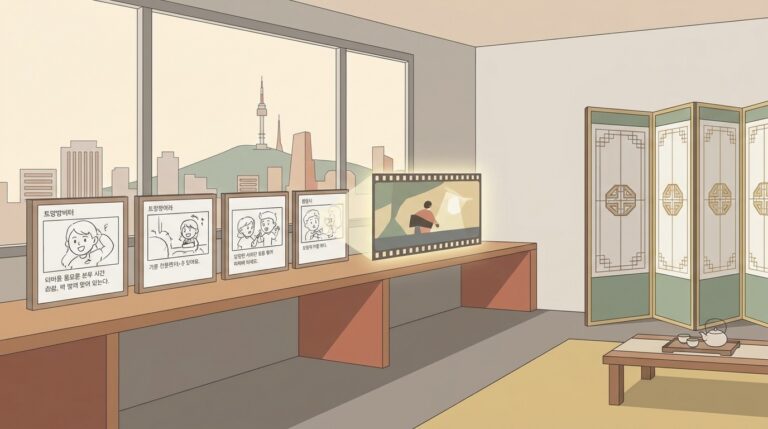
Mastering Screen Adaptations: How to Talk Transmedia Super IPs in C1 Korean
Phase 1: 공감 (Story-Driven Opening)
안녕하세요! 매일한글 에디터입니다. (Hello! It’s your Daily Hangul editor.)
Picture this: You are sitting in an open-plan production lounge in Sangam-dong, Seoul’s media epicenter. You and your Korean creative team are sipping iced Americanos, fiercely debating the live-action screenplay of a legendary webnovel. You want to argue that while preserving the original vibe is crucial, the episodic 120-chapter webtoon pacing will completely flop if copied scene-for-scene into an eight-episode OTT miniseries. You try to jump in, but the only words that come out are: “원작이랑 드라마는 달라요” (The original and drama are different). Everyone nods politely, but the rich, strategic nuance of transmedia adaptation evaporates into thin air.
At a C1 level, discussing Korean media isn’t just about sharing whether you “liked” a K-Drama or a Webtoon. It’s about unpacking how massive intellectual properties—from Moving to Marry My Husband—pivot across mediums. Adapting a webtoon requires a surgical understanding of narrative rhythm, fan sentiment, and screenwriting craft. Drawing from our Masterclass learners who work in content localization, screenwriting, and media marketing, this guide unpacks the native, high-level vocabulary you need to discuss creative adaptation with confidence and style.
Phase 2: 핵심 표현 3선 심층 분석 (Deep Dive into Top 3 Expressions)
1. 원작의 결을 살리다 (Wonjag-ui gyeol-eul sallida)
- Pronunciation: [Won-ja-gui gyeo-reul sal-li-da] (Think of ‘gyeol’ like the smooth ‘grain’ of fine wood)
- Meaning: Literally “to keep the grain/texture of the original alive”; figuratively, to preserve the core emotional essence, tone, and character dynamics of the source material during an adaptation.
- K-Culture Moment: Used by acclaimed showrunners and critics when praising an adaptation (e.g., Itaewon Class or D.P.) that changes subplots for television but leaves the philosophical spirit intact.
- Editor’s Insight: The word ‘결’ (grain/texture) is a poetic, high-register Korean concept. When applied to art, it means the intangible soul of a story. Saying “원작을 그대로 따라했어요” (They copied the original exactly) sounds amateur; “원작의 결을 기막히게 살렸어요” (They brilliantly preserved the essence of the original) sounds like a veteran cultural critic.
- Situation Spectrum: Casual: ⚠️ | Semi-formal: ✅ | Formal: ✅
- 🤔 Think About It: Western critics often talk about “faithfulness” to the plot, but Korean creatives frequently emphasize “결” (the emotional grain). How does shifting focus from plot mechanics to emotional texture change how we judge adaptations?
2. 서사 호흡을 조절하다 (Seosa hoheub-eul jojeolhada)
- Pronunciation: [Seo-sa ho-heu-beul jo-jeol-ha-da] (Pronounce ‘ho-heup’ smoothly, like drawing an intentional breath)
- Meaning: Literally “to regulate the narrative breathing”; figuratively, to restructure narrative pacing and tempo to fit a specific medium.
- K-Culture Moment: Heard constantly in writers’ rooms when transforming scroll-format webtoons—which rely on weekly cliffhangers—into bingeable 60-minute streaming episodes.
- Editor’s Insight: In Korean storytelling, pacing is treated as a living, breathing entity (‘호흡’). A story that drags has ‘호흡이 길다’ (long breath), while a fast-paced thriller has ‘호흡이 가파르다’ (steep/breathless). Controlling this rhythm is a badge of directorial skill.
- Situation Spectrum: Casual: ⚠️ | Semi-formal: ✅ | Formal: ✅
- 🤔 Think About It: Why do you think Korean media professionals conceptualize narrative timing through the biological metaphor of breathing (‘호흡’) rather than mechanical terms like “tempo” or “beats”?
3. 매체 특성에 맞춰 각색하다 (Maeche teukseong-e matchwo gaksaekhada)
- Pronunciation: [Mae-che teuk-seong-e mat-chwo gak-saek-ha-da] (Rhymes smoothly: match-wo gak-saek)
- Meaning: Literally “to dramatize/adapt in alignment with media characteristics”; adapting content strategically according to the affordances of the target platform.
- K-Culture Moment: Standard jargon during production press conferences when a director defends why certain fantasy visual effects or inner monologues from a webnovel were completely re-envisioned for cinema.
- Editor’s Insight: ‘각색’ (adaptation/dramatization) differs from ‘번역’ (translation). Adding ‘매체 특성에 맞춰’ (in accordance with medium characteristics) elevates the statement from simple rewriting to intentional transmedia world-building.
- Situation Spectrum: Casual: 🚫 | Semi-formal: ✅ | Formal: ✅
- 🤔 Think About It: Web novels depend on extensive internal exposition, while screen formats demand visual subtext. How does linguistic precision around “medium characteristics” help resolve creative friction between original authors and screenwriters?
Phase 3: 교과서 한국어 vs 진짜 한국어 (Textbook vs. Real Korean)
Situation 1: Praising a successful screen adaptation
- 📖 교과서 한국어 (Textbook): 이 영화는 원작 만화와 거의 똑같아서 재미있습니다. (I yeonghwaneun wonjak manhwa-wa geoui ttokgateaseo jaemi-isseumnida. / This movie is interesting because it is almost identical to the original comic.)
- 🗣️ 진짜 한국어 (Real Native C1): 원작의 매력 포인트를 훼손하지 않으면서도, 영상 문법에 맞춰 서사를 입체적으로 잘 풀어냈어요. (Wonjag-ui maeryeok pointeureul hwesonhaji aneumyeonseodo, yeongsang munbeobe matchwo seosareul ipchejeog-euro jal pureonaesseoyo. / While not undermining the source material’s charm, they unfolded the narrative three-dimensionally in accordance with cinematic grammar.)
- 💡 왜 다를까? Textbook Korean treats similarity as quality. Real industry Korean values transformation: retaining emotional depth while exploiting the target medium’s cinematic tools.
Situation 2: Criticizing a rushed adaptation
- 📖 교과서 한국어 (Textbook): 이야기가 너무 빨라서 이해하기 어렵습니다. (Iyagiga neomu ppallaseo ihaehagi eoryeopseumnida. / The story is too fast, so it is difficult to understand.)
- 🗣️ 진짜 한국어 (Real Native C1): 방대한 세계관을 몇부작 안에 욱여넣다 보니, 서사 호흡이 무너지고 개연성마저 잃었어요. (Bangdaehan segyegwaneul myeotbujak ane ugyeoneotda boni, seosa hoheubi muneojigo gaeyeonseongmajeo ilheosseoyo. / Because they crammed an expansive universe into too few episodes, the pacing collapsed and it even lost its plausibility.)
- 💡 왜 다를까? Words like ‘욱여넣다’ (to cram forcefully) and ‘개연성’ (dramatic plausibility) articulate precise technical flaws rather than childish complaints.
Phase 4: K-Culture 딥다이브 & 비언어적 매너 (Deep Dive & Non-Verbal Manners)
4-1. 눈치 (Nunchi) & Professional Body Language
When discussing adaptation scripts with Korean creators, respect for the source author (원작 작가님) is paramount. If you propose substantial structural cuts:
* The Softening Tilt: Slightly tilt your head and bring both hands together above the table before delivering a structural overhaul.
* The Validation Buffer: Always state what works before suggesting cuts: “원작의 이 설정은 정말 탁월하지만…” (While this setup in the original is truly brilliant…).
* Gaze Modulation: Avoid intense, unblinking eye contact when pointing out pacing flaws. Gaze at the treatment document, making your critiques feel like collaborative problem-solving aimed at the text rather than personal attacks on the writer.
4-2. The Transmedia Cultural Code: The Webtoon-to-OTT Engine
In South Korea, webtoons are not regarded as simple “cartoons.” They are high-stakes intellectual properties (슈퍼 IP) incubated through millions of real-time reader comments on Naver Webtoon and KakaoPage. When a webtoon is greenlit for a global streaming service, the core conflict is between “원작 충성도” (fidelity to the original fandom) and “대중성 확보” (broad public appeal). Understanding this friction enables you to evaluate Korean adaptations like an industry insider.
Phase 5: 실전 롤플레이 시나리오 (Real-World Roleplay Scenario)
- Setting: A development meeting at a production studio in Sangam DMC.
- Characters:
- 민수 (Min-su): Lead Development Producer, cautious about fan reactions.
- Learner (You): Creative Consultant advising on the series adaptation of a smash-hit portal fantasy webnovel.
민수: 작가님, 이번 4화 각본 초고 봤는데요. 원작 팬들이 가장 열광했던 몬스터 토벌 에피소드가 통째로 빠졌더라고요. (Jakganim, ibeon sahwa gakbon chogobwatneundeyo. Wonjak paendeuri gajang yeol-gwanghaetdeon monseuteo tobeol episodeuga tongjjaero ppajyeotdeoragoyo.)
🎭 대본을 조심스럽게 넘기며 난처한 표정을 짓는다. (Flipping through the script pages with a concerned grimace.)
“Writer, I reviewed the first draft of Episode 4. The monster subjugation sequence that original fans went crazy for was completely cut out.”
You: 네, 프로듀서님. 원작 팬덤의 우려는 백번 이해하지만, 드라마 매체 특성상 불가피한 선택이었습니다. (Ne, peurodyuseonim. Wonjak paendeom-ui uryeoneun baekbeon ihaehajiman, deurama maeche teukseongsang bulgahpihan seontaeg-ieosseumnida.)
🎭 태블릿에 그려진 캐릭터 관계도를 가리키며 차분하게 말한다. (Pointing calmly at the character relationship map on your tablet.)
“Yes, Producer. I fully understand the fandom’s concerns, but given television’s medium characteristics, it was an unavoidable choice.”
민수: 그래도 원작 파괴라는 반발이 심할 텐데요. 그 부분을 걷어내면 메인 캐릭터의 각성이 밋밋해지지 않을까요? (Geuraedo wonjak pagweraneun banbari simhal tendehyo. Geu bubuneul geodeonaemyeon mein kaerikteo-ui gakseongi minmithaejiji aneulkkayo?)
🎭 미간을 살짝 찌푸리며 의문을 제기한다. (Furrowing his brow slightly as he raises the concern.)
“Still, the backlash calling it ‘destruction of the canon’ will be fierce. If we remove that portion, won’t the main character’s awakening fall flat?”
You: 오히려 웹툰식 전투를 그대로 옮겨오면 회당 제작비 부담도 크고, 서사 호흡이 늘어집니다. (Ohiryeo webtunsik jeontureul geudaero olmgyeoomyeon hoedang jejakbi budamdo keugo, seosa hoheubi neureojimnida.)
🎭 고개를 천천히 끄덕이며 확신에 찬 어조로 설명한다. (Nodding slowly, explaining with a confident tone.)
“On the contrary, directly importing webtoon-style battles balloons our episodic budget and drags down our narrative pacing.”
민수: 그럼 그 전투를 대신해서 주인공의 내적 동기를 어떻게 끌어올릴 계획이신가요? (Geureom geu jeontureul daesinhaeseo ju-ingong-ui naejeok donggireul eotteoke kkeureoollil gyehoeg-isingayo?)
🎭 턱을 괴고 진지하게 경청할 준비를 한다. (Resting his chin on his hand, ready to listen attentively.)
“Then how do you plan to elevate the protagonist’s inner motivation in place of that battle?”
You: 외적인 액션 대신 인물 간의 심리적 갈등을 극대화해서 원작의 결을 더 묵직하게 살리려고 합니다. (Oejeogin aeksyeon daesin inmul gan-ui simrijeok galdeung-eul geukdaehwahae-seo wonjag-ui gyeol-eul deo mukjikhage salliryeogo hamnida.)
🎭 두 손을 모아 가볍게 테이블 위에 얹으며 미소 짓는다. (Clasping both hands lightly on the table with a reassuring smile.)
“Instead of external action, we amplify interpersonal psychological conflict to bring out the core texture of the original with greater gravity.”
민수: 아, 심리 스릴러적인 텐션을 가미하겠다는 말씀이시군요. 설득력이 있네요. (A, simni seurilleojeogin tensyeoneul gamihagettaneun malsseum-isigunyo. Seoldeukryeogi itneyo.)
🎭 안도하며 펜으로 메모를 적는다. (Looking relieved and jotting notes with his pen.)
“Ah, so you intend to infuse psychological thriller tension. That is convincing.”
You: 맞습니다. 영상 매체의 서사 호흡에 맞춘 영리한 각색이 결국 대중과 마니아층을 모두 잡는 길이니까요. (Matseumnida. Yeongsang maeche-ui seosa hoheube matchun yeongnihan gaksaegi gyeolguk daejung-gwa mania-cheung-eul modu jamneun girinikkayo.)
🎭 눈을 맞추며 부드럽게 고개를 끄덕인다. (Meeting eyes and nodding gently.)
“Exactly. A clever adaptation tailored to the visual screen’s pacing is ultimately how we capture both the general public and dedicated fans.”
🔀 인터랙티브 분기점 (Interactive Fork)
How would you respond if Min-su pushed back: “Still, couldn’t we keep at least half of the monster fight?”
- Option A: “절대 안 됩니다. 영화랑 만화는 근본적으로 다른 예술입니다.” (Jeoldae an doemnida. Yeonghwayrang manhwaneun geunbonjeog-euro dareun yesurimnida. / Absolutely not. Film and comics are fundamentally different arts.)
- Feedback (Bad): Overly defensive and condescending; dismisses collaborative problem solving.
- Option B: “원작의 액션 시퀀스는 숏폼 클립이나 티저 예고편에서 임팩트 있게 재현하고, 본편은 호흡을 압축해 밀도를 높이는 건 어떨까요?” (Wonjag-ui aeksyeon sikweonseuneun syot-pom keullib-ina tijeo yegopyeoneseo impaekteu itge jaehyeonhago, bonpyeoneun hoheubeul apchukhae mildoreul nop-ineun geon eotteolkkayo? / How about recreating the original action sequence in short-form teasers for impact, while compressing the main episode’s pacing to increase narrative density?)
- Feedback (Best!): Brilliant transmedia strategy balancing marketing fan-service with structural narrative discipline.
- Option C: “음… 정 그러시다면 그냥 대충 넣고 나중에 편집실에서 덜어내죠.” (Eum… jeong geureosidamyeon geunyang daechung neotko najung-e pyeonjipsireseo deoreonaejyo. / Well… if you insist, let’s just shove it in and cut it out later in the edit room.)
- Feedback (Risk): Shows lack of artistic conviction and creates unnecessary production waste.
Phase 6: 10초 감정 섀도잉 드릴 (Shadowing Drill)
Practice these lines with precise emotional resonance. The slash (/) indicates a natural pause.
[🧐 단호하면서도 논리정연하게 / Firm and Persuasive]
원작의 핵심 매력은 살리되, / 매체 특성에 맞춰 / 서사 호흡을 과감하게 재창작해야 합니다.
(Wonjag-ui haeksim maeryeog-eun sallidoe, / maeche teukseong-e matchwo / seosa hoheub-eul gwagamhage jaechangjakhaeya hamnida.)
“We must preserve the original’s core charm, / but boldly restructure the narrative pacing / to match the medium’s characteristics.”-
[🤝 우려를 공감하며 안심시키는 톤 / Empathetic and Reassuring]
원작 팬덤의 기대치를 모르는 건 아니지만, / 그대로 답습하면 / 자칫 극의 핍진성이 흔들릴 수 있어요.
(Wonjak paendeom-ui gidaechi-reul moreuneun geon anijiman, / geudaero dapseuphamyeon / jachit geug-ui pipjinseong-i heundeullil su isseoyo.)
“It’s not that I’m unaware of original fans’ expectations, / but if we copy it blindly, / the drama’s dramatic verisimilitude could falter.” -
[💡 통찰력 있고 자신감 넘치는 마무리 / Insightful and Confident]
단순한 재현을 넘어서 / 영상 언어로 번안할 때, / 진정한 슈퍼 IP의 확장이 완성됩니다.
(Dansunhan jaehyeoneul neomeoseo / yeongsang eon-eoro beonanhal ttae, / jinjeonghan syupeo IP-ui hwakjang-i wanseongdoemnida.)
“When we go beyond simple reproduction / and translate it into cinematic language, / true expansion of the super IP is achieved.”
Phase 7: K-Culture 미니 사전 (Mini Dictionary)
-
원작 파괴 (Won-jak Pa-goe)
- Translation: Destruction of the source canon.
- Usage: Used by passionate fandoms when an adaptation changes essential character motivations or key world rules for the worse.
- 싱크로율 (Sing-keu-ro-yul)
- Translation: Synchronization rate.
- Usage: Measures how closely a live-action actor mirrors the visual design, voice, and aura of their original 2D webtoon counterpart.
- 핍진성 (Pip-jin-seong)
- Translation: Verisimilitude / Plausibility within the fictional world.
- Usage: Crucial in fantasy/sci-fi adaptation meetings. While “개연성” refers to logical cause-and-effect in reality, “핍진성” refers to whether the world feels authentic and internally coherent according to its own magical rules.
- 각색 작가 (Gak-saek Jak-ga)
- Translation: Adaptation screenwriter.
- Usage: The specialized screenwriters hired specifically to transform webtoons or webnovels into production-ready TV scripts and cinematic treatments.
Phase 8: 여행자를 위한 생존 키트 (Creative Industry Survival Kit)
Top 3 Industry Survival Phrases:
- 원작과 각색본 사이의 톤앤매너 차이가 궁금합니다.
(Wonjak-gwa gaksaekbon sai-ui ton-aen-maeneo chaiga gunggeumhamnida.)
Pro Tip: Use this during filmmaker Q&A sessions at the Busan International Film Festival (BIFF) or Bucheon Fantastic Film Festival (BIFAN). - 원작의 클리셰를 영상화하면서 어떻게 비틀었나요?
(Wonjag-ui keullisyereul yeongsanghwahamyeonseo eotteoke biteureonnayo?)
Pro Tip: Asking how cliches were “twisted” (비틀다) showcases sharp analytical C1 Korean. - 시즌제 확장을 염두에 둔 서사 구조인가요?
(Sijeunje hwakjang-eul yeomdue dun seosa gujoin-gayo?)
Pro Tip: Perfect for media conferences when inquiring about multi-season transmedia universe plans.
Editor’s Travel Note:
When visiting Seoul to explore the IP ecosystem, explore the Sangam Digital Media City (DMC) complex where top networks (CJ ENM, JTBC, MBC) are headquartered. Download the Naver Series app on Android or iOS to compare webnovels with their webtoon serialized counterparts before walking through the major flagship bookstores like Kyobo Book Centre Gwanghwamun, which features dedicated curated zones for popular webnovel paperbacks and IP merchandise.
Phase 9: “한 발 더 깊이” (Reflective Cultural Essay)
In Korean transmedia discussions, adaptation is not viewed merely as a commercial licensing contract; it is deeply intertwined with cultural concepts of 예의 (decorum and respect). Original webtoon and webnovel creators spend years communicating intimately with serialized audiences via weekly author notes. Therefore, when a streaming adaptation succeeds, critics praise how the script “honors the creator’s labor without becoming its prisoner.” Conversely, adaptations that fail are often criticized not for small plot deviations, but for an arrogant disregard of the fan community’s shared emotional history.
💬 Your Turn: Think of a webtoon or book from your home country that was turned into a movie. Did the filmmakers manage to “원작의 결을 살리다” (preserve its core grain), or did they commit “원작 파괴” (canon destruction)? Tell us in Korean in the comments below!
Phase 10: FAQ & 흔한 실수 (FAQ & Common Mistakes)
Q: Can I use ‘원작을 바꾸다’ instead of ‘원작을 각색하다’?
A: ‘바꾸다’ simply means ‘to change’ in a general, casual way. When speaking at a professional C1 level, using ‘각색하다’ (to dramatize/adapt) conveys artistic intent, whereas ‘바꾸다’ can sound accidental or sloppy.
Q: What is the exact difference between ‘개연성’ and ‘핍진성’?
A: ‘개연성’ (probability/logic) checks if events make sense according to real-world causal logic. ‘핍진성’ (verisimilitude) checks if the story feels believable within its own fantastical premise. For example, dragons existing is a matter of 핍진성; a wounded dragon dying from a single needle strike without explanation violates 개연성.
Q: Is ‘싱크로율’ formal enough for a script pitch meeting?
A: Yes! While it originated as internet slang (derived from “synchronization” and Korean “율/rate”), it is now universally recognized across Korean entertainment boardrooms, press releases, and script reviews.
🚨 흔한 실수 (Common Mistakes) Checklist:
- ❌ Saying “웹툰을 드라마로 번역했어요”
👉 Correct: “웹툰을 드라마로 각색했어요.” (Translation applies to languages; adaptation applies to media). - ❌ Saying “속도가 너무 빨라요” when critiquing narrative flow
👉 Correct: “서사 호흡이 너무 급해요.” (Brings high-register professionalism to script critiques). - ❌ Calling all source material ‘책’ (book)
👉 Correct: Use “원작 IP” or specify “원작 웹소설 / 원작 웹툰” to acknowledge platform nuances.
Phase 11: 액션 미션 & 참여 유도 (Action Missions)
- 🥉 Bronze Mission (Solo Vocal Drill): Record your voice saying: “원작의 결을 살리되 서사 호흡을 조절해야 흥행할 수 있어요.” three times without pausing.
- 🥈 Silver Mission (Social Media Post): Choose your favorite K-Drama adaptation (e.g., Business Proposal, All of Us Are Dead) and post a one-sentence critique on Instagram or Threads using the word 싱크로율 or 원작의 결.
- 🥇 Gold Mission (Industry Application): Next time you watch an adaptation, write down two things: what medium characteristics (매체 특성) were added, and whether the narrative pacing (서사 호흡) felt balanced.
- 🎮 K-Culture Mission: Read episode 1 of a webtoon on Webtoon/KakaoPage and watch episode 1 of its drama adaptation. Spot the first structural change and explain why the screenwriter made that adaptation choice.
Phase 12: 인터랙티브 퀴즈 챌린지 (Interactive Quiz)
1. 상황 판단 (Situational Judgment)
You are in a script development meeting. The director wants to delete a major secondary character from the web novel to streamline the 8-episode series. Which phrase expresses your professional agreement most elegantly?
- A) 그 캐릭터는 인기가 없으니까 지워버리죠. (That character isn’t popular, so let’s erase them.)
- B) 8부작이라는 매체 특성을 고려할 때, 서사 호흡을 압축하기 위한 불가피하고 합리적인 선택입니다. (Considering the medium characteristics of an 8-episode format, it is an unavoidable and rational choice to compress the narrative pacing.)
- C) 원작 작가한테 물어보고 싫다고 하면 다시 넣죠. (Let’s ask the original author, and if they dislike it, we put it back.)
🔍 정답 확인 (Click to view answer)
정답: B
설명: Option B provides an objective, strategic defense based on structural medium constraints rather than emotional whims or amateur phrasing.
2. 빈칸 채우기 (Fill in the Blank)
- “이 드라마는 배우들의 뛰어난 연기 덕분에 원작 만화 캐릭터와의 _________이/가 100%에 달한다는 찬사를 받았다.”
(This drama received acclaim that its _________ with original comic characters reached 100% thanks to outstanding acting.)
🔍 정답 확인 (Click to view answer)
정답: 싱크로율 (Synchronization Rate)
설명: ‘싱크로율’ is the exact industry term for how seamlessly live-action actors embody source characters.
3. True / False 문화 퀴즈
- Statement: In Korean media terminology, ‘개연성’ and ‘원작 파괴’ mean the exact same thing.
🔍 정답 확인 (Click to view answer)
정답: False
설명: ‘개연성’ refers to narrative plausibility and internal logic, whereas ‘원작 파괴’ refers to ruining or disrespecting the source canon during an adaptation.
🎬 Watch Our Daily Videos! (Daily Hangul Official Instagram)
Review the expressions you learned in this article with our fun daily short videos! Check out native pronunciation and real-life nuances in action.
- Instagram @dailyhangul_en







