

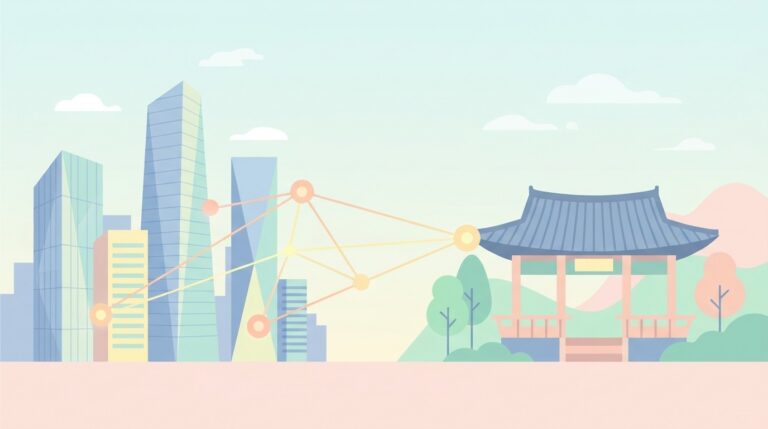
Phase 1: 공감 (Story-Driven Opening)
안녕하세요! 매일한글 에디터입니다.
Imagine you are sitting in a conference hall overlooking the historic Gyeongbokgung Palace in central Seoul. On your left is a seasoned diplomat from the Ministry of Foreign Affairs (외교부, Oegyobu); on your right, a senior policy researcher from a prominent think tank. You are discussing the latest breaking news: a superpower has just imposed sudden trade curbs, weaponizing raw material exports to sway domestic policies. The researcher turns to you and asks: “강대국의 일방적인 경제적 강압 조치에 맞서, 우리 중견국들이 취해야 할 가장 현실적인 출구 전략은 무엇이라고 보십니까?” (Gangdaeguk-ui ilbangjeogin gyeongjejeok gang-ap jochi-e matseo, uri junggyeon-gukdeuri chwihaeya hal gajang hyeonsiljeogin chulgu jeollyag-eun mueos-irago bosimnikka? / “Against unilateral economic coercion from great powers, what do you see as the most pragmatic exit strategy for middle powers like us?”)
Did your heart skip a beat? If you felt a momentary wave of panic, you are certainly not alone. At the C2 level, Korean moves beyond everyday pleasantries or standard business emails into the realm of strategic ambiguity, diplomatic rhetoric, and complex geopolitical discourse. Many advanced learners tell us: “I can discuss Korean dramas and understand news broadcasts, but the moment the conversation turns to international political economy and multi-lateral coalitions, I run out of the nuanced Korean vocabulary needed to articulate my thoughts.”
This guide is crafted precisely for those high-stakes moments. Based on real debates from international summits held in Korea, this lesson equips you with the razor-sharp lexical tools and cultural frameworks needed to advocate for middle-power collective resilience networks—helping you sound as authoritative, poised, and articulate as a seasoned Korean diplomat.
Phase 2: 핵심 표현 3선 심층 분석 (Deep Dive: Top 3 Core Expressions)
1. 경제안보 회복탄력성 네트워크 (Gyeongje-anbo hoebok-tallyeokseong neteuwokeu)
- Pronunciation: [Gyeong-je-an-bo hoe-bok-tal-lyeok-seong ne-teu-wo-keu] (Sounds like: Gyoung-jeh ahn-boh hway-bok tal-lyuk-sung network)
- Meaning: Literal: Economic security elasticity recovery network | Real Nuance: Collective economic resilience network designed to absorb, cushion, and counter asymmetric economic shocks or supply-chain weaponization.
- K-Culture Moment: Seen frequently in high-stakes political dramas like Chief of Staff (보좌관) or national crisis thrillers like Default (국가부도의 날), where top strategists negotiate contingency plans to withstand foreign financial shocks.
- Editor’s Insight: ‘회복탄력성’ is an indispensable modern policy buzzword in Seoul. It goes beyond mere “defense” (방어); it conveys dynamic recovery—the capability of an economic system to bounce back swiftly after unilateral external coercion.
- Situation Spectrum: Casual: 🚫 | Semi-formal: ⚠️ | Formal: ✅
- 🤔 Think About It: Notice how Korean diplomatic language favors Sino-Korean compounds (회복탄력성) paired with modern loanwords (네트워크). How does your native language balance historical political vocabulary with globalized concepts?
2. 다자간 공조 틀을 구축하다 (Dajagan gongjo teur-eul guchukada)
- Pronunciation: [Da-ja-gan gong-jo teu-reul gu-chu-ka-da] (Sounds like: Dah-jah-gahn gong-joh teu-rul goo-choo-kah-dah)
- Meaning: Literal: To construct a multilateral mutual-assistance frame | Real Nuance: To institutionalize a coalition framework where multiple mid-sized nations coordinate policies to balance against larger coercive powers.
- K-Culture Moment: Evokes the diplomatic agility celebrated in historical Korean sageuks (period dramas) when clever royal envoys forge alliances across neighboring states to avoid vassalage.
- Editor’s Insight: While ‘협력’ (hyeomnyeok) means general cooperation, ‘공조’ (gongjo) specifically implies synchronized, strategic maneuvers among distinct sovereign bodies facing a shared vulnerability.
- Situation Spectrum: Casual: 🚫 | Semi-formal: ⚠️ | Formal: ✅
- 🤔 Think About It: English often uses verbs like “build” or “forge.” In Korean diplomatic discourse, ‘틀을 구축하다’ literally means “erecting a structural mold or scaffolding.” What does this spatial metaphor reveal about Korean views on institutional stability?
3. 부당한 외압에 맞서 전략적 자율성을 확보하다 (Budanghan oe-ab-e matseo jeollyakjeok jayulseong-eul hwakbohada)
- Pronunciation: [Bu-dang-han oe-ab-e mat-seo jeol-lyak-jeok ja-yul-seong-eul hwak-bo-ha-da] (Sounds like: Boo-dahng-hahn way-ahp-eh maht-suh jul-lyahk-juck jah-yool-sung-eul hwahk-boh-hah-dah)
- Meaning: Literal: In the face of unjust external pressure, secure strategic autonomy | Real Nuance: Resisting coercive external leverage by cultivating policy independence and diversified international partnerships.
- K-Culture Moment: Recall the strategic tension in Mr. Sunshine or modern diplomatic blockbusters like Escape from Mogadishu, where Korean representatives must secure autonomous agency amidst competing foreign influences.
- Editor’s Insight: ‘외압’ (external pressure) is a culturally charged term in modern Korean history, deeply linked to the historical trauma of foreign interference. Using this phrase instantly commands serious respect in academic and policy discussions.
- Situation Spectrum: Casual: 🚫 | Semi-formal: ⚠️ | Formal: ✅
- 🤔 Think About It: Why does Korean political discourse prioritize ‘자율성’ (autonomy/self-regulation) over absolute ‘독립’ (independence) when discussing middle-power international relations?
Phase 3: 교과서 한국어 vs 진짜 한국어 (Textbook vs. Real-World C2 Korean)
Scenario 1: Proposing an alliance against coercive trade measures
- 📖 교과서 한국어: 다른 나라들과 함께 강대국의 나쁜 행동을 막아야 합니다. (Dareun naradeulgwa hamkke gangdaeguk-ui nappeun haengdong-eul mag-aya hamnida. / We must stop the bad actions of big countries together with other nations.)
- 🗣️ 진짜 한국어: 유사입장국 간의 다자적 연대를 통해 일방주의적 강압에 대한 억지력을 제고해야 합니다. (Yusa-ipjangguk gan-ui dajajeok yeondae-reul tonghae ilbangju-uijeok gang-ab-e daehan eokjireyok-eul jegohada. / We must enhance our deterrence against unilateral coercion through multilateral solidarity among like-minded nations.)
- 💡 왜 다를까?: In elite policy circles, phrases like ‘나쁜 행동’ sound juvenile. Sophisticated speakers utilize precise Sino-Korean compounds like ‘유사입장국’ (like-minded states) and ‘억지력을 제고하다’ (elevate deterrence).
Scenario 2: Diversifying supply chains to survive embargoes
- 📖 교과서 한국어: 문제가 생기지 않도록 물건을 사는 곳을 여러 군데로 나누어야 합니다. (Munjega saenggiji antorok mulgeon-eul saneun gos-eul yeoreo gundero nanueoya hamnida. / We should divide the places where we buy goods into several places so problems don’t happen.)
- 🗣️ 진짜 한국어: 공급망 교란 위험을 분산하고 대체 공급선을 제도화하여 충격 완충 지대를 마련해야 합니다. (Gonggeupmang gyoran wiheom-eul bunsanhago daeche gonggeupseon-eul jedohwahayeo chunggyeok wanchung jidae-reul maryeonhaeya hamnida. / We must disperse supply chain disruption risks and institutionalize alternative supply lines to establish a shock buffer zone.)
- 💡 왜 다를까?: Native high-level discourse avoids wordy descriptive clauses, favoring conceptual formulations such as ‘공급망 교란’ (supply chain disruption) and ‘충격 완충 지대’ (shock buffer zone).
Phase 4: K-Culture 딥다이브 & 비언어적 매너 (Deep Dive & Non-Verbal Manners)
4-1. 눈치 (Nunchi) & Non-Verbal Decorum in Korean Diplomacy
When delivering critique or proposing a defense against superpowers in a Korean diplomatic setting, your physical demeanor is just as crucial as your vocabulary:
* Restrained Cadence (완곡어법 & 침착성): Never raise your voice or demonstrate outward anger when discussing coercion. Use a measured, steady tone of voice. Lowering your pitch slightly communicates immense inner resolve and gravitas (무게감).
* Eye Contact & Subtle Head Tilts: Maintain steady, respectful eye contact without staring aggressively. When an opposing counterpart speaks, execute deliberate, slow micro-nods (미세한 끄덕임) to show cognitive comprehension without signaling political agreement.
* The Open Hand Gesture: When referencing ‘다자간 공조’ (multilateral coordination), avoid pointing your index finger. Keep your palm upward and fingers together, sweeping smoothly across the table to visually symbolize an open, inclusive coalition.
4-2. Cultural Code Analysis: The Legacy of Diplomatic Agility
To understand Korean diplomacy, one must understand the legendary Goryeo Dynasty diplomat 서희 (Seo Hui). In 993 CE, facing an overwhelming Khitan invasion force, Seo Hui did not surrender or rely on desperate military clashes. Instead, through extraordinary negotiation (담판), he convinced the Khitan general that trade and diplomatic cooperation with Goryeo served Khitan security better—securing territory without shedding a drop of blood.
In modern K-media (such as the political drama Designated Survivor: 60 Days), this archetype persists: Korea perceives itself as surrounded by heavyweights, requiring middle powers to unite through wits, institutional networks, and moral legitimacy rather than brute military dominance.
Phase 5: 실전 롤플레이 시나리오 (Real-World Roleplay Scenario)
Setting: A bilateral briefing room at the Seoul International Forum for Economic Security. You are a senior policy director from an allied middle-power nation discussing regional supply-chain shocks with Director Park (박 국장), an experienced Korean economic diplomat.
- 박 국장 (Director Park): 최근 특정 강대국의 핵심 광물 수출 통제 움직임이 심상치 않습니다. 이번 조치가 우리 양국의 주력 산업에 미칠 파급력이 상당할 텐데요. (Choegeun teukjeong gangdaeguk-ui haeksim gwangmul suchul tongje umjigim-i simsanchi anseumnida. Ibeon jochiga uri yangguk-ui juryeok saneob-e michil pageubnyeog-i sangdanghal tendeyo.)
- 🎭 행동 지문: [Director Park unbuttons his suit jacket as he sits, leaning forward slightly with a furrowed brow, clasping his hands on the briefing table.]
- Translation: “The recent moves by a certain great power to restrict the export of critical minerals look alarming. This measure will have substantial ripple effects on key industries in both of our nations.”
-
You (Learner): 전적으로 공감합니다. 개별 국가 차원의 단편적 대응만으로는 이러한 경제적 강압을 상쇄하기에 한계가 명확합니다. (Jeonjeog-euro gonggamhamnida. Gaebyeol gukga chawon-ui danpyeonjeok dae-eungman-euroneun ireohan gyeongjejeok gang-ab-eul sangswaehagi-e hangyega myeonghwak-hamnida.)
- 🎭 행동 지문: [Speak in a deliberate, composed baritone, nodding slowly to validate his assessment.]
-
Translation: “I completely agree. Piecemeal responses at the individual nation level clearly have limits in offsetting such economic coercion.”
-
박 국장 (Director Park): 그렇다면 우리 같은 중견국들이 취할 수 있는 구체적인 연대 방안은 무엇이라고 보십니까? (Geureotamyeon uri gateun junggyeon-gukdeuri chwihal su inneun guchejeogin yeondae bang-an-eun mueos-irago bosimnikka?)
- 🎭 행동 지문: [He tilts his head attentively, pen suspended above his notepad.]
-
Translation: “If so, what specific coalition measures do you believe middle powers like us can take?”
-
You (Learner): 무엇보다 유사입장국 간 ‘경제안보 회복탄력성 조기경보 네트워크’를 상설화하여 공급망 충격을 선제적으로 흡수해야 합니다. (Mueotboda yusa-ipjangguk gan ‘gyeongje-anbo hoebok-tallyeokseong jogigyeongbo neteuwokeu’-reul sangseolhwahayeo gonggeupmang chunggyeok-eul seonjejeog-euro heubsuhaeya hamnida.)
- 🎭 행동 지문: [Bring both hands together in an open gesture over the policy documents.]
-
Translation: “Above all, we must institutionalize a ‘Joint Early-Warning Economic Security Resilience Network’ among like-minded nations to preemptively absorb supply chain shocks.”
-
박 국장 (Director Park): 흥미롭군요. 하지만 특정 국가를 겨냥한 배타적 블록화로 비춰질 경우 외교적 마찰이 불가피할 텐데요? (Heungmirobgunyo. Hajiman teukjeong gukga-reul gyeonyanghan baetajeok beullok-hwaro bichwojil gyeong-u oegyojeok machar-i bulgahpihal tendeyo?)
- 🎭 행동 지문: [Raises his eyebrows slightly, resting his chin on his thumb to test your strategic depth.]
-
Translation: “Intriguing. However, if this is perceived as an exclusive bloc targeting a specific country, wouldn’t diplomatic friction be inevitable?”
-
You (Learner): 바로 그 점 때문에 본 구상은 봉쇄가 아닌 ‘규범 기반 질서 수호와 공급망 회복탄력성’이라는 보편적 가치에 방점을 두어야 합니다. (Baro geu jeom ttaemune bon gusang-eun bongswaega anin ‘gyubeom giban jilseo suhowa gonggeupmang hoebok-tallyeokseong’-iraneun bopyeonjeok gachi-e bangjeom-eul dueoya hamnida.)
- 🎭 행동 지문: [Maintain calm eye contact and speak with quiet conviction.]
-
Translation: “It is for that very reason that this framework must emphasize universal values—upholding the rules-based order and supply chain resilience—rather than containment.”
-
박 국장 (Director Park): 탁월한 통찰이십니다. 다자간 공조 틀 안에서라면 각자도생의 위험을 방지하고 외교적 운신의 폭을 넓힐 수 있겠군요. (Tagwolhan tongchar-isimnida. Dajagan gongjo teul an-eseoramyeon gakjado-saeng-ui wiheom-eul bangjihago oegyojeok unsin-ui pog-eul neolphil su itgetgunyo.)
- 🎭 행동 지문: [Nods with genuine approval, writing the phrase down on his official memorandum.]
-
Translation: “That is an exceptional insight. Within a multilateral coordination framework, we can prevent the danger of fractured isolation and expand our diplomatic room to maneuver.”
-
You (Learner): 맞습니다. 연대를 통한 제도화야말로 강압적 외압에 맞서는 중견국의 가장 효과적인 지렛대입니다. (Masseumnida. Yeondae-reul tonghan jedohwayamal-lo gang-amjeok oe-ab-e matseoneun junggyeon-guk-ui gajang hyogwajeogin jiretdae-imnida.)
- 🎭 행동 지문: [Finish with a courteous bow of the head as you exchange files.]
- Translation: “Exactly. Institutionalization through solidarity is indeed the most potent diplomatic leverage for middle powers confronting external coercion.”
🔀 인터랙티브 분기점 (Interactive Branching Decision)
When Director Park asks how to handle pressure from the dominant trade partner directly, how do you respond?
- Option A: “강대국의 요구를 무조건 단호하게 거부하고 전면전을 불사해야 합니다.” (We must unconditionally refuse the superpower’s demands and not shy away from total economic war.)
- Feedback (Bad): ❌ Too reckless. In high-level diplomacy, total war rhetoric (전면전) lacks strategic flexibility and scares away coalition partners.
- Option B: “원칙적 연대와 다변화를 병행하되, 기존 파트너와도 대화 채널을 상시 가동하는 투트랙 외교가 필요합니다.” (We need two-track diplomacy: principle-based multilateral solidarity and diversification, while keeping dialogue channels open with established partners.)
- Feedback (Best): 🌟 Brilliant! Demonstrates C2-level balance by using ‘투트랙 외교’ (two-track diplomacy) and safeguarding national interest without gratuitous escalation.
- Option C: “우리가 약소국이니 일단 강대국의 제재 조치를 수용하고 기다리는 게 상책입니다.” (Since we are a small nation, accepting their sanctions and waiting it out is the best policy.)
- Feedback (Risk): ⚠️ Defeatist. Using ‘약소국’ (weak/small state) instead of ‘중견국’ (middle power) undermines your country’s sovereignty and strategic autonomy.
Phase 6: 10초 감정 섀도잉 드릴 (10-Second Emotional Shadowing Drill)
Practice reading these high-level sentences aloud. Follow the pauses (/) and embody the indicated emotional state.
- [🏛️ 단호하고 격조 높은 어조로 / Firm and Regal Tone]
“일방주의적 강압 조치는 / 결코 지속 가능한 해법이 될 수 없으며, / 다자간 공조만이 / 불안정성을 해소할 유일한 대안입니다.”
(Ilbangju-uijeok gang-ap jochineun / gyeolko jisok ganeunghan haebeob-i doel su eopseumyeo, / dajagan gongjomani / buranjeongseong-eul haesohal yu-ilhan dae-animnida.)
“Unilateral coercive measures / can never be a sustainable solution, / and multilateral coordination alone / is the only alternative to resolve instability.” -
[🤝 신중하면서도 결단력 있게 / Prudent yet Decisive Tone]
“우리는 개별적 타협 대신, / 공급망 회복탄력성 연대를 구축하여 / 국가적 전략 자율성을 / 끝까지 수호해 나갈 것입니다.”
(Urineun gaebyeoljeok tahyeop daesin, / gonggeupmang hoebok-tallyeokseong yeondae-reul guchukhayeo / gukgajeok jeollyak jayulseong-eul / kkeutkkaji suhohae nagal geosimnida.)
“Instead of individual compromises, / we will build a supply-chain resilience coalition / and defend our national strategic autonomy / until the very end.”
Phase 7: K-Culture 미니 사전 (4 Key Terms)
-
외교적 운신의 폭 (Oegyojeok unsin-ui pok)
- Translation: Diplomatic room for maneuver / Strategic elbow room.
- Usage: Often paired with the verb ‘넓히다’ (to widen). Crucial when discussing how middle powers avoid getting hemmed in by superpowers.
- 외교적 지렛대 (Oegyojeok jiretdae)
- Translation: Diplomatic leverage.
- Usage: Using trade alliances, technical leadership, or moral legitimacy as leverage in bilateral negotiations.
- 각자도생 (Gak-ja-do-saeng)
- Translation: Every person (or nation) fending for themselves; dog-eat-dog isolation.
- Usage: A famous four-character idiom (사자성어) frequently used as a stark warning against abandoning multilateralism during global crises.
- 안미경중 (An-mi-gyeong-jung)
- Translation: “Security with the US, economy with China” dilemma.
- Usage: A modern Korean geopolitical compound (안보는 미국, 경제는 중국). Used widely in Seoul editorials to describe the core strategic predicament facing Korea’s economic security.
Phase 8: 여행자를 위한 생존 키트 (Diplomatic & Professional Traveler’s Survival Kit)
Survival Expressions TOP 3 for the Seoul Policy District
- “공식 오찬 자료와 배포용 성명서를 먼저 검토할 수 있을까요?”
(Gongsik ochan jaryowa baepoyong seongmyeongseo-reul meonjeo geomtohal su isseulkkayo?)
Pro Tip: Use this when arriving at conferences in Gwanghwamun or Yeouido to request the official embargoed press brief. - “비보도 전제(오프더레코드)로 배경 설명을 부탁드립니다.”
(Bibodo jeonje-ro baegyeong seolmyeong-eul butakdeurimnida.)
Pro Tip: Essential for off-the-record background briefings with Korean ministry officials or policy analysts. - “수석 대표의 기조연설 직후 질의응답 세션이 마련되어 있습니까?”
(Suseok daepyo-ui gijoyeonseol jikhu jiri-eungdap sesyeon-i maryeondoe-eo isseumnikka?)
Pro Tip: Polished question for the master of ceremonies (사회자) before an international forum starts.
Editor’s Travel Note: Navigating Seoul’s Policy Corridors
- Transit & Route Finding: Foreign navigation apps often struggle with local routing in Korea due to security regulations. Make sure to download the Naver Map App Download before navigating the diplomatic complexes around Gwanghwamun, the Ministry of Foreign Affairs (외교부), or traveling down to the Government Complex Sejong (정부세종청사).
- Diplomatic Etiquette: When visiting official think tanks like the Korea National Diplomatic Academy (국립외교원) or the Asan Institute, always present your bilingual business card (명함) with both hands, text facing toward the recipient.
Phase 9: “한 발 더 깊이” (Critical Thinking Essay)
Historically, the Korean Peninsula has often been described through the folk metaphor: “고래 싸움에 새우 등 터진다” (A shrimp’s back breaks in a fight between whales). For centuries, Korea grappled with asymmetric power dynamics exerted by surrounding empires. However, contemporary Korea entirely rejects the fatalistic “shrimp” mentality. Instead, modern South Korea positions itself as a “dolphin” (돌고래)—intelligent, swift, and highly interconnected—or even an anchor node in a coalition of middle powers. By institutionalizing multilateral networks, middle powers ensure that no single whale can crush them individually.
💬 Your Turn: Does your country perceive itself as a “whale,” a “middle-power dolphin,” or something else entirely in regional geopolitics? How does your native language describe the strategy of collective resilience?
Phase 10: FAQ & 오해 방지 (FAQ Schema & Common Traps)
Q: Can I use the word ‘연대’ (Yeondae) in business meetings, or is it strictly political?
A: ‘연대’ (Solidarity/Coalition) is commonly used in both politics and corporate strategy! You will often hear Korean tech executives speak of ‘기술 연대’ (technological solidarity/alliance) when forming consortiums against global monopolies.
Q: What is the exact difference between ‘강압’ (Gang-ap) and ‘압박’ (Ap-bak)?
A: ‘압박’ (ap-bak) means “pressure” in a general sense (e.g., time pressure, diplomatic pressure). ‘강압’ (gang-ap) is much heavier: it incorporates the character 강 (coercive/forced), explicitly denoting unjust, domineering intimidation that infringes upon another’s sovereign rights.
Q: How do I soften my disagreement during a high-stakes policy discussion in Korean?
A: Instead of saying “그 의견은 틀렸습니다” (That opinion is wrong), use the classic diplomatic softener: “말씀하신 취지에는 십분 공감합니다만, 실효성 측면에서 다른 변수도 고려해 볼 필요가 있습니다.” (While I fully empathize with your intention, from the perspective of efficacy, we may also need to take other variables into account.)
🚨 흔한 실수 (Common Mistakes) 경고판
- Mistake 1: Translating “Great Powers” directly as 큰 나라들 (Keun naradeul).
- Correct Action: Always use 강대국 (Gangdaeguk) in diplomatic context.
- Mistake 2: Using 싸우다 (ssawuda / fight) when referring to policy pushback.
- Correct Action: Use 맞서다 (matseoda / counter/stand up to) or 대응하다 (dae-eunghada / respond/cope with).
- Mistake 3: Saying 우리 같은 작은 나라들 (Small countries like us).
- Correct Action: Refer to yourself with dignity as 중견국 (Junggyeon-guk / Middle power).
Phase 11: 액션 미션 & 참여 유도 (Action Missions)
- 🥉 Bronze Mission (Solo Shadowing): Record yourself reading the two Phase 6 shadowing drill sentences using your smartphone voice memo app. Focus on slow, resonant cadence.
- 🥈 Silver Mission (SNS & Forum Sharing): Share an English or Korean editorial about supply chain disruptions on your LinkedIn or study blog, using the phrase: “유사입장국 간의 다자적 연대와 회복탄력성 구축이 시급합니다.”
- 🥇 Gold Mission (Real-World Application): In your next Korean language exchange or debate session, debate the dilemma of ‘안미경중’ using at least two expressions learned today.
- 🎮 K-Culture Mission: Watch an episode of a political K-drama (like Chief of Staff or Designated Survivor: 60 Days) or a news briefing from Arirang TV / KBS News. Note down how many times you spot words like 외압, 공조, 연대, or 회복탄력성!
Phase 12: 인터랙티브 퀴즈 챌린지 (Interactive Quiz Challenge)
1. 상황 판단 퀴즈 (Contextual Judgment)
At an international economic forum, a foreign diplomat criticizes your joint initiative as “an aggressive anti-superpower alliance.” Which Korean response demonstrates the highest level of diplomatic refinement (C2)?
* (A) “우리는 강대국과 끝까지 싸울 준비가 되어 있습니다.”
* (B) “본 연대는 특정국을 배제하기 위함이 아니며, 규칙 기반 다자무역 질서와 공급망 회복탄력성을 담보하기 위한 방어적 공조입니다.”
* (C) “우리가 뭘 하든 그것은 우리의 자유이니 상관하지 마십시오.”
🔍 정답 및 해설 보기 (Click to view answer)
정답: (B)
* 해설: Option (B) strikes the exact diplomatic balance: it disarms the opponent’s aggressive framing (특정국을 배제하기 위함이 아니며) and frames the coalition around legitimate universal values (공급망 회복탄력성을 담보하기 위한 방어적 공조). Options (A) and (C) are emotionally combative and tactless.
2. 빈칸 채우기 (Fill in the Blank)
- “단일 공급망에 대한 과도한 의존은 외교적 [ ]를 초래하므로, 대체 공급선 구축을 통해 전략적 자율성을 제고해야 한다.”
- Hint: Meaning “vulnerability” or “weakness.”
🔍 정답 및 해설 보기 (Click to view answer)
정답: 취약성 (Chwi-yak-seong / Vulnerability)
* 문장 완성: “단일 공급망에 대한 과도한 의존은 외교적 취약성을 초래하므로, 대체 공급선 구축을 통해 전략적 자율성을 제고해야 한다.”
3. True / False 문화 퀴즈
- In high-level Korean political and diplomatic discourse, calling a country a ‘중견국’ (Middle Power) implies weakness and a lack of regional influence.
🔍 정답 및 해설 보기 (Click to view answer)
정답: False
* 해설: In Korean foreign policy doctrine, ‘중견국’ (Middle Power) is a badge of active, responsible diplomacy. It designates dynamic states that serve as agenda-setters, bridge-builders, and conveners of multilateral coalitions between superpowers.
🎬 Watch Our Daily Videos! (Daily Hangul Official Instagram)
Review the expressions you learned in this article with our fun daily short videos! Check out native pronunciation and real-life nuances in action.
- Instagram @dailyhangul_en







