

Phase 1: Empathy (Real-Life Seoul Survival)
안녕하세요! 매일한글 에디터입니다. (Annyeonghaseyo! It’s your Daily Hangul editor.)
Picture this: You have finally settled into your new life in Seoul. You navigated the immigration office, secured your Alien Registration Card (ARC), and finally got approved for your very first Korean credit card. Walking down the streets of Gangnam or Hongdae, you feel like a character straight out of a K-Drama—effortlessly tapping your sleek Hyundai Card at stylish cafes and buzzing convenience stores.
Then, one Friday afternoon, you open your card statement app or receive an automated KakaoTalk notification. Amidst the sea of technical Korean, a cryptic phrase catches your eye: 일부결제금액이월약정(리볼빙). You vaguely remember ticking a consent box during the online application, assuming it was just a helpful safety net or a fancy reward feature. But when you check the fine print, your heart drops: 수수료율 16.5% (Interest rate: 16.5% APR)!
Don’t panic—you are definitely not alone. Many expatriates and intermediate Korean learners fall into the “Revolving Payment trap” simply because Korean financial apps use heavily formal Sino-Korean jargon. This guide is crafted directly from real-life feedback from foreign residents in Korea. By mastering the phrases in this lesson, you will gain the confidence to decline unwanted credit traps, question high fees like a local, and protect your hard-earned won.
Phase 2: Core Expressions Breakdown
1. 리볼빙 서비스 해지해 주세요. (Ribolbing seobiseu haejihae juseyo.)
- Pronunciation: [Ree-bol-bing seo-bee-seu hae-jee-hae joo-seh-yo] (Think of ‘rib’ + ‘all’ + ‘bing’)
- Meaning: “Please cancel the revolving payment service.”
- Literal vs. Real Nuance: Literally “Revolving service, do termination please.” In Korea, credit companies often bundle revolving credit automatically under pleasant-sounding names. Saying this clearly tells the bank teller or customer service agent that you refuse to carry balances over with high interest.
- K-Culture Moment: You will hear this exact sentence in realistic workplace dramas like Misaeng or One Dollar Lawyer, where financially savvy characters catch predatory terms in contracts before signing.
- Editor’s Insight: Remember the verb 해지하다 (haeji-hada)—it is specifically used for canceling services, subscriptions, and financial contracts, whereas 취소하다 (chwisohada) is for canceling an action or transaction (like an order).
- Situation Spectrum:
- Casual: 🚫
- Semi-formal: ⚠️ 리볼빙 취소할게요. (Ribolbing chwisohalgeyo.)
- Formal: ✅ 리볼빙 서비스 해지해 주세요. (Ribolbing seobiseu haejihae juseyo.)
- 🤔 Think About It: In many Western countries, credit cards are revolving by default. In Korea, however, full monthly balance settlement (일시불) is the golden standard. Why do you think Korean society treats revolving balances with so much caution?
2. 수수료율이 몇 퍼센트예요? (Susuryoyuri myeot peosenteuyeyo?)
- Pronunciation: [Soo-soo-ryo-yoo-ree myeot peo-sen-teu-yeh-yo?]
- Meaning: “What is the fee/interest percentage rate?”
- Literal vs. Real Nuance: Literally “Fee rate what percent is it?” In everyday banking, 수수료율 refers to transaction fees, installment charges, or interest rates on rolled-over payments.
- K-Culture Moment: Seen in consumer protection segments on morning news programs like KBS Morning Yard, where financial experts warn viewers to always ask for the exact numerical percentage before signing.
- Editor’s Insight: Combining 수수료 (susuryo – commission/fee) and 율 (yul – rate) creates an intimidating compound word, but asking this question instantly commands respect and shows you are not an uninformed customer.
- Situation Spectrum:
- Casual: 🚫
- Semi-formal: ✅ 수수료율이 몇 퍼센트예요? (Susuryoyuri myeot peosenteuyeyo?)
- Formal: ✅ 수수료율이 어떻게 됩니까? (Susuryoyuri eotteoke doemnikka?)
- 🤔 Think About It: How do service fees compare between your home country and Korea, where transaction transparency is strongly regulated by the Financial Supervisory Service?
3. 일시불로 결제할게요. (Ilsibullo gyeoljehalgeyo.)
- Pronunciation: [Eel-shee-bool-lo gyeol-jeh-hal-geh-yo] (Eel + see + bull)
- Meaning: “I will pay in full (lump-sum payment).”
- Literal vs. Real Nuance: “Lump sum by, payment will do.” Whenever you make a credit card purchase over 50,000 KRW in Korea, store clerks will ask: “할부로 해 드릴까요?” (Would you like installments?) Responding with this phrase ensures no installment fees or revolving interest are ever applied.
- K-Culture Moment: A quintessential scene in department store shopping sequences across countless K-Dramas when the cool, independent protagonist confidently buys a gift without splitting the bill.
- Editor’s Insight: Make 일시불 (ilsibul) your favorite shopping word in Korea. It guarantees peace of mind and keeps your credit rating pristine.
- Situation Spectrum:
- Casual: ⚠️ 일시불로 할래. (Ilsibullo hallae.)
- Semi-formal: ✅ 일시불로 결제할게요. (Ilsibullo gyeoljehalgeyo.)
- Formal: ✅ 전액 일시불로 처리해 주십시오. (Jeonaek ilsibullo cheorihae jusipsio.)
- 🤔 Think About It: Why does Korea have such a widespread system of offering split payments (할부) even at grocery stores and clothing boutiques?
Phase 3: Textbook Korean vs. Real Korean
Situation 1: Declining an Optional Service During Credit Card Registration
- 📖 교과서 한국어 (Textbook): 저는 리볼빙 서비스 가입을 원하지 않습니다. (Jeoneun ribolbing seobiseu gaeibeul wonhaji anseumnida. – I do not desire enrollment in the revolving service.)
- 🗣️ 진짜 한국어 (Real-World): 리볼빙은 빼고 신청할게요. (Ribolbing-eun ppaego sincheonghalgeyo. – Please leave out the revolving service when applying.)
- 💡 왜 다를까? (Why the difference?): Koreans rarely say “I do not desire” (원하지 않습니다) in daily transactions. Instead, they use the dynamic verb 빼다 (ppaeda – to take out/exclude), making your request sound direct, crisp, and natural.
Situation 2: Inquiring About Installment Interest Rates
- 📖 교과서 한국어 (Textbook): 할부 결제 시 수수료가 부과됩니까? (Halbu gyeolje si susuryoga bugwadoemnikka? – Is a fee levied upon installment payment?)
- 🗣️ 진짜 한국어 (Real-World): 이거 무이자 할부 돼요? (Igeo muija halbu dwaeyo? – Does this qualify for interest-free installments?)
- 💡 왜 다를까? (Why the difference?): Real shoppers don’t ask theoretical questions about fee application formulas; they cut straight to the chase by asking whether 무이자 (muija – zero interest) is available.
Phase 4: K-Culture Deep Dive & Non-Verbal Etiquette
4-1. 눈치 (Nunchi) & Non-Verbal Manners at the Bank Counter
When visiting a bank counter (은행 창구) or signing digital tablet forms in Korea, visual cues communicate your awareness:
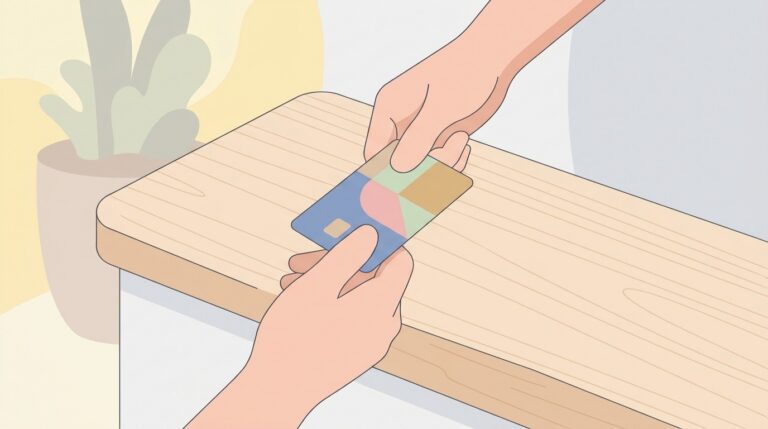
* Two-Hand Document Presentation: Always hand over your ID (외국인등록증) and payment card with both hands, thumbs securing the upper edges, accompanied by a polite 15-degree bow.
* The Careful Pause (검토의 눈빛): Clerks will often rapidly tap through agreement checkboxes on the stylus tablet. Don’t be afraid to gently hold your index finger up and say, “잠시만요, 확인할게요” (Just a moment, let me verify). Taking 10 seconds to read the screen shows maturity and earns sincere respect from the clerk.
4-2. The “Ppalli-Ppalli” Culture and the Dark Side of Revolving Credit
In Korea’s hyper-fast digital ecosystem, credit card applications are processed in mere minutes via smartphone apps. Card companies frequently bundle 리볼빙 (일부결제금액이월약정) into “Essential Consent” (필수 동의) bundles under confusing promotional wording like “Cash Flow Protection Program.”
In Korean society, relying on revolving credit is closely tied to rapid drops in one’s personal credit score (신용점수). Unlike in some countries where carrying a revolving balance is seen as normal consumer behavior, Korean financial institutions view activating revolving credit as a potential sign of personal liquidity distress. Staying alert is your best defense!
Phase 5: Real-World Roleplay Scenario
Setting: You are sitting at a bustling Shinhan Bank counter in downtown Seoul. Bank Clerk Min-ji (민지 계장님) is reviewing your newly approved credit card settings on a digital signature pad.
- 민지 계장: 고객님, 카드 발급 완료되셨고요. 여기 리볼빙 서비스도 같이 등록해 드릴까요? 혹시 잔액이 부족할 때 편리해요. (Gogaengnim, kadeu balgeup wanryodoesyeotgoyo. Yeogi ribolbing seobiseudo gachi deungrokhae deurilkkayo? Hoksi janaegi bujokhal ttae pyeonrihaeyo.)
(Dear customer, your card is issued. Shall I enroll you in the revolving service too? It’s convenient if your balance falls short.) - 🎭 당신:
[🤔 고개를 살짝 갸웃거리며]리볼빙 서비스요? 혹시 수수료율이 몇 퍼센트예요? (Ribolbing seobiseuyo? Hoksi susuryoyuri myeot peosenteuyeyo?)
(Revolving service? By any chance, what is the interest fee rate?) - 민지 계장:
[태블릿 화면을 가리키며]회원 등급에 따라 다른데요, 보통 연 14%에서 19% 사이로 책정됩니다. (Hoewon deunggeube ttara dareundeyo, botong yeon sipsa-peosenteueseo sipgu-peosenteu sairo chaekjeongdoemnida.)
(It depends on your membership tier, but it is typically set between 14% and 19% annually.) - 🎭 당신:
[💡 단호하지만 정중하게 미소 지으며]아, 생각보다 수수료율이 정말 높네요! (A, saenggakboda susuryoyuri jeongmal nomneyo!)
(Ah, the fee rate is much higher than I thought!) - 민지 계장: 네, 그래서 결제 금액이 이월되면 부담이 되실 수 있어요. 어떻게 해 드릴까요? (Ne, geuraeseo gyeolje geumaegi iwol-doemyeon budami doesil su isseoyo. Eotteoke hae deurilkkayo?)
(Yes, so if payment amounts are carried over, it can become burdensome. What would you like to do?) - 🎭 당신: 저는 리볼빙은 빼고 전액 일시불로 설정해 주세요. (Jeoneun ribolbing-eun ppaego jeonaek ilsibullo seoljeonghae juseyo.)
(Please leave revolving out and set it to 100% full lump-sum payment.) - 민지 계장:
[고개를 끄덕이며 전산 입력]네, 알겠습니다. 리볼빙 미신청으로 깔끔하게 처리해 드렸습니다! (Ne, algesseumnida. Ribolbing misincheong-euro kkalkkeumhage cheorihae deuryeosseumnida!)
(Understood. I have cleanly processed it as non-enrollment in revolving!) - 🎭 당신: 감사합니다! 꼼꼼히 확인해 주셔서 안심이 되네요. (Gamsahamnida! Kkomkkomhi hwaginhae jusyeoseo ansimi doeneyo.)
(Thank you! Verifying it thoroughly gives me great peace of mind.)
🔀 Interactive Branch Point: When the Clerk Offers “Minimum Payment” Setup
What would you say next if the clerk asks: “그래도 혹시 모르니 최소결제금액 10%만 이월되도록 약정해 두시겠어요?” (Just in case, would you like to set a 10% minimum roll-over agreement?)
- Option A: “아니요, 수수료가 높으니 전액 일시불로만 해주세요.” (Aniyo, susuryoga nopeuni jeonaek ilsibulroman haejuseyo.)
- Outcome: [BEST] Clear, polite, and completely safe. You close the door on unexpected double-digit interest fees.
- Option B: “그냥 대충 편한 기본 설정으로 해주세요.” (Geunyang daechung pyeonhan gibon seoljeong-euro haejuseyo.)
- Outcome: [RISK] “Default” settings at commercial banks frequently opt you in to revolving credit by default.
- Option C: “네, 최소 금액만 결제되는 걸로 해주세요.” (Ne, choeso geumaekman gyeoljedoeneun geollo haejuseyo.)
- Outcome: [DANGEROUS MISTAKE] You have just activated revolving credit. 90% of your bill will roll over each month at steep 16%+ APR!
Phase 6: 10-Second Emotion Shadowing Drill
Practice reading these out loud with rhythm and native feeling. Pause at the / marks!
[😰 신중하고 명확하게 - Cautious & Clear]
리볼빙 서비스는 / 수수료율이 너무 높아서 / 신청 안 할게요.
(Ribolbing seobiseuneun / susuryoyuri neomu nop-aseo / sincheong an halgeyo.)-
[🧐 눈을 반짝이며 똑 부러지게 - Sharp & Inquiring]
혹시 / 이번 달 결제 금액 / 무이자 할부로 / 변경할 수 있나요?
(Hoksi / ibeon dal gyeolje geumaek / muija halburo / byeongyeonghal su innayo?) -
[😊 안도하며 상쾌하게 - Relieved & Cheerful]
휴, 다행이다! / 전액 일시불로 / 깔끔하게 결제해 주세요.
(Hyu, dahaeng-ida! / Jeonaek ilsibullo / kkalkkeumhage gyeoljehae juseyo.)
Phase 7: K-Culture Mini Dictionary
-
일부결제금액이월약정 (Ilbu gyeolje geumaek iwol yakjeong)
Translation: Partial Payment Balance Carry-Over Agreement (The official Korean financial term for Revolving Credit).
Real Context: You will see this long formal title on card statements and bank terms. Recognize it instantly as the danger sign for high interest. -
무이자 할부 (Muija halbu)
Translation: Interest-free installment.
Real Context: When buying electronics at Hi-Mart or booking flights via Korean travel sites, stores frequently offer 2 to 6 months of “무이자 할부” where the store or card company absorbs the financing fee. -
한도 상향 (Hando sanghyang)
Translation: Credit limit increase.
Real Context: After building a 6-month transaction track record in Korea, you will receive text messages offering “한도 상향 안내”. You can accept or decline via your banking app. -
연체료 (Yeoncheryo)
Translation: Late payment overdue penalty fee.
Real Context: Missing your credit card repayment date (결제일) triggers instant penalty fees and automated warning calls from the bank’s collection team within 48 hours.
Phase 8: Survival Kit for Living in Korea
Top 3 Survival Phrases for Credit Cards
- “리볼빙 해지됐는지 확인해 주세요.” (Ribolbing haejidwaenneunji hwaginhae juseyo. – Please confirm whether revolving has been canceled.)
Pro Tip: Use this over customer service phone calls (1588-xxxx) to ensure your cancellation went through. - “몇 개월까지 무이자 돼요?” (Myeot gaewolkkaji muija dwaeyo? – Up to how many months is interest-free?)
Pro Tip: Perfect to ask at department stores or clinics before major purchases. - “결제 계좌 잔액 확인해 주세요.” (Gyeolje gyejwa janaek hwaginhae juseyo. – Please check the linked payment account balance.)
Pro Tip: Prevents accidental default by making sure your linked checking account has enough funds before your monthly due date.
Editor’s Practical Living Note
Always keep your primary Korean banking application updated. Check your active services using the 스마트폰 신한 SOL 페이 앱 공식 다운로드 or the respective app of your card issuer. In the app menu, search for “리볼빙 해지” in the search bar to double-check that your enrollment status says “미가입” (Not Enrolled).
Phase 9: A Step Deeper (한 발 더 깊이)
The Korean financial term 이월 (Iwol) literally combines “moving” (移) and “month” (月)—meaning to transfer a burden across monthly borders. In Korean collectivist and Confucian-influenced society, carrying debts from one month into the next has historically carried a deep stigma, which is why older Koreans almost religiously favor paying everything off in a single stroke (일시불). This is also why financial regulations strictly mandate that card companies spell out the entire mouthful—일부결제금액이월약정—rather than just hiding behind the trendy loanword “리볼빙”. The language itself is designed to remind consumers of the creeping weight of unpaid balances.
💬 Your Turn: Does your home country commonly use revolving credit cards by default, or is full balance clearing the norm? Share your experiences in the comments below!
Phase 10: FAQ & Common Mistakes
Q: Is Korean credit card “리볼빙” the same as a normal 3-month installment (할부)?
A: No! Normal installment (할부) divides a single purchase over a fixed number of months with clear, predictable fees (or zero fees during promotions). Revolving credit (리볼빙), however, applies to your entire card balance on an ongoing basis, carries variable rates up to 19.9%, and has no fixed end date until repaid.
Q: Does enrolling in revolving credit affect a foreigner’s visa renewal in Korea?
A: While merely signing up doesn’t immediately hurt your visa, letting revolving debt spiral can hurt your credit score (NICE or KCB). Immigration offices (출입국관리사무소) now periodically check foreign residents’ financial delinquency records when renewing F-series or E-series long-term visas.
Q: Can I turn off revolving credit anytime without a penalty?
A: Yes, absolutely! You can cancel revolving anytime as long as you pay off the accrued balance. There are no cancellation penalties for terminating the agreement.
🚨 외국인 학습자 흔한 실수 TOP 3 (Common Mistakes)
- Mistake: Auto-checking all consent boxes (전체 동의) during mobile signup.
Correct Action: Tap only mandatory items marked [필수] and uncheck optional items marked [선택]. - Mistake: Assuming “최소결제금액” (Minimum Payment) is a complimentary feature.
Correct Action: Always verify that your monthly payment amount is set to 전액 결제 (100% full payment). - Mistake: Confusing 체크카드 (Check Card / Debit) with 신용카드 (Credit Card).
Correct Action: Remember that debit cards cannot have revolving credit attached; only credit cards carry this feature.
Phase 11: Action Mission & Engagement
- 🥉 Bronze Mission (Solo Mastery): Practice saying “리볼빙 서비스 해지해 주세요” 5 times in front of the mirror until your pronunciation flows without pauses.
- 🥈 Silver Mission (Social Check): Open your Korean credit card mobile app right now, search for “리볼빙”, take a screenshot of your “미가입” (Unenrolled) status, and share your success on social media tagging Daily Hangul!
- 🥇 Gold Mission (Real-World Application): Next time you purchase something over 50,000 KRW at a mart or retail store, say “일시불로 결제해 주세요!” with a bright smile.
🎮 K-Culture Challenge: In your favorite Korean drama or webtoon, see if you can spot a bank visit scene or a credit card receipt showing the word 일시불!
Phase 12: Interactive Quiz Challenge
Q1. Situational Judgment: You are applying for a credit card in Seoul and see an optional box: [선택] 일부결제금액이월약정(리볼빙) 신청. What is the most financially sound choice for everyday living?
* A) Check it because it sounds like a discount coupon.
* B) Uncheck it to prevent high-interest debt accumulation.
* C) Check it because it is mandatory for foreign residents.
👉 Click to reveal the Answer & Explanation
Correct Answer: B
Explanation: Revolving services carry interest rates often exceeding 15–19% APR in Korea. Leaving this unchecked prevents unexpected fees and maintains a healthy credit profile!
Q2. Fill in the Blank: At the checkout counter, the cashier asks: “할부로 해 드릴까요?” How do you reply if you want to pay the full amount without installments?
* Answer: “아니요, _________로 결제할게요.” (Aniyo, _________ro gyeoljehalgeyo.)
👉 Click to reveal the Answer & Explanation
Correct Answer: 일시불 (Ilsibul – Lump sum payment)
Explanation: “일시불로 결제할게요” is the standard, natural response indicating you want to pay in full today without splitting fees.
Q3. True or False: In Korea, if a store advertises “무이자 할부”, it means you have to pay a small administrative revolving commission fee.
* [ True / False ]
👉 Click to reveal the Answer & Explanation
Correct Answer: False
Explanation: “무이자 (Mu-ija)” literally means “Zero Interest” (無利子). Under promotional terms, no fee is added to your installment payments!
🎬 Watch Our Daily Videos! (Daily Hangul Official Instagram)
Review the expressions you learned in this article with our fun daily short videos! Check out native pronunciation and real-life nuances in action.
- Instagram @dailyhangul_en







