

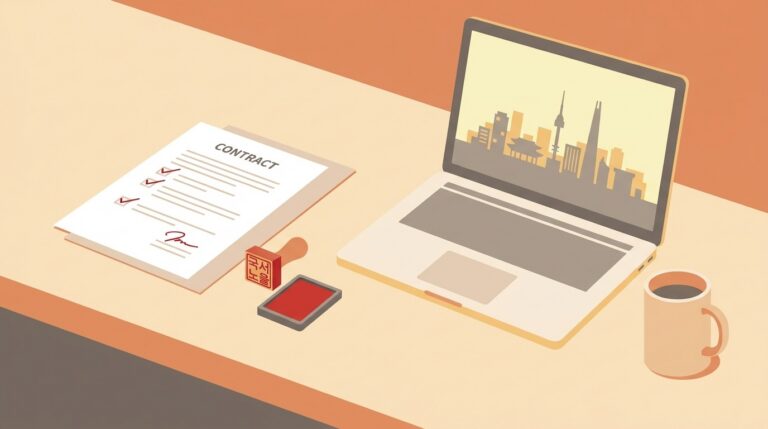
Mastering Korean Contract Redlines: How to Negotiate NDAs and Toxic Clauses Without Losing Friends
Phase 1: Empathy (Story Immersion Opening)
안녕하세요! 매일한글 에디터입니다. (Hello! I’m your Daily Hangul editor.)
Imagine this scene straight out of a classic K-Drama like Misaeng (미생) or Suits Korea: You are sitting at a sleek conference table in Gangnam, or staring down an urgent email thread with a Korean partner company. Attached is a heavy Non-Disclosure Agreement (비밀유지협약) and a master service agreement. As you scroll through the draft, your eyes widen—a punitive liquidated damages clause (위약벌) that looks unfairly steep, alongside a vague toxic clause (독소 조항) that assigns all IP liabilities solely to your team.
Your instinct is to strike through the clauses aggressively and send back a heavily marked-up file. But your hand pauses over the keyboard: Will sending a redlined document offend my Korean counterparts? How do I request revisions to high-risk terms while preserving mutual trust and polite business etiquette?
If you have ever felt paralyzed trying to balance legal firmness with Korean business politeness, you are not alone! Over the past decade, dozens of international professionals have asked us how to negotiate Korean contracts without sounding confrontational. In Korea, business agreements are deeply rooted in mutual respect, clear transparency, and diplomatic framing. In this guide, you will master the exact intermediate (B2) phrasing needed to exchange redline drafts (‘변경 내용 추적’) and negotiate NDAs smoothly, keeping your relationships intact and your company protected.
Phase 2: Top 3 Core Expressions in Depth
1. 변경 내용 추적 기능을 켜 두었습니다 (Byeong-gyeong nae-yong chu-jeok gi-neung-eul kyeo du-eot-seum-ni-da)
- Pronunciation: [Byeong-gyeong nae-yong chu-jeok gi-neung-eul kyeo du-eot-seum-ni-da] (Think of ‘byeong’ like ‘bye-ong’ and ‘chu-jeok’ like ‘choo-juck’)
- Meaning: Literal: “I have turned on the track changes function.” | Actual Nuance: “For full transparency and convenience, all edits and comments are clearly visible in the draft.”
- K-Culture Moment: In office dramas, an efficient junior manager sends an amended draft to an executive saying this phrase to show thoroughness and respect for the reader’s time.
- Editor’s Insight: In Korean corporate culture, sending a revised document without showing tracked changes can look evasive or careless. Adding this phrase establishes that you respect the other party’s time and have nothing to hide.
- Situation Spectrum: Casual: 🚫 | Semi-formal: ⚠️ | Formal: ✅
- 🤔 Think About It: In Western contracts, redlining is standard practice. Why do you think Korean professionals explicitly announce Track Changes with a polite cushion phrase rather than just sending the file silently?
2. 위약벌 및 비밀유지 조항을 일부 수정했습니다 (Wi-yak-beol mit bi-mil-yu-ji jo-hang-eul il-bu su-jeong-haet-seum-ni-da)
- Pronunciation: [Wi-yak-beol mit bi-mil-yu-ji jo-hang-eul il-bu su-jeong-haet-seum-ni-da] (Pronounce ‘wi-yak’ like ‘we-yuck’ and ‘beol’ like ‘bowl’)
- Meaning: Literal: “I modified parts of the penalty and confidentiality clauses.” | Actual Nuance: “We have adjusted the disproportionate risk provisions to align with standard mutual market standards.”
- K-Culture Moment: A lawyer in a tense legal drama calmly presenting adjusted contract clauses across a glass desk to protect their client from unreasonable liabilities.
- Editor’s Insight: Notice the word 일부 (il-bu – partially). Even if you made extensive changes, using ‘일부’ softens the impact and prevents the recipient from feeling that their original draft was completely rejected.
- Situation Spectrum: Casual: 🚫 | Semi-formal: ⚠️ | Formal: ✅
- 🤔 Think About It: How does softening statements with words like ‘partially’ (일부) reflect the broader Korean communication style of preserving the other party’s 체면 (che-myeon, social face)?
3. 투명한 검토를 위해 레드라인 본을 공유드립니다 (Tu-myeong-han geom-to-reul wi-hae re-deu-ra-in bo-neul gong-yu-deu-rim-ni-da)
- Pronunciation: [Tu-myeong-han geom-to-reul wi-hae re-deu-ra-in bo-neul gong-yu-deu-rim-ni-da] (Say ‘tu-myeong’ like ‘two-myung’ and ‘geom-to’ like ‘gum-toe’)
- Meaning: Literal: “I share the redline version for transparent review.” | Actual Nuance: “Here is the comparative markup so both legal teams can align quickly and collaboratively.”
- K-Culture Moment: A cross-border tech team lead emailing a joint venture partner before finalizing an international partnership MOU.
- Editor’s Insight: Korean companies frequently use the English loanword 레드라인 (redline) or 수정본 (revised draft) interchangeably. Framing the redline around 투명한 검토 (transparent review) highlights integrity.
- Situation Spectrum: Casual: 🚫 | Semi-formal: ✅ | Formal: ✅
- 🤔 Think About It: Contrast the emotional feeling of “Here are our corrections” versus “Sharing for transparent review.” How does your native language handle this diplomatic framing?
Phase 3: Textbook Korean vs. Real Korean
Situation 1: Submitting revisions for the other party’s review
- 📖 교과서 한국어: 계약서를 수정했으니 확인해 주십시오. (Gye-yak-seo-reul su-jeong-haet-seuni hwak-in-hae ju-sip-si-o. / “I amended the contract, so please check it.”)
- 🗣️ 진짜 한국어: 워드 파일에 변경 내용 추적 켜두었으니, 수정본 편하게 검토 부탁드립니다. (Wodeu pa-i-re byeong-gyeong nae-yong chu-jeok kyeo-dueot-seuni, su-jeong-bon pyeon-ha-ge geom-to bu-tak-deu-rim-ni-da. / “We left Track Changes on in the Word file, so please feel free to review the revised draft at your convenience.”)
- 💡 왜 다를까?: The textbook command form ‘-주십시오’ sounds commanding and blunt in modern collaborative business. Native speakers use cushion words (‘편하게 검토 부탁드립니다’) to indicate flexibility and goodwill.
Situation 2: Raising concerns over harsh penalty terms
- 📖 교과서 한국어: 이 위약벌 조항은 불공정하므로 삭제해야 합니다. (I wi-yak-beol jo-hang-eun bul-gong-jeong-ha-muro sak-je-hae-ya ham-ni-da. / “This penalty clause is unfair, so it must be deleted.”)
- 🗣️ 진짜 한국어: 위약벌 조항에 다소 부담스러운 부분이 있어, 상호 협의 가능한 수준으로 문구를 완화해 보았습니다. (Wi-yak-beol jo-hang-e da-so bu-dam-seu-reon bu-bun-i it-seo, sang-ho hyeop-ui ga-neung-han su-jun-euro mun-gu-reul wan-hwa-hae bo-at-seum-ni-da. / “The penalty clause carries some heavy exposure, so we softened the phrasing to a mutually acceptable level.”)
- 💡 왜 다를까?: Calling a partner’s clause ‘불공정’ (unfair) directly triggers defensive reactions. Professional Korean uses mitigating expressions like ‘다소 부담스러운’ (somewhat burdensome) and ‘문구를 완화하다’ (soften/relax the wording).
Phase 4: K-Culture Deep Dive & Non-Verbal Manners
4-1. 눈치 (Nunchi) & Digital Etiquette in Contract Reviews
In Korean business communication, how you present corrections is just as vital as the legal points themselves. When exchanging redlines:
1. Always Attach .docx, Never Just a Locked PDF: Sending a locked PDF during an iterative drafting stage forces the other side to do tedious manual comparisons, which displays poor 눈치 (nunchi – situational awareness). Sending an editable Word document with Track Changes on signals respect for their workflow.
2. The Magic Cushion Phrases (쿠션어): Never start your email with the redline immediately. Open with: “노고에 감사드립니다” (Thank you for your hard work) or “보내주신 초안 잘 검토했습니다” (We carefully reviewed the draft you provided).
3. Tone Down the Red: When adding comments in the margins, frame them as questions or requests for perspective: “~로 수정 제안드립니다. 확인 부탁드립니다” (We suggest revising to ~; please kindly check) rather than absolute declarations.
4-2. Cultural Code Analysis: Contracts in Korean Work Culture
In K-Dramas like Misaeng or Search: WWW, you often witness intense contract standoffs. In Korea, an agreement is not merely a legal shield for worst-case litigation; it symbolizes the blueprint for an ongoing relationship (신뢰 관계). Pushing too hard without giving the other party an honorable way to concede can kill negotiations prematurely. Framing adjustments as joint risk mitigation makes you look like a savvy, considerate partner rather than an adversary.
Phase 5: Real-World Roleplay Scenario
Setting: You are meeting online via video conference with Team Leader Park (박 팀장) from an enterprise software partner in Seoul to align on the NDA and vendor agreement terms.
- Turn 1 (박 팀장): 준호 님, 지난번에 보내드린 비밀유지협약(NDA)과 계약서 초안 검토해 보셨나요? (Junho nim, ji-nan-beon-e bo-nae-deu-rin bi-mil-yu-ji-hyeop-yak(NDA)-gwa gye-yak-seo cho-an geom-to-hae bo-syeot-na-yo? / “Junho, have you had a chance to review the NDA and contract draft we sent last time?”)
- 🎭 Politely leaning forward, holding a tablet pen.
- Turn 2 (You): 네, 박 팀장님. 팀 내부적으로 꼼꼼히 검토 완료했습니다. (Ne, Park tim-jang-nim. Tim nae-bu-jeok-euro kkom-kkom-hi geom-to wan-ryo-haet-seum-ni-da. / “Yes, Team Leader Park. Our internal team has completed a thorough review.”)
- 🎭 Nodding respectfully with a pleasant, professional smile.
- Turn 3 (박 팀장): 혹시 특별히 수정이 필요하거나 조율하고 싶은 조항이 있으셨을까요? (Hok-si teuk-byeol-hi su-jeong-i pil-yo-ha-geona jo-yul-ha-go sip-eun jo-hang-i it-eu-syeot-seul-kka-yo? / “Were there any specific clauses that need amendments or adjustment?”)
- 🎭 Looking attentive, awaiting your reaction.
- Turn 4 (You): 네, 비밀유지 기간과 위약벌 조항에 다소 상호 협의가 필요한 부분이 있었습니다. (Ne, bi-mil-yu-ji gi-gan-gwa wi-yak-beol jo-hang-e da-so sang-ho hyeop-ui-ga pil-yo-han bu-bun-i it-seot-seum-ni-da. / “Yes, there were points regarding the NDA duration and the penalty clause that require mutual alignment.”)
- 🎭 Calm tone, maintaining steady eye contact.
- Turn 5 (박 팀장): 아, 그러셨군요. 어떤 방향으로 수정을 원하시는지 말씀해 주시겠어요? (A, geu-reo-syeot-gun-yo. Eot-teon bang-hyang-euro su-jeong-eul won-ha-si-neun-ji mal-sseum-hae ju-si-get-eo-yo? / “Ah, I see. Could you tell us what direction of revision you have in mind?”)
- 🎭 Taking notes in a notebook.
- Turn 6 (You): 수정 이력이 투명하게 남도록 워드 파일에 변경 내용 추적을 켜고 레드라인 본을 정리해 두었습니다. (Su-jeong i-ryeok-i tu-myeong-ha-ge nam-do-rok wodeu pa-i-re byeong-gyeong nae-yong chu-jeok-eul kyeo-go re-deu-ra-in bo-neul jeong-ri-hae dueot-seum-ni-da. / “To keep the revision history transparent, we turned on Track Changes in the Word file and prepared a redlined draft.”)
- 🎭 Sharing screen to preview the cleanly tracked edits.
- Turn 7 (박 팀장): 아, 변경 내용 추적을 켜서 보내주시니 저희 법무팀에서도 확인하기 훨씬 수월하겠네요! (A, byeong-gyeong nae-yong chu-jeok-eul kyeo-seo bo-nae-ju-si-ni jeo-hui beop-mu-tim-e-seo-do hwak-in-ha-gi hwol-ssin su-wol-ha-get-nae-yo! / “Ah, having Track Changes on will make it much easier for our legal team to review!”)
- 🎭 Relieved nod with an appreciative expression.
- Turn 8 (You): 회의 직후 바로 메일로 송부드리겠습니다. 편하게 살펴보시고 의견 주십시오. (Hoe-ui jik-hu ba-ro me-il-ro song-bu-deu-ri-get-seum-ni-da. Pyeon-ha-ge sal-pyeo-bo-si-go ui-gyeon ju-sip-si-o. / “I will send it via email right after the meeting. Please review it at your convenience and share your thoughts.”)
- 🎭 Affirmative slight bow with both hands resting lightly on the desk.
🔀 Interactive Fork (분기점)
Now Team Leader Park asks: “위약벌 배상 한도를 어느 정도로 생각하시나요?” (What level of penalty cap are you considering?) How do you reply?
- Choice A: “독소 조항이라서 위약벌은 무조건 전부 삭제해야 합니다.” (This is a toxic clause, so the penalty must unconditionally be deleted completely.)
- Feedback [Bad]: Extremely aggressive! Directly calling their clause a ‘독소 조항’ in front of them causes major loss of face and stalls negotiations.
- Choice B: “상호 간의 계약 금액 범위 내로 위약벌 상한을 제한하는 안으로 수정 의견을 남겨두었습니다.” (We left a revision comment suggesting capping the penalty within the scope of our contract value.)
- Feedback [Best]: Perfect! It provides a rational, market-standard compromise using polished intermediate business Korean.
- Choice C: “저희가 마음대로 수정했으니 법무팀이랑 알아서 확인해 보세요.” (We modified it however we wanted, so check it with your legal team yourself.)
- Feedback [Risk]: Sounds indifferent and confrontational. This damages business rapport and marks you as an unprofessional partner.
Phase 6: 10-Second Emotion Shadowing Drill
Sentence 1: Announcing Track Changes diplomatically
[💼 정중하고 명확하게 / Polite and clear]
투명한 검토를 위해 / 워드 파일에 / 변경 내용 추적을 / 켜 두었습니다.
(Tu-myeong-han geom-to-reul wi-hae / wodeu pa-i-re / byeong-gyeong nae-yong chu-jeok-eul / kyeo du-eot-seum-ni-da.)
Sentence 2: Proposing clause modifications collaboratively
[🤝 협력적이고 부드러운 톤 / Collaborative and gentle]
위약벌 조항 문구를 / 상호 협의 가능한 수준으로 / 일부 완화하여 / 제안드립니다.
(Wi-yak-beol jo-hang mun-gu-reul / sang-ho hyeop-ui ga-neung-han su-jun-euro / il-bu wan-hwa-ha-yeo / je-an-deu-rim-ni-da.)
Sentence 3: Closing with courteous flexibility
[😊 다정하고 신뢰감 있게 / Warm and reassuring]
수정본 편하게 살펴보시고 / 보완할 점이 있으시면 / 언제든 말씀해 주세요.
(Su-jeong-bon pyeon-ha-ge sal-pyeo-bo-si-go / bo-wan-hal jeom-i it-eu-si-myeon / eon-je-deun mal-sseum-hae ju-se-yo.)
Phase 7: K-Culture Mini Dictionary
- 독소 조항 (Dok-so jo-hang) | Toxic clause / Poison pill provision
- In business Korean, this refers to one-sided, disproportionate clauses that expose one party to extreme liability. While commonly used in legal discussions internally, you rarely say ‘독소 조항’ directly to your partner’s face.
- 위약벌 (Wi-yak-beol) | Contractual penalty (Punitive liquidated damages)
- Unlike ordinary compensation for damages (손해배상액의 예정), 위약벌 is a non-reducible punitive private penalty under Korean civil law. It is crucial to review this carefully.
- 변경 내용 추적 (Byeong-gyeong nae-yong chu-jeok) | Track Changes (in MS Word)
- The gold-standard drafting mode in Korean corporate negotiation. Pairing this with 레드라인 본 (redline draft) marks you as an experienced operator.
- 날인 / 서명 (Nal-in / Seo-myeong) | Affixing a seal (stamp) / Signature
- While digital signatures (전자 서명) are expanding, traditional corporate seals (법인인감 날인) are still widely required on official execution pages.
Phase 8: Expat & Business Traveler Survival Kit
Top 3 Survival Expressions for Contract Negotiations
- 수정 이력을 표시해 두었습니다. (Su-jeong i-ryeok-eul pyo-si-hae dueot-seum-ni-da.)
- Meaning: “I have marked the revision history.”
- Pro Tip: Use this when emailing counterparts who may not be native Word power users.
- 법무팀 검토 후 회신드리겠습니다. (Beop-mu-tim geom-to hu hoe-sin-deu-ri-get-seum-ni-da.)
- Meaning: “I will reply after our legal team reviews it.”
- Pro Tip: The ultimate buffer phrase to buy time during intense negotiation meetings without losing face.
- 상호 합의 하에 조율 가능할까요? (Sang-ho hap-ui ha-e jo-yul ga-neung-hal-kka-yo?)
- Meaning: “Could we adjust this based on mutual agreement?”
- Pro Tip: Polite, open question format that invites productive problem-solving.
Editor’s Business Travel Note
When conducting business in Korea, downloading the official 국가법령정보센터 모바일 앱 (National Law Information Center App) lets you instantly verify Korean statutory terms and standard contract templates directly on your phone. Also, make sure to keep 한컴오피스 뷰어 앱 installed, as many public institutions and domestic enterprises still exchange preliminary files in .hwp or .hwpx format!
Phase 9: Deep Reflection (“한 발 더 깊이”)
In Western legal tradition, a contract is built to anticipate the dissolution of trust—an ironclad safeguard for litigation. In Korean business culture, however, a contract is celebrated as the threshold of 신뢰 (trust) and 정 (deep human connection). When Korean counterparts see thoughtful redlines accompanied by humble, collaborative wording, they view you not as a contentious opponent, but as a reliable, long-term ally who respects their collective reputation. Balancing clear contractual boundaries with verbal warmth is the true hallmark of advanced intercultural mastery.
💬 Your Turn: Have you ever experienced an awkward moment while negotiating contracts or requesting changes with an international team? What cushion word or approach helped you de-escalate the tension? Share your experience in the comments below!
Phase 10: FAQ & Common Mistakes (FAQ Schema)
Q: Is it considered offensive to redline a Korean business partner’s contract?
A: Not at all, provided you handle it transparently and courteously! Turn on ‘Track Changes’ (변경 내용 추적), provide concise rationales in marginal comments, and accompany the file with a polite cover note stating that you modified items to ensure mutual benefit (상호 협력).
Q: What is the difference between ‘손해배상’ (Son-hae-bae-sang) and ‘위약벌’ (Wi-yak-beol)?
A: 손해배상액의 예정 is an estimate of actual damages, which Korean courts can reduce if excessive. In contrast, 위약벌 is a punitive penalty that courts are generally reluctant to reduce. Always review 위약벌 clauses with extreme care and negotiate a reasonable liability cap.
Q: How do I refer to Track Changes in Korean emails without sounding overly technical?
A: You can simply write: “워드 파일에 변경 내용 추적을 켜두었으니 확인 부탁드립니다” (Track Changes is turned on in the Word file, so please check it) or mention “레드라인 본을 송부드립니다” (Sending the redline draft).
🚨 Common Mistakes Alert
- Mistake: Calling a draft “Wrong” or “Unacceptable” (틀렸다 / 수용 불가능하다)
- Correct Action: Frame it as risk balance: “상호 리스크 경감을 위해 문구 조정을 제안드립니다” (We propose wording adjustments to mitigate mutual risks).
- Mistake: Sending a clean Word document without revision history
- Correct Action: Always turn on Track Changes (변경 내용 추적) or attach both a clean copy and a highlighted redline copy.
- Mistake: Accusing the counterparty of including “toxic clauses” (독소 조항) in writing
- Correct Action: Use objective descriptions such as “상당한 부담이 되는 조항” (clauses imposing substantial burden) or “통상적인 상관례에 부합하도록 완화” (adjusting to meet standard commercial practices).
Phase 11: Action Mission & Engagement
- 🥉 Bronze Mission (Solo Shadowing): Read Sentence 1 from Phase 6 out loud three times, matching the pause markers
/and confident, polite cadence. - 🥈 Silver Mission (Writing Practice): Write a 2-sentence mock email opening in Korean informing your partner that you attached a redlined draft with Track Changes turned on.
- 🥇 Gold Mission (Real-World Application): In your next business email or language exchange, use the phrase “상호 협의를 위해 일부 수정 의견을 남겨두었습니다” (I left some revision comments for mutual alignment).
🎮 K-Culture Mission: Watch an episode of a Korean office drama (such as Misaeng or Agency). Spot how junior and senior managers negotiate when exchanging documents. Do you notice the cushion phrases they use before bringing up difficult news?
Phase 12: Interactive Quiz Challenge
Question 1 (Situational Judgment)
You need to email a Korean enterprise partner with redline changes on an NDA. Which subject line is the most polished and professional?
* A) 계약서 다 틀렸으니 수정본 확인하세요.
* B) [비밀유지협약] 변경 내용 추적본(레드라인) 검토 요청의 건
* C) 위약벌 독소 조항 삭제 요구서
Question 2 (Fill-in-the-Blank)
To say “To keep revision history transparent, we turned on Track Changes,” fill in the blank:
“수정 이력이 투명하게 남도록 워드 파일의 ‘___________’ 기능을 켰습니다.”
Question 3 (True or False Cultural Quiz)
In Korea, it is polite to silently remove clauses you disagree with without marking them, so the other party doesn’t feel embarrassed.
* True
* False
👉 Click to view answers and explanations!
- Q1 Answer: B ([비밀유지협약] 변경 내용 추적본(레드라인) 검토 요청의 건)
- Explanation: Using bracket tags like
[비밀유지협약]followed by clear, courteous noun phrasing (~검토 요청의 건) is standard corporate Korean etiquette. Options A and C are blunt and damaging to professional rapport.
- Explanation: Using bracket tags like
- Q2 Answer: 변경 내용 추적 (Byeong-gyeong nae-yong chu-jeok)
- Explanation: This is the exact Korean terminology for MS Word’s ‘Track Changes’ feature.
- Q3 Answer: False
- Explanation: Silently deleting clauses without tracking changes is viewed as secretive and untrustworthy in Korean corporate settings. Always exchange transparent redlines!
- Explanation: Silently deleting clauses without tracking changes is viewed as secretive and untrustworthy in Korean corporate settings. Always exchange transparent redlines!







