

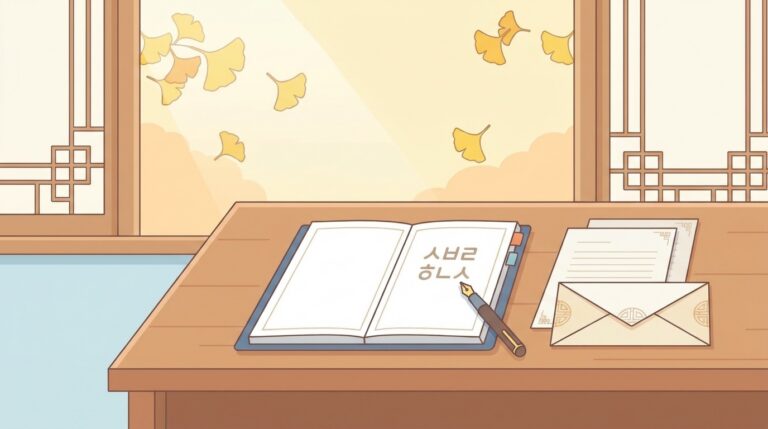
Writing a Heartfelt Korean Thank-You Letter to Your Teacher: The Polished Guide Without the Awkwardness
Phase 1: Empathy & Storytelling Opening
안녕하세요! It’s your Daily Hangul editor and cultural navigator!
Have you ever sat at your desk with a gorgeous sheet of Korean stationery (편지지 – pyeonjiji), pen uncapped, staring into space because you had no idea how to start? You want to write a thank-you note to your Korean professor, language tutor, or workplace mentor. You open your translation app and type, “Thank you for teaching me. I am good now.” But when it spits out “가르쳐 주셔서 감사합니다. 저는 이제 좋습니다,” your gut screams that something is terribly off.
In Korean dramas like Hospital Playlist or Black Dog, you often see juniors presenting handwritten letters to respected senior mentors. Notice how they never just jump straight into business? They always begin with a poetic, delicate observation about the season: the crisp autumn wind, the falling leaves, or the first snow. In Korean culture, jumping straight to “Thank you for X” feels abrupt—almost like showing up to a formal dinner in sweatpants.
Many of our intermediate learners tell us, “Editor, I know polite endings like -요 (-yo) and -습니다 (-seumnida), but my letters still sound like robotic customer service emails!” Don’t worry. Today, we are going to unlock the art of the traditional Korean greeting letter, starting with the quintessential opening: “선생님, 안녕하세요? 계절이 바뀌어 선선한 바람이 부는데 그동안 건강히 잘 지내셨는지요” (Hello Teacher, as the seasons change and a cool breeze blows, I hope you have been doing well and staying healthy). Let’s turn your awkward note into a keepsake your mentor will treasure forever!
Phase 2: 3 Core Expressions in Depth
Here are three foundational building blocks that will elevate your letter from elementary to deeply respectful and authentic.
1. 선생님, 안녕하세요? 계절이 바뀌어 선선한 바람이 부는데 그동안 건강히 잘 지내셨는지요? (Seon-saeng-nim, an-nyeong-ha-se-yo? Gye-jeor-i ba-kkwi-eo seon-seon-han ba-ram-i bu-neun-de geu-dong-an geon-gang-hi jal ji-nae-syeot-neun-ji-yo?)
- Pronunciation: Think of seon-seon as the gentle whoosh of an autumn breeze—crisp and soft like “sun-sun” with a breezy whisper. The ending -syeot-neun-ji-yo flows like gentle waves rolling up a sandy shore.
- Meaning: Literal: “Teacher, hello? The season has changed and a cool breeze blows; in the meantime, did you spend time healthily?” / Real Nuance: “Dear Teacher, I hope this crisp seasonal change finds you in great health and peace.”
- K-Culture Moment: This is the gold-standard opening used by Korean university students visiting professors ahead of Chuseok (Korean Thanksgiving) or Teachers’ Day (Seuseung-ui Nal).
- Editor’s Insight: Koreans consider weather and personal well-being inseparable. Mentioning the weather (gyejeol insa) proves that you aren’t just sending a generic template copy-pasted to ten people; you are sharing the exact atmosphere of the present moment with them.
- Situation Spectrum: Casual 🚫 | Semi-formal ⚠️ | Formal ✅
- 🤔 Think About It: Why does Korean letter writing prioritize atmospheric nature over immediate personal updates? How does acknowledging nature set an emotional bridge before sharing personal feelings?
2. 선생님의 따뜻한 가르침 덕분에 많이 성장할 수 있었습니다. (Seon-saeng-nim-ui tta-tteut-han ga-reu-chim deok-bu-ne man-i seong-jang-hal su it-seot-seum-ni-da.)
- Pronunciation: Tta-tteut-han features a double consonant (따 / tt) that sounds like the firm, pop-click “t” in “star”.
- Meaning: Literal: “Thanks to Teacher’s warm teaching, I was able to grow a lot.” / Real Nuance: “Your patient mentorship made all the difference in my personal and academic development.”
- K-Culture Moment: Often written on handwritten cards tucked inside a small box of traditional rice cakes (tteok) or high-end tea given to mentors.
- Editor’s Insight: The magic word here is 덕분에 (deokbune = thanks to you). In Korean social dynamics, crediting the mentor for your own progress demonstrates modesty (gyeomson), a cherished Confucian virtue.
- Situation Spectrum: Casual 🚫 | Semi-formal ⚠️ | Formal ✅
- 🤔 Think About It: In English, we often say “I achieved my goal thanks to your class.” In Korean, the focus stays on the mentor’s warmth (따뜻한 가르침) rather than just technical instruction. How does this reframe the teacher-student relationship?
3. 환절기에 감기 조심하시고 늘 건강하시기를 진심으로 바랍니다. (Hwan-jeol-gi-e gam-gi jo-sim-ha-si-go neul geon-gang-ha-si-gi-reul jin-sim-eu-ro ba-ram-ni-da.)
- Pronunciation: Hwan-jeol-gi sounds like “Hwan-jol-gee”. Ensure gam-gi does not sound like “gum-gee”—keep the “a” open like in “father”.
- Meaning: Literal: “In the in-between seasons period, be careful of colds and I sincerely wish you are always healthy.” / Real Nuance: “Please take good care during this transitional weather, and I wish you enduring health and happiness from the bottom of my heart.”
- K-Culture Moment: The timeless sign-off sentence seen at the end of heartfelt KakaoTalk messages and formal seasonal letters.
- Editor’s Insight: 환절기 (hwanjeolgi = seasonal transition period) is prime flu season in Korea. Wishing that someone avoids a cold (gamgi josim) is not an idle medical remark; it is the ultimate everyday expression of genuine Korean affection (jeong).
- Situation Spectrum: Casual ⚠️ | Semi-formal ✅ | Formal ✅
- 🤔 Think About It: In Western culture, telling someone “don’t catch a cold” might feel like your mom nagging you. In Korea, why is it considered the peak of thoughtful manners?
Phase 3: Textbook Korean vs. Real Korean
Let’s compare stiff, machine-translated Korean with the natural, refined phrasing native speakers use.
Situation 1: Asking how your teacher has been
- 📖 교과서 한국어 (Textbook Style): 어떻게 지냈어요? 저는 잘 지냈어요. (Eotteoke jinaesseoyo? Jeoneun jal jinaesseoyo. — How did you spend your time? I spent mine well.)
- 🗣️ 진짜 한국어 (Authentic Refined Style): 그동안 평안하셨는지요? 저는 선생님 덕분에 뜻깊은 날들을 보내고 있습니다. (Geudongan pyeong-an-ha-syeot-neun-ji-yo? Jeoneun seonsaengnim deokbune tteut-gipeun naldeureul bonaego itseumnida. — Have you been at peace during this time? Thanks to you, I have been having meaningful days.)
- 💡 왜 다를까?: “어떻게 지냈어요?” is too casual and inquisitorial for an elder or mentor. Asking whether they were “peaceful” (pyeong-an) honors their status, while describing your time as “meaningful” (tteut-gipeun) shows intellectual maturation.
Situation 2: Closing your letter
- 📖 교과서 한국어 (Textbook Style): 편지를 읽어 주셔서 감사합니다. 안녕히 계세요. (Pyeonjireul ilgeo jusyeoseo gamsahamnida. Annyeonghi gyeseyo. — Thank you for reading this letter. Goodbye.)
- 🗣️ 진짜 한국어 (Authentic Refined Style): 조만간 찾아뵙고 인사드리겠습니다. 건강 조심하세요! (Jomangan chajabwepgo insadeurigesseumnida. Geongang josimhaseyo! — I look forward to greeting you in person soon. Please stay healthy!)
- 💡 왜 다를까?: Ending a letter to a teacher with “안녕히 계세요” sounds like a kid leaving a classroom. Promising to pay a visit (chajabwepda) shows long-term loyalty and devotion.
Phase 4: K-Culture Deep Dive & Non-Verbal Manners
4-1. 눈치 (Nunchi) & Physical Letter Etiquette
- Two Hands Are Non-Negotiable: When handing over your envelope, hold both top corners with two hands, tilt your upper body forward around 15–30 degrees, and make soft eye contact before casting your eyes downward respectfully.
- The Red Ink Taboo: NEVER write your teacher’s name or sign your letter in red ink. In Korean folklore, red ink was historically used to record deceased names or ward off spirits, implying misfortune or death.
- Subtle Stationery Choices: Avoid neon colors or overly cartoonish cards unless you know your mentor enjoys cute aesthetics. Muted earth tones, traditional mulberry paper (hanji), or crisp cream-colored letter sets showcase elegance and sincerity.
4-2. Cultural Code Analysis: 스승의 은혜 (The Grace of Mentors)
There is a famous Korean adage: “스승의 그림자는 밟지도 않는다” (You do not even step on your teacher’s shadow). While contemporary Korea is much more relaxed, educators and mentors still hold a uniquely revered moral status. A thank-you letter is not seen merely as correspondence; it is a ritual reaffirming Inyeon (인연 – karmic connection). By weaving seasonal changes into your words, you align your mentor’s guidance with the natural order of life.
Phase 5: Real-World Roleplay Scenario
Setting: Professor Min’s sunlit university office during late autumn. Leaves are rustling outside, and a kettle of green tea steams on the low wooden table.
Characters:
* Elena (엘레나): An exchange student preparing to return to her home country.
* Professor Min (민 교수님): Elena’s warm yet dignified academic advisor.
🎬 Watch Our Daily Videos! (Daily Hangul Official Instagram)
Review the expressions you learned in this article with our fun daily short videos! Check out native pronunciation and real-life nuances in action.
- Instagram @dailyhangul_en
Frequently Asked Questions (FAQ)
Q: What does "📖 교과서 한국어" mean in Korean and how do you pronounce it?
A: In Korean, "📖 교과서 한국어" is pronounced [Textbook Style] and means: 어떻게 지냈어요? 저는 잘 지냈어요. (
Q: What does "🗣️ 진짜 한국어" mean in Korean and how do you pronounce it?
A: In Korean, "🗣️ 진짜 한국어" is pronounced [Authentic Refined Style] and means: 그동안 평안하셨는지요? 저는 선생님 덕분에 뜻깊은 날들을 보내고 있습니다. (
Q: What does "📖 교과서 한국어" mean in Korean and how do you pronounce it?
A: In Korean, "📖 교과서 한국어" is pronounced [Textbook Style] and means: 편지를 읽어 주셔서 감사합니다. 안녕히 계세요. (
Q: What does "🗣️ 진짜 한국어" mean in Korean and how do you pronounce it?
A: In Korean, "🗣️ 진짜 한국어" is pronounced [Authentic Refined Style] and means: 조만간 찾아뵙고 인사드리겠습니다. 건강 조심하세요! (







