

Phase 1: Empathy (A Story You Know All Too Well)
안녕하세요! 매일한글 에디터입니다.
Imagine this scenario: you just received a sleek, glossy medical envelope in the mail—or even faster, a vibrant KakaoTalk alert from a medical examination center in Gangnam. Your annual or biennial Korean health checkup (건강검진) results have arrived. If you’ve ever watched a K-Drama, you know that whenever a character nervously opens a white medical dossier, ominous piano music swells and tears follow! Naturally, your heart starts pounding when your eyes catch bold text reading 갑상선 결절 (Thyroid Nodule) followed by the phrase 추적 관찰 (Follow-up Monitoring).
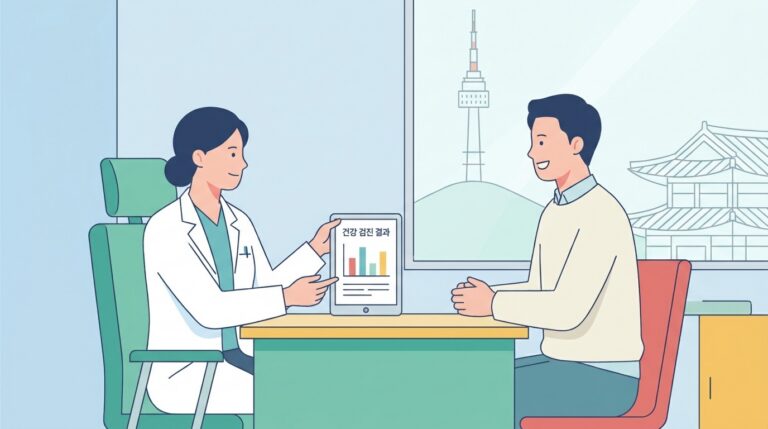
Your mind immediately races: Do I need surgery? Should I pack my bags? Why didn’t they call me immediately? But then you sit across from your doctor, who has a completely calm, reassuring smile. Waving their pen over the scan, they say: “아주 작은 결절이지만 모양이 깨끗해서 당장 치료할 필요 없이 1년마다 크기 변화만 추적 관찰하시면 돼요.” In plain English: it’s tiny, it has clean borders, and all you need is a routine annual ultrasound check.
Korean preventive medicine is world-renowned for its hyper-meticulous early screening. Because state-of-the-art ultrasound scans pick up every microscopic irregularity, seeing the words ‘결절’ (nodule) or ‘용종’ (polyp) is extraordinarily common. Over 90% of our intermediate learners freeze when encountering these clinical terms, confusing a standard safety check for an emergency. Today’s guide, built on real feedback from expats living in Seoul and Busan, will turn clinical anxiety into total linguistic confidence. Let’s master the exact vocabulary and cultural etiquette you need to navigate follow-up consultations like a seasoned local!
Phase 2: 3 Key Expressions Deep Dive
1. 추적 관찰 (Chujeok gwanchal)
- Pronunciation: [Choo-jeok gwan-chal] (Think: “Choo-train” + “jerk” + “gwan” + “chal-ice”)
- Meaning: Literal: Tracking observation | Actual: Clinical follow-up monitoring / Watchful waiting
- K-Culture Moment: In the hit medical drama Hospital Playlist (슬기로운 의사생활), neurosurgeon Chae Song-hwa calmly reassures an anxious patient that an ambiguous spot on their scan doesn’t require immediate surgery, just regular 6-month or 1-year 추적 관찰.
- Editor’s Insight: Western medicine often calls this “active surveillance” or “watchful waiting.” In Korea, because healthcare access is so swift and cost-effective, doctors routinely order “추적 관찰” rather than jumping into invasive interventions.
- Situation Spectrum: Casual ⚠️ | Semi-formal ✅ | Formal ✅
- 🤔 Think About It: In many Western healthcare systems, you often wait months just to see a specialist, so doctors rarely say “let’s just watch it every 6 months.” How does Korea’s fast, high-density hospital ecosystem shape the concept of proactive vigilance?
2. 모양이 깨끗하다 (Moyangi kkaekkeuthada)
- Pronunciation: [Mo-yang-i kkae-kkeut-ha-da] (Roughly: “Mo-yahng-ee kkae-koot-ha-da”)
- Meaning: Literal: The shape is clean | Actual: Smooth, well-defined margins / Benign appearance
- K-Culture Moment: In health variety shows like My Little Old Boy (미운 우리 새끼), when celebrity cast members go for endoscopy or ultrasound screenings, the family in the studio visibly exhales the moment the doctor says, “모양이 아주 깨끗하네요” (The shape is very clean/benign).
- Editor’s Insight: In Korean clinical parlance, “깨끗하다” doesn’t mean sanitary or washed! When describing nodules, polyps, or organ tissue, it signifies smooth, regular borders without calcification or jagged edges—a strong clinical indicator of a benign condition.
- Situation Spectrum: Casual ✅ | Semi-formal ✅ | Formal ✅
- 🤔 Think About It: Notice how Korean medicine bridges scary technical terminology (like ‘benign morphology’) using warm, sensory everyday adjectives like ‘clean’ (깨끗하다) to put patients at ease.
3. 혹 / 결절 (Hok / Gyeoljeol)
- Pronunciation: [Hoke] (rhymes with ‘folk’) / [Gyeol-jeol] (sounds like “Gyul-jawl”)
- Meaning: Literal: Lump, bump / Knot, nodule | Actual: Benign bump or nodule
- K-Culture Moment: Every Korean mother on a weekend family drama talking to her adult children on the phone: “목에 조그만 혹이 있다는데, 의사 선생님이 괜찮대.” (They said there’s a tiny bump in my neck, but the doctor said it’s nothing to worry about.)
- Editor’s Insight: “결절” is the formal Sino-Korean medical term printed on your official test results. When speaking verbally in a consultation or with family, native Koreans almost always use the softer, colloquial native Korean word “혹” (lump/bump) to avoid sounding alarming.
- Situation Spectrum:
- 혹: Casual ✅ | Semi-formal ✅ | Formal ⚠️
- 결절: Casual ⚠️ | Semi-formal ✅ | Formal ✅
- 🤔 Think About It: Why do you think native Korean speakers deliberately switch between Sino-Korean words (결절) for diagnosis and native Korean words (혹) for personal reassurance?
Phase 3: Textbook Korean vs. Real Korean
Situation 1: Asking if immediate treatment or surgery is needed
- 📖 교과서 한국어 (Textbook):
“현재 즉각적인 수술이나 약물 복용 치료가 요구되는 상태입니까?”
(Hyeonjae jeuk-gakjeogin susurina yangmul bogyong chiryoga yogudoeneun sangtae-imnikka? / Is this a condition requiring immediate surgical or pharmaceutical intervention?) - 🗣️ 진짜 한국어 (Real-world):
“당장 뭐 약 먹거나 수술할 필요는 전혀 없는 거죠?”
(Dangjang mwo yak meokgeona susulhal pil-yoneun jeonhyeo eomneun geojyo? / So there’s absolutely no need to take meds or have surgery right now, right?) - 💡 왜 다를까? (Why the difference?): Textbook phrasing sounds like an insurance affidavit! Real patients speak with conversational hedges like “당장” (right away), “뭐” (like/sort of), and “-는 거죠?” (seeking confirmation), which conveys natural emotion and relief.
Situation 2: Asking when to schedule the follow-up ultrasound
- 📖 교과서 한국어 (Textbook):
“다음 초음파 추적 관찰 검사 일정은 몇 개월 후에 진행합니까?”
(Daeum cho-eumpa chujeok gwanchal geomsa iljeong-eun myeot gaewol hue jinhaenghamnikka? / In how many months will the subsequent follow-up ultrasound examination proceed?) - 🗣️ 진짜 한국어 (Real-world):
“그럼 1년 뒤에 다시 초음파 보러 오면 될까요?”
(Geureom il-nyeon dwie dasi cho-eumpa boreo omyeon doelkkayo? / So should I just come back in a year to get the ultrasound checked again?) - 💡 왜 다를까? (Why the difference?): Native speakers rarely say “검사를 진행하다” (proceed with an exam) in conversation. Instead, they use active sensory verbs like “초음파 보러 오다” (come to look at an ultrasound) coupled with the soft interrogative ending “-면 될까요?” (would it be good if I…?).
Phase 4: K-Culture Deep Dive & Non-Verbal Manners
4-1. 눈치 (Nunchi) & Consultation Body Language
- The Screen-Glance Posture: In Korean outpatient clinics (외래 진료실), the doctor sits with two or three large monitors. When they point their stylus or ballpoint pen at your ultrasound scan, lean slightly forward, look directly at the pinpointed spot, and nod gently with a soft “아, 네네” (Ah, ne-ne). Staring fixedly into the doctor’s eyes while they’re analyzing your screen can actually disrupt their concentration!
- Two-Handed Document Receipt: When the physician or nurse hands you your official summary report (건강검진 종합소견표), always receive it with both hands or with your right hand supported at the wrist by your left hand. This subtle gesture conveys profound respect for their expertise.
4-2. Cultural Code: The Culture of Early Detection (조기 검진)
Korea’s National Health Insurance Service (국민건강보험) mandates and funds periodic checkups for all citizens and foreign residents. Because comprehensive checkups—including neck ultrasounds, endoscopies, and blood panels—are exceptionally affordable compared to many Western nations, Korean doctors operate on an aggressive “Early Discovery (조기 발견)” philosophy. Detecting a 3-millimeter thyroid nodule isn’t viewed as a crisis; it is treated as a routine maintenance milestone, much like checking the tire pressure on your car!
Phase 5: Real-Life Roleplay Scenario
Setting: Consultation Room 3 at Seoul Premier Health Center. Soft instrumental music plays in the corridor. Dr. Park (박 원장님), an experienced and gentle physician, is reviewing your thyroid ultrasound report on his screen while you sit beside him.
Alex: 원장님, 안녕하세요. 결과표 보고 결절이 있다고 해서 깜짝 놀라 달려왔어요.
(Wonjangnim, annyeohaseyo. Gyeolgwapyo bogo gyeoljeori itdago haeseo kkamjjak nolla dallyeowasseoyo.)
[Doctor, hello. I saw that I had a nodule on my result sheet and panicked, so I rushed here.]
🎭 Leaning forward nervously with both hands clutching the paper
Dr. Park: 아이고, 그러셨어요? 많이 놀라셨죠. 화면 여기 한번 같이 보실까요?
(Aigo, geureosyeosseoyo? Mani nollasyeotjyo. Hwamyeon yeogi hanbeon gachi bosilkkayo?)
[Oh dear, is that so? You must have been frightened. Shall we take a look at the screen together here?]
🎭 Pointing gently to the ultrasound image with his pen
Alex: 네! 여기 까맣게 보이는 이 동그란 점인가요?
(Ne! Yeogi kkamaege boineun i donggeuran jeomingayo?)
[Yes! Is it this round black spot showing up right here?]
🎭 Squinting at the monitor with genuine curiosity
Dr. Park: 맞아요. 갑상선 왼쪽에 0.4cm 정도 되는 아주 작은 결절이 하나 보여요.
(Majayo. Gapsangseon oenjjoge 0.4cm jeongdo doeneun aju jageun gyeoljeori hana boyeoyo.)
[That’s right. There is a tiny nodule measuring about 0.4 cm on the left side of your thyroid.]
🎭 Drawing a subtle circle on the screen margin
Alex: 0.4센티면… 혹시 위험하거나 수술해야 하는 건 아닌가요?
(0.4sentimyeon… hoksi wiheomhagona susulhaeya haneun geon aningayo?)
[If it’s 0.4 cm… could it be dangerous, or do I need surgery?]
🎭 Gulping slightly, voice laced with hesitation
Dr. Park: 전혀요! 주변 경계선 모양이 아주 깨끗하고 둥글어서 양성 혹으로 보입니다. 당장 시술이나 약물 치료는 전혀 필요 없어요.
(Jeonhyeoyo! Jubyeon gyeonggyeseon moyangi aju kkaekkeuthago dunggeureoseo yangseong hogeuro boimnida. Dangjang sisurina yangmul chiryoneun jeonhyeo pil-yo eopseoyo.)
[Not at all! The surrounding margin has a very clean shape and is rounded, so it appears to be a benign bump. There is zero need for immediate procedures or medication.]
🎭 Nodding with a wide, reassuring smile
Alex: 아, 정말 다행이네요! 그럼 저는 앞으로 어떻게 관리하면 될까요?
(A, jeongmal dahaeng-ineyoyo! Geureom jeoneun apeuro eotteoke gwanlihamyeon doelkkayo?)
[Ah, what a relief! Then how should I manage this going forward?]
🎭 Shoulders visibly relaxing with an audible sigh of relief
Dr. Park: 1년에 한 번씩 정기 검진 오실 때 초음파로 크기 변화만 추적 관찰하시면 충분합니다. 걱정 푹 놓으세요!
(Il-nyeone han beonssik jeonggi geomjin osil ttae cho-eumparo keugi byeonhwaman chujeok gwanchalhasimyeon chungbunhamnida. Geokjeong puk noseoyo!)
[It is more than enough to simply follow up on any size changes via ultrasound during your annual checkup. Put your worries completely to rest!]
🎭 Printing the summary and handing it over with two hands
🔀 Interactive Decision Point: What is your next line?
- Choice A: “원장님, 불안하니까 그냥 지금 당장 째서 떼어내 주시면 안 돼요?”
(Wonjangnim, buranhannikka geunyang jigeum dangjang jjaeseo tteeonae jusimyeon an dwaeyo? / Doctor, I’m anxious, so can’t you just slice it and cut it out right now?)- Feedback [Bad]: In Korea, operating on an asymptomatic, sub-centimeter benign nodule violates standard clinical protocols and causes unnecessary scar tissue. The doctor will firmly decline and try to soothe your overreaction!
- Choice B: “네, 원장님! 그럼 내년 건강검진 때 잊지 않고 초음파 다시 신청해서 볼게요. 감사합니다!”
(Ne, wonjangnim! Geureom naenyeon geonganggeomjin ttae itji anko cho-eumpa dasi sincheonghaeseo bolgeyo. Gamsahamnida! / Yes, Doctor! Then I won’t forget to request an ultrasound again during next year’s health checkup. Thank you!)- Feedback [Best]: 100% natural, polite, and demonstrates an exact understanding of preventive follow-up care (추적 관찰). Dr. Park will be delighted with your proactive health literacy.
- Choice C: “깨끗하다니까 앞으로 평생 병원 다시 안 와도 되겠네요!”
(Kkaekkeuthadanikka apeuro pyeongsaeng byeong-won dasi an wado doegenneyo! / Since it’s clean, I guess I never need to visit a hospital again for the rest of my life!)- Feedback [Risk]: While it is benign today, nodules can theoretically change or grow over decades. Dismissing follow-ups altogether defeats the entire purpose of “추적 관찰.”
Phase 6: 10-Second Emotion Shadowing Drill
Practice reading these sentences aloud, pausing at the slashes (/), and adopting the targeted emotional tone.
[😌 Relieved & Attentive]
모양이 깨끗하다고 하시니 / 정말 안심이 되네요.
(Moyangi kkaekkeuthadago hasini / jeongmal ansimi doeneyo.)
[Since you say the shape is clean / I feel so relieved.]-
[🧐 Inquiring & Composed]
그럼 특별한 치료 없이 / 1년 뒤에 크기 변화만 / 추적 관찰하면 될까요?
(Geureom teukbyeolhan chiryo eopsi / il-nyeon dwie keugi byeonhwaman / chujeok gwanchalhamyeon doelkkayo?)
[Then without any special treatment / should I just follow up on size changes / in one year?] -
[🙏 Heartfelt & Grateful]
원장님께서 알기 쉽게 설명해 주셔서 / 마음이 훨씬 편해졌어요!
(Wonjangnimkkeseo algi swipge seolmyeonghae jusyeoseo / maeumi hwolssin pyeonhaejyeosseoyo!)
[Because you explained it so clearly, Doctor / my mind feels so much more at peace!]
Phase 7: K-Culture Mini Dictionary
-
추적 관찰 (Chujeok gwanchal) | Follow-up Observation / Active Monitoring
- Clinical & Everyday Usage: Used whenever an exam uncovers a benign anomaly (nodule, polyp, or borderline blood indicator) that simply needs routine inspection rather than immediate medication.
- 결절 (Gyeoljeol) vs. 혹 (Hok) | Nodule vs. Bump/Lump
- Clinical & Everyday Usage: ‘결절’ is formal medical terminology found on paperwork. ‘혹’ is the universal spoken term used with friends, family, and even by doctors speaking gently to patients.
- 양성 (Yangseong) vs. 악성 (Akseong) | Benign vs. Malignant
- Clinical & Everyday Usage: “양성” means non-cancerous/benign. Careful: In everyday language, ‘양성’ can also mean ‘testing positive’ on a virus antigen test, but in tumor pathology, it means safe and benign!
- 정기 검진 (Jeonggi geomjin) | Periodic / Routine Health Checkup
- Clinical & Everyday Usage: Refers to standard bi-annual or annual screenings organized through workplaces or the National Health Insurance Service.
Phase 8: Traveler’s & Expat Survival Kit
Top 3 Medical Survival Expressions
- “결과지에 대해 조금만 더 자세히 설명해 주실 수 있나요?”
(Gyeolgwajie daehae jogeumman deo jasehi seolmyeonghae jusil su innayo?)- Pro Tip: Use this polite phrase if the doctor speaks too rapidly or uses difficult medical jargon.
- “혹시 큰 병원(상급 종합병원)에 가봐야 하는 소견인가요?”
(Hoksi keun byeong-won-e gabwaya haneun sogyeon-ingayo?)- Pro Tip: Ask this if you want absolute clarity on whether you need a university hospital referral (진료의뢰서).
- “보험 청구용 진단서와 영문 결과지도 발급되나요?”
(Boheom cheongguyong jindanseowa yeongmun gyeolgwajido balgeupdoenayo?)- Pro Tip: Essential for international health insurance claims. Most major Korean screening centers issue English reports for a tiny administrative fee (usually 5,000–10,000 KRW).
Editor’s Travel & Expat Note
- Essential Mobile Portal: Check out the 국민건강보험 공단 공식 홈페이지 to verify your checkup eligibility cycle and access digital test history with your alien registration card (ARC).
- Booking App: Download Korean medical navigation apps such as Goodoc (굿닥) or Ddokdak (똑닥) to find bilingual clinics and book ultrasound follow-ups without waiting in line.
Phase 9: “One Step Deeper” (Sociolinguistic Insight)
In Korean society, physical wellness is deeply communal. Receiving an annual checkup is not viewed as an isolated personal event; it is an obligation to one’s family and workplace. When a family member discovers a “혹” (nodule), the entire family often rallies, asking questions and comparing checkup results over dinner. The clinical emphasis on “추적 관찰” (tracking observation) reflects a broader cultural balance between hyper-efficient vigilance (빨리빨리 문화) and relational peace of mind. By keeping tabs on minor bodily shifts every year, Koreans transform potential health fears into manageable, predictable routines.
💬 Your Turn: Have you ever received a medical test result in Korea or your home country that sounded terrifying in medical jargon but turned out to be completely harmless? Let us know in the comments below!
Phase 10: FAQ & Common Mistakes
Q: Does having a ‘결절’ (nodule) on my thyroid ultrasound mean I am at high risk for cancer?
A: Not at all! Thyroid nodules are extraordinarily common, present in over 30–50% of healthy adults. When the doctor notes that “모양이 깨끗하다” (margins are smooth/clean) and under 1 cm, the likelihood of malignancy is extremely low. It simply requires routine annual ultrasound checks.
Q: Can I request my checkup results in English at Korean clinics?
A: Yes! Almost all major medical examination centers (건강검진센터) and university hospitals provide English summaries. Simply inquire at the reception counter before or immediately after your checkup: “영문 결과표 발급 가능한가요?”
Q: What is the difference between ‘초음파’ (ultrasound) and ‘조직 검사’ (biopsy)?
A: ‘초음파’ (Ultrasound) is a non-invasive scan using sound waves. A ‘조직 검사’ (Biopsy / Fine Needle Aspiration) is only performed if a nodule shows suspicious irregular margins (모양이 불규칙하다), microcalcification, or rapid growth beyond standard thresholds.
🚨 흔한 실수 (Common Mistakes) Warning Board
- Mistake 1: Confusing ‘양성’ (Benign) with ‘악성’ (Malignant).
- Wrong: Panicking when hearing “양성 혹” because in COVID-19 tests, “양성” (positive) means you have the virus!
- Correct Action: In tumor diagnosis, 양성 (良性) means benign/favorable, while 악성 (惡性) means malignant/cancerous.
- Mistake 2: Demanding immediate surgery for sub-centimeter clean nodules.
- Wrong: Saying “불안하니 당장 수술해 주세요!” (Cut it out now!).
- Correct Action: Respect clinical consensus. Say: “1년 뒤 추적 관찰로 지켜보겠습니다.” (I’ll monitor it in a year).
- Mistake 3: Skipping future annual checkups because it was benign this year.
- Wrong: Thinking “깨끗하다” means you never have to check it again.
- Correct Action: Maintain regular periodic appointments (정기 검진).
Phase 11: Action Missions
- 🥉 Bronze Mission (Solo Practice): Read the Phase 6 Shadowing Drill aloud three times. Focus on the pitch drop when uttering “추적 관찰하면 될까요?”
- 🥈 Silver Mission (SNS & Study Group): Post a short note on your language study feed explaining the difference between clinical 결절 and conversational 혹.
- 🥇 Gold Mission (Real-world Application): The next time you visit a Korean clinic or pharmacy, use the polite confirmation ending: “당장 치료할 필요는 없는 거죠?”
- 🎮 K-Culture Mission: Watch an episode of a Korean medical drama (such as Hospital Playlist or Dr. Romantic). Listen for how doctors deliver ultrasound or CT scan results to their patients using the word 깨끗하다!
Phase 12: Interactive Quiz Challenge
1. Situation Judgment
Your Korean doctor points to an ultrasound screen showing a 3mm thyroid nodule and says: “모양이 아주 깨끗해서 당장 치료는 필요 없고, 1년 뒤에 추적 관찰하시면 됩니다.” What is the most culturally and medically appropriate response?
* (A) “어머, 암인가요? 내일 당장 큰 병원 수술실 예약해 주세요!”
* (B) “네, 다행이네요. 그럼 1년 뒤 정기 검진 때 크기 변화만 다시 확인하러 올게요.”
* (C) “깨끗하니까 앞으로 평생 병원 올 일 없겠네요. 안녕히 계세요!”
2. Fill-in-the-Blank
Complete the natural Korean phrase:
“혹 모양이 아주 ________ (clean/smooth margins), 특별한 치료 없이 1년마다 ________ (follow-up monitoring)만 받으시면 돼요.”
3. True / False Cultural Trivia
- Question: In Korean medical terminology, if a doctor describes a nodule as “양성 혹 (Yangseong hok)”, it means the lump is cancerous and dangerous. (True / False?)
👉 Click here to check the answers and explanations!
- 1. Answer: (B)
Explanation: (A) represents an unnecessary panic reaction, and (C) dangerously ignores the instruction to return in one year for monitoring. - 2. Answer: 깨끗해서 / 추적 관찰
Explanation: “모양이 깨끗하다” refers to benign margins, and “추적 관찰” is the precise term for watchful clinical follow-up. - 3. Answer: False
Explanation: In Korean medical diagnoses, 양성 (良性) translates to benign (good/harmless). Malignant or cancerous is called 악성 (惡性).
🎬 Watch Our Daily Videos! (Daily Hangul Official Instagram)
Review the expressions you learned in this article with our fun daily short videos! Check out native pronunciation and real-life nuances in action.
- Instagram @dailyhangul_en







