

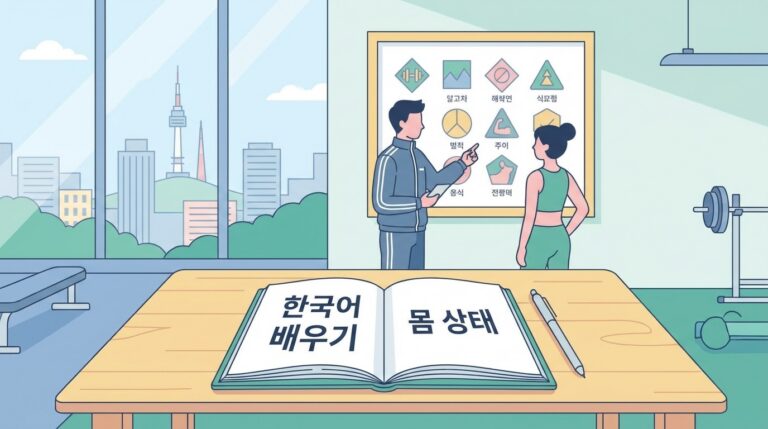
Phase 1: Empathy (Story-Driven Opening)
안녕하세요! This is your Daily Hangul editor, your personal cultural navigator through the vibrant streets of South Korea.
Picture this: You finally decide to sign up for a trendy fitness center in Hongdae or Gangnam. K-Pop beats are pumping in the background, neon LED signs glow with motivational quotes like “오늘의 땀은 내일의 보상” (Today’s sweat is tomorrow’s reward), and the personal trainer (PT) greets you with a warm smile. Before you can even touch a dumbbell, they politely guide you toward a sleek white machine with silver footplates and metal handles: the infamous InBody machine.
You kick off your socks, stand still, and hold the handles while the machine hums with futuristic beeps. Moments later, the printer spits out a detailed analysis sheet filled with graphs, percentages, and red/green indicators. The trainer looks down at the sheet, circles a section with a red pen, looks up with genuine care (and that gentle, trademark Korean honesty), and says:
“체성분 측정을 해 보니까 근육량이 조금 부족하네요.”
(Looking at the InBody test, your muscle mass is a bit low.)
If you froze for a second, don’t worry—you are not alone! For many expats and travelers in Korea, fitness consultations can feel like an intimidating pop quiz. You want to explain that you sit at a desk all day, that you just want to get toned, or that Korean stairs have already destroyed your calves, but your mind goes blank.
Learning how to handle gym registrations and body composition consultations in Korean gives you instant confidence. You’ll stop dreading the scale, know exactly how to express your fitness goals, and build an authentic rapport with your trainer. This guide is built directly on real feedback from international learners living in Seoul. Let’s master the art of the Korean gym consultation together!
Phase 2: Core Expressions Deep Dive
1. 체성분 측정을 해 보니까 근육량이 조금 부족하네요.
(Cheseongbun cheukjeongeul hae bonikka geunyungnyangi jogeum bujokhaneyo.)
- Pronunciation: Che-seong-bun cheuk-jeong-eul hae bo-ni-kka geun-yung-nyang-i jo-geum bu-jok-ha-ne-yo. (Sounds like: Cheh as in “check”, seong rhymes with “sung”, geun-yung-nyang rolls smoothly off the tongue like “gun-yoong-nyahng”).
- Meaning:
- Literal: “Because we tried body composition measuring, muscle quantity is a little lacking.”
- Real Nuance: “Looking at your InBody results, your muscle mass is on the lower side.”
- K-Culture Moment: You will hear this exact sentence in almost every Korean fitness YouTube video (like Physical Gallery or Kim Jong-kook’s GYM JONG KOOK) whenever a celebrity guest steps on the scale for their fitness evaluation.
- Editor’s Insight: Notice the ending -네요 (-neyo). In Korean, this conveys a realization based on direct observation. Instead of making a blunt judgment, the trainer is gently sharing what the machine just revealed.
- Situation Spectrum:
- Casual: 🚫 (Too formal for hanging out with friends)
- Semi-formal (Polite -요): ✅ (Standard and perfect for customer service & consultations)
- Formal (-습니다): ⚠️ (A bit stiff for a 1-on-1 lifestyle chat)
- 🤔 Think About It: In many Western fitness consultations, trainers hesitate to say your muscle mass is low right away. In Korea, direct health feedback is considered an act of care (jeong), not an insult. How does your native culture balance politeness and health honesty?
2. 운동을 꾸준히 해 본 적이 없어서 걱정돼요.
(Undong-eul kkujunhi hae bon jeog-i eopseoseo geokjeongdwaeyo.)
- Pronunciation: Un-dong-eul kku-jun-hi hae bon jeo-gi eop-seo-seo geok-jeong-dwae-yo. (Pronounce kku with tense lips like “coo” in “cool”, and geok-jeong like “guck-jung”).
- Meaning:
- Literal: “Because I have no experience doing exercise steadily, I am worried.”
- Real Nuance: “I haven’t worked out consistently before, so I’m a bit nervous.”
- K-Culture Moment: A classic line uttered by rookie idols during their debut preparation reality shows when the company assigns them an intensive conditioning regimen.
- Editor’s Insight: The grammar pattern -(으)ㄴ 적이 없다 expresses past experience (or lack thereof), while 꾸준히 (kkujunhi) means “consistently/regularly.” Using this phrase shows honesty and immediately signals your trainer to design a beginner-friendly workout routine.
- Situation Spectrum:
- Casual: ⚠️ (Only if you drop -요: 운동 꾸준히 해 본 적 없어서 걱정돼)
- Semi-formal: ✅ (The ideal response when opening up to your trainer)
- Formal: ✅ (운동을 꾸준히 해 본 적이 없어서 걱정됩니다)
- 🤔 Think About It: Does admitting inexperience feel uncomfortable where you come from? In Korean personal training, admitting you are a beginner earns respect because it shows you are ready to listen.
3. 체력부터 키우고 싶어요.
(Cheryeokbuteo kiugo sipeoyo.)
- Pronunciation: Che-ryeok-bu-teo ki-u-go si-peo-yo. (Che-ryeok sounds crisp like “cheh-ryuk”, followed by ki-u-go as in “key-oo-go”).
- Meaning:
- Literal: “From stamina, I want to raise.”
- Real Nuance: “I want to build up my basic stamina and endurance first.”
- K-Culture Moment: Protagonists in K-dramas recovering from burnout or heartbreak frequently declare this to signal a fresh, proactive chapter in their lives.
- Editor’s Insight: 체력 (che-ryeok) translates to physical endurance, stamina, or raw vitality. In Korea’s fast-paced society, having strong che-ryeok is prized above looking like a bodybuilder. Pairing it with ~부터 (~buteo / starting from) clearly communicates your priority.
- Situation Spectrum:
- Casual: ⚠️ (Use 체력부터 키우고 싶어 with close peers)
- Semi-formal: ✅ (Natural and clear for any gym consultation)
- Formal: ✅ (체력부터 키우고 싶습니다)
- 🤔 Think About It: Why do you exercise? Is your culture more focused on aesthetic looks (six-packs, lean limbs) or internal energy (che-ryeok) to survive long working days?
Phase 3: Textbook Korean vs. Real Korean
Situation 1: Explaining that you tire out very quickly
- 📖 교과서 한국어 (Textbook): 저는 쉽게 피로를 느낍니다. (Jeoneun swipge piroreul neukkimnida. / I feel fatigue easily.)
- 🗣️ 진짜 한국어 (Real-world): 제가 저질 체력이라 금방 지쳐요. (Jega jeojil cheryeogira geumbang jichyeoyo. / I have terrible stamina, so I run out of battery fast.)
- 💡 왜 다를까? (Why is it different?): While “피로를 느낍니다” sounds like a medical questionnaire, Koreans often use the self-deprecating slang 저질 체력 (jeojil che-ryeok / rock-bottom stamina) to laugh off their exhaustion and establish a friendly rapport with the trainer.
Situation 2: Asking how many sessions you should do weekly
- 📖 교과서 한국어 (Textbook): 주당 몇 회의 운동이 권장됩니까? (Judang myeot hoe-ui undong-i gwonjangdoemnikka? / How many workouts per week are recommended?)
- 🗣️ 진짜 한국어 (Real-world): 보통 일주일에 몇 번 정도 하는 게 좋아요? (Botong iljuire myeot beon jeongdo haneun ge joayo? / Normally, how many times a week is good to do?)
- 💡 왜 다를까? (Why is it different?): Real gym talk favors casual conversational verbs (하는 게 좋아요?) over rigid Sino-Korean bureaucratic terms (권장됩니까?).
Phase 4: K-Culture Deep Dive & Non-Verbal Manners
4-1. Nunchi & Physical Etiquette in the Gym Office
When sitting down for an InBody consultation in Korea:
* Receive the Paper with Both Hands: When your trainer prints out the InBody sheet and passes it across the desk, receive it using both hands (or touch your right forearm with your left hand). This non-verbal gesture shows respect and attentiveness.
* The “Sheepish Nod” (머쓱한 끄덕임): When the trainer circles your low muscle mass or high body fat, you don’t need to apologize or defend yourself. A soft, self-aware smile accompanied by a gentle nod (“네, 맞아요…” / Yes, that’s true…) signals that you accept reality with humility.
* Active Listening Sounds: Use soft reactions like 아, 진짜요? (Ah, really?) or 네네~ (Yes, yes) rather than remaining completely silent while the trainer speaks.
4-2. The “O-Un-Wan” (오운완) Phenomenon
Fitness in Korea is deeply linked to the concept of 갓생 (God-saeng / living an exemplary, disciplined life). On Korean Instagram, you will see millions of posts tagged with #오운완 (O-Un-Wan), short for 오늘 운동 완료 (Today’s Workout Complete). People post mirror selfies holding gym shaker bottles or showing off their gym sneakers. Taking fitness classes and tracking your InBody progress isn’t just about losing weight; it’s a visible badge of personal diligence in contemporary Korean youth culture.
Phase 5: Real-Life Roleplay Scenario
Setting: Inside Fit Lab Studio in Mapo, Seoul. High-energy lo-fi beats play softly. Trainer Min-woo (30s, energetic and attentive) sits across from Alex (an international resident eager to start working out).
- [Turn 1] 트레이너 민우: 자, 알렉스 님! 인바디 결과 나왔습니다. 한번 보실까요?
(Ja, Al-lek-seu nim! In-ba-di gyeol-gwa na-wat-seum-ni-da. Han-beon bo-sil-kka-yo?)
“Alright, Alex! Your InBody results are out. Shall we take a look?”
🎭 Hands the printed sheet across the desk with both hands. -
[Turn 2] 알렉스: 네! 결과가 어떻게 나왔어요? 조금 떨리네요.
(Ne! Gyeol-gwa-ga eo-tteo-ke na-wat-seo-yo? Jo-geum tteol-li-ne-yo.)
“Yes! How did it turn out? I’m a little nervous.”
🎭 Leans forward slightly, looking curious. -
[Turn 3] 트레이너 민우: 체성분 측정을 해 보니까 근육량이 조금 부족하네요. 대신 체지방은 표준이에요.
(Che-seong-bun cheuk-jeong-eul hae bo-ni-kka geun-yung-nyang-i jo-geum bu-jok-ha-ne-yo. Dae-sin che-ji-bang-eun pyo-jun-i-e-yo.)
“Looking at the body composition, your muscle mass is a bit low. On the bright side, your body fat is standard.”
🎭 Circles the middle bar on the graph with a red ballpoint pen. -
[Turn 4] 알렉스: 아, 그렇군요. 운동을 꾸준히 해 본 적이 없어서 걱정돼요.
(A, geu-reot-gun-yo. Un-dong-eul kku-jun-hi hae bon jeo-gi eop-seo-seo geok-jeong-dwae-yo.)
“Ah, I see. I’m worried because I’ve never worked out consistently.”
🎭 Smiles sheepishly and rubs the back of the neck. -
[Turn 5] 트레이너 민우: 괜찮습니다! 처음엔 다 그래요. 특별히 원하는 목표가 있으세요?
(Gwaen-chan-seum-ni-da! Cheo-eum-en da geu-rae-yo. Teuk-byeol-hi won-ha-neun mok-pyo-ga it-seu-se-yo?)
“It’s completely fine! Everyone starts out like that. Do you have a specific goal in mind?”
🎭 Gives an encouraging nod. -
[Turn 6] 알렉스: 거창한 것보다는 체력부터 키우고 싶어요.
(Geo-chang-han geot-bo-da-neun che-ryeok-bu-teo ki-u-go si-peo-yo.)
“Rather than anything extravagant, I want to build up my stamina first.”
🎭 Speaks with a determined, sincere tone. -
[Turn 7] 트레이너 민우: 아주 좋은 목표입니다! 그럼 일주일에 몇 번 정도 나오실 수 있어요?
(A-ju jo-eun mok-pyo-im-ni-da! Geu-reom il-ju-il-e myeot beon jeong-do na-o-sil su it-seo-yo?)
“That is a great goal! In that case, about how many times a week can you come in?”
🎭 Taps the calendar on his tablet. -
[Turn 8] 알렉스: (Select your response below!)
🔀 Interactive Branching Point: Choose Your Response!
- Option A: “매일 와서 하루에 세 시간씩 할게요!” (I will come every day and work out for three hours!)
- Outcome (Risk ⚠️): Trainer Min-woo will immediately pump the brakes. Over-committing is a classic rookie mistake that leads to fast burnout. He’ll gently remind you that rest is half the battle.
- Option B: “주 2회에서 3회 정도 꾸준히 나와 볼게요.” (I’ll try coming consistently about 2 to 3 times a week.)
- Outcome (Best ⭐): Perfectly realistic! The trainer will smile with approval and begin structuring your weekly split between light cardio and foundational resistance training.
- Option C: “시간 날 때 가끔 들를게요.” (I’ll drop by sometimes whenever I have free time.)
- Outcome (Bad 🚫): Gyms in Korea thrive on structured scheduling. An ambiguous answer makes it impossible for the trainer to design a program, and you might get pitched expensive flexible PT packages.
Phase 6: 10-Second Emotion Shadowing Drill
Practice these lines with rhythm and realistic feeling! The slashes (/) indicate natural pause points.
- [😅 Sheepish & honest]
체성분 측정을 해 보니까 / 근육량이 / 조금 부족하네요.
(Che-seong-bun cheuk-jeong-eul hae bo-ni-kka / geun-yung-nyang-i / jo-geum bu-jok-ha-ne-yo.) -
[🥺 Modest & vulnerable]
운동을 꾸준히 / 해 본 적이 없어서 / 걱정돼요.
(Un-dong-eul kku-jun-hi / hae bon jeo-gi eop-seo-seo / geok-jeong-dwae-yo.) -
[💪 Determined & hopeful]
거창한 것보다 / 체력부터 / 키우고 싶어요!
(Geo-chang-han geot-bo-da / che-ryeok-bu-teo / ki-u-go si-peo-yo!)
Phase 7: K-Culture Mini Dictionary
-
인바디 (In-ba-di)
- Definition: InBody (Bioelectrical Impedance Analysis machine).
- Real Context: In Korea, “InBody” has become a generic trademark like Xerox or Kleenex. Saying “인바디 재다” means to get your body composition measured.
- 골격근량 (Gol-gyeok-geun-ryang)
- Definition: Skeletal Muscle Mass.
- Real Context: This is the holy grail stat on the InBody sheet. When trainers say your muscle is lacking, they point directly to this row.
- 오운완 (O-un-wan)
- Definition: Today’s Workout Complete (오늘 운동 완료).
- Real Context: The essential Korean social media hashtag used by fitness enthusiasts after wrapping up a gym session.
- 저질 체력 (Jeo-jil che-ryeok)
- Definition: Extremely low stamina / “basement-level stamina.”
- Real Context: A relatable, lighthearted term Koreans use when climbing subway stairs leaves them breathless or when introducing themselves to a new trainer.
Phase 8: Traveler’s Survival Kit
Top 3 Gym Survival Phrases
- 일일권 있어요? (Il-il-gwon it-seo-yo?)
- Meaning: Do you have a one-day pass?
- Pro Tip: Ideal for travelers who don’t want a 3-month or 6-month contract. Day passes typically range between 10,000 KRW and 25,000 KRW.
- 운동복 대여 되나요? (Un-dong-bok dae-yeo doe-na-yo?)
- Meaning: Can I rent workout clothes?
- Pro Tip: Most Korean gyms provide sanitized shirts and shorts for a small monthly fee (or complimentary for day passes).
- 탈의실과 라커룸이 어디예요? (Tal-ui-sil-gwa ra-keo-ru-mi eo-di-ye-yo?)
- Meaning: Where are the changing rooms and lockers?
- Pro Tip: Take off your outdoor shoes before entering the locker room area!
Editor’s Travel Note
Before heading out, make sure to complete your Naver Map app download for English navigation. Search for 헬스장 (hel-seu-jang / gym) or 피트니스 (fitness) nearby. While major commercial franchises accept international credit cards with ease, smaller independent studios may ask for a domestic bank transfer or local card, so having a mobile payment backup is always smart.
Phase 9: One Step Deeper (Reflection)
In Korean society, your body is often viewed through the lens of holistic wellness and community responsibility. A trainer pointing out that your muscle mass is low is not an act of body-shaming; rather, it is rooted in a culture of practical problem-solving. Koreans value tangible diagnostics—whether it’s blood type, MBTI personality tests, or InBody scores—because having clear data gives you a roadmap for self-improvement.
When you understand that directness can be an expression of care rather than judgment, the entire Korean gym experience transforms from a stressful ordeal into an empowering journey.
💬 Your Turn: Have you ever had a health or fitness consultation in another country? How did their communication style compare to Korea’s data-driven directness? Leave a comment below!
Phase 10: FAQ & Avoiding Misunderstandings
Q: Can I use the gym without getting an InBody test?
A: Absolutely. While almost all gyms offer it as part of their complimentary onboarding session, you can politely decline by saying: “인바디는 안 해도 괜찮아요.” (In-ba-di-neun an hae-do gwaen-chan-a-yo. / It’s okay, I don’t need to do the InBody.)
Q: What should I wear during the InBody measurement?
A: Remove heavy coats, smartwatches, heavy jewelry, and shoes/socks. Bare feet must directly contact the metal footplates for the electrical sensors to register your body metrics accurately.
Q: Is PT (Personal Training) mandatory when registering?
A: Not at all! Membership (헬스 회원권) and Personal Training (PT) are sold separately. You can register purely for general gym floor access.
🚨 Common Mistakes Alert!
- Mistake 1: Wearing outdoor running shoes on the workout floor.
- Correct Action: Bring a separate pair of clean indoor sneakers (실내용 운동화) in your bag and change in the locker room.
- Mistake 2: Translating “gym” as “체육관 (che-yuk-gwan)”.
- Correct Action: In everyday Korean, a regular fitness center is called a 헬스장 (hel-seu-jang). 체육관 usually refers to a school gymnasium or a boxing/martial arts dojo.
- Mistake 3: Calling the trainer “선생님 (seon-saeng-nim)” exclusively.
- Correct Action: While 선생님 is polite, calling them 트레이너 님 (teu-re-i-neo nim) or their name followed by 코치님 (ko-chi-nim) shows that you understand Korean gym culture.
Phase 11: Action Missions
- 🥉 Bronze Mission (Solo Practice): Stand in front of your mirror and practice saying: “체력부터 키우고 싶어요!” three times with a confident posture.
- 🥈 Silver Mission (Social Media/Study Group): Take a photo of your workout sneakers or water bottle and share it with the caption: #오운완 (Today’s workout done!).
- 🥇 Gold Mission (Real-world Challenge): Next time you visit a fitness facility in Korea, walk up to the desk and ask: “일일권 얼마예요?” (How much is a one-day pass?).
🎮 K-Culture Mission: Watch an episode of a Korean variety show where the cast visits a fitness center (such as Running Man or I Live Alone). Spot how many times someone mentions 근육량 (muscle mass) or 인바디 (InBody)!
Phase 12: Interactive Quiz Challenge
Test your knowledge with these three practical questions!
1. Situational Judgment
Your trainer looks at your InBody sheet and says your muscle mass is low. How do you naturally convey that you want to prioritize general energy and stamina over bulking?
* A) “저는 매일 삼겹살을 먹을 거예요.”
* B) “체력부터 키우고 싶어요.”
* C) “근육은 전혀 필요 없어요.”
2. Fill-in-the-Blank
Fill in the missing word:
“운동을 ________ 해 본 적이 없어서 걱정돼요.” (I am worried because I haven’t exercised consistently.)
* A) 가끔 (gakkeum)
* B) 꾸준히 (kkujunhi)
* C) 어제 (eoje)
3. Cultural True or False
True or False: In Korea, you can wear your outdoor walking sneakers directly onto the gym floor as long as they don’t look muddy.
👉 Click to reveal answers & explanations!
- Answer: B (체력부터 키우고 싶어요.)
- Explanation: This clearly states your goal of building vitality first. Option A talks about eating pork belly, and Option C bluntly rejects muscle entirely!
- Answer: B (꾸준히 / kkujunhi)
- Explanation: 꾸준히 means “steadily / consistently.” 가끔 means “sometimes,” and 어제 means “yesterday.”
- Answer: FALSE
- Explanation: Korean gyms enforce a strict indoor-shoe policy (실내용 운동화) to keep machines and floors clean. Always bring clean shoes in your gym bag!
- Explanation: Korean gyms enforce a strict indoor-shoe policy (실내용 운동화) to keep machines and floors clean. Always bring clean shoes in your gym bag!







