

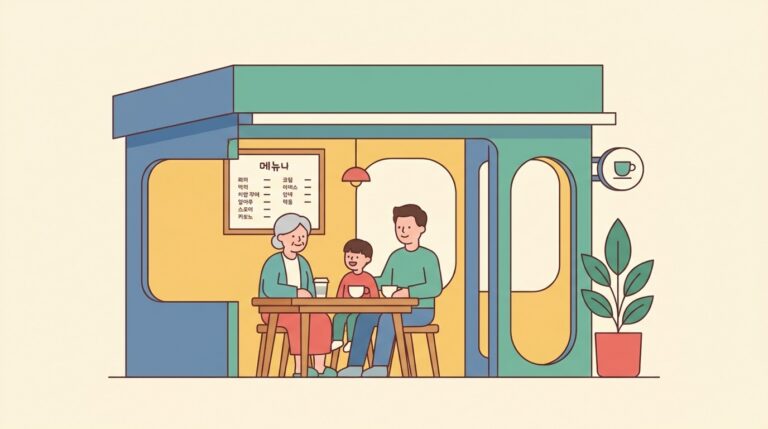
Beyond ‘No-Kids’ Zones: How to Talk About Etiquette, Empathy, and Shared Spaces in Korea
Phase 1: Empathy (Story-Driven Opening)
안녕하세요! (Annyeonghaseyo!) It is your Daily Hangul editor here, your 10-year local culture navigator.
Picture this: You find the coziest, aesthetic rooftop cafe in Seongsu-dong, just like the ones you saw in your favorite K-dramas like Run On or Our Beloved Summer. You climb the stairs, eager to sit with an iced Americano and your notebook, only to notice a sleek acrylic sign by the door: “No Kids Zone (노키즈존)” or, more recently in some neighborhoods, “No Senior Zone (노시니어존)”.
As someone traveling or living in Korea, walking past these signs can trigger a mix of curiosity and discomfort. Why are public businesses banning specific age groups? When you talk with Korean friends, opinions split down the middle: some argue that hardworking people deserve quiet, safe spaces without running toddlers or loud phone calls, while others argue that banishing children or seniors harms social solidarity.
Our foreign learners often tell us: “I want to join this debate in Korean without sounding rude or taking extreme sides. How do I gently say that mutual manners and consideration are better than outright exclusion?” Today, we are unlocking intermediate (B1) Korean tools to help you express nuanced social empathy. Master these phrases, and you will bridge the gap between being a silent observer and having deep, heart-to-heart cultural conversations with locals over coffee.
Phase 2: Core Expressions Deep Dive
1. 서로 배려했으면 좋겠어요 (Seoro baeryeohaesseumyeon jokesseoyo)
- Pronunciation: [Suh-ro bae-ryuh-haet-seu-myeon jo-ket-suh-yo] (Sounds like Sir-row + bae + ryuh + hat-soon-me-on + joe-cat-so-yo)
- Meaning: Literal: “It would be good if we considered each other.” | Nuance: “I wish we could all show a little more mutual consideration instead of making rigid rules.”
- K-Culture Moment: Often heard in social lifestyle variety shows like You Quiz on the Block whenever everyday citizens discuss neighborhood etiquette and community spirit.
- Editor’s Insight: The suffix
-았/었으면 좋겠어요is your best friend at the B1 level. It softens your wish so it never sounds like a blunt command, expressing a gentle hope for harmony. - Situation Spectrum:
- Casual (반말): ⚠️ (Needs adjustment: 서로 배려했으면 좋겠어)
- Semi-formal (해요체): ✅ Perfect for cafes, friends, and discussions
- Formal (하십시오체): ✅ (서로 배려했으면 좋겠습니다)
- 🤔 Think About It: In your home country, do people solve cafe noise through private business rules, or through spontaneous social norms?
2. 모두가 편하게 머물 수 있는 공간 (Moduga pyeonhage meomul su inneun gonggan)
- Pronunciation: [Mo-du-ga pyeon-ha-ge meo-mul su in-neun gong-gan] (Rhythm: Mo-doo-gah pyun-hah-gae muh-mool soo in-noon gong-gahn)
- Meaning: Literal: “A space where everyone can stay comfortably.” | Nuance: “An inclusive environment where nobody feels unwelcome or alienated.”
- K-Culture Moment: Used by socially conscious Korean architects and cafe owners creating “Yes Kids Zones” or universal barrier-free community spaces in Jeju and Seoul.
- Editor’s Insight:
머물다(to stay/linger) brings a warm, poetic warmth compared to the purely functional있다(to be/exist). It highlights feeling relaxed and emotionally settled. - Situation Spectrum:
- Casual: ✅ (Noun phrase, can be used in casual chat)
- Semi-formal: ✅ (Use with ~이에요: …공간이에요)
- Formal: ✅ (Use with ~입니다: …공간입니다)
- 🤔 Think About It: Does language in your country have a single word for “a space of emotional safety and rest,” like how Koreans use
머무는 공간?
3. 양쪽 입장이 다 이해돼요 (Yangjjok ipjang-i da i-hae-dwaeyo)
- Pronunciation: [Yang-jjok ip-jang-i da i-hae-dwae-yo] (Sounds like Yang-choke eep-jahng-ee dah ee-hae-dweh-yo)
- Meaning: Literal: “Both sides’ positions are understood.” | Nuance: “I can completely see where both sides are coming from.”
- K-Culture Moment: Indispensable when Korean news anchors or YouTube debate panels mediate discussions between cafe owners and parents.
- Editor’s Insight: Using
입장(stance/standpoint) signals high emotional intelligence in Korean. It prevents you from getting backed into an absolute black-and-white corner during debates. - Situation Spectrum:
- Casual: ⚠️ (양쪽 입장 다 이해돼)
- Semi-formal: ✅ (Natural and balanced)
- Formal: ✅ (양쪽 입장이 모두 이해됩니다)
- 🤔 Think About It: Why does Korean culture value acknowledging the counterpart’s standpoint before stating a personal disagreement?
Phase 3: Textbook Korean vs. Real Korean
Situation 1: Expressing that strict bans feel uncomfortable
- 📖 교과서 한국어 (Textbook):
- 금지 표지판은 나쁩니다. (Geumji pyojipaneun nappeumnida.) — Banning signs are bad.
- 🗣️ 진짜 한국어 (Real-life Native):
- 무조건 금지하기보다는 에티켓을 안내하면 어떨까요? (Mujogeon geumjihagibodaneun etikeseul annaehamyeon eotteolkkayo?) — Instead of outright bans, what if we provided etiquette guidance instead?
- 💡 왜 다를까? (Why is it different?):
Calling something “bad” (나쁘다) sounds childish and confrontational. Native speakers use comparative suggestions (-기보다는 ... 어떨까요?) to present constructive alternatives.
Situation 2: Asking someone nearby to lower their volume gently
- 📖 교과서 한국어 (Textbook):
- 조용히 하세요. (Joyonghi haseyo.) — Be quiet.
- 🗣️ 진짜 한국어 (Real-life Native):
- 죄송하지만 목소리를 조금만 낮춰주실 수 있을까요? (Joesonghajiman moksorireul jogeumman natchwojusil su isseulkkayo?) — Excuse me, but would you mind lowering your voice just a little bit?
- 💡 왜 다를까? (Why is it different?):
조용히 하세요feels like a strict school teacher reprimanding kids. Adding죄송하지만(I am sorry, but…) and조금만(just a little) cushions the request through relational warmth.
Phase 4: K-Culture Deep Dive & Non-Verbal Manners
4-1. 눈치 (Nunchi) & Gestures in Shared Spaces
When entering a quiet Korean cafe in Hongdae or Bukchon, observe the room’s “soundscape” before picking a table:
* The Decibel Check: If people are studying with laptops (known as Kagong-jok / 카공족), lower your conversational tone. Even if a cafe is not officially a quiet zone, loud laughs will trigger subtle sideways glances (nunchi).
* The Head-Nod Acknowledgment: If your child drops a spoon or your phone makes a loud notification chime, immediately make eye contact with nearby patrons, offer a short 15-degree head bow, and whisper: 죄송합니다 (Joesonghamnida). In Korea, acknowledging a disturbance immediately erases 90% of irritation because people value that you care about their peace.
4-2. Cultural Code Analysis: Why Did “No-Zones” Emerge?
Korea transformed from a collectivist village culture into hyper-dense urban living within two generations. Cafes in Korea are not just beverage shops—they function as living rooms, private study corners, and remote offices. Because private apartments are often compact and work cultures are exhausting, Koreans treat cafe time as a paid oasis of undisturbed tranquility (힐링, Healing).
When a child runs around or an adult plays a loud TikTok on speaker, business owners fear losing regular customers, prompting defensive “No Kids” or “No Senior” signs. Understanding this tension helps us see that the solution isn’t hatred; it’s learning to balance collective harmony with individual rest.
Phase 5: Real-Life Roleplay Scenario
Setting: Café Ondal in Yeonnam-dong. The shopkeeper, Min-ji, is polishing glasses behind the counter. A customer is sitting with their laptop while an international traveler and long-time patron strikes up a conversation about a new sign outside.
- Min-ji: 요즘 주변 카페들이 다 노키즈존으로 바뀌고 있어서 고민이에요. (Yojeum jubyeon kapedeuri da nokijeujoneuro bakkwigo isseoseo gomineyo.) — Lately, all the nearby cafes are turning into No-Kids Zones, so I am quite conflicted.
🎭 Sighs softly while drying a ceramic cup. - You: 사장님도 노키즈존으로 바꿀까 고민 중이세요? (Sajangnimdo nokijeujoneuro bakkulkka gomin jung-iseyo?) — Are you thinking about changing to a No-Kids Zone too, boss?
🎭 Leans forward on the wooden counter with genuine interest. - Min-ji: 손님들 중에는 조용한 분위기를 원하시는 분들이 많거든요. (Sonnimdeul jung-eneun joyonghan bunwigireul wonhasineun bundeuri mankeodeunyo.) — Many of our customers want a quiet, focused atmosphere, you see.
🎭 Glances toward the customers studying on their laptops. - You: 양쪽 입장이 다 이해돼요. 자영업 하시는 게 정말 쉽지 않죠. (Yangjjok ipjang-i da i-hae-dwaeyo. Jayeongeop hasineun ge jeongmal swipji anchyo.) — I understand both perspectives completely. Running an independent business is truly not easy.
🎭 Nods empathetically with warm eyes. - Min-ji: 맞아요. 하지만 아이들이나 어르신을 막는 건 마음이 너무 아파요. (Majayo. Hajiman aideurina eoreusineul magneun geon maeumi neomu apayo.) — Exactly. But turning away children or seniors really breaks my heart.
🎭 Lowers her eyes with a conflicted expression. - You: 배제하는 팻말 대신 에티켓을 부탁하는 안내문을 두면 어떨까요? (Baejehaneun paenmal daesin etikeseul butakhaneun annaemuneul dumyeon eotteolkkayo?) — Instead of a sign of exclusion, how about posting a gentle note asking for shared etiquette?
🎭 Smiles warmly while making a gentle welcoming hand gesture. - Min-ji: 와, ‘케어 키즈존’이나 ‘배려존’ 같은 방식 말씀이시죠? (Wa, ‘Keeo kijeujon’ina ‘baeryeojon’ gateun bangsik malsseumisijyo?) — Oh, you mean like a ‘Care Kids Zone’ or a ‘Consideration Zone’?
🎭 Eyes brighten with renewed optimism. - You: 네! 서로 배려하면서 모두가 환영받는 공간이 되면 좋겠어요. (Ne! Seoro baeryeohamyeonseo moduga hwanyeongbanneun gonggani doemyeon jokesseoyo.) — Yes! I hope it becomes a space where everyone is welcomed through mutual consideration.
🎭 Gives a reassuring, cheerful smile.
🔀 Interactive Decision Point
How would you reply if another customer loudly grumbles: “아이들은 카페에 안 오는 게 맞지 않나요? (Shouldn’t kids stay out of cafes altogether?)”?
- Choice A: “시끄러우면 집에서 커피 드세요.” (Sikkeoreoumyeon jibeseo keopi deuseyo. / If it’s noisy, drink coffee at home.)
- 👉 Feedback: Bad. This is aggressive and escalates conflict in public.
- Choice B: “아이들도 사회의 일원이니까, 서로 배려하며 머무는 연습이 필요하다고 생각해요.” (Aideuldo sahoeui il-woninikka, seoro baeryeohamyeo meomuneun yeonseubi piryohadago saenggakhaeyo. / Kids are members of society too, so I think practicing mutual consideration together is valuable.)
- 👉 Feedback: Best! Highly polite, uses thoughtful B1 vocabulary, and centers on constructive community growth.
- Choice C: “저는 상관없어요.” (Jeoneun sang-gwaneopseoyo. / I don’t care.)
- 👉 Feedback: Risk. While it avoids conflict, it sounds cold and indifferent (방관자 tone).
Phase 6: 10-Second Emotion Shadowing Drill
Read these out loud along with the emotion markers. Pause at /:
[🥺 Thoughtful & Empathetic]
양쪽 입장이 / 다 이해돼서 / 마음이 좀 복잡해요.
(Yangjjok ipjang-i / da i-hae-dwaeseo / maeumi jom bokjapaeyo.)
I understand both standpoints, / so my feelings / are a bit complicated.-
[💡 Constructive & Polite]
무조건 금지하기보다는 / 서로 매너를 지켜주면 / 좋겠어요.
(Mujogeon geumjihagibodaneun / seoro maeneoreul jikyeojumyeon / jokesseoyo.)
Rather than banning outright, / I hope we can just / respect basic manners for each other. -
[😊 Hopeful & Warm]
누구나 환영받는 / 따뜻한 공간이 / 많아졌으면 좋겠어요.
(Nuguna hwanyeongbanneun / ttatteut-han gonggani / man-ajyeosseumyeon jokesseoyo.)
I hope there will be more / warm spaces / where anyone feels welcomed.
Phase 7: K-Culture Mini Dictionary
- 배려 (Baeryeo) [Consideration / Caring]
- Context: Korea’s core civic virtue. From subway priority seats to quiet libraries, baeryeo refers to actively adjusting your comfort so someone else doesn’t suffer.
- 노키즈존 (No Kijeu Jon) [No-Kids Zone]
- Context: Establishments prohibiting children under 8-13 years old. Often contrasted with newer 웰컴키즈존 (Welcome Kids Zone).
- 공공예절 (Gonggong-yejeol) [Public Etiquette]
- Context: Etiquette guidelines taught in Korean schools, covering subway behavior, escalator queues, and quiet cafe tones.
- 상생 (Sangsaeng) [Coexistence / Win-Win Living]
- Context: Used frequently in current affairs and editorials to describe different social groups thriving alongside one another peacefully.
Phase 8: Survival Kit for Travelers
Top 3 Survival Expressions
- 혹시 여기 아이 동반 가능한가요? (Hoksi yeogi ai dongban ganeunghangayo?)
- By any chance, are children allowed here?
- Pro Tip: Always ask this before ordering at trendy non-franchise cafes in areas like Yeonnam or Itaewon.
- 조금만 조용히 말씀해 주시겠어요? (Jogeumman joyonghi malsseumhae jusigesseoyo?)
- Could you please speak just a little more quietly?
- Pro Tip: Deliver this with an apologetic half-smile to keep the interaction gentle.
- 함께 쓰는 공간이라 조심하고 있어요. (Hamkke sseuneun gonggan-ira josimhago isseoyo.)
- Since it is a shared space, I am being careful.
- Pro Tip: Excellent to say when setting up your laptop or when settling down with companions.
Editor’s Travel Note
When cafe hopping in Seoul, check business policies ahead of time. Use the official Naver Map app download for iOS and Android search engine; local Korean cafe listings will explicitly state “노키즈존 (No Kids Zone)” or “유아의자 제공 (High chairs provided)” in their amenity descriptions. Also, remember that major franchise chains like Starbucks or Twosome Place are virtually never No-Kids Zones!
Phase 9: “One Step Deeper” (Thought Question)
Korean society is currently navigating a profound transition. The tension over No-Kids Zones isn’t a sign of hostility toward children; rather, it reflects an exhausted urban population struggling to preserve boundaries of mental quietude (개인의 휴식) alongside traditional communal responsibilities (공동체 의식). When a space declares a ban, it highlights an inability to negotiate etiquette informally, resorting instead to clear-cut administrative boundaries. Creating spaces of inclusive belonging requires both parents and child-free adults to meet halfway through empathy.
💬 Your Turn: What kinds of etiquette signs exist in your home country? Do you believe businesses should have the right to curate child-free or senior-free environments? Share your thoughts below in Korean or English!
Phase 10: FAQ & Common Mistakes
Q: Are “No-Kids Zones” legal in South Korea?
A: In 2017, the National Human Rights Commission of Korea ruled that No-Kids Zones represent unreasonable discrimination. However, this ruling carries administrative recommendation power, not criminal penalties, meaning private business owners still legally hold the freedom to set entry conditions for their private property.
Q: What is a “Care Kids Zone” (케어키즈존)?
A: It is an increasingly popular middle ground! Instead of banning children, owners welcome families with the condition that guardians actively watch over their children to prevent accidents and excessive noise.
Q: Is it rude to discuss this topic with Korean acquaintances?
A: Not at all! It is a very mainstream editorial debate topic. As long as you use soft sentence endings like ~인 것 같아요 (I think that…) or ~했으면 좋겠어요 (I hope that…), Koreans love hearing international comparisons on public manners.
🚨 Common Mistakes Alert!
- Mistake: Saying
"그 사람들은 나빠요"(Those people are bad).- Correction: Say
"그 입장도 이해는 가지만 아쉬워요"(I understand that stance, but it feels a bit regrettable).
- Correction: Say
- Mistake: Confusing
배려(consideration) with양보(conceding a seat/yielding).- Correction:
배려is the broader mindset of caring for others;양보is the physical act of giving up a seat or right.
- Correction:
- Mistake: Shouting
"조용히 해!"(Be quiet!).- Correction: Always soften requests with
"죄송하지만... 조금만..."in public environments.
- Correction: Always soften requests with
Phase 11: Action Mission & Engagement
- 🥉 Bronze Mission: Stand in front of your mirror and practice saying:
"서로 배려했으면 좋겠어요!"three times with a gentle smile. - 🥈 Silver Mission: Find a photo of your favorite neighborhood cafe, write one sentence in Korean wishing for community harmony using
-았/었으면 좋겠어요, and share it with your language exchange partner. - 🥇 Gold Mission: Next time you order at a Korean cafe, say
"감사합니다, 좋은 하루 보내세요!"(Thank you, have a great day!) with clear eye contact and a warm nod. - 🎮 K-Culture Mission: Watch an episode of a Korean slice-of-life drama (like Hospital Playlist) and spot instances where characters perform small acts of baeryeo (e.g., holding elevator doors, passing napkins, lowering voices).
Phase 12: Interactive Quiz Challenge
1. Situation Judgment: You are at a trendy cafe and notice a family with a stroller looking hesitant outside. What is the most natural, polite way to suggest to your friend that more places should embrace families?
* A) 아이들이 오면 무조건 시끄러워요.
* B) 모두가 환영받는 공간이 더 많아졌으면 좋겠어요.
* C) 사장님한테 왜 아이를 안 받냐고 화내야 해요.
2. Fill in the Blank:
금지하는 팻말 대신 서로 ( )하는 에티켓을 지켰으면 좋겠어요.
(배제 / 배려 / 불평)
3. True or False:
In Korea, saying “조용히 하세요” is the friendliest and most polite way to ask strangers in a cafe to keep their volume down.
(True / False)
👉 Click here to reveal the answers and explanations!
- Answer: B (
모두가 환영받는 공간이 더 많아졌으면 좋겠어요).- Explanation: Option B expresses a positive, inclusive hope using the
-았/었으면 좋겠어요pattern. Option A is dismissive, and C is inappropriately aggressive.
- Explanation: Option B expresses a positive, inclusive hope using the
- Answer: 배려 (Consideration).
- Explanation: The full sentence reads: “금지하는 팻말 대신 서로 배려하는 에티켓을 지켰으면 좋겠어요” (Instead of signs of exclusion, I hope we follow etiquette of mutual consideration).
- Answer: False.
- Explanation: “조용히 하세요” sounds imperative and stern. Instead, use: “죄송하지만 목소리를 조금만 낮춰주실 수 있나요?”
- Explanation: “조용히 하세요” sounds imperative and stern. Instead, use: “죄송하지만 목소리를 조금만 낮춰주실 수 있나요?”
🎬 Watch Our Daily Videos! (Daily Hangul Official Instagram)
Review the expressions you learned in this article with our fun daily short videos! Check out native pronunciation and real-life nuances in action.
- Instagram @dailyhangul_en







