

Phase 1: 공감 (스토리 몰입형 오프닝)
안녕하세요! 매일한글 에디터입니다.
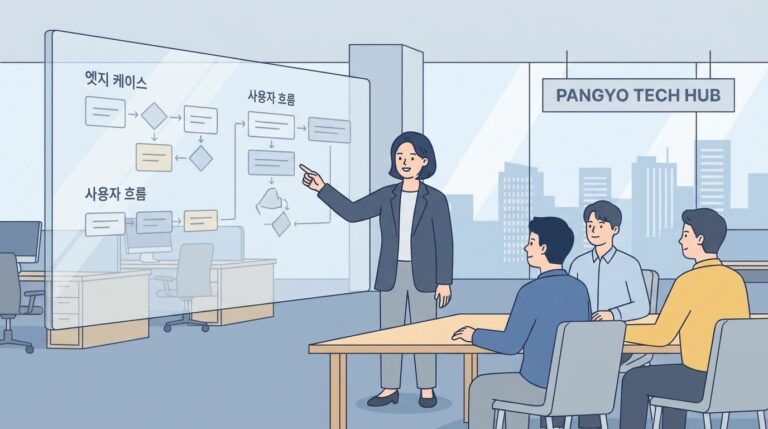
Imagine this: You are standing in front of a sleek conference room whiteboard in Pangyo Techno Valley—Korea’s Silicon Valley. Developers and UX designers are leaning in, sipping iced Americanos. You’ve just presented the core user flow for your new feature. Then, the lead tech architect squints and asks: “만약 사용자가 결제 버튼을 연속으로 따닥 누르거나, 와이파이가 튕기면 어떻게 되나요?” (What happens if a user double-taps the payment button or their Wi-Fi drops?)
In the fast-moving Korean tech world, presenting only the “happy path” (정상 경로) will quickly earn you a sharp critique from senior engineers. Korean teams place immense value on speed (빨리빨리), but when it comes to production code, they demand meticulous exception handling to prevent server crashes and user frustration. If you can confidently articulate edge cases, fallback policies, and spec freezes in Korean, your engineering team will not just listen—they will deeply respect your ownership.
Today, we’re going beyond basic office talk. Based on real workshops with bilingual product managers in Seoul’s top tech hubs, here is your definitive field guide to defining PRD edge cases and locking down specs like a native Pangyo PM.
Phase 2: 핵심 표현 3선 심층 분석
1. 예외 상황 처리 정책을 정의했어요 (한글)
- Pronunciation: [Yewoe sanghwang cheori jeongchaeg-eul jeong-uihaesseoyo] (Sounds like: Ye-way sang-hwang chuh-ree jung-chaek-eul jung-ui-hae-ssuh-yo — pronounce yewoe like saying “yeah-way” briskly)
- Meaning: “I have defined the handling policies for exception scenarios (edge cases).”
- K-Culture Moment: Think of the drama Start-Up when Samsan Tech has to pitch their AI model to skeptical investors. Before anyone can question vulnerability, the PM steps up and shows that every single network crash scenario has a backup plan.
- Editor’s Insight: In Korean IT corporate culture, “예외 상황” (exception situations) is the formal translation for edge cases. Pairing it with “정책을 정의하다” (to define a policy) signals that you are not just suggesting ideas—you are establishing definitive product requirements.
- Situation Spectrum:
- Casual: 🚫
- Semi-formal: ⚠️ (예외 상황 처리 기준 정했어요)
- Formal / Business Meeting: ✅
- 🤔 Think About It: Why does Korean business discourse use “정책” (policy) for simple app logic? In Korea’s collectivist work culture, a “policy” protects the team from ambiguity and prevents post-release blame.
2. 해피 패스뿐만 아니라 엣지 케이스까지 챙겼습니다 (한글)
- Pronunciation: [Haepi paesuppunman anira etji ke-iseukkaji chaenggyeotseumnida] (Sounds like: Happy pass-ppun-man ah-nee-ra edge case-kkaji cheng-gyut-seum-nee-da)
- Meaning: “Beyond the happy path, I took care of the edge cases as well.”
- K-Culture Moment: A junior PM handing over a Figma file to a senior developer during a sprint review, earning an appreciative nod.
- Editor’s Insight: Notice the verb 챙기다 (chaenggida). It literally means “to pack” or “to look after,” but in Korean workplaces, it is the ultimate praise word for showing thorough ownership. Saying you “챙겼다” proves you aren’t leaving loose ends for the developers to patch later.
- Situation Spectrum:
- Casual: ⚠️ (엣지 케이스까지 다 챙겼어)
- Semi-formal: ✅
- Formal: ✅
- 🤔 Think About It: Contrast this with English “I handled the edge cases.” “챙기다” implies a warm, proactive diligence toward your teammates’ cognitive load.
3. 중복 클릭이랑 재고 부족 방지 로직을 추가했습니다 (한글)
- Pronunciation: [Jungbok keullig-irang jaego bujok bangji rojig-eul chugahaesseumnida] (Sounds like: Joong-bok click-ee-rang jae-go boo-jok bahng-jee lo-jik-eul choo-ga-hae-ssum-nee-da)
- Meaning: “I added logic to prevent double clicks and out-of-stock errors.”
- K-Culture Moment: High-traffic moments like K-pop concert ticketing on Interpark or limited-edition sneaker drops on KREAM, where duplicate requests can crash payment gateways.
- Editor’s Insight: Notice the combination of English loanwords (클릭, 로직) with Sino-Korean nouns (중복 – duplication, 방지 – prevention). This hybrid vocabulary is the hallmark of natural B2-level business Korean in tech.
- Situation Spectrum:
- Casual: ⚠️
- Semi-formal: ✅
- Formal: ✅
- 🤔 Think About It: Why do Korean PMs say “로직을 추가하다” rather than pure Korean? In digital industries, loanwords streamline collaboration with developers who code in English.
Phase 3: 교과서 한국어 vs 진짜 한국어
Situation 1: Declaring a Spec Freeze for the Sprint
- 📖 교과서 한국어: 이번 스프린트의 개발 요구 명세를 동결하도록 하겠습니다. (Ibeon seupeurinteu-ui gaebal yogu myeongse-reul donggyeolhadorok hagetseumnida.) — “We will hereby freeze the development requirement specifications for this sprint.”
- 🗣️ 진짜 한국어: 이번 스프린트 스펙은 여기서 픽스하고 갈게요. (Ibeon seupeurinteu seupeg-eun yeogiseo pikseuhago galgeyo.) — “Let’s fix the specs here for this sprint and move forward.”
- 💡 왜 다를까? Textbook Korean uses archaic Sino-Korean legal terms like “명세 동결”. Real Pangyo PMs mix industry loanwords like “스펙 픽스” (spec fix) paired with the collaborative phrase “~하고 갈게요” (let’s do this and proceed).
Situation 2: Informing Devs About Network Timeout Fallbacks
- 📖 교과서 한국어: 네트워크 연결이 두절될 시 재시도 기능을 실행해야 합니다. (Neteuwokeu yeongyeor-i dujeoldoel si jaesido gineung-eul silhaenghaeya hamnida.) — “When network connection is severed, retry capability must be executed.”
- 🗣️ 진짜 한국어: 네트워크 끊기면 토스트 띄우고 자동 재시도 로직 돌려주세요. (Neteuwokeu kkeunkimyeon toseuteu tti-ugo jadong jaesido rojik dollyeojuseyo.) — “If the network drops, please pop up a toast message and run the auto-retry logic.”
- 💡 왜 다를까? Native developers talk in concrete UI/UX components (“토스트 띄우다” = trigger a toast alert) rather than abstract passive verbs.
Phase 4: K-Culture 딥다이브 & 비언어적 매너
4-1. 눈치 (Nunchi) & Meeting Room Gestures
When freezing specs in a Korean tech company, watch the room’s air (분위기). Developers often communicate hesitation without saying “No.” Look for:
1. Tilting the head slightly and sighing inward while saying “아… 그게 공수가 좀 큰데요…” (Ah… that estimation/effort is quite big).
2. Hand gesture: Place both palms flat on the desk or point specifically at a line item on the monitor using an open hand (never point with an aggressive single finger).
3. When proposing an edge case policy, use a modest pitch: “혹시 몰라서 이 케이스도 방어해 봤는데요…” (Just in case, I also put up defensive logic for this case…). It softens the blow by showing you are saving them future debugging headaches.
4-2. Cultural Code: The “티켓팅 (Ticketing)” Battle Mentality
Korea has the fastest internet infrastructure in the world, yet ticket drops for BTS concerts, IU shows, or limited-run bakery pop-ups sell out within 0.1 seconds. Because Korean end-users are hyper-digitized and notoriously unforgiving with bugs, handling “중복 클릭” (double clicks / multi-tapping) and “품절 팝업” (sold-out popups) is considered the holy grail of product design in Korea. A PM who designs robust fallback states earns an instant reputation for high engineering empathy.
Phase 5: 실전 롤플레이 시나리오
- Setting: Conference Room 4B at an e-commerce unicorn in Pangyo. 10 minutes left before sprint planning ends.
- Characters:
- Alex (You): Intermediate PM leading the checkout redesign.
- 민석 (Min-seok): Veteran Senior Tech Lead known for strict QA standards.
- 민석: 🎭 화면의 PRD 문서를 넘기며 안경을 고쳐 쓴다.
“알렉스 님, 결제 플로우 해피 패스는 깔끔한데, 트래픽 몰릴 때 예외 처리는 어떻게 되나요?”
(Alex-nim, gyeolje peullou haepi paeseu-neun kkalkkeumhande, teuraepig mollil ttae yewoe cheori-neun eotteoke doenayo?)
“Alex, the happy path for the payment flow looks clean, but how are exception handlings set when traffic spikes?” -
Alex: 🎭 자신감 있게 노션 화면의 4번 섹션으로 스크롤을 내리며
“네, 민석 님! 정상 작동 흐름뿐만 아니라 엣지 케이스 처리 정책도 다 정의해 뒀습니다.”
(Ne, Minseok-nim! Jeong-sang jakdong heureumppunman anira etji ke-iseu cheori jeongchaek-do da jeong-uihae dwotseumnida.)
“Yes, Min-seok! Beyond the normal operation flow, I’ve already defined handling policies for edge cases.” -
민석: 🎭 관심을 보이며 턱을 괸다.
“오, 그래요? 사용자가 결제 버튼 중복 클릭하는 건 막았나요?”
(O, geuraeyo? Sayongjaga gyeolje beoteun jungbok keullikhaneun geon magannayo?)
“Oh, really? Did you prevent users from double-clicking the pay button?” -
Alex: 🎭 다이어그램을 손바닥으로 짚으며 설명한다.
“네, 1차 탭 즉시 버튼 비활성화하고 로딩 스피너 띄우는 중복 방지 로직 넣었습니다.”
(Ne, il-cha taep jeuksi beoteun bihwalseonghwahago roding seupeineo tti-uneun jungbok bangji rojik neoeotseumnida.)
“Yes, I added anti-duplicate logic that disables the button immediately on the first tap and displays a loading spinner.” -
민석: 🎭 고개를 끄덕이며 미소를 띤다.
“좋네요. 결제 승인 대기 중에 통신 끊기면 어떻게 폴백(fallback)되죠?”
(Jonne-yo. Gyeolje seung-in daegi jung-e tongsin kkeunkimyeon eotteoke polbaek-doejyo?)
“Nice. If the network drops while waiting for payment authorization, how does it fall back?” -
Alex: 🎭 침착하고 명확한 목소리로
“네트워크 타임아웃 3초 초과 시 자동 취소 토스트를 띄우고 장바구니 상태를 유지하도록 정책을 짰어요.”
(Neteuwokeu taim-a-ut sam-cho chogwa si jadong chwiso toseuteu-reul tti-ugo jangbaguni sangtae-reul yujihadorok jeongchaeg-eul jjasseyo.)
“If the network timeout exceeds 3 seconds, the policy triggers an auto-cancel toast alert and preserves the shopping cart state.” -
민석: 🎭 만족스러운 표정으로 양손을 가볍게 마주친다.
“완벽하네요! 이 정도면 개발 공수 정확히 산정할 수 있겠어요.”
(Wanbyeokhani-yo! I jeongdomyeon gaebal gongsu jeonghwak-hi sanjeonghal su itgesseoyo.)
“Flawless! With this detail, we can accurately estimate development engineering resources.” -
Alex: 🎭 팀원 전체를 둘러보며 마무리 멘트를 건넨다.
“감사합니다. 그럼 추가 변동 없이 이번 스프린트는 이 스펙으로 픽스하고 갈게요!”
(Gamsahamnida. Geureom chuga byeondong eopsi ibeon seupeurinteu-neun i seupegeuro pikseuhago galgeyo!)
“Thank you. In that case, with no further modifications, let’s lock these specs and proceed for this sprint!”
🔀 인터랙티브 분기점 (Interactive Choice)
Min-seok asks: “만약 결제 도중에 품절되면 어떻게 처리하죠?” (What if it goes out of stock during payment?)
- Option A: “그건 개발팀에서 알아서 에러 코드 뱉어주시면 안 되나요?” (Can’t the dev team just spit out an error code on your own?)
- Option B: “PRD 5.2조에 품절 시 실시간 팝업 띄우고 대체 상품 추천 페이지로 랜딩되게 정책 정리해 뒀습니다.” (In PRD section 5.2, I defined the policy to trigger a real-time out-of-stock popup and redirect to an alternative item recommendation page.)
- Option C: “품절은 거의 안 일어날 테니까 일단 배포하고 나중에 보시죠.” (Sold-out rarely happens anyway, so let’s deploy first and check later.)
Feedback:
* Option A [Bad]: Shifting product policy decisions onto developers ruins team trust and signals lack of product ownership.
* Option B [Best]: Demonstrates bulletproof edge-case readiness, complete with UX fallback paths. Engineers will love working with you.
* Option C [Risk]: Extreme operational risk. If a flash sale happens, unhandled inventory races will lead to customer service disasters.
Phase 6: 10초 감정 섀도잉 드릴
Practice these lines out loud! Follow the / pauses and internalize the emotional tags.
[💼 프로페셔널하고 차분하게]
정상 플로우뿐만 아니라 / 네트워크 끊김과 재고 품절 같은 / 엣지 케이스 정책도 / 다 정의했습니다.
(Jeongsang peullouppunman anira / neteuwokeu kkeunkimgwa jaego pumjeol gateun / etji ke-iseu jeongchaekdo / da jeong-uihaetseumnida.)
“Not only the normal flow / but edge case policies like network disconnects and sold-out items / have all been defined.”-
[🛡️ 단호하고 꼼꼼하게]
중복 클릭 방지를 위해 / 1차 탭 즉시 / 로딩 상태로 전환하도록 / 스펙을 픽스했습니다.
(Jungbok keullik bangjireul wihae / il-cha taep jeuksi / roding sangtaero jeonhwanhadorok / seupegeul pikseuhaetseumnida.)
“To prevent duplicate clicks / upon first tap / to switch to a loading state / I have locked the spec.” -
[🤝 팀워크를 이끌며 든든하게]
예외 케이스 방어 로직까지 다 챙겼으니 / 이번 스프린트는 / 이대로 픽스하고 가시죠!
(Yewoe ke-iseu bangeo rojikkkaji da chaenggyeosseuni / ibeon seupeurinteuneun / idaero pikseuhago gasijyo!)
“Since we’ve covered all exception defense logic / for this sprint / let’s fix it as is and move ahead!”
Phase 7: K-Culture 미니 사전
- 엣지 케이스 (Etji ke-iseu): Edge case. In Korean tech, this term is almost always used in loanword form rather than pure Korean to refer to rare or boundary condition bugs.
- 픽스하다 (Pikseuhada): To fix/finalize. Derived from the English “fix,” it specifically means locking requirements, schedules, or decisions so no further scope creep happens.
- 방어 로직 (Bangeo rojik): Defensive logic / Guard rails. The code or conditional UI created to prevent catastrophic failures when unexpected user behavior occurs.
- 공수 (Gongsu): Person-hours / Effort estimate. A Sino-Korean term essential for planning; asking “공수가 얼마나 들까요?” means “How many developer days/hours will this take?”
Phase 8: 여행자를 위한 생존 키트
If you are an expat product manager, founder, or tech professional visiting or working in South Korea, keep these ready:
- Top 1 Survival Expression:
이 부분 엣지 케이스 정책 확정됐나요?
(I bubun etji ke-iseu jeongchaek hwakjeong-dwaennayo?)
Pro Tip: Use this during standup when you sense an unaddressed user flow. - Top 2 Survival Expression:
서버 부하 걸리면 어떻게 폴백 처리해요?
(Seobeo buha geollimyeon eotteoke polbaek cheorihaeyo?)
Pro Tip: Shows great technical consideration when reviewing architecture with backend engineers. - Top 3 Survival Expression:
스펙 변경 없이 이대로 동결하겠습니다.
(Seupek byeongyeong eopsi idaero donggyeolhagetseumnida.)
Pro Tip: The golden boundary phrase that stops endless scope creep. -
Editor’s Travel Note:
Working out of Pangyo or Gangnam coworking spaces like WeWork or FastFive? Download the 카카오맵 (KakaoMap) 대중교통 길찾기 앱 for precise subway transfer door recommendations to make sprint reviews on time. And remember: buying an 아이스 아메리카노 (Iced Americano) tray for the engineering squad before a high-stakes spec review is universal Korean corporate magic.
Phase 9: “한 발 더 깊이” (생각 질문)
In many Western workplaces, handling edge cases can be an iterative discovery process—ship an MVP, let users break it, and patch later. In South Korea, however, public consumer forums like DC Inside, Blind, or App Store review sections react swiftly and severely to glitchy rollouts. This high expectation makes Korean tech teams lean heavily toward collective risk avoidance. When a PM explicitly preempts failure modes in a PRD, they aren’t just writing documentation; they are demonstrating respect for the engineering team’s weekend sleep and the company’s public standing.
💬 Your Turn: Does your home tech ecosystem prioritize “shipping fast and breaking things,” or do you favor comprehensive defensive logic like Korea’s IT industry? Share your product management experience below!
Phase 10: FAQ & 오해 방지 (FAQ Schema)
Q: Can I use the word “스펙 동결” (Spec Freeze) directly with senior executives?
A: Yes! “스펙 동결” is standard formal Korean. However, in casual verbal communication with your squad during daily standups, Korean PMs almost always say “스펙 픽스(Spec Fix)” or “스펙 마감(Spec deadline).”
Q: What is the difference between “예외 상황” and “엣지 케이스”?
A: “예외 상황” (Yewoe sanghwang) is formal Korean often written in official PRDs and client-facing whitepapers. “엣지 케이스” (Etji ke-iseu) is conversational tech jargon used daily in developer Slack channels and sprint meetings.
Q: How do I say “Happy Path” naturally in Korean?
A: While “해피 패스” (Haepi paeseu) is widely understood in modern product squads, native teams frequently call it “정상 작동 흐름” (normal operational flow) or “기본 플로우” (base flow).
🚨 흔한 실수 (Common Mistakes) 경고판
- Mistake: Saying “에러를 픽스했어요” when you actually mean you locked the product specifications.
Correct Action: Remember that in Korean tech slang, “픽스하다” means to freeze/finalize decisions. For fixing a software bug, use 버그를 수정했어요 (I fixed the bug). - Mistake: Using informal particles like “~이랑” in written formal PRDs.
Correct Action: In documentation, replace 중복 클릭이랑 품절 with formal conjunctions: 중복 클릭 및 품절 (Double clicks as well as stock shortages). - Mistake: Forgetting to qualify “재고 품절” (sold out).
Correct Action: Distinguish between 일시 품절 (temporarily out of stock) and 단종/완전 품절 (discontinued/permanently out of stock) in your fallback policy.
Phase 11: 액션 미션 & 참여 유도
- 🥉 Bronze Mission (Solo Practice): Read Phase 6 Shadowing Drill aloud 3 times, focusing on natural pauses at slashes (
/). - 🥈 Silver Mission (Social/Study Share): Write down one edge case for your current real or imaginary app project using the pattern:
[예외 상황] 방어 로직을 추가했습니다and post it in your study notes. - 🥇 Gold Mission (Real-world Challenge): Next time you talk to a Korean colleague or language partner, describe an app glitch using the words “중복 클릭” (double click) and “통신 끊김” (network disconnect).
- 🎮 K-Culture Mission: Watch an episode of a tech-centered Korean drama (like Start-Up or Search: WWW). Listen closely for workplace loanwords like 스펙, 픽스, 이슈, 컨펌!
Phase 12: 인터랙티브 퀴즈 챌린지
1. 상황 판단 (Scenario Decision)
Developers are debating what to do if a user loses Wi-Fi while purchasing a concert ticket. Which sentence is the most professional response for a PM?
* (A) 그냥 에러 페이지 띄우고 끝내죠.
* (B) 네트워크 타임아웃 발생 시 자동 롤백 및 토스트 알림을 제공하도록 정책을 정의했습니다.
* (C) 와이파이 문제니까 우리 책임은 아니에요.
2. 빈칸 채우기 (Fill-in-the-Blank)
“정상적인 작동 흐름뿐만 아니라, 예상치 못한 _______ _______(Edge case) 처리 정책도 PRD에 꼼꼼하게 반영했습니다.”
3. True or False 문화 퀴즈
In Korean startup meetings, saying “이번 스펙은 여기서 픽스하고 갈게요” means you plan to debug code immediately.
* (True / False)
👉 Click to reveal answers & explanations!
- Answer: (B)
Explanation: Option B demonstrates professional PM leadership by clearly defining a fallback mechanism (롤백) and user communication (토스트 알림). -
Answer: 예외 상황 (or 엣지 케이스)
Explanation: Both “예외 상황” (formal Korean) and “엣지 케이스” (industry loanword) fit naturally. -
Answer: False
Explanation: “스펙 픽스(Spec fix)” does not mean repairing a bug; it is Korean tech slang for freezing requirements so the scope does not change.
🎬 Watch Our Daily Videos! (Daily Hangul Official Instagram)
Review the expressions you learned in this article with our fun daily short videos! Check out native pronunciation and real-life nuances in action.
- Instagram @dailyhangul_en







