

Phase 1: Empathy & Immersion Opening
안녕하세요! 매일한글 에디터입니다.
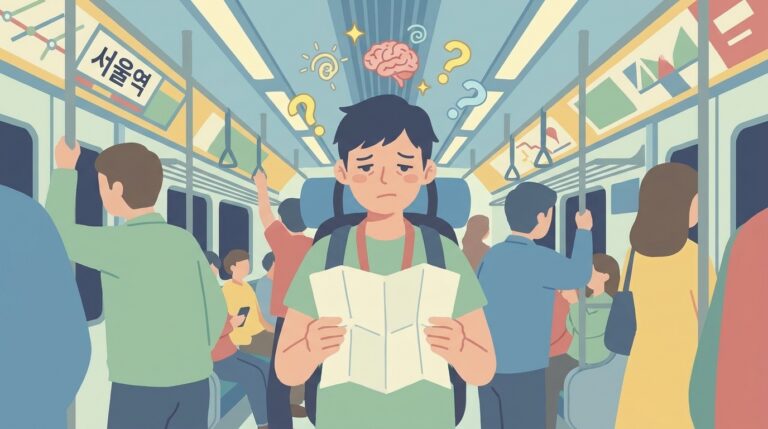
Imagine this: You have just landed at Incheon Airport after a grueling 14-hour flight. You successfully navigated the airport railroad to Hongdae Station, your rolling suitcase bumping against the platform. You step up to an automatic kiosk at a bustling café to order an iced Americano to save your dropping eyelids, but suddenly the touchscreen switches back to rapid Korean prompts. Behind you, a line of fast-walking locals starts building up. Your battery is at 3%, your legs feel like wet noodles, and your brain abruptly freezes into blank white static.
We have all been there. That moment when your brain turns into dial-up internet and your plans evaporate into pure chaos is a universal human experience. In English, you might whisper, “I am losing my mind” or “I am having a total meltdown.” But in Korea, locals sum up this exact sensation in two snappy, ultra-relatable syllables: 멘붕 (Men-bung).
This guide was built from real classroom feedback with dozens of beginner learners who felt paralyzed trying to remember stiff textbook grammar while exhausted. Today, you will master how to say you are completely drained or panicking without sounding like a robotic translation tool. Let’s dive into the ultimate survival phrasebook for when life gets overwhelming in Seoul!
Phase 2: Deep Dive into 3 Core Expressions
1. 멘붕 (Men-bung) / 멘붕 왔어요 (Men-bung wa-sseo-yo)
- Pronunciation: [Men-bung wa-sseo-yo] (Think of ‘men’ as in ‘mental’ + ‘boong’ like a bouncy spring sound: ‘Men-Boong’)
- Meaning: Literal: “Mental collapse came” | Actual Nuance: “My brain just short-circuited” or “I am having a total meltdown.”
- K-Culture Moment: In variety shows like Running Man, whenever a cast member is blindsided by a ridiculous mission, dramatic shattered-glass graphics appear over their face alongside the caption 멘붕!
- Editor’s Insight: A blend of 멘탈 (Mental) and 붕괴 (Collapse). It describes sudden psychological paralysis when something unexpected blindsides you.
- Situation Spectrum:
- Casual (Close friends, peers): ✅
- Semi-formal (Polite everyday tone with ‘~요’): ✅
- Formal (Job interview, business meeting): 🚫
- 🤔 Think About It: In English, “mental breakdown” sounds heavy and medical. Why do you think young Koreans turned “mental collapse” into a lighthearted, humorous social slang?
2. 힘들어 죽겠어요 (Him-deu-leo juk-ge-sseo-yo)
- Pronunciation: [Heem-deu-reo jook-ge-sseo-yo] (Say ‘heem-doo-ruh’ + ‘jook-get-suh-yo’ like a dramatic sigh)
- Meaning: Literal: “It is tough to the point of dying” | Actual Nuance: “I am exhausted to death!”
- K-Culture Moment: Office workers in K-dramas collapsing into plastic chairs after a 12-hour shift, loosening their neckties, and exhaling this line before drinking a cold beer.
- Editor’s Insight: Koreans frequently add ~죽겠다 (~juk-get-da) (dying of…) to any intense feeling: 배고파 죽겠어요 (starving to death), 더워 죽겠어요 (dying of heat). It is emotional hyperbole, not an emergency!
- Situation Spectrum:
- Casual: ✅
- Semi-formal: ✅
- Formal: ⚠️ (Use caution; say ‘조금 피곤합니다’ in formal reports instead)
- 🤔 Think About It: Why does everyday Korean language favor extreme sensory expressions over detached, moderate descriptions?
3. 영혼 가출 (Yeong-hon ga-chul)
- Pronunciation: [Yeong-hon ga-chul] (Rhymes with ‘young-horn gah-chool’)
- Meaning: Literal: “Soul ran away from home” | Actual Nuance: “The lights are on, but nobody is home” / “Zoned out completely from burnout.”
- K-Culture Moment: K-Pop idols staring blankly into empty space at 4:00 AM while waiting for music bank rehearsals, looking adorably zombie-like.
- Editor’s Insight: 가출 (Ga-chul) means running away from home. When you are so exhausted that you cannot process simple questions, your soul has basically packed its bags and left your body.
- Situation Spectrum:
- Casual: ✅
- Semi-formal: ⚠️ (Cute, but better reserved for light banter)
- Formal: 🚫
- 🤔 Think About It: How does treating your tired mind as an independent “escaped soul” help soften social awkwardness when you make a clumsy mistake?
Phase 3: Textbook Korean vs. Real Korean
Situation 1: When the subway train leaves in the wrong direction
- 📖 교과서 한국어 (Textbook): 저는 지금 매우 당황스럽습니다. (Jeoneun jigeum maeu danghwangseureopseumnida. – “I am currently experiencing great bewilderment.”)
- 🗣️ 진짜 한국어 (Real-life): 아, 완전 멘붕 왔어요! (A, wanjeon menbung wasseoyo! – “Ah, my brain just totally short-circuited!”)
- 💡 왜 다를까?: Textbook phrasing sounds like a police report. Real Koreans use 완전 (Wanjeon – totally) paired with 멘붕 왔어요 to share a quick, relatable laugh over a chaotic mishap.
Situation 2: After walking 20,000 steps exploring Bukchon Hanok Village
- 📖 교과서 한국어 (Textbook): 체력이 모두 소진되었습니다. (Cheryeogi modu sojindoeeotseumnida. – “My physical stamina has been completely depleted.”)
- 🗣️ 진짜 한국어 (Real-life): 저 지금 영혼 나갔어요… (Jeo jigeum yeonghon nagasseoyo… – “My soul literally left my body…”)
- 💡 왜 다를까?: Nobody speaks in passive medical terms with friends. Visual, metaphoric expressions create instant bonding over mutual exhaustion.
Phase 4: K-Culture Deep Dive & Non-verbal Manners
4-1. 눈치 (Nunchi) & Body Language
When Koreans say 멘붕 왔어요, speech is only 30% of the message. The non-verbal cues complete the picture:
1. The Double-Temple Clutch: Gently press your temples or grab your head with both hands while letting your jaw drop slightly.
2. The Deflated Exhale (한숨 – Hansum): A quiet “휴~ (Hyu~)” sound while dropping your shoulders by 2 inches.
3. Eye Contact: Do not stare aggressively at someone while saying you are having a meltdown; tilt your gaze at a 45-degree angle toward the floor to show you are processing internal chaos, not confronting them.
4-2. Cultural Code: The Subtitle Culture of K-Variety
If you watch shows like Running Man, 2 Days & 1 Night, or YouTube shows like Workman, you will see explosive font graphics whenever cast members face sudden disaster. The Korean cultural concept of 멘붕 became widely celebrated because modern Korean life moves at ultra-high speed (빨리빨리 – Ppalli-ppalli). In a society that demands sharp focus, playfully admitting “I’m experiencing a mental collapse!” acts as an essential pressure-relief valve.
Phase 5: Real-Life Roleplay Scenario
- Setting: 11:30 PM at a cozy 24-hour study café in Sinchon. Midterm exams are tomorrow morning.
- Characters: You (a determined exchange student) and 민지 (Minji) (your patient Korean study buddy).
-
[Turn 1] 민지 (Minji): 이번 시험 범위 진짜 너무 많지 않아? (Ibeon siheom beomwi jinjja neomu manchi ana?)
- 🎭 Dropping a massive 300-page textbook onto the wooden desk with a thud.
- “Isn’t the test scope this time way too huge?”
- [Turn 2] You: 맞아요. 저 지금 완전 멘붕 왔어요. (Majayo. Jeo jigeum wanjeon menbung wasseoyo.)
- 🎭 Staring at page 12 with glazed eyes, clutching your iced coffee like a lifeline.
- “Totally. My brain is in full meltdown mode right now.”
- [Turn 3] 민지 (Minji): 벌써 멘붕 오면 안 돼! 아직 절반도 못 봤잖아. (Beolsseo menbung omyeon an dwae! Ajik jeolbando mot bwatjana.)
- 🎭 Handing you an energy drink with a sympathetic smile.
- “You can’t have a meltdown already! We haven’t even finished half of it.”
- [Turn 4] You: 글자가 다 춤추는 것 같아요. 힘들어 죽겠어요! (Geuljaga da chumchuneun geot gatayo. Himdeureo jukgesseoyo!)
- 🎭 Resting your forehead directly on the cool tabletop.
- “The letters look like they’re dancing. I’m exhausted to death!”
- [Turn 5] 민지 (Minji): ㅋㅋㅋ 인정! 나도 방금 영혼 가출했어. (Kkk injeong! Nado banggeum yeonghon gachulhaesseo.)
- 🎭 Leaning back in her chair and staring blankly up at the fluorescent light.
- “Hahaha, valid! My soul just checked out of my body too.”
- [Turn 6] You: 우리 10분만 멍때릴까요? (Uri sip-bun-man meong-ttae-ril-kka-yo?)
- 🎭 Waving your hand weakly toward the snack corner.
- “Shall we just zone out for 10 minutes?”
- [Turn 7] 민지 (Minji): 완전 찬성! 편의점 가서 초콜릿 사 오자. (Wanjeon chanseong! Pyeon-ui-jeom gaseo chokollit sa oja.)
- 🎭 Stretching her arms high above her head with a yawn.
- “100% agreed! Let’s hit the convenience store and grab chocolate.”
- [Turn 8] You: 좋아요. 당 충전하고 다시 시작해요! (Johayo. Dang chungjeonhago dasi sijakhaeyo!)
- 🎭 Getting up slowly, feeling your humor restored.
- “Sounds great. Let’s recharge our sugar and restart!”
🔀 Interactive Decision Point
Minji looks over at you and asks: “Are you okay to do one more chapter?” What do you say?
- Option A: “아니요, 저 지금 완전 멘붕이에요! 잠깐 쉬어요.” (Aniyo, jeo jigeum wanjeon menbung-ieyo! Jamkkan swieoyo.)
- 🌟 Result: Best! Friendly, honest, and natural. Minji will laugh and grab snacks with you.
- Option B: “저는 정신적으로 완전히 붕괴되었습니다.” (Jeoneun jeongsinjeogeuro wanjeonhi bunggoedoeeotseumnida.)
- ⚠️ Result: Bad. Overly formal and melodramatic. Minji will wonder if you need an ambulance.
- Option C: “야! 힘들어 죽겠어! 조용히 해!” (Ya! Himdeureo jukgesseo! Joyonghi hae!)
- 🚫 Result: Risk! Rude tone drop (반말) plus commanding her to shut up. This damages friendships quickly!
Phase 6: 10-Second Emotional Shadowing Drill
Practice these lines out loud with the designated rhythm (/ = brief pause) and emotional intention!
[😱 완전히 패닉 상태로 / Panicked and overwhelmed]- 아… / 어떡하지? / 완전 멘붕 왔어!
- (A… / eotteokhaji? / wanjeon menbung wasseo!)
- “Ah… / what do I do? / My brain just totally melted!”
[😮💨 지치고 탈진한 목소리로 / Drained and dramatically tired]- 오늘 하루 종일 걸어서 / 힘들어 죽겠어요…
- (Oneul haru jongil georeoseo / himdeureo jukgesseoyo…)
- “Walking around all day today / I am exhausted to death…”
[👻 멍하니 초점을 잃은 눈빛으로 / Spaced-out zombie mode]- 저 지금… / 영혼이 / 나갔어요…
- (Jeo jigeum… / yeonghoni / nagasseoyo…)
- “Right now… / my soul has / left the building…”
Phase 7: K-Culture Mini Dictionary
- 멘붕 (Men-bung) | Mental Breakdown / Brain Freeze
- Everyday usage: Used when plans collapse, you miss a train, or your phone screen shatters unexpectedly.
- 멍때리다 (Meong-ttae-ri-da) | To Zone Out / Space Out
- Everyday usage: Korea even holds annual “Space-out Competitions” (멍때리기 대회) along the Han River to encourage busy citizens to rest their brains.
- 당 충전 (Dang Chung-jeon) | Sugar Recharge
- Everyday usage: Slang for eating sweet macarons, milk tea, or candy when feeling mentally drained at work or school.
- 현타 (Hyeon-ta) | Reality Check / Post-Meltdown Clarity
- Everyday usage: Short for 현실 자각 타임 (Reality realization time). The bittersweet clarity you feel right after a crazy impulse or meltdown.
Phase 8: Survival Kit for Travelers
Top 3 Meltdown Survival Phrases:
- 길을 잃었어요. 멘붕이에요! (Gireul ileosseoyo. Menbung-ieyo!)
- Meaning: I lost my way. I am having a meltdown!
- Pro Tip: Say this to young staff at subway information desks with a polite smile; they will immediately empathize and pull out a map.
- 조금 쉬었다 가요. (Jogeum swieotda gayo.)
- Meaning: Let’s rest a bit before going.
- Pro Tip: Perfect phrase when your travel partner is walking too fast through Seoul’s endless hilly alleys.
- 달콤한 것 마시고 싶어요. (Dalkomhan geot masigo sipeoyo.)
- Meaning: I want to drink something sweet.
- Pro Tip: Instant ticket to finding a café for your urgent 당 충전 (sugar recharge).
🧳 Editor’s Travel Note:
Navigating massive stations like Express Bus Terminal or Sindorim can induce instant 멘붕 even for locals! To avoid getting stranded, do not rely solely on global map apps that lack transit accuracy in Korea. Instead, check out this guide on how to use the Naver Map application for real-time exit numbering and indoor walking routes.
Phase 9: “A Step Deeper” (Reflective Question)
In many Western cultures, acknowledging that you are overwhelmed can sometimes feel uncomfortable or like an admission of personal inadequacy. In Korea, however, communal expressions like 힘들어 죽겠다 or 멘붕 function as everyday bonding rituals. By sharing your state of exhaustion, you invite others to comfort you with food, laughter, or a collective sigh of relief. It is an expression of 정 (Jeong – affectionate connection) through shared vulnerability.
💬 Your Turn: What is your native language’s go-to slang when your brain completely freezes? Does it sound funny or serious? Let me know in the comments below!
Phase 10: FAQ & Avoiding Misunderstandings
Q: Can I say “멘붕 왔어요” to my Korean university professor or company boss?
A: No! 멘붕 is casual slang. In formal contexts or academic evaluations, stick to polite, professional terms like “조금 혼란스럽습니다” (I am a bit confused) or “다시 확인해 보겠습니다” (I will check again).
Q: Is “힘들어 죽겠어요” considered bad luck because of the word ‘죽다’ (to die)?
A: Not at all in everyday colloquial conversation! While elders might occasionally tell children not to say “죽겠다” too often, it is practically the unofficial national motto of tired students and hard workers throughout South Korea.
Q: What is the grammatical difference between “멘붕이다” and “멘붕 오다”?
A: 멘붕이에요 means “I am in a state of mental breakdown,” while 멘붕 왔어요 means “A mental breakdown came upon me” (focusing on the sudden event that triggered it). In daily conversation, both are used interchangeably!
🚨 Common Mistakes Board:
- Mistake: Using 멘붕 (Menbung) during serious emergencies (car accidents, medical issues).
- Correct Action: 멘붕 is for humorous/light everyday stress. For actual emergencies, say: 도와주세요! (Dowajuseyo! – Please help me!)
- Mistake: Saying “힘들어 죽겠다” without the polite ending (~요) to taxi drivers or store owners.
- Correct Action: Always attach ~요: say 힘들어 죽겠어요 to remain respectful.
- Mistake: Translating “mental breakdown” literally into Sino-Korean medical terms like “정신 쇠약” in daily chat.
- Correct Action: Stick to the conversational favorite: 멘붕 왔어요.
Phase 11: Action Mission & Engagement
- 🥉 Bronze Mission (Solo Drill): Look into the mirror, make a funny stressed-out face, and say “아, 완전 멘붕 왔어요!” three times with dramatic hand gestures.
- 🥈 Silver Mission (Social Connection): Head over to your favorite K-pop or K-drama fan community and leave a comment identifying a scene where a character had an obvious 멘붕 moment.
- 🥇 Gold Mission (Real-World Test): Next time you study tough Korean grammar or get tangled in flashcards, tell your study partner or post in your study log: “오늘 공부, 영혼 가출했어요!”
🎮 K-Culture Mission: Watch any random clip of Running Man on YouTube. Count how many seconds it takes for skull graphics or the word 멘붕 to flash across the screen!
Phase 12: Interactive Quiz Challenge
Test your knowledge below! Click each dropdown toggle to check your score and insights.
1. Situation Decision: You accidentally drop your freshly bought boba milk tea all over your sneakers. What is the most natural thing to say to your Korean friend?
* (A) 저는 지금 매우 비극적입니다.
* (B) 아, 진짜 멘붕 왔어!
* (C) 안녕히 계세요.
👉 Click to reveal Answer & Explanation
- Correct Answer: (B) 아, 진짜 멘붕 왔어!
- Why?: Dropping food or making an unexpected clumsy mess is the classic textbook definition of a 멘붕 moment. Option (A) is overly tragic like a Shakespeare play, and (C) means “Goodbye!”
2. Fill-in-the-Blank: Complete the phrase meaning “I walked 10 miles and I’m exhausted to death!”
* 오늘 너무 많이 걸어서 힘들어 ________!
👉 Click to reveal Answer & Explanation
- Correct Answer: 죽겠어요 (jukgesseoyo)
- Why?: The formula
[Feeling/Condition] + ~죽겠어요expresses intense hyperbole in a casual, relatable way.
3. True or False: You can comfortably shout “부장님, 저 멘붕 왔어요!” (Boss, I’m having a meltdown!) during an official presentation to your senior company manager.
👉 Click to reveal Answer & Explanation
- Correct Answer: False!
- Why?: 멘붕 is slang. Using it in an official corporate presentation with executives will make you seem unprofessional. Keep it for your peers during the coffee break!







