

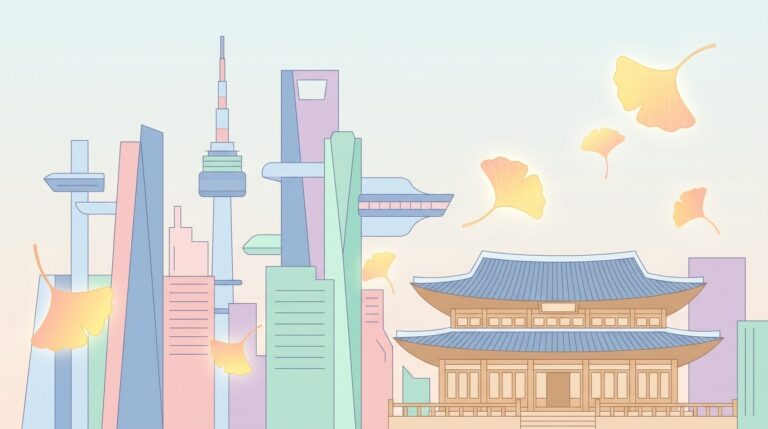
From Mulberry Fields to Megacities: How to Express Korea’s Relentless Transformation Like an Insider
Phase 1: Empathy (A Story-Immersive Opening)
안녕하세요! 매일한글 에디터입니다 (Annyeonghaseyo! I am your Daily Hangul editor).
Picture this: You are standing at the bustling intersection of Gangnam Station. Neon holographic displays tower over sleek glass monoliths, autonomous delivery pods hum along the pavement, and high-fashion flagships occupy every corner. Then, an older Korean colleague sips their warm misutgaru latte, looks into the neon glow, and says with a melancholic smile: “여기 예전엔 다 배밭이고 논밭이었는데… (Yeogi yeojenen da baebat-igo nonbat-ieonneunde… – All of this used to be pear orchards and rice paddies).”
If you have ever felt your jaw drop at how Seoul reinvents its entire skyline every decade, you have brushed shoulders with one of the most poignant cultural currents in Korea: the breathtaking collision of supersonic modern progress and deep, wistful nostalgia.
For advanced learners aiming for the C1 level, simply saying “한국은 정말 빨리 변해요 (Hanguk-eun jeongmal ppalli byeonhaeyo – Korea changes really fast)” feels flat and juvenile. It misses the emotional texture of what Koreans call apchuk seongjang (compressed development)—the bittersweet awe of watching centuries of evolution crammed into a single generation.
Today, we are unlocking three powerhouse four-character idioms (사자성어, sajaseong-eo) that will elevate your professional storytelling, enrich your corporate boardroom presentations, and allow you to philosophize about time, tech, and cultural identity like a cultured Seoul intellectual. Let’s dive into the linguistic art of balancing ruthless agility with timeless roots!
Phase 2: Deep Dive into 3 Core Idioms
1. 상전벽해 (桑田碧海)
- Pronunciation: [Sang-jeon-byeok-hae] (Sounds like “Sahng-juhn-byuk-heh”, rhyming smoothly with a brisk exhale)
- Meaning: Mulberry fields turn into the deep blue sea. (Radical, unrecognizable epochal transformation).
- K-Culture Moment: You will hear this in historical-to-modern transitions in dramas like Reborn Rich (재벌집 막내아들) or documentaries comparing 1970s Seoul with the contemporary digital metropolis.
- Editor’s Insight: Mulberry trees (sang) were once essential for silkworm farming and agriculture. Imagining those vast, grounded fields suddenly submerging into a vast blue ocean (byeokhae) captures not just change, but a complete structural paradigm shift. Use it when an area, an industry, or a country becomes entirely unrecognizable from its origins.
- Situation Spectrum: Casual ⚠️ | Semi-formal ✅ | Formal ✅
- 🤔 Think About It: Does your native culture frame drastic progress as a triumph of human mastery, or as an inevitable, slightly overwhelming tide of nature like an oceanic shift?
2. 격세지감 (隔世之感)
- Pronunciation: [Gyeok-se-ji-gam] (Think “Gyuk-seh-jee-gahm”, crisp ‘k’ sound at the end of the first syllable)
- Meaning: The feeling that an entire generation or era has passed. (Marveling at how dramatically life has evolved in a seemingly short span).
- K-Culture Moment: Watch any variety show where 90s K-Pop legends (like Lee Hyo-ri or Sechs Kies) encounter 4th-generation idol fandom tech like photocard trading apps and AI covers—they invariably sigh, “정말 격세지감이다! (Jeongmal gyeoksejigam-ida!)”
- Editor’s Insight: While 상전벽해 focuses on the external, objective environment, 격세지감 is deeply internal. It is the uncanny sensation of feeling like a time-traveler in your own skin because everyday realities have leaped forward so fast.
- Situation Spectrum: Casual ✅ | Semi-formal ✅ | Formal ✅
- 🤔 Think About It: When was the last time technology made you feel like an antique? In Korean, acknowledging that gap with 격세지감 shows humility, self-awareness, and emotional depth.
3. 온고지신 (溫故知新)
- Pronunciation: [On-go-ji-sin] (Smooth and gentle: “On-go-jee-sheen”)
- Meaning: Reviewing the old to understand the new; finding innovative future solutions anchored in traditional wisdom.
- K-Culture Moment: The design philosophy behind Hyundai’s retro-futuristic EV cars (Ioniq 5 echoing the 1974 Pony) or modern Hanok architecture blends in Ikseon-dong.
- Editor’s Insight: In high-stakes business meetings, beginners often preach disruptive agility alone. But high-level Korean executives revere balance. 온고지신 is the ultimate compliment for a project that honors founding heritage while fearlessly executing modern pivots.
- Situation Spectrum: Casual ⚠️ | Semi-formal ✅ | Formal ✅
- 🤔 Think About It: In an age prioritizing disposable tech and rapid sprints, how does your culture value ancestral methods when crafting innovative solutions?
Phase 3: Textbook Korean vs Real Korean
Scenario 1: Remarking on how rapidly a neighborhood has evolved
- 📖 Textbook Korean: 이 동네는 지난 몇 년 사이에 모습이 매우 많이 바뀌었습니다. (I dongneneun jinan myeot nyeon saie moseubi maeu mani bakkwieotseumnida. – The appearance of this neighborhood has changed very much in the past few years.)
- 🗣️ Real C1 Native Korean: 옛 모습을 찾아보기 힘들 정도로 완전 상전벽해네요. (Yet moseubeul chajabogi himdeul jeongdoro wanjeon sangjeonbyeokhaeneyo. – It’s an absolute sea change; you can hardly find traces of the past.)
- 💡 Why does it differ? Textbook formulations rely on dry passive verbs. Real native speakers use figurative idioms (상전벽해) combined with vivid sensory thresholds (옛 모습을 찾아보기 힘들 정도로) to project sophistication and emotional resonance.
Scenario 2: Bridging company tradition with AI implementation
- 📖 Textbook Korean: 우리는 옛날 방식을 지키면서 새로운 기술을 배워야 합니다. (Urineun yennal bangsigeul jikimyeonseo saeroun gisureul baewoya hamnida. – We must keep old methods while learning new technology.)
- 🗣️ Real C1 Native Korean: 본질적 가치를 지키되 온고지신의 자세로 디지털 전환을 꾀해야 합니다. (Bonjiljeok gachireul jikidoe ongojisin-ui jaserodigiteol jeonhwaneul kkoeya hamnida. – While safeguarding our core values, we must pursue digital transformation in the spirit of learning from the past to pioneer the new.)
- 💡 Why does it differ? At the C1 executive level, using classical idioms (온고지신) along with refined verbs (꾀하다 instead of 하다) inspires confidence and establishes strategic authority.
Phase 4: K-Culture Deep Dive & Non-Verbal Manners
4-1. Nunchi & The Art of the Nostalgic Pause
When invoking idioms like 상전벽해 or 격세지감, your delivery is as important as your pronunciation. Koreans do not yell these idioms with triumphant grins; they are delivered with a measured nod, a micro-pause, and distant eyes—a non-verbal cue known as hoehwasik yeoun (conversational lingering resonance).
* Eye Contact: Soften your gaze slightly upward or toward the horizon before making direct eye contact. This signals contemplative reflection.
* Postural Gesture: Avoid vigorous finger-pointing. Keep an open hand gesture with palms facing slightly upward when comparing the past to the present.
4-2. Cultural Code Analysis: The Seongsu-dong Paradox
Take Seongsu-dong, once an industrial sprawl of noisy shoe factories and gritty metal workshops. Today, it stands as the “Brooklyn of Seoul,” where global luxury pop-ups inhabit red-brick warehouse shells.
This aesthetic exemplifies 온고지신. Modern Korean youth do not wish to erase the past through sterile demolition; they preserve the industrial patina while infusing high-concept retail. When you articulate this tension using advanced idioms, you demonstrate that you understand not just the Korean language, but the collective psyche balancing fast-paced consumerism with historical preservation.
Phase 5: Real-Life Roleplay Scenario
- Setting: A high-end cafe in Seongsu-dong overlooking refurbished brick warehouses.
- Character: Director Min (민 이사), a thoughtful 48-year-old creative director mentoring you on an upcoming brand campaign.
Turn 1
* Director Min: 여기가 원래 구두 공장 지대였던 거 기억나요? (Yeogiga wonrae gudu gongjang jidaeyeotdeon geo gieongnayo?)
* 🎭 Gently stirring his cold brew, looking out the floor-to-ceiling glass.
* (Do you remember when this entire district was just handcrafted shoemaking factories?)
Turn 2
* You: 그럼요. 불과 십 년 전만 해도 투박한 골목이었는데, 정말 상전벽해네요. (Geureomyo. Bulgwa sip nyeon jeonman haedo tubakhan golmogieonneunde, jeongmal sangjeonbyeokhaeneyo.)
* 🎭 Nodding slowly, taking in the architectural view.
* (Of course. Merely ten years ago this was a rough back alley; it is truly a radical metamorphosis.)
Turn 3
* Director Min: 맞아요. 요즘 젊은 세대가 필름 카메라와 레트로를 소비하는 걸 보면 격세지감이 들기도 하고요. (Majayo. Yojeum jeolmeun sedega pilleum kamerawa reteuroreul sobihaneun geol bomyeon gyeoksejigami deulgido hagoyo.)
* 🎭 Chuckling quietly with an affectionate smile.
* (Indeed. Seeing the younger generation obsess over film cameras and retro vibes gives me a profound sense of generation gap.)
Turn 4
* You: 단순한 복고풍 유행이라기보다는, 새로운 감각으로 재해석하는 느낌입니다. (Dansunhan bokgopung yuhaeng-iragibodaneun, saeroun gamgageuro jaehaeseokhaneun neukkim-imnida.)
* 🎭 Leaning forward attentively with an engaged, professional posture.
* (Rather than a mere nostalgic fad, it feels like they are reinterpreting it with fresh sensibilities.)
Turn 5
* Director Min: 좋은 지적이에요. 그럼 우리 이번 신규 프로젝트 컨셉도 그렇게 잡아야 할까요? (Joeun jijeogieyo. Geureom uri ibeon singyu peurojekteu keonseptdo geureoke jabaya halkkayo?)
* 🎭 Setting his glass down, testing your strategic instinct.
* (Astute point. Then should we frame our new brand campaign around that philosophy?)
Turn 6
* You: 네, 브랜드의 헤리티지를 바탕으로 온고지신의 미학을 구현해보면 어떨까요? (Ne, beuraendeu-ui heritijireul batangeuro ongojisin-ui mihageul guhyeonhaebomyeon eotteolkkayo?)
* 🎭 Speaking with quiet conviction, making firm yet respectful eye contact.
* (Yes, what if we embody the aesthetics of learning from the old to innovate the new, grounded in our brand heritage?)
Turn 7
* Director Min: 온고지신이라… 시대의 변화 속에서도 중심을 잃지 않는 기획이 되겠군요! (Ongojisin-ira… Sidae-ui byeonhwa sogeseodo jungsimeul ilchi anneun gihoegi doegessgunyo!)
* 🎭 Nodding with obvious satisfaction, tapping the table enthusiastically.
* (Learning from the past to create the new… That guarantees an agile campaign that won’t lose its core identity amidst shifting tides!)
Turn 8
* You: 네! 변화무쌍한 트렌드일수록 흔들리지 않는 본질이 강력한 차별점이 될 테니까요. (Ne! Byeonhwamussanghan teurendeu-ilsurok heundeulliji anneun bonjiri gangnyeokhan chabyeoljeomi doel tenikkayo.)
* 🎭 Smiling warmly, concluding the strategic vision.
* (Exactly! Because the more volatile the trends, the more an unwavering essence becomes our sharpest differentiator.)
🔀 Interactive Branching Choice
At Turn 6, how do you reply to Director Min’s question about the campaign direction?
- Choice A (Best): “브랜드의 고유한 철학을 보존하면서 온고지신의 자세로 디지털 세대를 공략해야 합니다. (Beuraendeu-ui goyuhan cheolhageul bojeonhamyeonseo ongojisin-ui jaserodigiteol sedereul gongryakhaeya hamnida.)”
- Outcome: Best. Balances reverence for institutional roots with tactical awareness. Director Min will mark you down as a top-tier strategist.
- Choice B (Risk): “요즘 옛날 건 촌스러우니까 싹 다 버리고 요즘 유행에만 올인하시죠. (Yojeum yennal geon chonseureounikka ssak da beorigo yojeum yuhaeng-eman olinhasijyo.)”
- Outcome: Risk. Suggesting a reckless wipe of corporate identity comes off as shallow and reactive, alienating veteran stakeholders.
- Choice C (Bad): “그냥 상전벽해처럼 다 바뀌었으니 아무거나 팔아도 잘 팔릴 것 같아요. (Geunyang sangjeonbyeokhaecheoreom da bakkwieosseuni amugeona paradeo jal pallil geot gat-ayo.)”
- Outcome: Bad. Misuses the idiom grammatically and conceptually, reducing a nuanced cultural observation to flippant commerce.
Phase 6: 10-Second Emotional Shadowing Drill
Master the natural musical rhythm of Korean phrasing. Pay attention to the / breathing pauses and channel the designated emotion!
[😮 In awe & slightly contemplative]
“어릴 적 살던 동네가 / 몰라보게 바뀌어서 / 정말 상전벽해라는 말을 / 실감했어요.”
(Eoril jeok saldeon dongnega / mollaboge bakkwieoseo / jeongmal sangjeonbyeokhaeraneun mareul / silgamhaesseoyo.)
“The neighborhood I grew up in / has changed beyond recognition / so I truly felt the weight / of mulberry fields turning into oceans.”-
[☕ Gentle nostalgia mixed with a touch of melancholy]
“스마트폰 하나로 다 되는 세상을 보니 / 격세지감이 느껴지네요.”
(Seumateupon hanaro da doeneun sesangeul boni / gyeoksejigami neukkyeojineyo.)
“Seeing a world where everything runs on a single smartphone / leaves me with a poignant sense of passing eras.” -
[🔥 Resolute, visionary & commanding]
“빠른 기술 변화 속에서도 / 온고지신의 정신으로 / 본질적인 가치를 지켜야 합니다.”
(Ppareun gisul byeonhwa sogeseodo / ongojisin-ui jeongsineuro / bonjiljeogin gachireul jikyeoya hamnida.)
“Amidst rapid technological upheaval / with the spirit of renewing the old to birth the new / we must protect our fundamental values.”
Phase 7: K-Culture Mini Dictionary
- 상전벽해 (桑田碧海, Sangjeonbyeokhae) | Radical Metamorphosis
Usage: Editorial articles, urban regeneration pitches, and formal speeches describing swift industrialization or geographic overhauls. - 격세지감 (隔世之感, Gyeoksejigam) | The Sensation of an Epochal Gulf
Usage: Conversational reflections across generational changes, digital shifts, or when revisiting childhood memories. - 온고지신 (溫故知新, Ongojisin) | Honoring Heritage to Forge Innovation
Usage: Corporate vision statements, brand philosophy narratives, and design discourse highlighting classic modernization. - 시류 (時流, Siryu) | Current of the Times / Prevailing Tide
Usage: Business debates. Often paired as “시류에 영합하다 (blindly pander to trends)” vs “시류를 선도하다 (lead the tide of the era)”.
Phase 8: Survival Kit for Travelers
Top 3 Cultured Phrases
- “옛날 모습과 현대적인 감각이 절묘하게 어우러져 있네요.”
- (Yennal moseupgwa hyeondaejeogin gamgagi jeolmyohage eoureojyeo itneyo.)
- Pro Tip: Drop this while walking through Ikseon-dong or Euljiro to impress local boutique owners and museum docents.
- “이곳은 올 때마다 새로운 게, 그야말로 상전벽해입니다.”
- (Igosheun ol ttaemada saeroun ge, geuyamallo sangjeonbyeokhaeimnida.)
- Pro Tip: A brilliant icebreaker when a taxi driver points out recently erected skyscrapers along the Han River.
- “역사와 첨단 기술이 공존하는 모습이 인상적이에요.”
- (Yeoksawa cheomdan gisuri gongjonhaneun moseubi insangjeogieyo.)
- Pro Tip: Perfect for business networking lunches when asked about your impressions of Seoul.
Editor’s Travel Note
Navigating Seoul’s hyper-speed urban tapestry requires agility! Forget Western mapping tools which lag behind fast-paced zone reconstructions. Be sure to check the Naver Map Application Official Download to seamlessly explore secret alleyway speakeasies nested behind half-century-old metal workshops. Furthermore, when traversing the subway arteries, tap your digital transit card using the T-Money Mobile Korea Portal to ride Korea’s world-class transit system effortlessly.
Phase 9: “One Step Deeper” (Reflective Inquiry)
Korea experienced 압축성장 (compressed economic growth), vaulting from the ruins of war to an OECD tech titan within three short decades. While this relentless momentum gave birth to world-leading 5G networks, instantaneous rocket shipping, and cutting-edge media, it also bred an undercurrent of silent anxiety—a worry that sacred communal bonds (정, Jeong) and cultural heritage might evaporate overnight. The revival of idioms like 온고지신 is Korea’s collective psychological counterbalance: a conscious decision to anchor its soul in foundational wisdom even while sailing into the turbulent waters of AI and hyper-modernity.
💬 Your Turn: Does your culture celebrate breakneck innovation unconditionally, or is there an active pushback to protect ancestral anchors? Share your reflections in the comments below!
Phase 10: FAQ & Avoiding Misconceptions
Q: Can I use “상전벽해” to describe a person who lost weight or changed haircuts?
A: No. 상전벽해 is reserved exclusively for macroscopic, dramatic spatial, environmental, or institutional transformations (e.g., cityscapes, economies, industries). Using it for personal grooming sounds humorously exaggerated or awkward. For a friend’s dramatic personal glow-up, use “환골탈태 (煥骨脫胎, Hwan-gol-tal-tae – complete rebirth/shedding one’s old skin)” instead.
Q: Is “격세지감” only used by elderly Koreans?
A: While historically associated with older generations reminiscing about pre-digital eras, young adults and millennials now frequently use it in workplace contexts—especially regarding how fast software tools, social media dynamics, and meme culture fluctuate.
Q: What is the grammatical particle to pair with “온고지신”?
A: It is most frequently deployed adverbially with the postposition -의 자세로 (in the stance of…), -의 정신으로 (in the spirit of…), or as an adjectival modifier: “온고지신의 지혜 (the wisdom of learning from the past to understand the present)”.
🚨 Common Mistakes Alert
- Mistake: Overusing 상전벽해 in casual text messages with peers.
- Correct Action: Keep it for semi-formal, professional, or reflective storytelling. For casual surprises, use “완전 천지개벽 수준이다! (Wanjeon cheonjigaebyeok sujunda! – That’s literally earth-shattering!)”.
- Mistake: Conflating 격세지감 with mere nostalgia (그리움).
- Correct Action: Remember that 격세지감 contains an element of shock at the passage of time, whereas 그리움 is simple longing for what was lost.
- Mistake: Pronouncing 온고지신 with harsh stress accents.
- Correct Action: Blend the four syllables evenly without over-enunciating the vowels; allow each morpheme to glide smoothly.
Phase 11: Action Missions
- 🥉 Bronze Level: Stand in front of your mirror and practice the Phase 6 Shadowing Drill three times until the cadence feels second nature.
- 🥈 Silver Level: Next time you post an Instagram reel or photo showing a retro-modern cafe in Korea, caption it with: “변화무쌍한 도시 속에서 느끼는 온고지신의 미학.”
- 🥇 Gold Level: In your next Korean 1:1 tutoring session or team meeting, casually initiate a discussion about business innovation using the phrase: “온고지신의 정신으로 기존 시스템의 장점을 살려보는 건 어떨까요?”
🎮 K-Culture Mission: Watch an episode of a documentary like Docu Prime (EBS) or a business interview on YouTube. Count how many times the panelists employ 상전벽해 or 격세지감 when discussing the Korean IT boom!
Phase 12: Interactive Quiz Challenge
Question 1: Situational Judgment
You are presenting a quarterly marketing review. You want to highlight that while your beauty company needs to jump onto TikTok algorithms, it must never abandon its 30-year legacy of organic skincare ingredients. Which idiom delivers the most refined strategic impact?
* A) 상전벽해 (Sangjeonbyeokhae)
* B) 온고지신 (Ongojisin)
* C) 격세지감 (Gyeoksejigam)
👉 Click to Reveal Answer & Feedback
Correct Answer: B) 온고지신
Explanation: 온고지신 signifies utilizing traditional wisdom as the catalyst for modern innovation. Choice A refers to dramatic environmental transformation, while Choice C is an emotional realization of time’s passing.
Question 2: Fill in the Blank
Complete the sentence with the correct idiom:
“스마트폰이 보급된 지 겨우 십여 년 만에 일상 풍경이 완전히 달라진 것을 보면 정말 ( )이/가 든다.”
👉 Click to Reveal Answer & Feedback
Correct Answer: 격세지감 (격세지감이 든다)
Explanation: The sentence focuses on the uncanny inner feeling (~이/가 든다) of seeing daily life transform in just a decade. Therefore, 격세지감 is the accurate pairing.
Question 3: Cultural True/False
True or False: Calling an urban renovation project 상전벽해 implies that the historical roots were completely worthless and only modern glass buildings are valuable.
👉 Click to Reveal Answer & Feedback
Correct Answer: False
Explanation: 상전벽해 is an emotionally rich, descriptive idiom that expresses awe and transience. It does not carry an inherent moral judgment that modern is “better” or that the past was “useless”; rather, it contemplates the immense velocity of time and change.







