

Phase 1: 공감 (Story-Immersive Opening)
안녕하세요! 매일한글 에디터입니다.
Have you ever found yourself in a high-stakes discussion with a respected Korean mentor, professor, or senior executive, desperately wanting to disagree with their hypothesis—yet completely paralyzed by the fear of coming across as rude, arrogant, or culturally tone-deaf? In Korean society, where hierarchical linguistic decorum (ye / 예) runs deep, voicing intellectual opposition without triggering defensive hostility is considered the pinnacle of pragmatic linguistic mastery.
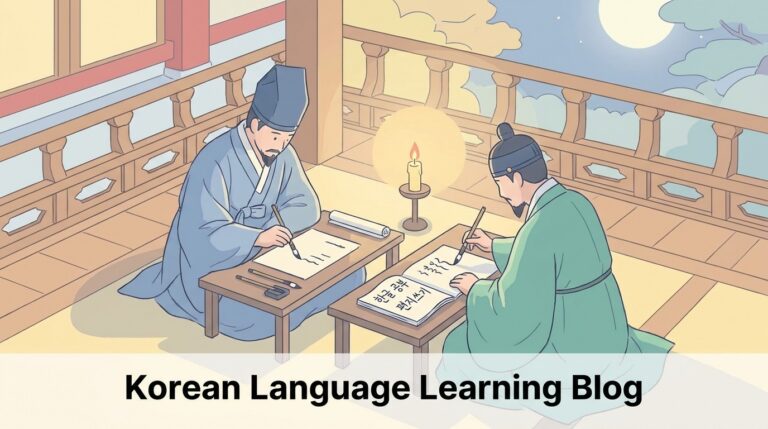
Consider the historical drama Tree With Deep Roots or corporate sagas like Misaeng. Whenever a junior protagonist challenges an orthodoxy, the room freezes. Yet over 460 years ago, Joseon witnessed the gold standard of democratic intellectual discourse: the legendary Four-Seven Debate (사단칠정 논쟁). In 1558, Toegye Yi Hwang—a revered 60-year-old titan of Neo-Confucian philosophy—received a sharp, unvarnished letter of critique from Gobong Ki Dae-seung, a newly passed 33-year-old junior scholar. Rather than pulling rank or dismissing the upstart, Master Toegye humbly engaged in an eight-year epistolary dialogue, exchanging dozens of profound letters. He revised his own lifelong doctrine (Ibalgi-suri-seol), treating the young challenger as an equal intellectual partner.
Mastering C2-level Korean means moving beyond basic deferential forms into the art of intellectual grace: expressing razor-sharp counter-arguments while elevating the dignity of your counterpart. Based on years of mentoring senior diplomats, researchers, and global executives navigating elite Korean institutions, this guide dissects the exact rhetorical devices, psychological postures, and historical eloquence behind Korea’s most famous intellectual debate. Let us elevate your Korean to the highest scholarly echelon.
Phase 2: Core 3 Expressions Deep Dive (C2 Level)
1. 감히 한 말씀 올리자면 (Gami han malsseum ollijamyeon)
- Pronunciation: [Gam-i han mal-sseum ol-li-ja-myeon] (Sounds like: Gah-mee hahn mahl-ssuhm ohl-lee-jah-myuhn)
- Meaning: Literal: “If I dare offer an elevated word…” | Real Nuance: “With utmost deference to your preeminence, permit me to venture a dissenting perspective.”
- K-Culture Moment: Echoed across historical epics like The King’s Affection and modern legal thrillers like Stranger (Secret Forest) when a principled subordinate speaks truth to supreme authority.
- Editor’s Insight: The adverb 감히 (gami – daringly/presumptuously) acts as a strategic buffer. By overtly recognizing your audaciousness before stating an uncomfortable truth, you disarm the listener’s ego and signal intellectual humility rather than rebellion.
- Situation Spectrum: Casual 🚫 | Semi-formal ⚠️ | Formal/Scholarly ✅
- 🤔 Think About It: In Western rhetorical debate, starting with an apology or self-deprecation can undermine your authority. Why does highlighting your junior station in Korean actually enhance your credibility?
2. 소견으로는 미흡하나마 (Sogyeon-eoroneun miheubhanama)
- Pronunciation: [So-gyeon-eu-ro-neun mi-heub-ha-na-ma] (Sounds like: Soh-gyuhn-oo-roh-nuhn mee-heub-hah-nah-mah)
- Meaning: Literal: “Although deficient in my small personal view…” | Real Nuance: “Based on my rigorous yet humble analysis…”
- K-Culture Moment: Used by elite scholars defending a thesis in prestigious academic conferences at Seoul National University or when advising senior board members in high-level symposiums.
- Editor’s Insight: 소견 (sogyeon) literally means “shallow/narrow sight,” a classic Sino-Korean humble noun used exclusively for one’s own opinion. Pairing it with 미흡하나마 frames your critique not as an absolute assertion, but as an earnest offering for collective refinement.
- Situation Spectrum: Casual 🚫 | Semi-formal ⚠️ | Formal/Scholarly ✅
- 🤔 Think About It: Contrast this with the English expression “In my humble opinion.” How does the Korean lexical choice reflect the Joseon virtue of Gyeong (敬 – Reverent Mindfulness)?
3. 학문적 견해를 달리하다 (Hangmunjeok gyeonhaereul dallihada)
- Pronunciation: [Hang-mun-jeok gyeon-hae-reul dal-li-ha-da] (Sounds like: Hahng-moon-juhk gyuhn-hae-rool dahl-lee-hah-dah)
- Meaning: Literal: “To make academic perspectives different” | Real Nuance: “To disagree on foundational theoretical grounds without personal animus.”
- K-Culture Moment: Frequently employed in high-level intellectual dialogues, op-eds in publications like the Chosun Ilbo or Hankyoreh, and ministerial confirmation hearings.
- Editor’s Insight: Notice that Korean prefers the verb 달리하다 (to make different) rather than 틀리다 (to be wrong) or 반대하다 (to oppose). This frames disagreement as a divergence of intellectual trajectories rather than a zero-sum conflict.
- Situation Spectrum: Casual 🚫 | Semi-formal ✅ | Formal/Scholarly ✅
- 🤔 Think About It: How does decoupling the idea from the person through abstract Sino-Korean verbs allow Korean intellectuals to preserve social harmony while debating fiercely?
Phase 3: Textbook Korean vs. Real Korean
Situation 1: Challenging a Senior’s Theoretical Hypothesis
- 📖 교과서 한국어: 제 생각에는 교수님의 의견이 틀렸다고 생각합니다. (Je saenggagenun gyosunimui uigyeoni teullyeottago saenggakhapnida. / “In my opinion, I think your opinion is wrong, Professor.”)
- 🗣️ 진짜 한국어: 대석학의 고견에 감히 반론을 제기하기 송구하오나, 사료의 맥락상 재고의 여지가 있지 않을까 사료됩니다. (Daeseokhagui gogyeone gami ballonul jegihagi songguhahona, saryoui maengnaksang jaegoui yeojiga itji aneulkka saryodoemnida. / “While I am hesitant to raise a counterargument against a great master’s profound insight, I venture to consider whether there remains room for re-evaluation in the context of historical documents.”)
- 💡 왜 다를까?: Using 틀렸다 in advanced discourse is a catastrophic pragmatic failure in Korean culture. Real intellectual Korean wraps dissent in humble conditionals (-지 않을까 사료됩니다).
Situation 2: Conceding and Refining Your Position After a Critique
- 📖 교과서 한국어: 당신 말이 맞습니다. 제가 고치겠습니다. (Dangsin mari matseumnida. Jega gochigetseumnida. / “Your words are correct. I will fix it.”)
- 🗣️ 진짜 한국어: 짚어주신 지적을 겸허히 수용하여, 제 논리의 미진한 부분을 보완토록 하겠습니다. (Jipeojusin jijeogul gyeomheohi suyonghayeo, je nonriui mijinhan bubunul bowantorok hagetseumnida. / “I humbly embrace the points you raised and shall supplement the unrefined aspects of my logic.”)
- 💡 왜 다를까?: The second-person pronoun 당신 can sound confrontational in intellectual settings. At the C2 level, one utilizes passive nominal markers (짚어주신 지적) and classic epistolary commitments (-토록 하겠습니다).
Phase 4: K-Culture Deep Dive & Non-Verbal Manners
4-1. Nunchi & Physical Gestures (Debating Across Generations)
When articulating intellectual divergence to a senior scholar in Korea, your physical presence must telegraph respect while your analytical logic remains unyielding:
* The Angle of the Gaze: Never lock eyes rigidly when delivering a counterpoint; it can be perceived as belligerent defiance (도전). Cast your eyes gently toward the table or the manuscript before you, raising them respectfully when listening.
* Two-Handed Posture: If referencing notes or documents, touch them using both hands. When speaking, keep your hands lightly folded over the solar plexus (Gongsu / 공수 posture).
* The Micro-Nod: Between your sentences, execute slight micro-nods to acknowledge the gravity of the subject, signaling that you are weighing every single word with profound care.
4-2. Cultural Code Analysis: The Spirit of Seogan (서간 – Epistolary Letters)
To understand Toegye Yi Hwang and Gobong Ki Dae-seung, one must look at Seogan-mun (서간문)—the Joseon art of letter writing. In traditional Korea, the written letter provided a psychological sanctuary that oral debates could not. Because face-to-face disagreement risks causing a loss of face (che-myeon / 체면), letters allowed both the elder Toegye and the younger Gobong to reflect, contemplate, and choose vocabulary that honored the human being while dissecting the philosophical idea. This tradition directly influenced modern Korean written memos, scholarly peer reviews, and executive communication: formal writing remains the supreme medium for respectful, nuanced dissent.
Phase 5: Real-World Roleplay Scenario
Setting: A quiet seminar room at the Academy of Korean Studies in Seongnam. Professor Park (박 교수), a distinguished authority on Joseon metaphysics, has just concluded a lecture emphasizing Toegye’s primacy of Li (이/理). The learner (Julian, a doctoral researcher) raises a thoughtful challenge drawn from Gobong’s emphasis on Qi (기/氣).
Characters:
* 박 교수 (Prof. Park): 65 years old, authoritative yet deeply principled scholar.
* 줄리안 (Julian): C2 doctoral candidate, poised and linguistically immaculate.
- 줄리안: 교수님, 오늘의 명강의 깊이 감사드립니다. 감히 한 말씀 여쭈어도 되겠습니까? (Gyosunim, oneului myeong-gang-ui gipi gamsadeuripnida. Gami han malsseum yeojjueodo doegesseumnikka?)
🎭 두 손을 단정히 모으고 부드러운 눈빛으로 조심스럽게 운을 뗀다.
(Professor, thank you deeply for today’s brilliant lecture. May I dare ask a question?) -
박 교수: 허허, 줄리안 연구원. 얼마든지 편하게 말해보게. 어떤 대목이 궁금한가? (Heoheo, Julian yeonguwon. Eolmadeunji pyeonhage malhaeboge. Eotteon daemogi gunggeumhanga?)
🎭 온화한 미소를 띠며 안경을 고쳐 쓴다.
(Haha, Researcher Julian. Speak freely. Which part piqued your curiosity?) -
줄리안: 퇴계 선생의 이발기수(理發氣隨) 관점은 숭고하나, 고봉 기대승이 지적했듯 칠정(七情) 외에 사단(四端)이 별도로 존재할 수 없다는 주기론적 맥락 또한 간과하기 어렵지 않겠습니까? (Toegye seonsaengui ibalgisu gwanjeomun sunggohana, Gobong Ki Dae-seungi jijeokhaetdeut chiljeong oe-e sadani byeoldo-ro jonjaehal su eopdaneun jugironjeok maengnak ttohan gangwahagi eoryeopji anketseumnikka?)
🎭 목소리의 높낮이를 차분히 유지하며 공손히 질문을 전개한다.
(While Master Toegye’s perspective on ‘Li issuing and Qi following’ is sublime, is it not also difficult to overlook Gobong Ki Dae-seung’s context that the Four Beginnings cannot exist apart from the Seven Emotions?) -
박 교수: 음, 역시 예리하군. 자네는 퇴계의 이기호발설이 인간 감정의 현실태를 온전히 설명하지 못한다고 보는 겐가? (Eum, yeoksi yerihagun. Janeneun Toegyeui igihobalseori ingan gamjeongui hyeonsiltaereul onjeonhi seolmyeonghaji mothandago boneun genga?)
🎭 진지한 표정으로 턱을 괴며 학문적 깊이에 몰입한다.
(Mmm, sharp as expected. Do you posit that Toegye’s Dual Emanation Theory fails to fully explain the empirical reality of human emotion?) -
줄리안: 소견으로는 미흡하나마, 순수한 도덕 감정도 결국 기(氣)의 발현이라는 물질적 토대 속에서만 작동한다고 사료됩니다. (Sogyeon-eoroneun miheubhanama, sunsuhan dodeok gamjeongdo gyeolguk gi-ui balhyeon-iraneun muljiljeok todae sogeseoman jakdonghandago saryodoemnida.)
🎭 정중히 고개를 살짝 숙이며 겸양의 뉘앙스를 강조한다.
(In my meager view, I consider that even pure moral sentiments ultimately operate solely within the material foundation of Qi’s manifestation.) -
박 교수: 하하, 과연 26세의 청년 고봉이 60세의 퇴계를 몰아붙이던 서신의 패기가 느껴지는군그래! (Haha, gwayeon isimyukse-ui cheongnyeon Gobongi yuksibse-ui Toegyereul mora-buchideon seosinui paegiga neukkyeojineungungurae!)
🎭 무릎을 탁 치며 호탕하게 웃음을 터뜨린다.
(Haha! I truly feel the spirited vigor of the 26-year-younger Gobong challenging the 60-year-old Toegye in their letters!) -
줄리안: 외람되게도 학문적 견해를 달리 펼쳤음에도, 너그럽게 헤아려 주셔서 송구하고 감사할 따름입니다. (Oeramdoe-gedo hangmunjeok gyeonhaereul dalli pyeolchyeosseum-edo, neogeureopge he-aryeo jusyeoseo songguhago gamsahal ttareum-ipnida.)
🎭 가슴 깊이 안도하며 정중히 고개 숙여 인사한다.
(Though I presumptuously articulated a differing academic perspective, I am merely humbled and grateful for your generous understanding.) -
박 교수: 학문이란 모름지기 권위가 아니라 치열한 탁마(琢磨)에서 꽃피는 법이지. 다음 주에 그 논거를 문서로 정리해 오게. 토론해보세. (Hangmun-iran moreumjigi gwon-wiga anira chiyeolhan takma-eseo kkotpineun beobiji. Daeum jue geu non-georeul munseo-ro jeongnihae oge. Toronhaebose.)
🎭 학생의 어깨를 격려하듯 다정하게 두드린다.
(True scholarship blossoms not from authority, but from rigorous mutual polishing. Organize your thesis in writing next week. Let us debate it.)
🔀 Interactive Decision Point
Suppose Professor Park pushes back firmly, asking: “그렇다면 자네는 도덕적 본질마저 물질적 상대주의로 격하시키겠다는 뜻인가?” (Do you mean to demote moral essence into material relativism?) How should you respond?
- Option A: “그건 절대 아닙니다. 교수님이 제 말을 오해하신 것 같습니다.” (Geugeon jeoldae animnida. Gyosunimi je mareul ohaehasin geot gatseumnida. / “That is definitely not true. Professor, you seem to have misunderstood me.”)
- Option B: “결코 그러한 취지는 아니오며, 본질의 숭고함을 유지하되 현실적 실천의 방도를 모색하고자 함입니다.” (Gyeolko geureohan chwijineun aniomyeo, bonjirui sunggohameul yujihadoe hyeonsiljeok silcheonui bangdoreul mosaekhagoja ham-ipnida. / “That is by no means my intent; rather, while preserving the nobility of essence, I endeavor to seek the methodology of practical application.”)
- Option C: “네, 현대 철학에서는 리(理)보다 기(氣)를 중시하는 것이 더 합리적입니다.” (Ne, hyeondae cheolhageseoneun riboda gireul jungjihaneun geosi deo hamrijeok-ipnida. / “Yes, in modern philosophy, valuing Qi over Li is more rational.”)
Feedback:
* Option A [Bad]: Accusing a master of “misunderstanding” (오해하다) violates pragmatic honorific etiquette and sounds aggressively defensive.
* Option B [Best]: Reframes the intent using exquisite Sino-Korean registers (결코 그러한 취지는 아니오며), bridging both essence and reality harmoniously.
* Option C [Risk]: Abruptly dismisses the mentor’s foundational paradigm under the banner of “modern rationality,” forfeiting the nuance of the debate.
Phase 6: 10초 감정 섀도잉 드릴 (Emotional Shadowing Drill)
Practice these cadence breaks (/) and emotional milestones out loud to capture the sophisticated delivery of high-register Korean dissent:
[🙇♂️ 극도의 겸양과 신중함을 담아]
감히 / 소견을 올리자면, / 기존의 학설과는 / 궤를 달리하는 부분이 / 있사옵니다.
(Gami / sogyeon-eul ollijamyeon, / gijon-ui hakseol-gwaneun / gwereul dallihaneun bubun-i / itsaomnida.)
“If I dare voice my humble view, / there exists an aspect / that diverges from established doctrine.”-
[🤔 차분하면서도 흔들림 없는 확신]
학문적 토론에 있어 / 연륜의 고하보다는 / 논리의 완결성이 / 우선되어야 마땅하다고 / 사료됩니다.
(Hangmunjeok torone isseo / yeollyun-ui gohabodaneun / nonri-ui wangyeolseong-i / useondweeoya mattanghadago / saryodoemnida.)
“In scholarly discourse, / rather than seniority of age, / the analytical coherence of logic / ought rightfully to take precedence, / so I reckon.” -
[🤝 상대의 권위를 세워주며 열린 결말]
대석학의 가르침을 / 거울삼아, / 부족한 제 사유를 / 부단히 탁마해 / 나가겠습니다.
(Daeseokhagui gareuchimeul / geoul-sama, / bujokhan je sayureul / budanhi takmahae / nagagetseumnida.)
“Taking the great master’s teaching / as my mirror, / I shall relentlessly polish / my own deficient contemplation / moving forward.”
Phase 7: K-Culture Mini Dictionary
-
사단칠정 (Sadan-chiljeong / 四端七情)
Translation: The Four Beginnings and Seven Emotions.
Usage: Refers to Mencius’ four innate moral virtues (benevolence, righteousness, propriety, wisdom) vs. the seven universal human emotions (joy, anger, sorrow, fear, love, hatred, desire). In high-level Korean, it metaphorically denotes any comprehensive debate examining the dialectic between universal moral principles and pragmatic human psychology. -
주리론 (Juriron / 主理論) vs. 주기론 (Jugiron / 主氣論)
Translation: Principle-Centric Theory vs. Material-Centric Theory.
Usage: Toegye championed Juri (focusing on universal moral order and ethical ideals), while Gobong laid the seeds for Yulgok Yi I’s Jugi (emphasizing reality, empirical conditions, and dynamic adaptation). Today, intellectuals use this pair to describe disputes between principled idealists and pragmatic realists. -
경 (Gyeong / 敬 – Reverent Mindfulness)
Translation: Active inner reverence, composure, and ethical presence.
Usage: The supreme psychological state cultivated by Toegye. In modern Korean communication, displaying Gyeong means listening with wholehearted intentionality and disagreeing with immense courtesy rather than reactive hostility. -
탁마 (Takma / 切磋琢磨)
Translation: Mutual polishing and refining of jade/gems.
Usage: Originating from cutting and grinding precious stones, this term describes intense, reciprocal intellectual debate between scholars who push each other toward crystalline perfection without animosity.
Phase 8: Traveler’s Survival Kit
If you journey to the spiritual heartlands of Joseon Neo-Confucianism, these cultural expressions and logistical steps will elevate your experience:
High-Register Expressions for Seowon (서원 – Confucian Academies)
- 도산서원의 퇴계 선생 유묵을 배관(拜觀)할 수 있겠습니까?
(Dosanseowon-ui Toegye seonsaeng yumug-eul baegwanhal su itgetseumnikka?)
Pro Tip: At Dosan Seowon in Andong, replacing the common verb 보다 (to see) with the exalted archaic Sino-Korean 배관하다 (to gaze upon with reverent worship) will astonish the local scholars and docents. -
고봉 선생의 학맥(學脈)이 깃든 월봉서원의 원규를 살피고자 합니다.
(Gobong seonsaengui hangmaegi gitdeun Wolbongseowon-ui won-gyureul salpigwaja hamnida.)
Pro Tip: Used when visiting Wolbong Seowon in Gwangju, showing you recognize Ki Dae-seung’s intellectual sanctuary. -
탁마의 정신이 서린 고문헌의 보존 상태가 참으로 경이롭습니다.
(Takmaui jeongsini seorin gomunheonui bojeon sangtaega cham-euro gyeong-iropseumnida.)
Pro Tip: A refined phrase to compliment academy archivists on their preservation of centuries-old wooden printing blocks (Mokpan).
Editor’s Travel Note: Journey to the Hall of Debate
To experience where this intellectual miracle happened, make a pilgrimage to Dosan Seowon in Andong.
* Navigation: Download the essential 네이버 지도 앱 다운로드 to pinpoint rural bus schedules (Bus #567 from Andong Station).
* Local Protocol: When walking into the main lecture hall (Jeonggyodang), step lightly, never tread on the central wooden threshold (Muntteok), and keep your voice lowered to mirror the solemn atmosphere of Joseon deliberation.
Phase 9: “한 발 더 깊이” (Philosophical Insight)
In contemporary Western debate, dialectic success is frequently measured by capitulation: winning the argument through undeniable rhetorical dominance. However, the Joseon Four-Seven Debate presents an alternative civilizational blueprint. In Toegye’s eyes, being challenged by a junior was neither an insult nor a battle of wills; it was a divine opportunity for Jagyeong (自敬 – self-reverence through ethical self-correction). Toegye’s linguistic humility did not dilute his stature—it immortalized him as the ultimate scholar-statesman. True C2 Korean fluency is not merely the ability to deploy complex subordinate clauses; it is the capacity to cultivate this profound Joseon ethos: treating intellectual divergence as an act of communal elevation rather than a threat to personal hierarchy.
💬 Your Turn: Have you ever experienced a debate where someone disagreed with you so respectfully that you felt honored rather than defensive? How would you express that sentiment in Korean? Share your reflections below! (여러분의 소중한 생각을 댓글로 들려주세요!)
Phase 10: FAQ & Common Mistakes
Q: Can I use “감히 한 말씀 올리자면” with friends or peers during a debate?
A: No. Using such elevated, humble archaisms with peers sounds either mockingly dramatic, sarcastic, or excessively theatrical. Save it for academic seminars, formal dissertations, legal addresses, or executive-level corporate presentations.
Q: What is the primary linguistic difference between Toegye’s and Gobong’s letters?
A: Toegye, as the elder and senior statesman, utilized refined deference blended with fatherly warmth (Hae-eun / 혜은), employing sentences ending in -게나 or -오. Gobong, maintaining his station as a humble petitioner, composed his letters in the ultimate humble register (Bae-sang / 拜上 – bowed with two palms to the ground), balancing uncompromising logical critique with extreme lexical modesty.
Q: How can I soften a blunt disagreement in a business meeting without sounding too archaic?
A: Instead of historical Joseon terms, pivot to modern elite boardroom equivalents: “말씀해주신 취지에는 깊이 공감하오나, 현장의 변수를 고려했을 때 다른 각도에서의 검토도 긴요할 것으로 사료됩니다.” (I deeply resonate with the intent of your words, yet considering practical variables, I deem an examination from an alternative angle to be vital).
🚨 Common Mistakes Warning Board
- Mistake 1: Using “제 생각에는 틀렸습니다” (You are wrong in my view).
Correct Action: Never use 틀리다 for opinions. Use 견해를 달리하다 (hold a differing view) or 재고의 여지가 있다 (there is room for reconsideration). - Mistake 2: Confusing “주리론” (Principle) with “주기론” (Material Qi) when debating pragmatism.
Correct Action: Use 주리론적 관점 when defending ethical ideals and moral absolutes; use 주기론적 맥락 when defending empirical reality, flexibility, and tangible evidence. - Mistake 3: Overusing humble markers without substantive logic.
Correct Action: Humility without rigorous logic is empty flattery (아첨). Ensure your polite preambles are followed by crisp, well-structured analytical claims.
Phase 11: Action Missions & Engagement
- 🥉 Bronze Mission (Solo Practice): Read the 3 sentences in Phase 6 out loud three times, matching the cadence breaks and recording yourself on your smartphone to evaluate vocal composure.
- 🥈 Silver Mission (Social Dialogue): Translate your favorite debate quote from your home country into respectful, high-register Korean and post it on your Instagram Story or X (Twitter), tagging
@DailyHangul. - 🥇 Gold Mission (Real-world Challenge): In your next Korean graduate seminar, language exchange, or corporate meeting, politely offer a counterpoint using the frame: “선생님(부장님)의 고견에 깊이 경청하였사오나, 소견으로는 미흡하나마 한 가지 다른 관점을 보태어보고자 합니다.”
🎮 K-Culture Mission: Watch an episode of a political Sageuk (such as Jeong Do-jeon or Six Flying Dragons) and spot at least one instance where a minister uses 감히 or 통촉하여 주옵소서 to challenge the King. Note how their physical posture complements their words!
Phase 12: Interactive Quiz Challenge
Test your mastery of elite Korean debate decorum and Joseon philosophical history!
1. [상황 판단] 학술 세미나에서 원로 교수의 이론적 맹점을 지적할 때 가장 품격 있는 표현은?
(A) 교수님 말씀은 현실을 전혀 모르는 탁상공론입니다.
(B) 대석학의 고견에 감히 반론을 제기하기 송구하오나, 사료의 재검토 여지가 사료됩니다.
(C) 당신의 의견에는 심각한 논리적 결함이 존재합니다.
2. [빈칸 채우기] 서로의 견해가 다를 때 인신공격 없이 세련되게 다름을 나타내는 동사구는?
“우리는 사안을 바라보는 학문적 견해를 (_______) 뿐입니다.”
3. [문화 O/X] 60세의 퇴계 이황은 33세의 젊은 학자 기대승의 비판 서신을 받고, 관직의 위계를 내세워 기대승을 처벌하거나 서신 교환을 거부했다. (O / X)
👉 Click to view answers and explanations (정답 및 해설 보기)
-
정답: (B)
해설: (A)와 (C)는 직설적인 인신공격 및 감정적 비난 표현(탁상공론, 당신, 심각한 결함)이 포함되어 있어 C2 수준의 학술적 예법에 위배됩니다. (B)는 원로의 학문적 성취를 인정하면서도 논리적 재검토를 정중히 제안하는 완벽한 고위 예사 표현입니다. -
정답: 달리할 (달리하다)
해설: ‘틀리다’ 대신 ‘달리하다’를 사용하는 것은 상대방의 존엄성을 훼손하지 않고 순수하게 논리적 지향점의 차이를 밝히는 고품격 한국어 표현입니다. -
정답: X
해설: 퇴계 이황은 26세 연하의 젊은 학자였던 기대승의 비판을 권위로 억누르지 않았으며, 오히려 8년간 수십 통의 편지를 주고받으며 자신의 학설(사단칠정 분속설)을 스스로 수정·보완하는 대석학의 겸양을 실천했습니다.






