

Phase 1: Empathy & Story-Driven Hook
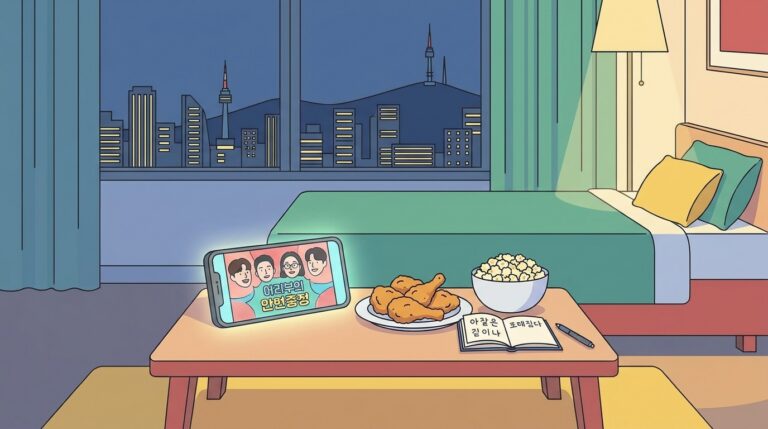
안녕하세요! 매일한글 에디터입니다. (Hello! This is your Daily Hangul editor.) Picture this: it is 11:58 PM on a chilly Friday night in Seoul. Your eyes feel heavy and your bed is calling, but you refuse to sleep. Why? Because the semi-final episode of your favorite Korean reality survival show has just dropped on TVING and Netflix. You know with absolute certainty that if you do not watch it right now, the winner’s face will be plastered across Instagram, X (Twitter), and your morning group chats before you even brush your teeth tomorrow.
Staying up late to dodge spoilers has become a shared cultural ritual in Korea. Whether it is a wild dating reality show like Transit Love (환승연애) or an intense culinary showdown like Culinary Class Wars (흑백요리사), fans sacrifice sleep just to protect the suspense. In this guide, curated directly from our learners’ real-life social hurdles, you will master the exact conversational Korean needed to navigate these drop days, defend against plot leaks, and talk like a true entertainment insider!
Phase 2: 3 Core Expressions Deep-Dive
1. 스포 방지 (Seupo bangji)
- Pronunciation: Seu-po bang-ji (Sounds like “seh-poh bahng-jee”)
- Meaning: “Spoiler prevention” (Literal) vs. “Spoiler alert / Anti-spoiler courtesy” (Real-life nuance)
- K-Culture Moment: Korean netizens prepend
[스포 방지]or[스포 주의]to community post titles on platforms like Theqoo or DC Inside so fellow fans can safely scroll without unwanted revelations. - Editor’s Insight: “스포” (seupo) is a classic Korean abbreviation of the English word spoiler. Coupled with the Sino-Korean noun “방지” (bangji, prevention), this term functions as a polite barrier protecting fellow fans’ viewing joy.
- Situation Spectrum: Casual ✅ | Semi-formal ✅ | Formal ⚠️
- 🤔 Think About It: In many Western online forums, people just drop spoilers carelessly. Why does Korean web culture place such a heavy community emphasis on tagging
[스포 방지]before speaking?
2. 정주행하다 (Jeongjuhaenghada)
- Pronunciation: Jeong-ju-haeng-ha-da (Sounds like “jung-joo-heng-hah-dah”)
- Meaning: “Driving steadily in the correct lane” (Literal) vs. “To binge-watch an entire series in order” (Real-life nuance)
- K-Culture Moment: When an entire 10-episode Korean drama drops at 4:00 PM on a Friday, fans shout: “오늘 밤 치킨 시키고 첫 회부터 정주행할 거야!” (Oneul bam chikin sikigo cheot hoebuteo jeongjuhaenghal geoya! / “I’m ordering chicken and binge-watching from episode one tonight!”)
- Editor’s Insight: Notice the traffic metaphor! Driving straight in the correct direction is “정주행” (jeongjuhaeng). Its opposite is “역주행” (yeokjuhaeng, driving the wrong way), which Koreans use when an old drama or music track miraculously climbs back up the charts months later.
- Situation Spectrum: Casual ✅ | Semi-formal ✅ | Formal ⚠️
- 🤔 Think About It: English uses an eating metaphor (“bingeing”), while Korean uses a navigational travel metaphor (“driving the full course”). What does this say about the way we view entertainment?
3. 밤을 새우다 / 밤새우다 (Bameul saeuda)
- Pronunciation: Ba-meul sae-u-da (Sounds like “bah-meul seh-oo-dah”)
- Meaning: “To stay awake through the dark hours” (Literal) vs. “To pull an all-nighter for something thrilling” (Real-life nuance)
- K-Culture Moment: Crawling into work on Friday morning with dark circles, you confess to your colleague: “어젯밤에 새 에피소드 보느라 밤새웠어요.” (Eojetbame sae episodeu boneura bamsaeweosseoyo. / “I pulled an all-nighter watching the new episodes last night.”)
- Editor’s Insight: In casual speech, native speakers often drop the object particle and shorten this to “밤새다” (bamsaeda). Grammatically, “밤을 새우다” is transitive (you actively stayed awake), but you will hear both used interchangeably among friends.
- Situation Spectrum: Casual ✅ | Semi-formal ✅ | Formal ✅
- 🤔 Think About It: In Korea’s fast-paced society, is pulling an all-nighter for pop culture seen as pure exhaustion, or a passionate badge of honor?
Phase 3: Textbook Korean vs. Real Korean
Situation 1: Telling a friend not to reveal the winner
- 📖 교과서 한국어 (Textbook): 드라마의 결말을 미리 말하지 마세요. (Deuramaui gyeolmareul miri malhaji maseyo. / “Please do not tell me the ending of the drama beforehand.”)
- 🗣️ 진짜 한국어 (Real-life): 아, 제발 스포하지 마! (A, jebal seupohaji ma! / “Ah, please don’t spoil it!”)
- 💡 왜 다를까? (Why the difference?): Nobody uses stiff nouns like “결말을 미리 말하다” when talking casually with peers. Koreans transform “스포” into an active verb: “스포하다” (to spoil) or “스포 당하다” (to get spoiled).
Situation 2: Describing how trendy a new survival show is
- 📖 교과서 한국어 (Textbook): 이 예능 프로그램은 대중에게 인기가 대단히 많습니다. (I yeneung peurogeuraemeun daejungege ingiga daedanhi manseumnida. / “This entertainment program is exceptionally popular with the public.”)
- 🗣️ 진짜 한국어 (Real-life): 요즘 이 예능 완전 핫해, 난리 났어! (Yojeum i yeneung wanjeon hathae, nalli nasseo! / “This variety show is so hot right now, everyone’s freaking out!”)
- 💡 왜 다를까? (Why the difference?): To convey viral social media momentum, everyday speakers rely on vivid slang like “완전 핫해” (totally hot) and the colorful idiom “난리 났다” (chaos broke out / it went crazy viral).
Phase 4: K-Culture Deep Dive & Non-Verbal Manners
4-1. 눈치 (Nunchi) & Gestures
When new episodes drop on platforms like TVING or Netflix, the social golden rule in Korean offices and university campuses is 눈치 (Nunchi: social awareness).
* The Ear-Covering Defense: If someone starts a sentence with “너 그거 봤어?” (Did you see that?), and you haven’t watched it yet, you immediately throw your hands over your ears, cross your index fingers into an ‘X’, and squeeze your eyes shut. This universal body language warns everyone within earshot to freeze.
* The Whispering Office Etiquette: If two colleagues have both stayed up until 3:00 AM to watch the show, they will gather near the water cooler, lean forward, and whisper to ensure they do not accidentally spoil colleagues working nearby.
4-2. Cultural Codes: The Friday Afternoon OTT Blitz
In South Korea, broadcast TV used to dominate prime-time evening slots. Today, OTT platforms rule the cultural watercooler. Korean platforms frequently drop new episodes at 4:00 PM on Fridays. Why 4:00 PM? So workers commuting home on the subway can start streaming immediately! By Friday evening, social feeds become a minefield. Koreans refer to unluckily stumbling across an unprompted spoiler as “스포를 밟다” (literally: stepping on a spoiler, like stepping on a landmine). Staying up late to finish the show is essentially defensive entertainment shield-building!
Phase 5: Real-Life Roleplay Scenario
- Setting: Friday lunchtime at a trendy cafe in Seongsu-dong. Your Korean friend and coworker Minji (민지) is tapping her fingers eagerly on the table, barely able to contain her excitement about last night’s episode.
- 민지: 너 어제 공개된 새 에피소드 봤어? 나 지금 입이 근질거려 죽겠어!
(Neo eoje gonggaedwoen sae episodeu bwasseo? Na jigeum ibi geunjilgeoryeo jukgesseo!)
“Did you watch the new episode that dropped yesterday? My mouth is itching to talk about it!”
🎭 [민지가 눈을 반짝이며 커피잔을 바닥에 탁 내려놓는다] -
나: 잠깐만! 나 아직 마지막 30분 못 봤단 말이야!
(Jamkkanman! Na ajik majimak samsipbun mot bwatdan mariya!)
“Wait a second! I haven’t watched the last 30 minutes yet!”
🎭 [두 손으로 귀를 틀어막으며 다급하게 뒤로 물러선다] -
민지: 앗, 진짜? 스포 당하면 안 되니까 입 닫고 있어야겠네.
(At, jinjja? Seupo danghamyeon an doenikka ip datgo isseoyagenne.)
“Oh, really? You shouldn’t get spoiled, so I better keep my mouth shut.”
🎭 [장난스럽게 제 손으로 입술 지퍼를 채우는 시늉을 한다] -
나: 응, SNS도 일부러 안 켜고 있어. 스포 밟을까 봐.
(Eung, SNS-do ilbureo an kyeogo isseo. Seupo balbeulkka bwa.)
“Yeah, I’m deliberately avoiding social media in case I step on a spoiler.”
🎭 [스마트폰 화면을 뒤집어 테이블 위에 단단히 엎어 놓는다] -
민지: 인정! 나도 저번에 금요일 밤에 스포 밟아서 완전 후회했잖아.
(Injeong! Nado jeobeone geumyoil bame seupo balbaseo wanjeon huhoehaetjana.)
“Total agreement! I stepped on a spoiler last Friday night too and totally regretted it.”
🎭 [고개를 격하게 끄덕이며 깊은 한숨을 쉰다] -
나: 그래서 오늘 퇴근하자마자 치킨 시켜놓고 정주행하려고!
(Geuraeseo oneul toegeunhaja-maja chikin sikyeonoko jeongjuhaengharyeogo!)
“That’s why the moment I get off work, I’m ordering fried chicken and binge-watching it!”
🎭 [결연한 표정으로 주먹을 불끈 쥐어 보인다] -
민지: 오, 치맥 하면서 정주행? 완전 완벽한 불금 계획이네!
(O, chimaek hamyeonseo jeongjuhaeng? Wanjeon wanbyeokhan bulgeum gyehoeigine!)
“Ooh, binge-watching with chicken and beer? That’s the ultimate Burning Friday plan!”
🎭 [박수를 짝 치며 환하게 웃는다] -
나: 다 보고 나면 오늘 밤에 카톡으로 폭풍 수다 떨자!
(Da bogo namyeon oneul bame katogeuro pokpung suda tteolja!)
“Once I finish, let’s chat up a storm on KakaoTalk tonight!”
🎭 [눈을 찡긋하며 시원하게 아이스 아메리카노를 마신다]
🔀 Interactive Choice Point
Right after Minji asks if you watched the episode in Turn 1, how do you respond?
* Option A: “누가 탈락했는지만 먼저 살짝 말해줘!” (Nu-ga tallakhaenneunjiman meonjeo saljjak malhaejwo! / Just tell me quickly who got eliminated!)
* 👉 Feedback (Risk): You satisfy immediate curiosity, but you instantly destroy the dramatic tension of the final episode. Minji might also judge you for being reckless with spoilers!
* Option B: “절대 스포하지 마! 오늘 밤에 다 보고 얘기하자.” (Jeoldae seupohaji ma! Oneul bame da bogo yaegihaja. / Don’t spoil anything! Let’s talk after I finish it tonight.)
* 👉 Feedback (Best!): Perfect natural Korean! Sets a clear boundary while maintaining excitement and proposing a fun chat later.
* Option C: “나 그런 유치한 방송 볼 시간 없어.” (Na geureon yuchihan bangsong bol sigan eopseo. / I don’t have time to watch childish shows like that.)
* 👉 Feedback (Bad): Total conversation killer. Shuts down your friend’s enthusiasm and harms your rapport.
Phase 6: 10-Second Emotion Shadowing Drill
Read these aloud while mimicking the emotional tags and pauses marked by /!
- [😱 Panic & Urgency]
“아, 안 돼! / 스포하지 마! / 나 아직 결말 / 못 봤단 말이야!”
(A, an dwae! / Seupohaji ma! / Na ajik gyeolmal / mot bwatdan mariya!)
“Ah, no! Don’t spoil it! I haven’t seen the ending yet!” -
[😴 Exhausted but Victorious]
“어제 새 에피소드 / 먼저 챙겨 보느라 / 결국 새벽 세 시까지 / 밤새웠어.”
(Eoje sae episodeu / meonjeo chaenggyeo boneura / gyeolguk saebyeok se sikkaji / bamsaeweosseo.)
“I stayed up until 3 AM last night to watch the new episode before anyone else.” -
[🔥 Determined & Excited]
“오늘 칼퇴하고 / 치킨 뜯으면서 / 무조건 / 끝까지 정주행한다!”
(Oneul kaltoe-hago / chikin tteudeumyeonseo / mujogeon / kkeutkkaji jeongjuhaenghanda!)
“I’m leaving work on the dot today, grabbing chicken, and binge-watching all the way through!”
Phase 7: K-Culture Mini Dictionary
-
스포일러 밟다 (Seupo-il-leo balp-da)
Meaning: To inadvertently step on a spoiler while browsing social media or reading message threads.
Usage: “인스타 보다가 스포 밟아서 기분 완전 잡쳤어.” (I was browsing Instagram, stepped on a spoiler, and it completely ruined my mood.) -
본방사수 (Bon-bang-sa-su)
Meaning: Defending the original real-time broadcast by watching it the second it airs.
Usage: Originally coined for traditional TV broadcasts, now humorously applied to streaming OTT drops: “오늘 4시 공개되자마자 본방사수 간다!” (The second it drops at 4:00 today, I’m watching live!) -
떡밥 (Tteok-bap)
Meaning: Clues, easter eggs, or foreshadowing in a mystery or reality series (literally “fish bait”).
Usage: “감독이 3화에 뿌려둔 떡밥이 드디어 풀렸어!” (The clues the director scattered in episode 3 were finally resolved!) -
팝콘각 (Pop-con-gak)
Meaning: A juicy, dramatic situation ripe for grabbing popcorn and watching the fireworks.
Usage: “오늘 두 참가자 신경전 대박이던데 완전 팝콘각이야!” (The psychological battle between those two contestants today was epic—total popcorn angle!)
Phase 8: Traveler’s Survival Kit
Top 3 Survival Expressions for OTT Enthusiasts
-
“와이파이 비밀번호가 뭐예요?” (Wa-i-pa-i bimilbeonhoga mwoyeyo?)
Meaning: “What is the Wi-Fi password?”
Pro Tip: Korean cafes boast superfast fiber internet. If you are catching an episode on your tablet before subway rush hour, just check the bottom of your order receipt where the Wi-Fi credentials are often printed! -
“휴대폰 충전 좀 맡길 수 있을까요?” (Hyudaepon chungjeon jom matgil su isseulkkayo?)
Meaning: “Could I have my phone charged here for a bit?”
Pro Tip: Binge-watching drains smartphone batteries rapidly. Most cozy Korean indie cafes and restaurants will happily plug your phone into a multi-port charger behind the counter. -
“혹시 결말 스포예요?” (Hoksi gyeolmal seupoyeyo?)
Meaning: “Is this by any chance an ending spoiler?”
Pro Tip: Use this polite check when striking up conversations about shows at guest houses or izakayas.
Editor’s Travel Note: The Streaming Commute
When traveling across Seoul, check out the 티빙(TVING) 앱 공식 안내 and the 넷플릭스 코리아 모바일 앱 서비스 to download episodes using your hotel’s high-speed network beforehand. Furthermore, Seoul Metro trains offer ultra-fast public Wi-Fi (“Public WiFi Free”), meaning you can continue streaming uninterrupted while riding the Line 2 circular loop without eating into your precious travel SIM card data!
Phase 9: A Step Deeper (Cultural Reflection)
In South Korea, pop culture is never experienced in isolation. Because of the country’s dense urban layout and hyper-connected digital infrastructure, hit variety shows and dramas act as an instant national bonding medium. When a show captures the public imagination, skipping it can feel like being exiled from the social conversation at work or university. Staying up until 2:00 AM on a Friday to beat spoilers is not about mindless screen addiction; it is an active effort to belong to the collective emotional wave (공감대, gong-gam-dae) that will define this weekend’s conversations.
💬 Your Turn: Have you ever stayed up way past your bedtime just to dodge online spoilers for a Korean series? Which K-drama or reality show made you sacrifice your sleep? Tell us in the comments below!
Phase 10: FAQ & Common Mistakes
Q: Can I use “스포” in a formal business presentation?
A: No! “스포” is informal slang. In a formal business or academic presentation, always use standard vocabulary such as “결말 유출” (leakage of the conclusion) or “정보 사전 공개” (prior disclosure of information).
Q: What is the grammatical difference between “밤새다” and “밤을 새우다”?
A: “밤새다” is an intransitive verb meaning the night itself passed until dawn. “밤을 새우다” is a transitive verb meaning you actively stayed awake through the night. However, in modern everyday Korean speech, “나 어제 밤샜어” (I stayed up all night yesterday) is universally accepted and understood.
Q: When do TVING and Netflix Korea typically drop new reality episodes?
A: TVING and Coupang Play typically drop original content on Friday afternoons (around 4:00 PM or 8:00 PM KST), whereas Netflix series usually release worldwide simultaneously at 4:00 PM or 5:00 PM KST.
🚨 Common Mistakes Warning Board
- ❌ Mistake 1: Saying “스포일러 하지 마세요”
✔️ Correct Action: Shorten it! In casual everyday conversation, say “스포하지 마세요” or simply “스포 금지!” (Spoilers forbidden! - ❌ Mistake 2: Using “정주행” when listening to one song repeatedly.
✔️ Correct Action: “정주행” means watching/reading a narrative work from start to finish. If you are repeating a single K-pop song, say “무한 반복 중” (on infinite repeat). - ❌ Mistake 3: Saying “스포를 먹다” (eating a spoiler).
✔️ Correct Action: The authentic native expression is always “스포를 밟다” (stepping on a spoiler) or “스포 당하다” (getting hit by a spoiler).
Phase 11: Action Mission & Engagement
- 🥉 Bronze Mission (Solo Shadowing): Look in the mirror, make an ‘X’ sign with your hands, and practice shouting with exaggerated emotion: “아 제발 스포하지 마! 나 오늘 정주행할 거야!” 5 times.
- 🥈 Silver Mission (Social Share): Next time you start a new Korean series on Netflix, screenshot the title card and post it to your Instagram story with the caption: “오늘 밤 치킨 먹으면서 정주행각! 🍗🍿”
- 🥇 Gold Mission (Live Application): When chatting with your Korean language exchange partner or tutor, ask them: “요즘 한국에서 제일 핫한 예능이 뭐예요? 스포 없이 추천해 주세요!” (What variety show is hottest in Korea right now? Please recommend it without spoilers!)
- 🎮 K-Culture Mission: Watch any Korean variety show episode with Korean subtitles on and pause every time you spot the bracketed tag
[스포 방지]or the word정주행!
Phase 12: Interactive Quiz Challenge
Q1. Situation Judgment
Your Korean friend opens their mouth and says: “너 솔로지옥 최종 선택 누가 됐는지 알아?” (Do you know who got chosen in the Single’s Inferno finale?). You haven’t watched it yet. Which response is the most natural and culturally appropriate?
* A) “어제 밤을 새워서 이미 다 알아요.”
* B) “아, 제발 스포하지 마! 나 아직 못 봤단 말이야.”
* C) “드라마의 결말을 공식적으로 발설하지 마십시오.”
Q2. Fill in the Blank
Complete the sentence with the correct term:
“이번 주말에 방에서 넷플릭스 1화부터 끝까지 __________할 거예요!”
(I’m going to binge-watch Netflix from episode 1 to the end in my room this weekend!)
Q3. True or False
In Korean digital slang, the phrase “스포를 밟다” means intentionally searching for spoilers because you cannot wait to find out the plot.
* (True / False)
👉 Click to reveal answers & explanations!
-
Q1 Answer: B
Explanation: “아, 제발 스포하지 마! 나 아직 못 봤단 말이야” is the authentic, natural way to stop a friend from spoiling the outcome! Choice A claims you already stayed up and watched it, while Choice C is comically rigid textbook speech. -
Q2 Answer: 정주행 (정주행하다)
Explanation: Watching a series from the very beginning to the end in sequential order is called “정주행”. -
Q3 Answer: False
Explanation: “스포를 밟다” literally translates to “stepping on a spoiler” (like a landmine). It means you unintentionally stumbled upon an unwanted spoiler while scrolling online!







