

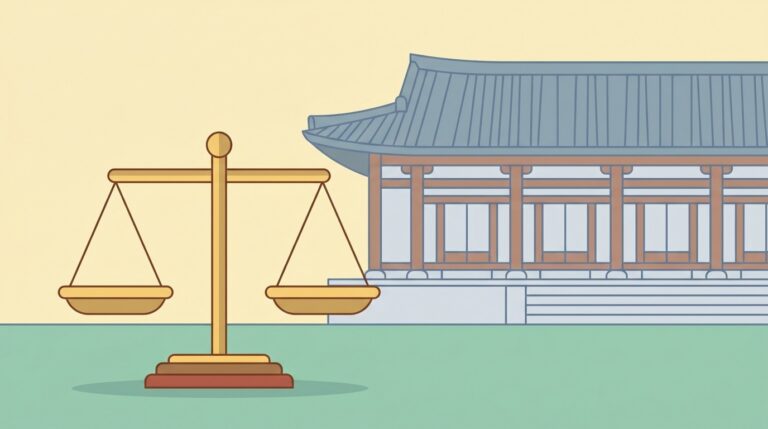
Mastering the Art of Constitutional Balance: How Korean Law Harmonizes Conflicting Fundamental Rights
Phase 1: Empathy (Immersive Opening)
안녕하세요! It’s your Daily Hangul editor here.
Picture this: You are watching a high-stakes Korean legal drama like Law School or Stranger (비밀의 숲). The courtroom is dead silent. On one side, an investigative journalist claims the constitutional right to freedom of expression; on the other, a public figure demands the fundamental right to privacy and human dignity. As an advanced learner, you might expect one right to crush the other in a zero-sum, dramatic Western-style showdown. But instead, the presiding judge leans into the microphone and delivers a nuanced, philosophical verdict grounded not in total victory, but in preserving both rights simultaneously.
When foreign scholars, diplomats, and advanced Korean learners encounter the Korean Constitutional Court (헌법재판소), they often run into a massive conceptual barrier: understanding how clashing constitutional rights (기본권의 충돌) are resolved. In Korean jurisprudence, courts rarely discard one right completely. Instead, they pursue what jurists call ‘규범조화적 해석’ (harmonious norm interpretation)—a sophisticated doctrine ensuring neither right is hollowed out.
Mastering this concept elevates your Korean from textbook fluency to elite, C2-level conceptual competence. It lets you participate in high-level intellectual discourse, analyze Korean public policy debates, and understand the cultural philosophy of co-existence (상생) that underpins modern Korean society. This guide is crafted from real-world seminars with legal translators and advanced scholars to give you that exact master-level edge.
Phase 2: Deep Dive into 3 Core Expressions
1. 규범조화적 해석 (Gyu-beom-jo-hwa-jeok hae-seok)
- Pronunciation: [Gyu-beom-jo-hwa-jeok hae-seok] (Think of ‘Gyu’ like ‘cue’, ‘beom’ like ‘bum’, ‘jo-hwa’ like the harmony in a choir, and ‘hae-seok’ like analyzing a text).
- Meaning: Literal: “Norm-harmonizing interpretation” | Real Nuance: A constitutional interpretation method where two conflicting fundamental rights are both upheld to their optimum degree without either being unconditionally abolished.
- K-Culture Moment: In legal dramas, professors and constitutional justices invoke this phrase when reprimanding hot-headed defense attorneys who demand the absolute annulment of an opposing civic duty.
- Editor’s Insight: In Korean legal dogmatics, this is the antithesis of a zero-sum game (제로섬 게임). When you use this phrase in debate, you instantly sound like an appellate judge seeking equilibrium rather than a partisan debater.
- Situation Spectrum: Casual 🚫 | Semi-formal ⚠️ | Formal ✅
- 🤔 Think About It: Why does Korean legal theory prefer “norm harmony” over establishing a rigid, permanent hierarchy of constitutional rights?
2. 과잉금지원칙 (Gwa-ing-geum-ji-won-chik)
- Pronunciation: [Gwa-ing-geum-ji-won-chik] (Break it down: ‘Gwa-ing’ sounds like ‘gwa-ing’ [excess], ‘geum-ji’ [prohibition], ‘won-chik’ [principle])
- Meaning: Literal: “Principle of prohibition against excess” | Real Nuance: The Principle of Proportionality under Article 37(2) of the Korean Constitution, testing purpose legitimacy, suitability of means, least restrictive means, and balance of legal interests.
- K-Culture Moment: Used prominently in news segments covering editorial debates on whether COVID-19 curfews or anti-protest blockades infringed upon civil liberties beyond constitutional limits.
- Editor’s Insight: You will often hear this paired with 비례의 원칙 (Principle of Proportionality). At the C2 level, deploying this phrase signals that you are dissecting state intervention through an institutional, constitutional lens.
- Situation Spectrum: Casual 🚫 | Semi-formal ⚠️ | Formal ✅
- 🤔 Think About It: How does the linguistic framing of “prohibiting excess” reflect the Korean public’s vigilance against authoritarian overreach?
3. 법익의 균형성 (Beob-ik-ui gyun-hyeong-seong)
- Pronunciation: [Beo-bik-ui gyun-hyeong-seong] (Flow smoothly: ‘Beob-ik’ merges into ‘beo-bik’, and ‘gyun-hyeong-seong’ sounds like a resonant chime)
- Meaning: Literal: “Balance of legal interests” | Real Nuance: The critical final stage of the proportionality test, where the public interest served by a restriction must demonstrably outweigh the private right being curtailed.
- K-Culture Moment: Broadcast debates on JTBC or MBC during constitutional reviews of contested labor strikes or platform monopolies.
- Editor’s Insight: C2 speakers replace the everyday word 장단점 (pros and cons) with 법익 균형성 whenever discussing statutory amendments, editorial ethics, or regulatory policy.
- Situation Spectrum: Casual 🚫 | Semi-formal ✅ | Formal ✅
- 🤔 Think About It: Compare 법익 (legal interest protected by law) with the everyday English term ‘benefit’. Notice how Korean ties the interest directly to statutory legitimacy.
Phase 3: Textbook Korean vs. Real Native Korean
Situation 1: Arguing that both sides of a civic dispute have legitimate constitutional protections
- 📖 Textbook Korean: 우리는 양쪽 권리를 다 지켜줘야 합니다. (Ulineun yangjjok gwonlireul da jikyeojwoya hamnida. / We must protect both sides’ rights.)
- 🗣️ Real Native Korean (C2): 어느 한쪽의 일방적 희생을 강요하기보다는, 규범조화적 합일점을 도출하는 것이 헌법 정신에 부합합니다. (Eoneu hanjjogui ilbangjeok hisaengeul gang-yohagibodaneun, gyubeomjohwajeok habiljeomeul dochulhaneun geosi heonbeop jeongsine buhaphamnida. / Rather than forcing a unilateral sacrifice on one party, deducing a harmonious normative convergence accords with the spirit of the constitution.)
- 💡 Why is it different?: Educated native speakers rarely use colloquial terms like 다 지켜주다 in serious discourse; they deploy technical jurisprudence (규범조화적 합일점, 헌법 정신에 부합) to express principled mediation.
Situation 2: Criticizing an overly restrictive governmental regulation
- 📖 Textbook Korean: 정부의 이 법은 개인의 자유를 너무 많이 침해해요. (Jeongbuui i beobeun gaeinui jayureul neomu mani chimhaehaeyo. / This government law violates personal freedom too much.)
- 🗣️ Real Native Korean (C2): 해당 조치는 입법 목적에 비추어 볼 때 과잉금지원칙상 최소침해성 요건을 충족하지 못했습니다. (Haedang jochineun ipbeop mokjeoge bichwo bol ttae gwainggeumjiwonchiksang choesochimhaeseong yogeoneul chungjokhaji motaetsseumnida. / In light of its legislative intent, the measure in question fails to satisfy the requirement of the least restrictive means under the principle of proportionality.)
- 💡 Why is it different?: C2 discourse moves away from emotive assertions (너무 많이) to structured legal thresholds (최소침해성 요건).
Phase 4: K-Culture Deep Dive & Non-Verbal Manners
4-1. Nunchi & Gestures: The Posture of Legal Restraint
When debating fundamental rights in Korean professional circles, aggressive Western hand gestures—such as finger-pointing or chopping the air—are viewed as intellectually insecure. Instead, Korean constitutional attorneys and academics maintain a calm, centered posture. Keep both hands resting on the podium or table with palms tilted slightly inward. When offering a counterpoint on rights conflict, slightly tilt your head and preface your argument with 물론 상대측 법익도 중대합니다만 (Of course, the opposing party’s legal interest is also grave, but…). This subtle nod of acknowledgment preserves social harmony (예의) even while dismantling the opposing argument.
4-2. Cultural Code Analysis: The Spirit of Sangsaeng (상생)
Why is “harmonious norm interpretation” so revered in Korea? Unlike Western jurisdictions where legal battles often favor sharp zero-sum resolutions (e.g., categorical first-amendment absolutism), Korean constitutional jurisprudence is deeply colored by the historical imperative of social reconciliation (대화와 타협 and 상생). In Korean dramas like Hyena or Vincenzo, the tension frequently stems from whether raw power or institutional balance will prevail. Understanding this cultural preference for sustainable coexistence helps you realize why the Korean Constitutional Court works tirelessly to carve out intermediate, conditional decisions (헌법불합치 – constitutional non-conformity) rather than instant voiding.
Phase 5: Real-Life Roleplay Scenario
Setting: The Constitutional Research Seminar Room inside the Constitutional Court of Korea (헌법재판소), overlooking Bukchon Hanok Village. Dust motes float in the afternoon light. Professor Min, a sharp yet considerate constitutional scholar, is reviewing a moot court memorial with you.
- Professor Min: 이번 집회 및 시위의 자유와 인근 주민의 평온권이 정면으로 충돌하는 사안, 자네는 어느 법익을 우선해야 한다고 보나? (Ibeon jiphoe mit siwiui jayuwa ingeun juminui pyeong-onggwoni jeongmyeon-euro chungdolhaneun saan, jane-neun eoneu beob-ikeul useonhaeya handago bona? / In this case where the freedom of assembly clashes head-on with nearby residents’ right to peace, which legal interest do you believe takes precedence?)
- You: 🎭 (Calmly adjusting your notes, maintaining steady and respectful eye contact) 두 기본권 모두 헌법상 보호 가치가 동등하므로, 양자택일의 접근은 지양해야 합니다. (Du gibongwon modu heonbeopsang boho gachiga dongdeunghamuro, yangjataegirui jeopgeuneun ji-yanghaeya hamnida. / Since both fundamental rights possess equal constitutional protective value, an either-or approach must be avoided.)
- Professor Min: 그렇다면 일방의 효력을 전면 배제하지 않는 구체적인 해법이 있는가? (Geureotamyeon ilbang-ui hyoryeogeul jeonmyeon baejehaji anneun guchejeogin haebeobi inneunga? / Then do you have a concrete solution that does not completely exclude the efficacy of either party?)
- You: 🎭 (Presenting a typed memorandum with two hands) 네, 판례가 견지하는 규범조화적 해석의 원리에 입각하여 시위 시간과 소음 데시벨을 제한하는 대안을 제안합니다. (Ne, panryega gyeonjihaneun gyubeomjohwajeok haeseogui wonrie ipgakhayeo siwi sigangwa soeum desibeleul jehanhaneun dae-aneul je-anhamnida. / Yes, based on the principle of harmonious norm interpretation maintained by judicial precedent, I propose restricting assembly hours and noise decibel levels.)
- Professor Min: 음, 그것이 과잉금지원칙상 최소침해성의 요건을 온전히 만족한다고 보장할 수 있겠나? (Eum, geugeosi gwainggeumjiwonchiksang choesochimhaeseong-ui yogeoneul onjeonhi manjokhandago bojanghal su itgenna? / Hmm, can you guarantee that this fully satisfies the least restrictive means requirement under the principle of proportionality?)
- You: 🎭 (Speaking with measured cadence) 집회의 본질적 내용을 훼손하지 않는 선에서 주민의 법익과의 조화를 꾀하는 최소한의 규제이므로 충분히 정당화됩니다. (Jiphoe-ui bonjiljeok naeyongeul hwesonhaji anneun seoneseo juminui beob-ikgwaui johwareul kkoehaneun choesohanui gyuje-imuro chungbunhi jeongdanghwadoemnida. / It is justifiable because it represents the minimal regulation necessary to pursue harmony with residents’ legal interests without undermining the essential content of assembly freedom.)
- Professor Min: 훌륭하네. 법익 균형성을 면밀히 따져 합리적 절충선을 도출해냈군. (Hullyunghane. Beob-ik gyunhyeongseongeul myeonmilhi ttajyeo hamrijeok jeolchungseoneul dochulhaenaetgun. / Excellent. You meticulously scrutinized the balance of legal interests and derived a rational compromise.)
- You: 🎭 (Slight, reverent bow) 지도해주신 덕분에 헌법적 합일점을 모색할 수 있었습니다. (Jidohaejusin deokbune heonbeopjeok habiljeomeul moseokhal su isseotseumnida. / Thanks to your guidance, I was able to seek a constitutional consensus.)
🔀 Interactive Choice Point
How would you formulate your rebuttal if the opposing counsel insisted on banning the protest altogether?
* Option A: “주민의 권리가 먼저이므로 집회를 원천 차단하는 것은 당연합니다.” (Bad: Completely abandons harmonious interpretation and adopts an unconditional either-or stance).
* Option B: “어느 기본권도 절대적 우위를 점하지 못하므로, 전면 금지는 과잉금지원칙 위배로 위헌 소지가 큽니다.” (Best: Flawlessly applies the constitutional doctrine of non-hierarchy and proportionality review).
* Option C: “그냥 판사님의 성향에 따라 달라지는 문제 아니겠습니까?” (Risk: Too cynical and inappropriate for academic or legal settings).
Phase 6: 10-Second Emotion Shadowing Drill
Practicing these intonation pauses (/) will build your authoritative legal cadence.
[⚖️ 진중하고 논리정연하게 (Solemn & Logical)]
헌법상 두 기본권이 충돌할 때는 / 일방을 폐기하는 대신 / 규범조화적 해석을 / 선행해야 합니다.
(Heonbeopsang du gibongwoni chungdolhal ttaeneun / ilbangeul pyegihaneun daesin / gyubeomjohwajeok haeseogeul / seonhaenghaeya hamnida.)-
[🧐 신중하게 고뇌하며 (Thoughtful & Deliberative)]
공익과 사익 간의 / 법익 균형성을 상실한 제도는 / 위헌성을 면하기 어렵습니다.
(Gong-ikgwa sa-ik ganui / beob-ik gyunhyeongseongeul sangsilhan jedoneun / wiheonseongeul myeonhagi eoryeopseumnida.) -
[💡 단호하면서도 명쾌하게 (Firm & Articulate)]
수단의 적합성과 / 최소침해성의 원칙을 통과해야만 / 정당한 제한으로 인정됩니다.
(Sudanui jeokhapseonggwa / choesochimhaeseong-ui wonchikeul tonggwahaeyaman / jeongdanghan jehan-euro injeongdoemnida.)
Phase 7: K-Culture Mini Dictionary
- 기본권 충돌 (Gi-bon-gwon chung-dol) | Clashing fundamental rights | Used in judicial reviews when multiple constitutional rights of separate individuals intersect and negate each other.
- 최소침해성 (Choe-so-chim-hae-seong) | Least restrictive means | The requirement that state actions restricting basic freedoms must choose the gentlest, least intrusive instrument possible.
- 본질적 내용 침해금지 (Bon-jil-jeok nae-yong chim-hae-geum-ji) | Prohibition of encroaching on the essential core | Grounded in Korean Constitution Article 37(2), meaning no restriction may nullify the intrinsic essence of a basic right.
- 합목적성 (Hap-mok-jeok-seong) | Purposeful suitability | In policy and constitutional reviews, examining whether a measure practically serves its intended statutory objective.
Phase 8: Traveler’s Survival Kit
- Survival Phrase 1: 헌법재판소 견학 신청은 어디서 확인하나요? (Heonbeopjaepanso gyeonhak sincheong-eun eodiseo hwaginhanayo? / Where can I confirm reservations for the Constitutional Court tour?)
- Survival Phrase 2: 도서관에서 판례 평석 자료를 열람할 수 있습니까? (Doseogwaneseo panrye pyeongseok jaryoreul yeollamhal su isseumnikka? / Can I view judicial precedent commentary materials in the library?)
- Survival Phrase 3: 이 판결의 다수의견과 반대의견 요지를 알고 싶습니다. (I pangyeorui dasu-uigyeongwa bandae-uigyeon yojireul algo sipseumnida. / I would like to know the summary of the majority and dissenting opinions of this ruling.)
Editor’s Travel Note: If you are fascinated by Korean constitutional law, take Seoul Metro Line 3 to Anguk Station (안국역) Exit 2 and visit the Constitutional Court of Korea. Right across the street is the tranquil Baek In-je House. Be sure to check judicial tour schedules through the Official Constitutional Court of Korea Portal or organize your transit via Naver Map subway and bus routes. Remember that visitors must present official photo ID (passport) at the security desk.
Phase 9: Step Deeper (Reflective Essay)
In Anglo-American tort and constitutional law, conflicts often trigger sharp line-drawing tests where one party emerges victorious with an injunction while the other yields entirely. In contrast, the Korean Constitutional Court leans profoundly into what Korean intellectual history calls Hwajeong (화쟁)—the ancient Buddhist philosophy of harmonizing disputes without discarding divergent tenets. The doctrine of 규범조화적 해석 is the constitutional incarnation of this mindset. It presumes that our legal norms are not irreconcilable combatants, but co-existing facets of a singular, living constitutional order.
💬 Your Turn: Does your country’s judicial system prioritize an outright winner in constitutional conflicts, or does it strive for a middle-ground reconciliation like Korea? Share your reflections in the comments below!
Phase 10: FAQ & Common Mistakes
Q: What is the primary difference between 기본권의 충돌 (conflict of rights) and 기본권의 경합 (concurrence of rights)?
A: 기본권의 충돌 occurs when different subjects of basic rights clash against each other (e.g., an employer’s freedom of occupation vs. an employee’s labor rights). 기본권의 경합 happens when a single individual’s actions are simultaneously covered by multiple constitutional protections (e.g., an artist whose painting touches both freedom of artistic expression and freedom of conscience).
Q: Does 규범조화적 해석 mean the court always splits the difference fifty-fifty?
A: Absolutely not. It is not crude political horse-trading. Rather, the court seeks a principled optimization point (최적화) where the essential core (본질적 내용) of each fundamental right suffers the least conceivable infringement.
Q: Can private citizens utilize 과잉금지원칙 in everyday disputes?
A: Strictly speaking, 과잉금지원칙 evaluates state power limiting civic rights. However, educated Koreans frequently use it metaphorically in institutional contexts, such as criticizing corporate HR penalties that are disproportionate to an employee’s minor infraction.
🚨 Common Mistakes Board
- Mistake 1: Saying “기본권을 취소하다” (cancel a fundamental right) instead of “기본권을 제한하다” (restrict a fundamental right). Fundamental rights cannot be cancelled by ordinary statute; they can only be constitutionally restricted.
- Mistake 2: Mixing up 규범조화적 해석 with 합헌적 법률해석. The former resolves conflicts between two basic rights, whereas the latter interprets an ambiguous statute so it does not contradict the Constitution.
- Mistake 3: Assuming 비례성 심사 (proportionality review) only involves financial compensation. It is a strict 4-tier judicial test evaluating legislative purpose, means, minimal damage, and public-private interest balance.
Phase 11: Action Missions
- Bronze Mission (Solo Study): Read Article 37, Paragraph 2 of the Korean Constitution aloud three times while recording yourself to master legal phrasing.
- Silver Mission (Social Sharing): Tweet or share on Instagram one sentence comparing 규범조화적 해석 to a dispute in your favorite K-Drama, tagging #DailyHangul #KoreanLaw.
- Gold Mission (Real Application): Participate in an advanced Korean discussion forum or write a 200-word essay evaluating whether mandatory military service and freedom of conscience achieve genuine norm harmony in Korea.
- 🎮 K-Culture Mission: Watch Episode 1 of Law School (로스쿨) or Extraordinary Attorney Woo (이상한 변호사 우영우) and listen for how the characters argue over competing rights.
Phase 12: Interactive Quiz Challenge
Test your mastery of Korean constitutional concepts!
- Situational Judgment: An appellate lawyer argues that because Property Rights are vital, the government cannot restrict land development near ecological reserves under any circumstances. What constitutional error was made?
- Fill in the Blank: 헌법 제37조 제2항에 따라 기본권을 제한하는 경우에도 자유와 권리의 ________ 내용 침해는 금지된다.
- True or False: 규범조화적 해석은 두 기본권 중 서열상 하위에 위치한 권리를 완전히 무효화시키는 해석 방식이다.
👉 Click to Reveal Answers and Detailed Explanations
- Answer: The lawyer neglected the doctrine of 법익 균형성 and 규범조화적 해석. Fundamental rights are not absolute, and environmental public interests can legitimately restrict property rights within proportional bounds.
- Answer: 본질적인 (bon-jil-jeok-in). (Even when restricting rights, encroaching upon their ‘essential’ content is strictly prohibited).
- Answer: False (X). Harmonious norm interpretation explicitly rejects discarding one right; it strives to maximize the operational validity of both.






