

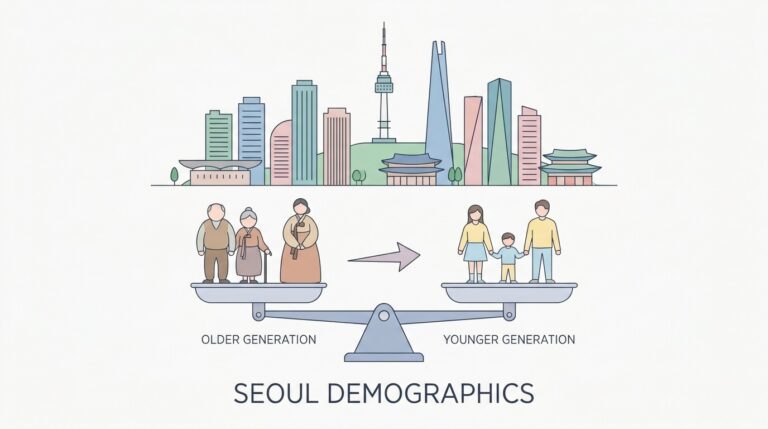
Phase 1: Empathy & Story Opening
안녕하세요! 매일한글 에디터입니다. (Hello! This is your Daily Hangul Editor.)
Picture this: You are sitting in a buzzing cafe in Yeouido, Seoul’s premier financial district, surrounded by analysts and government policy wonks in sharp suits. At the table behind you, a spirited discussion flares up over an iced Americano. A junior consultant in his late twenties sighs, looking at his smartphone pay stub: “국민연금 보험료율은 자꾸 올린다는데, 우리 은퇴할 때 연금 남아있긴 할까요?” (They keep raising the pension contribution rate, but will there even be any pension left when we retire?) Across the table, a senior team lead in her fifties gently pushes back, reminding him of how their generation spent decades sustaining the post-IMF economy under low coverage.
If you have ever felt completely locked out of these high-level societal conversations while watching Korean cable news shows like JTBC Newsroom or bingeing sharp office dramas like Agency (대행사) and Misaeng (미생), you are not alone! Discussing Korea’s shrinking demographics, the “demographic cliff” (인구절벽), and parametric pension reform (모수 개혁) feels daunting even to seasoned Korean speakers.
Navigating Korea’s demographic reality requires stepping beyond introductory vocabulary. When you can articulate terms like “저부담-고급여” (low contribution, high benefit) and debate “세대 간 형평성” (intergenerational equity) with precision, you cross the threshold from being an outside observer to an insightful insider who truly understands the anxieties and hopes of modern Koreans. This guide is crafted directly from field feedback by advanced learners navigating corporate Korea and civic policy forums. Let’s demystify the conversation together!
Phase 2: Top 3 Core Expressions Deep Dive
1. 모수 개혁 (Mosu gaehyeok)
- Pronunciation: [Mosu gaehyeok] (Sounds like “mo-soo gae-hyuk” — think of “mow” + “sue” followed by “get” without the ‘t’ and “hyuck”)
- Meaning: Literal: Parameter reform | Nuanced: Adjusting key figures (such as raising the contribution rate or tweaking the income replacement ratio) within the existing institutional framework, rather than rebuilding the entire pension system from scratch.
- K-Culture Moment: You will hear this phrase constantly on current affairs roundtables such as MBC’s 100-Minute Debate (100분 토론) whenever lawmakers argue over numerical percentage points rather than total structural overhaul.
- Editor’s Insight: It is often paired in contrast with ‘구조 개혁’ (structural reform). Knowing this term signals that you understand policy mechanics rather than just speaking in vague generalities.
- Situation Spectrum: Casual 🚫 | Semi-formal ⚠️ | Formal ✅
- 🤔 Think About It: Does your home country focus more on adjusting numbers within existing systems, or on dismantling and rebuilding welfare safety nets?
2. 더 내고 덜 받는 구조 (Deo naego deol batneun gujo)
- Pronunciation: [Deo naego deol batneun gujo] (Duh nay-go dull baht-neun goo-jo)
- Meaning: Literal: The structure of paying more and receiving less | Nuanced: The painful fiscal reality facing younger contributors, where contribution rates (보험료율) must rise while eventual payouts (소득대체율) decrease or stabilize.
- K-Culture Moment: Frequently quoted in satirical YouTube sketches and economic webtoons depicting the plight of Korea’s “MZ Generation” (2030세대) who feel burdened by mandatory deductions on their salary slips.
- Editor’s Insight: While economists might say “재정 안정화 조치” (fiscal stabilization measures), ordinary working citizens describe the reform bluntly with this exact visceral expression.
- Situation Spectrum: Casual ✅ | Semi-formal ✅ | Formal ⚠️
- 🤔 Think About It: Why do you think colloquial Korean relies so heavily on action verbs (내다, 받다) to explain macroeconomic shifts?
3. 세대 간 형평성 (Sedaegan hyeongpyeongseong)
- Pronunciation: [Sedaegan hyeongpyeongseong] (Seh-dae-gahn hyung-pyung-sung)
- Meaning: Literal: Intergenerational fairness | Nuanced: Ensuring that the cost burden of supporting a super-aged society does not fall disproportionately on future generations while leaving older recipients vulnerable to poverty.
- K-Culture Moment: This expression surfaces repeatedly in documentaries exploring youth disenfranchisement, university debate championships, and editorials addressing the low birth rate crisis.
- Editor’s Insight: ‘형평성’ implies dynamic fairness and systemic justice, which carries much more ethical weight than simple mathematical equality (‘평등’).
- Situation Spectrum: Casual ⚠️ | Semi-formal ✅ | Formal ✅
- 🤔 Think About It: How is traditional filial piety (효, Hyo) challenged when state-managed pensions replace the family as the primary social safety net?
Phase 3: Textbook Korean vs. Real Korean
Situation 1: Expressing worry over the fund running out
- 📖 교과서 한국어 (Textbook): 국민연금 재정이 고갈될 가능성이 매우 높습니다. (Gungminyeon-geum jaejeong-i gogaldoel ganeungseong-i maeu nopseumnida. / The likelihood of the national pension fund being depleted is extremely high.)
- 🗣️ 진짜 한국어 (Real Korean): 이대로 가면 우리 세대는 연금 한 푼도 못 건지는 거 아니에요? (Idaero gamyeon uri sedae-neun yeon-geum han pundo mot geonjineun geo anieyo? / If things stay like this, won’t our generation fail to get back even a single penny?)
- 💡 왜 다를까? (Why is it different?): Native speakers use idiomatic idioms like “한 푼도 못 건지다” (not even salvaging a penny) to express immediate personal financial anxiety, bypassing sterile actuarial jargon.
Situation 2: Discussing rising monthly insurance deductions
- 📖 교과서 한국어 (Textbook): 정부는 보험료율 인상을 신중하게 검토하고 있습니다. (Jeongbu-neun boheomnyoyul insang-eul sinjunghage geomtohago itsseumnida. / The government is carefully reviewing an increase in the contribution rate.)
- 🗣️ 진짜 한국어 (Real Korean): 결국 매달 통장에서 떼가는 돈만 늘어나는 셈이죠. (Gyeolguk maedal tongjang-eseo ttegaganeun donman neureonaneun sem-ijyo. / In the end, it just means they are deducting even more money from our bank accounts each month.)
- 💡 왜 다를까? (Why is it different?): The colloquial verb “떼가다” (to automatically deduct or withhold money from paychecks) vividly captures the everyday frustration workers feel when seeing their net pay shrink.
Phase 4: K-Culture Deep Dive & Non-Verbal Manners
4-1. 눈치 (Nunchi) & Non-Verbal Communication
When discussing demographic and pension issues across generations in Korea, body language is paramount:
* Softening Critical Arguments: If you are expressing concern about the burden on younger workers in front of senior colleagues, tilt your head slightly (약 15도) and use open, upturned palms rather than pointed fingers. Start with an acknowledgment: “선배님들 세대의 헌신 덕분에 국가가 성장했지만…” (Thanks to the dedication of your generation, our country grew, but…).
* Eye Contact Modulation: Direct, unblinking eye contact during ideological disagreements can come across as aggressive confrontation. Break eye contact momentarily downwards when formulating counterpoints to show intellectual deference and thoughtful contemplation.
4-2. Cultural Code Analysis: The Generational Contract
In K-dramas portraying corporate and family dynamics (such as Misaeng or My Mister), you frequently see middle-aged managers carrying the dual pressure of supporting both their aging parents and their university-educated children. Unlike Western societies where social security was institutionalized early, Korea only launched the National Pension System in 1988 under a “low-contribution, high-benefit” (저부담-고급여) model to encourage initial enrollment.
Today, Korea is transitioning into a “초고령사회” (super-aged society, where over 20% of the population is 65 or older) at the fastest pace in recorded world history. As a result, conversations around pension reform are not abstract math problems; they cut straight to the core of filial obligation, corporate loyalty, and generational mistrust.
Phase 5: Real-World Roleplay Scenario
Setting: A quiet private dining room in Gwanghwamun, Seoul. Min-woo (31, Senior Policy Analyst) is dining with Director Yoon (56, Department Head) after attending a National Assembly public hearing on fiscal sustainability.
- 윤 국장 (Director Yoon):
🎭 찻잔을 내려놓으며 깊은 한숨을 쉰다오늘 공청회 들으면서 참 마음이 무겁더군. 우리 세대가 은퇴를 앞두고 있는데 개혁이 늦어지면 큰일이야. (Oneul gongcheonghoe deureumyeonseo cham ma-eum-i mugeopdeogun. Uri sedae-ga euntoe-reul apdugo inneunde gaehyeok-i neojeojimyeon keun-ir-iya. / Listening to today’s public hearing made my heart heavy. My generation is on the verge of retirement, and if reform is delayed, it will be a disaster.) - 민우 (Min-woo):
🎭 공감하듯 고개를 끄덕이며네, 국장님. 특히 현행 9%인 보험료율을 인상하는 모수 개혁은 더 이상 미룰 수 없는 과제 같습니다. (Ne, gukjangnim. Teukhi hyeonhaeng gu-peosenteu-in boheomnyoyul-eul insanghaneun mosu gaehyeok-eun deo isang mirul su eomneun gwaje gatseumnida. / Yes, Director. In particular, parametric reform to raise the current 9% contribution rate seems to be a task that can no longer be delayed.) - 윤 국장 (Director Yoon):
🎭 안경을 고쳐 쓰며하지만 소득대체율을 그대로 두고 보험료만 올리면 국민적 저항이 만만찮을 텐데 말이지. (Hajiman sodeukdaecheyul-eul geudaero dugo boheomnyoman ollimyeon gungminjeok jeohang-i manmanchanheul tende mariji. / But if we keep the income replacement ratio as it is and only increase premiums, public resistance will be quite fierce.) - 민우 (Min-woo):
🎭 조심스럽지만 단호한 어조로바로 그 지점에서 청년 세대의 불만이 터져 나오는 것 같습니다. 저부담-고급여 체제의 부담을 온전히 떠안아야 하니까요. (Baro geu jijeom-eseo cheongnyeon sedae-ui bulman-i teojyeo naoneun geot gatseumnida. Jeobudam-gogeubyeo cheje-ui budam-eul onjeonhi tteoan-aya hanikkayo. / That is precisely where the frustration of the youth generation erupts. They feel they must fully shoulder the burden of the past low-contribution, high-benefit system.) - 윤 국장 (Director Yoon):
🎭 씁쓸한 표정을 지으며우리도 젊은 시절 부모님 부양하랴, 경제 위기 넘기랴 고생 많았네. 세대 갈등으로만 번지지 않았으면 좋겠어. (Urido jeolmeun sijeol bumonim buyangharya, gyeongje wigi neomgirya gosaeng mananne. Sedae galdeung-euroman beonjiji anatssumeon jokgesseo. / In our youth, we also struggled—supporting our parents and surviving financial crises. I just hope this doesn’t turn entirely into a generational war.) - 민우 (Min-woo):
🎭 두 손으로 물잔을 받치며맞습니다. 그래서 세대 간 형평성을 맞추기 위해 보험료 인상 속도를 연령대별로 차등화하자는 제안도 힘을 얻고 있습니다. (Matseumnida. Geuraeseo sedaegan hyeongpyeongseong-eul matchugi wihae boheomnyo insang sokdo-reul yeonnyeongdaebyeollo chadeunghwahajaneun jean-do him-eul eotgo itsseumnida. / That’s right. That is why proposals to differentiate the speed of premium increases across age groups to achieve intergenerational equity are gaining traction.) - 윤 국장 (Director Yoon):
🎭 턱을 괴고 생각에 잠기며나이대별 차등 인상이라… 그 방식도 기성세대의 반발을 부를 수 있겠지만, 논의해 볼 만한 카드군. (Naidaebyeol chadeung insang-ira… Geu bangsik-do giseongsedae-ui banbal-eul bureul su itgetjiman, non-uihae bol manhan kadeugun. / Differentiated increases by age group… That might also provoke backlash from older demographics, but it is certainly a card worth discussing.) - 민우 (Min-woo):
🎭 미소를 띠며 정리하듯네, 결국 서로의 희생을 인정하며 사회적 대타협을 이루는 것이 핵심이라고 생각합니다. (Ne, gyeolguk seoro-ui huisaeng-eul injeonghamyeo sahoejeok daetahyeob-eul iruneun geos-i haeksim-irago saenggakhapnida. / Exactly. Ultimately, I believe the key lies in acknowledging each other’s sacrifices and achieving a grand social compromise.)
🔀 Interactive Decision Point: If you were Min-woo, how would you respond next?
- Choice A: “기성세대가 연금을 너무 많이 받아 가는 게 근본적인 원인 아닙니까?” (Isn’t the root cause that the older generation is taking too much pension money?)
Feedback: [Bad] Overly confrontational! It violates professional etiquette and ignores historical context, triggering defensive resistance. - Choice B: “세대 간 형평성을 담보하면서 지속 가능한 재정을 만드는 절충안을 찾아야 합니다.” (We must find a compromise that secures intergenerational equity while ensuring fiscal sustainability.)
Feedback: [Best] Sophisticated, balanced, and diplomatic. Demonstrates C1-level nuance suitable for executive leadership. - Choice C: “어차피 기금이 고갈될 텐데 연금 제도 자체를 폐지하는 게 낫지 않을까요?” (Since the fund will be depleted anyway, wouldn’t it be better to just abolish the pension system altogether?)
Feedback: [Risk] Unrealistic and radical. While common in heated internet comments, it lacks constructive policy insight.
Phase 6: 10-Second Emotion Shadowing Drill
Read aloud along the slashes (/) to master natural pauses, matching the emotional cues!
[😤 답답하고 진지하게 / Frustrated and serious]
솔직히 / 지금 구조로 가면 / 우리 세대는 더 내고 덜 받는 거 / 뻔하잖아요.
(Soljikhi / jigeum gujolo gamyeon / uri sedae-neun deo naego deol batneun geo / ppeonhajanayo.)
Honestly, / if we continue with the current structure, / it is obvious / that our generation will pay more and receive less.-
[🤔 신중하고 조심스럽게 / Deliberate and cautious]
기성세대의 기여를 존중하되 / 세대 간 형평성을 고려한 / 모수 개혁이 / 반드시 선행되어야 합니다.
(Giseongsedae-ui giyeo-reul jonjunghadoe / sedaegan hyeongpyeongseong-eul goryeohan / mosu gaehyeok-i / bandeusi seonhaengdoe-eoya hamnida.)
While respecting the contributions of the older generation, / parametric reform that accounts for intergenerational equity / must / take precedence. -
[🤝 설득력 있고 단호하게 / Persuasive and resolute]
결국 / 고통 분담 없이는 / 연금 개혁의 사회적 대타협을 / 이끌어낼 수 없습니다.
(Gyeolguk / gotong bundam eopsineun / yeon-geum gaehyeok-ui sahoejeok daetahyeob-eul / ikkeureonael su eopseumnida.)
Ultimately, / without shared sacrifice, / we cannot achieve / a grand social compromise on pension reform.
Phase 7: K-Culture Mini Dictionary
-
모수 개혁 (Mosu gaehyeok)
Parametric Reform | In policy debates, it refers specifically to adjusting mathematical levers—principally the insurance contribution rate (보험료율) and income replacement ratio (소득대체율)—to guarantee financial solvency without altering the underlying national system architecture. -
소득대체율 (Sodeukdaecheyul)
Income Replacement Ratio | The proportion of average pre-retirement lifetime earnings that a worker receives as pension payout after retirement. Raising this increases retirement security but accelerates fund depletion. -
초고령사회 (Chogoryeongsahoe)
Super-Aged Society | A demographic status defined internationally where persons aged 65 or older exceed 20% of the entire population. Korea officially crossed this threshold, reshaping its labor force, healthcare costs, and housing dynamics. -
사회적 대타협 (Sahoejeok daetahyeop)
Grand Social Compromise | A political buzzword representing a consensus reached among labor unions, employer confederations, generational cohorts, and the state to enact painful but necessary structural reforms.
Phase 8: Traveler’s Survival Kit
Even short-term expats, digital nomads, and travelers dealing with immigration or corporate postings need these functional expressions:
- Survival Phrase 1: 국민연금 환급 신청은 어디서 하나요? (Gungminyeon-geum hwangeub sincheong-eun eodiseo hanayo? / Where do I apply for a national pension lump-sum refund?)
Pro Tip: Foreign nationals leaving Korea can often reclaim their paid contributions at the airport or pension offices depending on bilateral totalization agreements. - Survival Phrase 2: 급여명세서에서 4대 보험 공제 내역을 확인하고 싶어요. (Geubyeo-myeongseseo-eseo sadae boheom gongje naeyeok-eul hwaginhago sipeoyo. / I would like to check the deduction details for the four major social insurances on my payslip.)
Pro Tip: Use this when reviewing your contract with HR teams in Korean multinational firms. - Survival Phrase 3: 세후 실수령액이 정확히 얼마인가요? (Sehu silsuryeong-aek-i jeonghwakhi eolma-ingayo? / What is the exact net salary received after taxes and deductions?)
Pro Tip: In job interviews, always differentiate between nominal pre-tax salary (세전 연봉) and real take-home pay (세후 실수령액).
🧳 Editor’s Travel & Expat Note
To check your accrued entitlements, verify reciprocal international pension treaties, or track monthly contributions seamlessly, check out the comprehensive 국민연금공단 모바일 앱 내 곁에 국민연금 서비스 안내 to securely manage your social insurance affairs via mobile authentication.
Phase 9: 한 발 더 깊이 (Deep Cultural Thought)
In traditional Korea, pension programs did not exist because the family was the self-contained welfare state. Eldest sons inherited family lineage and property under the moral imperative of filial piety (효, Hyo) to nurse and support elderly parents until death. However, Korea’s lightning-fast modernization separated nuclear families, led to hyper-urbanization in the Seoul Metropolitan Area, and precipitated an ultra-low fertility rate.
Today, as parametric reform forces society to renegotiate who pays and who receives, the debate is not merely an accounting issue. It tests whether an individualistic, modern society can invent a new form of communal solidarity that replaces ancestral family structures without causing profound intergenerational alienation.
💬 Your Turn: In your home country, is public pension viewed as a guaranteed social right, or an individual investment? Share your thoughts below in Korean or English!
Phase 10: FAQ & Common Mistakes
Q: What is the exact difference between ‘모수 개혁’ (parametric reform) and ‘구조 개혁’ (structural reform)?
A: ‘모수 개혁’ (Parametric reform) adjusts the numeric levers of the current National Pension—namely changing the 9% contribution rate or the 40-50% replacement ratio. ‘구조 개혁’ (Structural reform), on the other hand, reorganizes how basic old-age pensions (기초연금), occupational pensions (퇴직연금), and private pensions are integrated together into a multi-tiered national framework.
Q: Why is the phrase ‘저부담-고급여’ (low contribution, high benefit) considered a problem today?
A: When the National Pension was founded in 1988, the contribution rate was set very low (initially 3%, now 9%) to encourage widespread buy-in, while promising a generous payout (initially up to 70% replacement). Because Korea’s birth rate collapsed and lifespans extended dramatically, this initial design guarantees the fund will be depleted unless contributions increase or payouts are moderated.
Q: Can foreign residents in Korea receive national pension benefits?
A: Yes, under the principle of reciprocity (상호주의). If your home country has signed a Social Security Agreement (사회보장협정) with South Korea, your contribution periods can be combined, or you can receive a lump-sum refund (반환일시금) upon departing the country permanently.
🚨 흔한 실수 (Common Mistakes) Checklist
- Mistake: Confusing ‘보험료’ (premium paid by the insured) with ‘보험금’ (payout/benefit received by the insured).
Correct Action: Use ‘보험료’ when talking about money taken from your salary; use ‘연금 급여액’ or ‘보험금’ when discussing money the state pays out to retirees. - Mistake: Translating “intergenerational conflict” as ‘세대 싸움’ in formal contexts.
Correct Action: Always employ the professional sociological term ‘세대 갈등’ (sedae galdeung). - Mistake: Using casual endings like “~잖아요” with government officials or senior executives during policy discussions.
Correct Action: Maintain formal speech patterns such as “~로 사료됩니다” or “~할 필요성이 제기되고 있습니다”.
Phase 11: Action Missions
- 🥉 Bronze Mission (Solo Shadowing): Read aloud the Phase 6 Shadowing Drill 5 times. Record your voice on your smartphone and check whether you naturally paused at the slashes (
/). - 🥈 Silver Mission (Community Engagement): Leave a comment below using the terms ‘모수 개혁’ and ‘세대 간 형평성’ in one coherent Korean sentence.
- 🥇 Gold Mission (Real-World Application): Watch a 5-minute clip of a Korean news report discussing ‘국민연금 개혁’ on YouTube. Identify whether the speakers are advocating for raising the contribution rate (보험료율 인상) or raising the replacement ratio (소득대체율 인상).
🎮 K-Culture Bonus Mission: In your favorite K-drama, notice whenever parents talk about their retirement plans or when young characters lament deductions on their pay envelopes. Post the timestamp in the comments!
Phase 12: Interactive Quiz Challenge
Test your mastery of C1 Korean demographic policy discourse!
1. Context Judgment (상황 판단)
You are presenting a policy brief to corporate executives. Which sentence expresses that parametric reform must balance fairness without being confrontational?
* (A) 기성세대가 양보 안 하면 청년들은 연금 다 떼이고 맙니다.
* (B) 세대 간 형평성을 확보하기 위해 보험료율 조정을 포함한 모수 개혁의 사회적 합의가 시급합니다.
* (C) 연금 제도는 어차피 지속 불가능하므로 사적 연금으로 전면 대체해야 합니다.
2. Fill in the Blank (빈칸 채우기)
국민연금의 초기 설계였던 ‘____-____’ 구조는 급격한 저출생·고령화로 인해 기금 고갈 위기를 초래했습니다.
(Hint: Low contribution, high benefit)
3. True / False Cultural Quiz (O/X 퀴즈)
- (True / False): ‘모수 개혁’ implies abolishing the public pension system and converting it completely into private retirement accounts.
👉 Click here to reveal the Answers & Detailed Explanations!
-
Answer: (B)
Explanation: Sentence (B) uses refined, standard C1 administrative syntax (‘세대 간 형평성 확보’, ‘모수 개혁의 사회적 합의가 시급합니다’). Sentence (A) is too emotional and crude, while (C) proposes an extreme stance unsupported by mainstream consensus. -
Answer: 저부담-고급여 (Jeobudam-gogeubyeo)
Explanation: The “low contribution, high benefit” system allowed initial beneficiaries to receive generous support, but necessitates modern parametric reform. -
Answer: False (X)
Explanation: Parametric reform (모수 개혁) adjusts internal calculation figures (contribution rates and replacement ratios). Privatization or structural transformation represents systemic structural reform (구조 개혁).







